
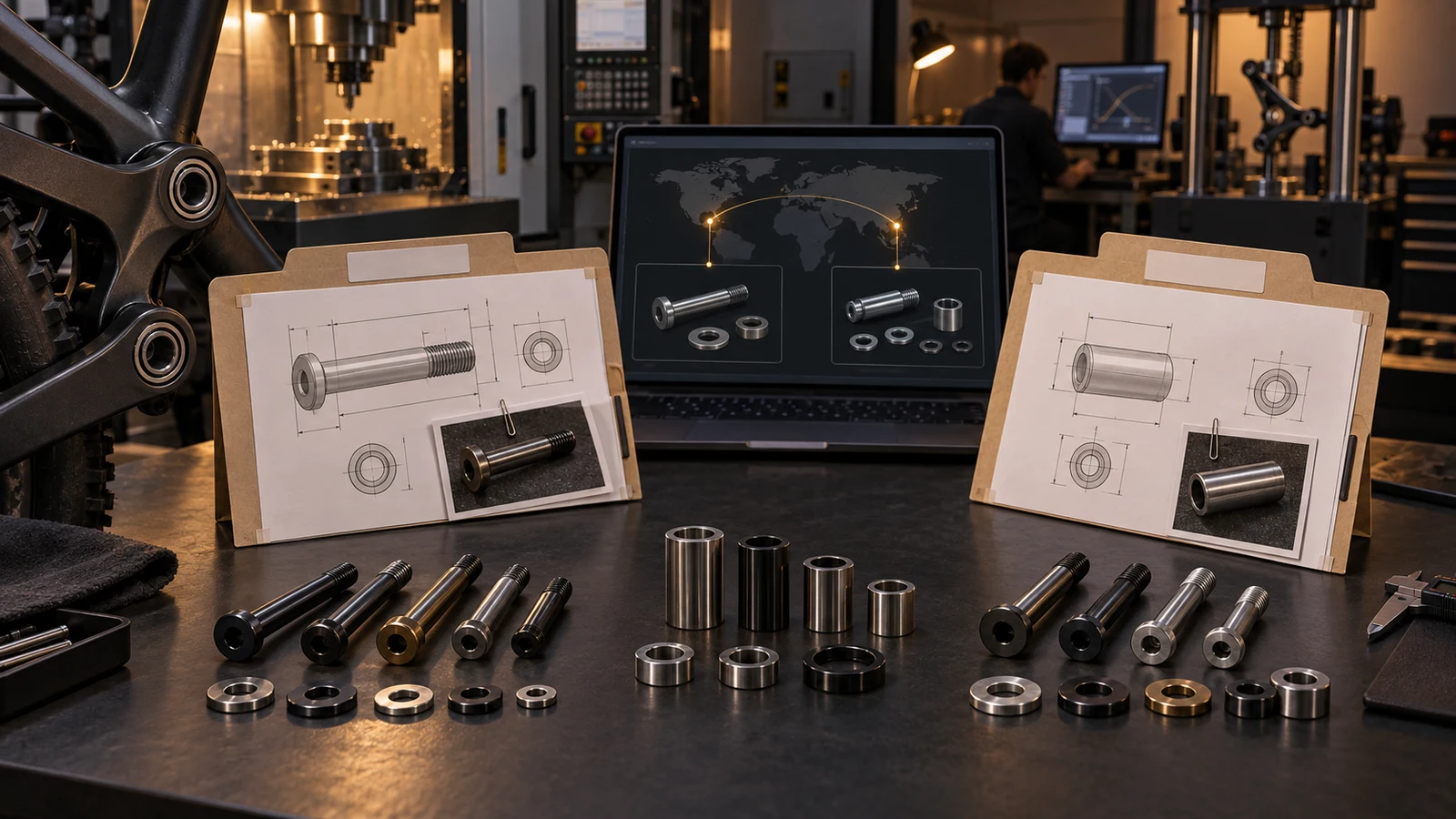
Evaluate global compliance support for a custom pivot bolt, sleeve or hardware kit by the contribution offered for your actual part and destination. Define the requested reference and finished configuration, then ask what manufacturing work, evidence and external coordination the proposal includes. PremFixer combines in-house manufacturing with qualified partner operations, but that model is not blanket certification or automatic market acceptance. A factory capability can help fulfil a defined requirement without giving the factory authority to make the importer's decision. Check the provider, represented subject and coverage limit for each requested result before treating a general capability statement as project approval.
Hero: concept illustration of example hardware and its application. It is not a factory photograph, tested component or approved production geometry.
Replace a country count with a coverage question
Ask which part, supplied form and requirement the offer covers. A loose custom bolt, an assembled service kit and a finished bicycle are different subjects. A history of shipments, even if documented, would not establish that each new configuration satisfies every destination's current rules.
A request saying ISO, EN, DIN, ASTM, JIS and GB compliant leaves the standard number, edition, relevant features and exceptions undefined. These labels identify standards families, not one combined product approval. Provide the actual references and drawing overrides before asking the supplier to confirm coverage.
The manufacturing knowledge guide helps identify an unresolved part requirement. This page addresses a different question: whether the supplier's offered contribution actually covers that requirement. It does not present an unverified country count as evidence of capability.
Separate the factory contribution from coordinated operations
PremFixer's confirmed in-house scope includes cold heading, CNC machining, thread rolling and tool/die manufacturing. Testing, heat treatment and surface treatment are coordinated through qualified partner operations where included in the defined project. One accountable project team does not mean every operation or instrument is owned by the factory.
For a finished bearing seat, ask who performs the manufacturing operation and who supplies the agreed dimensional evidence. For a surface requirement, clarify the selected finish, represented condition and requested evidence. The manufacturing overview, CNC turning scope and surface-treatment discussion give context, not automatic inclusion in every quotation.
Specify whether a requested deliverable is a process record, a measured feature report or an application test. A provider's ability to machine the geometry is not evidence that a particular laboratory assessment has been ordered or that the resulting report will be accepted by the intended recipient.
| Requested result | Scope to confirm | Shortcut risk | Verification question |
|---|---|---|---|
| Drawing-led manufacture | Part, revision and finished requirements | Standards family treated as full specification | Which features and exceptions are included? |
| Material or finish evidence | Represented item, condition and record type | Generic record used for changed component | What delivered configuration does it represent? |
| Dimensional inspection | Features, method and report provider | Factory capability mistaken for included report | Who measures what, and in which state? |
| Application assessment | Test subject, conditions and recipient | Single part report treated as bicycle approval | Who defines and accepts the assessment? |
| Certification support | Actual scheme, issuer and covered subject | A supplier document mistaken for certification | Is the issuer authorised for the required scope? |
| Destination coordination | Applicability reviewer and submitting role | One contact assumed to own every local role | Who decides, submits and accepts locally? |
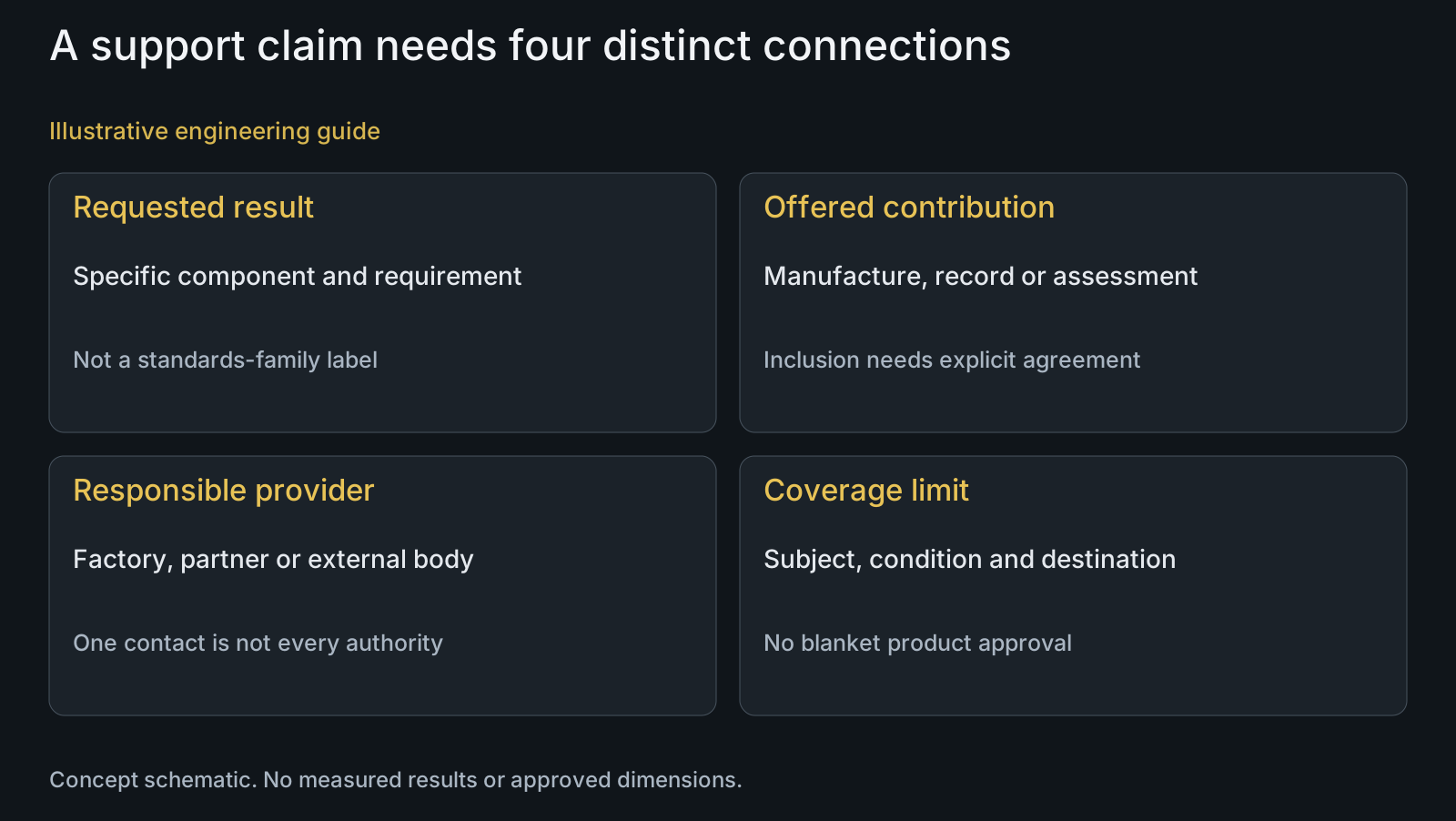
Verify evidence authority separately from manufacturing capability
A certificate, report and declaration answer different questions. Check the issuer, subject, covered site or configuration, stated reference and validity where relevant. If certification is required, the proposed provider must be suitable for that actual scheme; a general machining relationship does not establish certification authority.
ISO's certification guidance distinguishes certification from accreditation and explains that external bodies, not ISO itself, issue certificates. Its guidance supports checking the issuer and status. It does not certify this pivot hardware or establish universal acceptance of a particular document.
Use the quality-system discussion to keep organisational controls separate from finished-part acceptance. Review the company certificate page for the displayed record rather than convert it into an approval of all materials, geometry, tests or destination markets.
Keep local interpretation and supplier inputs distinct
The supplier can discuss the part description, offered manufacturing route and scoped evidence. The party responsible for destination applicability must confirm what the supplied goods require. Ask who performs that review, who may issue or submit the required document, and who accepts it; do not assign all three roles to a factory by default.
WTO's technical-barriers explanation describes national enquiry points as sources of information about regulations, standards and conformity-assessment procedures. This supports using the appropriate official information channel when scope is uncertain; it is not a product-clearance service or evidence of a PremFixer regulatory network.
For a scoped example, Your Europe's CE guidance ties CE marking to products covered by relevant rules. A buyer should therefore resolve applicability before request wording assumes a CE certificate for every loose pivot component. Destination names alone cannot settle that question.
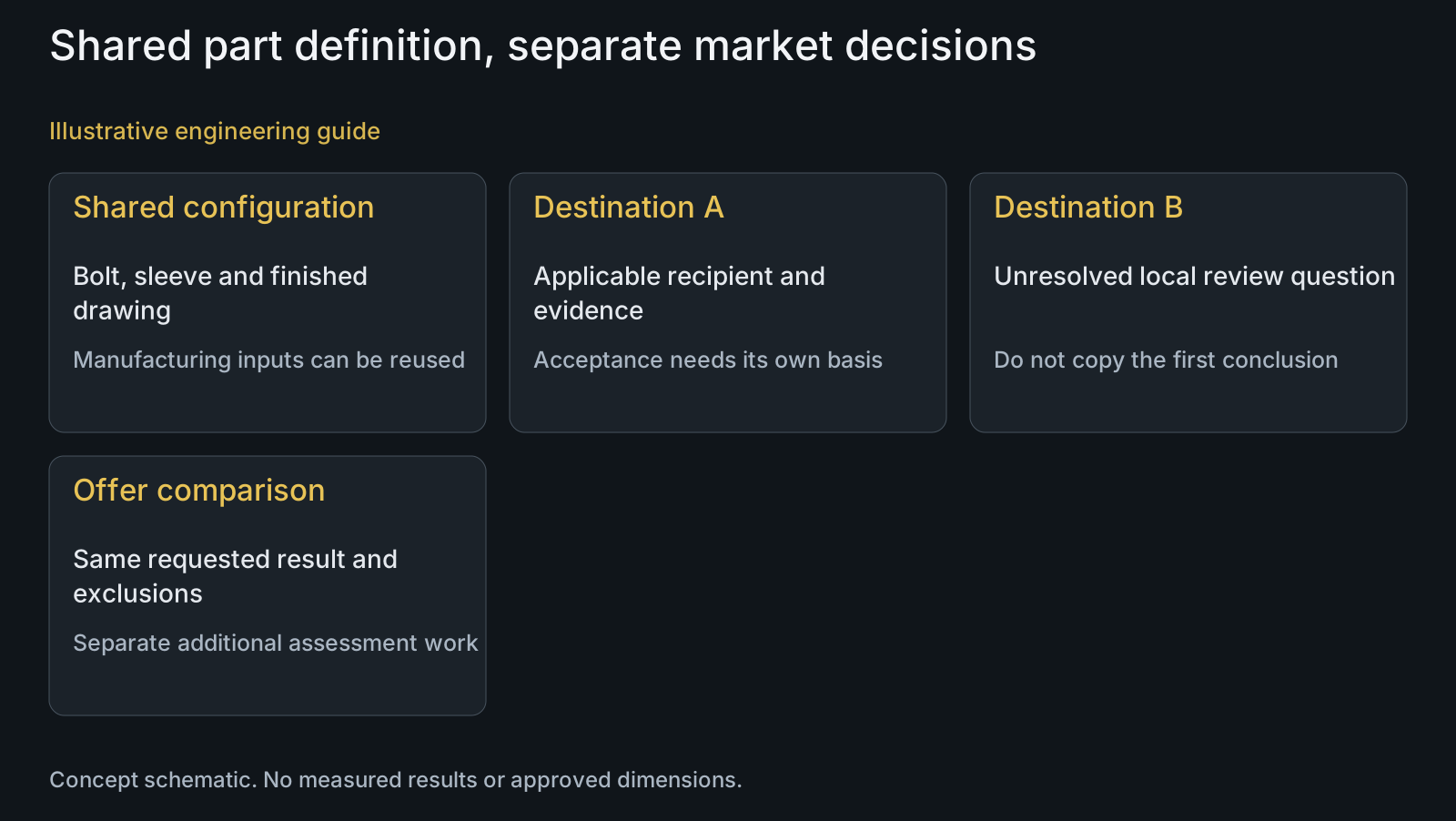
Compare support offers against the same requested result
Compare what will be supplied, not the length of each provider's capability list. If one proposal includes final-state feature measurements and another includes only manufacture to the drawing, they are not equivalent evidence packages. Ask whether external assessment, samples, reports and any required local coordination are included, excluded or still awaiting review.
A useful response can state that a manufacturing feature is within scope while a requested assessment needs a separate provider or more inputs. That is more informative than an unqualified promise of complete global compliance. Where a report's recipient has acceptance criteria, obtain those criteria before committing to an otherwise unsuitable evidence format.
The certification cost and timeline guide helps compare bounded assessment proposals. The materials overview helps define the manufactured item. Neither creates a standard test package, guaranteed lead time or certification entitlement for this offer.
Apply the coverage test to two destinations
Illustrative engineering example: assume an OEM requests one custom shoulder bolt and sleeve configuration for two destination markets. It provides a drawing, material requirement and BOM, but the second market's evidence recipient and supplied-product classification are unresolved. No actual shipment, certificate or approval is assumed.
The shared manufacturing discussion can cover the same geometry and requested material condition. The buyer then creates two separate applicability questions for the responsible destination reviewers. A dimensional report may remain useful to both, but the example does not assume that an application test, declaration or market mark transfers between them.
The procurement decision is to define the manufacturing contribution while keeping the second market's acceptance question open. If its reviewer requires different evidence, the buyer can assess that addition explicitly. Use the customer decision knowledge center for adjacent decisions; the fictional scenario demonstrates a coverage test, not a successful compliance result.
Questions buyers need to confirm
Which countries' standards can PremFixer support?
Ask for a project-specific scope rather than a country list. Provide the component, destination, reference and required evidence so the manufacturing contribution and any partner work can be reviewed. A standards-family name or shipment history does not establish blanket acceptance of a new part.
Does one accountable project team mean all testing is in-house?
No. Confirmed in-house manufacturing is combined with qualified partner testing, heat treatment and surface-treatment operations where scoped. Ask which provider supplies the requested result and whether the activity and report are included in the actual offer.
Does a quality-system certificate approve the pivot bolt?
No blanket product approval follows from an organisational certificate. Check the record's subject and scope, then define the component's separate acceptance requirements. Geometry, finished material condition and any application assessment need their own appropriate evidence.
Can ISO, DIN and JIS labels prove interchangeable parts?
No. Give the full designations, editions, affected features and drawing exceptions. Different references can concern different subjects or requirements. The manufacturing review must resolve the actual feature definitions rather than assume equivalence from familiar acronyms.
Can the same evidence be reused when the destination changes?
Possibly, if it still represents the required subject and the new recipient accepts its scope. Keep shared component facts separate from destination applicability and document authority. A reused measurement record does not automatically transfer a declaration, product mark or market approval.
What should we provide for a global-support review?
Send the drawing and STEP model or sample, BOM, finished material/finish requirements, quantity basis and destinations. Identify the supplied form, intended use, requested references, evidence recipient and importer arrangement. State unresolved applicability questions so they are not hidden inside a manufacturing promise.
Technical references and scope
ISO certification guidance. Public explanation of certification, accreditation and external issuers; not product approval or evidence of this supplier's certification scope.
WTO technical barriers to trade information. Public explanation of enquiry-point information functions; not a destination determination or clearance service.
Your Europe CE marking guidance. Public product-applicability guidance for CE marking; not a classification of this loose pivot component.
Explore related component, material and sourcing decisions in the customer decision knowledge center. For a drawing review, use the Drawing/BOM RFQ path.
Define the support needed for your actual component
Share the drawing, STEP model or sample, BOM, finished material/finish requirements and destinations through the Drawing/BOM RFQ path. Add the requested references, evidence recipient and importer arrangement. PremFixer can review the scoped manufacturing contribution and partner operations while the responsible destination team resolves its applicability and acceptance questions.
Discuss the drawing and BOM