
Use this pivot manufacturing knowledge guide by starting with the requirement you cannot yet define. For an OEM pivot bolt, sleeve or kit, that might be material condition, a finished bearing seat, the purpose of a sample or the quantity being quoted. Follow the relevant guide and carry its useful inputs into your drawing, BOM or inquiry. The 300-question collection is organized around materials, manufacturing, OEM practice and purchasing; this page provides a decision-oriented entry route rather than 300 test results or universal specifications. Reading a guide can clarify the next question, but it cannot approve the actual bicycle application.
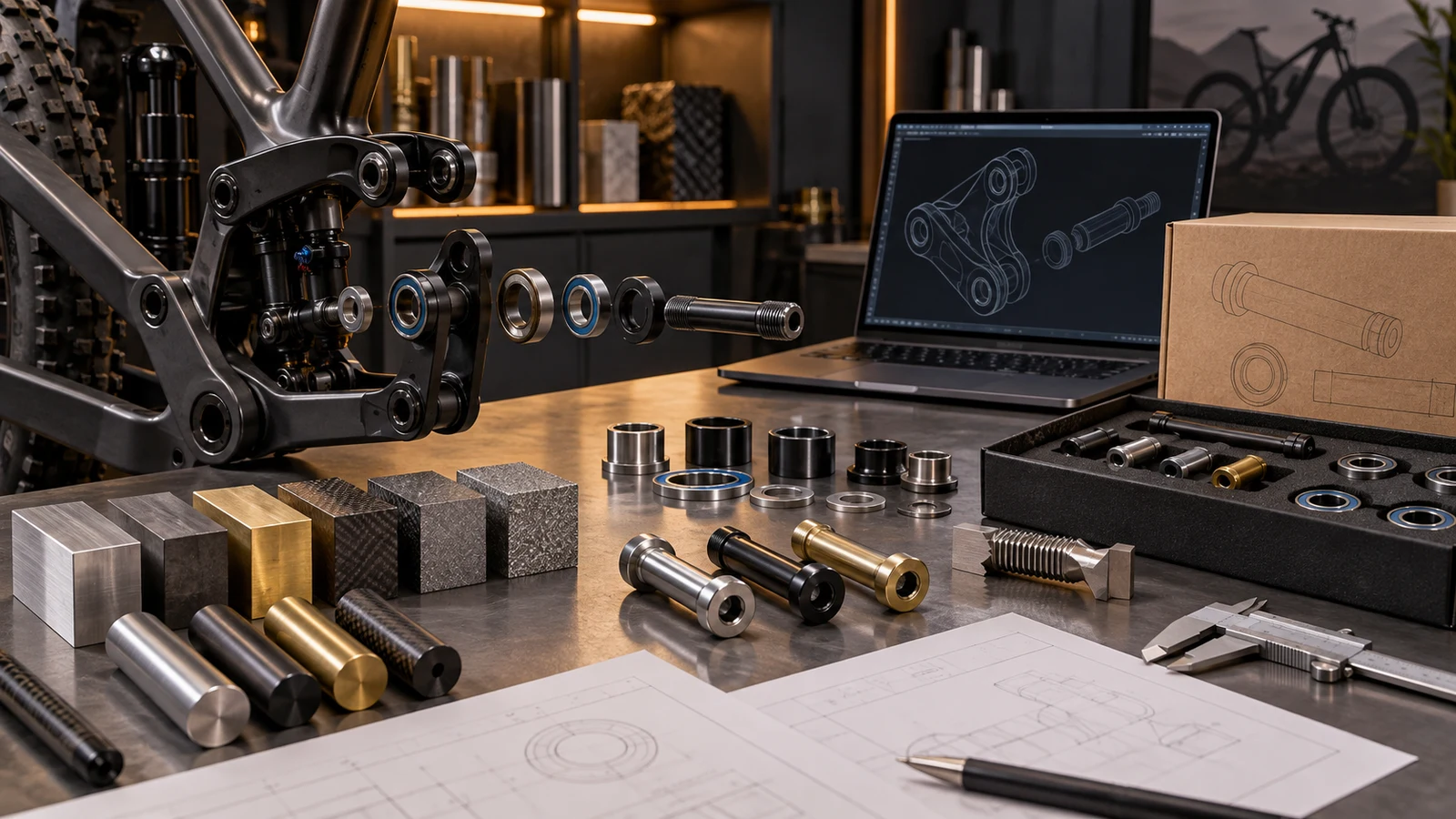
Hero: concept illustration of example hardware and its application. It is not a factory photograph, tested component or approved production geometry.
Choose the chapter by the unresolved requirement
The collection has four groups: materials, manufacturing and quality, OEM practice, and standards, systems and purchasing. The first three each contain eighty topics and the last contains sixty. These are navigation counts, not independent experiments, product approvals or a measure of factory capacity.
Start with the field that changes the next decision. If the material condition is missing, a packing guide will not resolve it. If a shoulder does not locate the intended bearing, a supplier price comparison is premature. Reading broadly can help, but the immediate question should remain visible.
Use the customer decision knowledge center for related decisions and the links below for focused starting points. Do not interpret every discussed material or process as a stocked product or a service included in every PremFixer quotation.
Use material guidance to define an item, not a universal winner
The pivot material-selection article helps separate a material name from the component's role and required condition. Carry the chosen specification, product condition and relevant finished-state requirements into the item definition rather than send a request for the 'best alloy.'
For mixed hardware, the multi-material kit guide keeps the individual items visible. A bolt and sleeve can share a purchasing package without sharing the same material, finish or manufacturing requirement.
Visit the materials overview for the manufacturing discussion. A guide explains the decision inputs; the actual drawing and offered scope determine what is requested. No universal substitution follows from an alloy's popularity or the appearance of a concept image.
| Open buyer question | Start with | Useful input to carry forward | Do not infer |
|---|---|---|---|
| Which material condition fits this item? | Materials and item-level requirements | Grade, condition and affected function | One alloy is best for every item |
| What defines the bearing or sleeve seat? | Drawing fits and manufacturing | Mating context and final-state requirement | Nominal shape is full acceptance |
| What will the supplied report establish? | Inspection and report scope | Feature, subject and represented condition | One document proves the application |
| What should a sample answer? | OEM development and sample purpose | Configuration and bounded review question | A fitting sample proves service life |
| What does the kit quote include? | BOM and coordinated supply scope | Included items, quantities and exclusions | Every visible assembly item is supplied |
| How should offers be compared? | Purchasing and supplier evaluation | Equivalent work and delivery basis | Origin or article count establishes value |
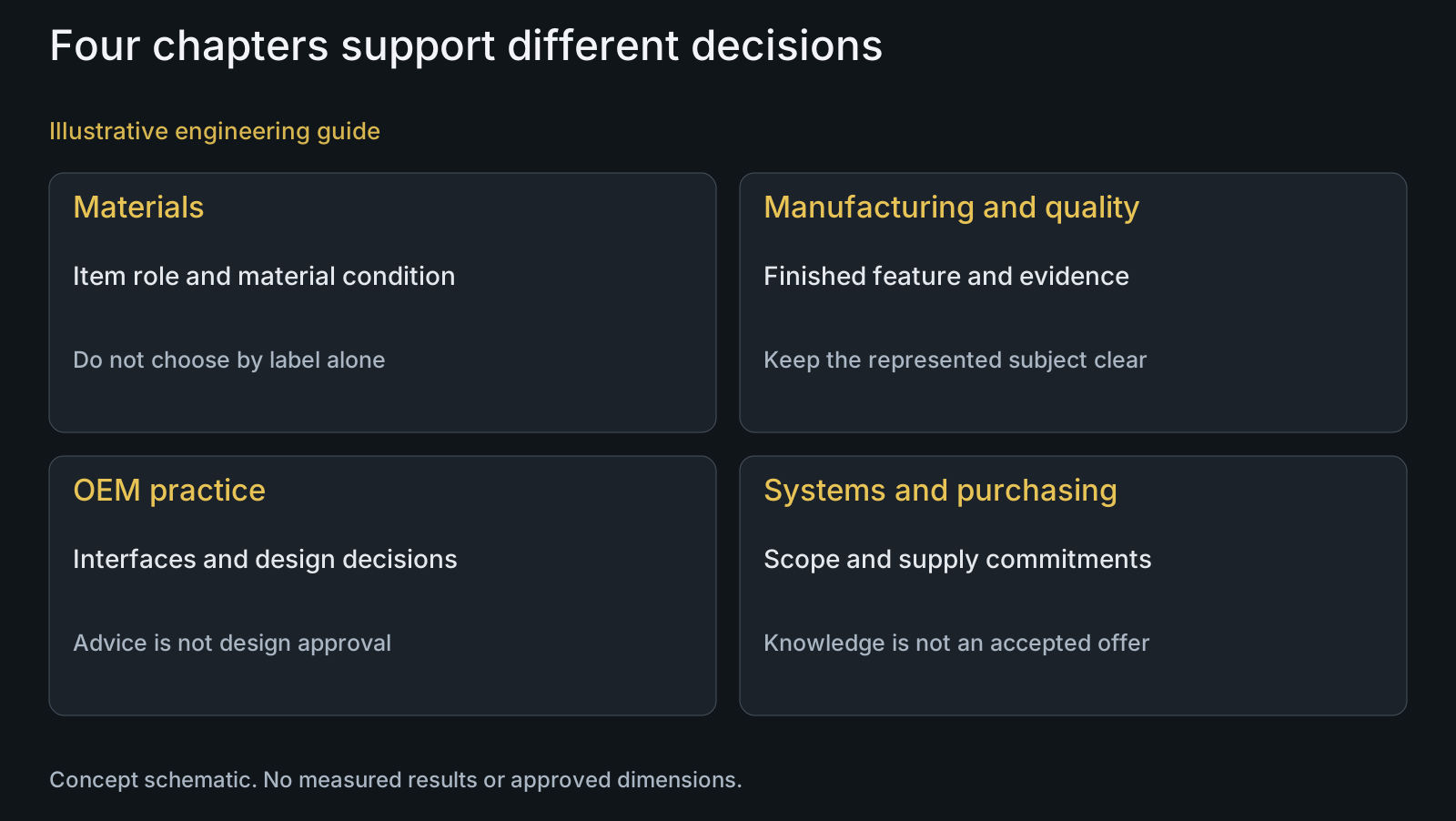
Connect manufacturing and quality questions to the finished feature
If a locating relationship is unclear, start with the drawing-fit guide. Identify the affected feature, relevant mating definition and finished-state requirement. A nominal CAD cylinder is not necessarily the complete acceptance definition.
For a surface requirement, the finishing-acceptance guide explains why completion of an operation, final dimensions and application behavior are separate subjects. For evidence, the test-report guide helps identify what the represented report actually covers.
The manufacturing overview describes the service context. It does not assign one machining route, tolerance or test package to every part in the collection. Use the relevant guide to ask a narrower question about your actual component.
Keep OEM decisions and purchasing commitments distinguishable
Use the DFM review guide when a drawing feature needs a manufacturing discussion. A suggested change remains different from the OEM's authorization to revise the part. Preserve that difference when transferring an explanation into a project document.
The sample-to-production guide addresses what a sample can establish. The quantity-scaling guide distinguishes sample demand, manufacturing batches and shipment releases. Neither creates a universal minimum quantity or delivery promise.
For a purchasing comparison, the supplier-evaluation guide helps frame the actual offer. The coordinated hardware service guide defines supply boundaries, while this page routes the reader to the relevant question rather than repeat an end-to-end workflow.
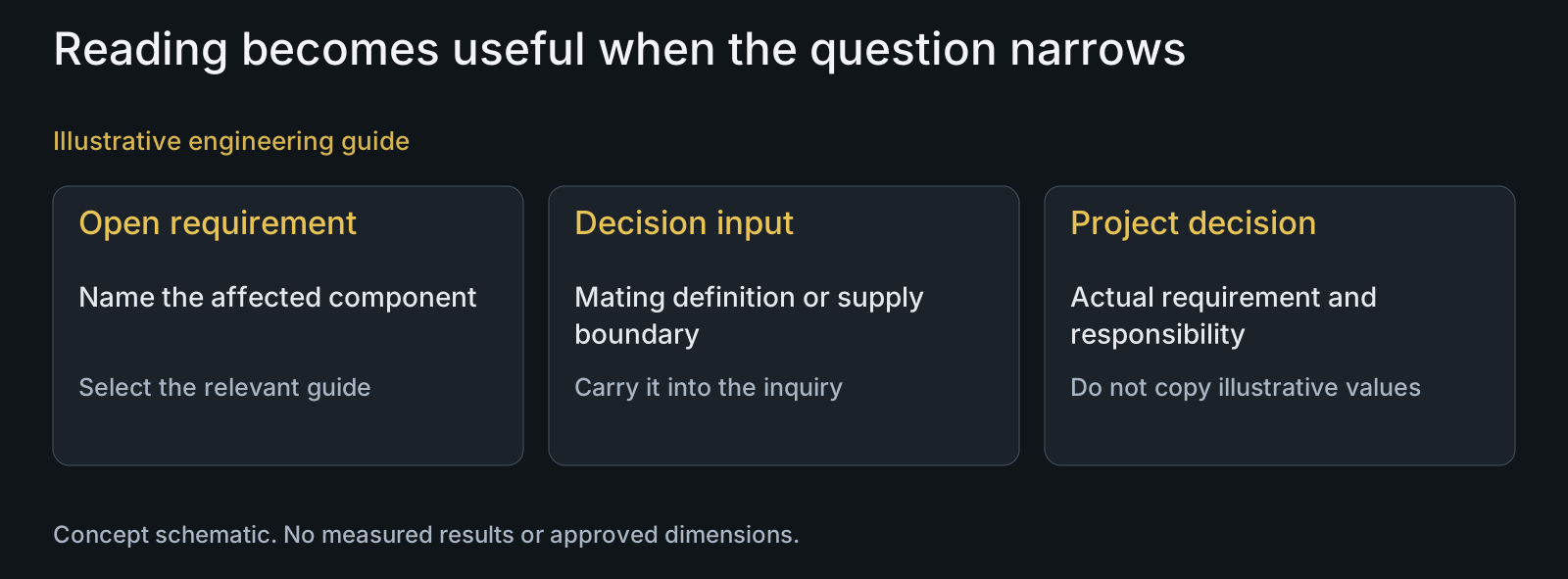
Apply the navigation to a sleeve and bolt inquiry
Illustrative engineering example: assume an OEM has a pivot bolt model, an incompletely defined sleeve seat and a proposed finished kit. It wants a manufacturing quotation but has not settled the sleeve's mating requirement or which bearing is customer-provided. No actual project, dimension, quote or validation result is assumed.
The useful starting point is the interface definition, not a regional price comparison. The drawing-fit guide identifies the fields needed to explain the seat. The mixed-material and supply-scope guides then help distinguish requested items from external mating information. The buyer can organize a more specific inquiry without reading every topic.
The next step is an explicit requirement decision, not automatic approval from the articles. The RFQ file guide helps prepare consistent geometry, requirements and BOM information. Keep the unresolved seat visible until the responsible design owner supplies its definition.
Carry useful conclusions into the project definition
Take the relevant question, the affected item and the needed input into the drawing or inquiry. Do not copy an illustrative assumption into a specification as if it were a measured fact. A comparison table can organize alternatives without prescribing a universal torque, tolerance or service interval.
ISO 10007's public scope describes configuration-management guidance across the product and service lifecycle. This is general context for keeping the project's definition coherent, not a mandated article-navigation format, a PremFixer software claim or a separate certification.
PremFixer manufactures to an agreed drawing-led scope and coordinates relevant partner operations. The guide supports communication among engineering, purchasing and quality teams; the applicable offer, part definition and actual evidence remain the basis for the work. This page makes no claim to be the industry's most comprehensive guide or a downloadable tested whitepaper.
Questions buyers need to confirm
Do I need to read all 300 topics before sending an RFQ?
No. Start with the requirement that affects the next decision and send the available consistent information. Identify unresolved fields rather than delay communication until every article has been read. The related links provide context, not a prerequisite examination.
Are the 300 questions 300 completed test reports?
No. They organize material, manufacturing, OEM and purchasing knowledge. Any actual test evidence must identify its component, configuration and conditions; an educational discussion or illustrative example is not such a report.
Can an article table be copied directly into our specification?
Only after the responsible team defines what applies to its actual part. The table organizes questions and comparisons; it does not supply universal limits, torque or approval. Keep illustrative assumptions separate from released requirements.
Which guide should we read if a sleeve seat is undefined?
Start with drawing fits and the relevant mating relationship. Identify the seat's function, finished-state requirement and receiving component before comparing suppliers on price. A nominal CAD shape may leave the controlling requirement open.
Does one-stop supply mean every discussed operation is in-house?
No. PremFixer combines confirmed in-house manufacturing with relevant qualified partner operations. The applicable part and offer define the supplied work; a knowledge collection is not an ownership list or automatic entitlement to every test.
What should we submit after using the guide?
Send the consistent drawing or model, BOM and quantity basis, then identify material/finish requirements and critical mating information. State the open decision and relevant guide question. The supplier can discuss the scoped request without treating the article as your design approval.
Technical references and scope
ISO 10007 public scope. Configuration-management guidance across products and services; no detailed clause, universal document format or company certification inferred.
Explore related component, material and sourcing decisions in the customer decision knowledge center. For a drawing review, use the Drawing/BOM RFQ path.
Turn the open question into a useful drawing-led inquiry
Share the drawing or STEP, item-level BOM and quantity basis, with the unresolved material, interface, inspection or supply question. Identify what is already defined and what needs discussion so PremFixer can respond to the relevant manufacturing scope.
Discuss the drawing and BOM