
A packaging and logistics audit for bicycle pivot hardware should establish whether the proposed pack protects the required surfaces, preserves component identity and delivers the agreed quantity at the defined receiving event. Assess those questions separately before accepting an on-time percentage. An intact outer carton can contain rubbing bearing seats, mixed spacers or an incomplete kit. A dispatch record can also be timely while the buyer lacks usable parts at the assembly line. The relevant decision is whether protection and delivery evidence represent the actual hardware, transport route and receiving workflow, with exceptions traced to corrective choices rather than dismissed as carrier problems.
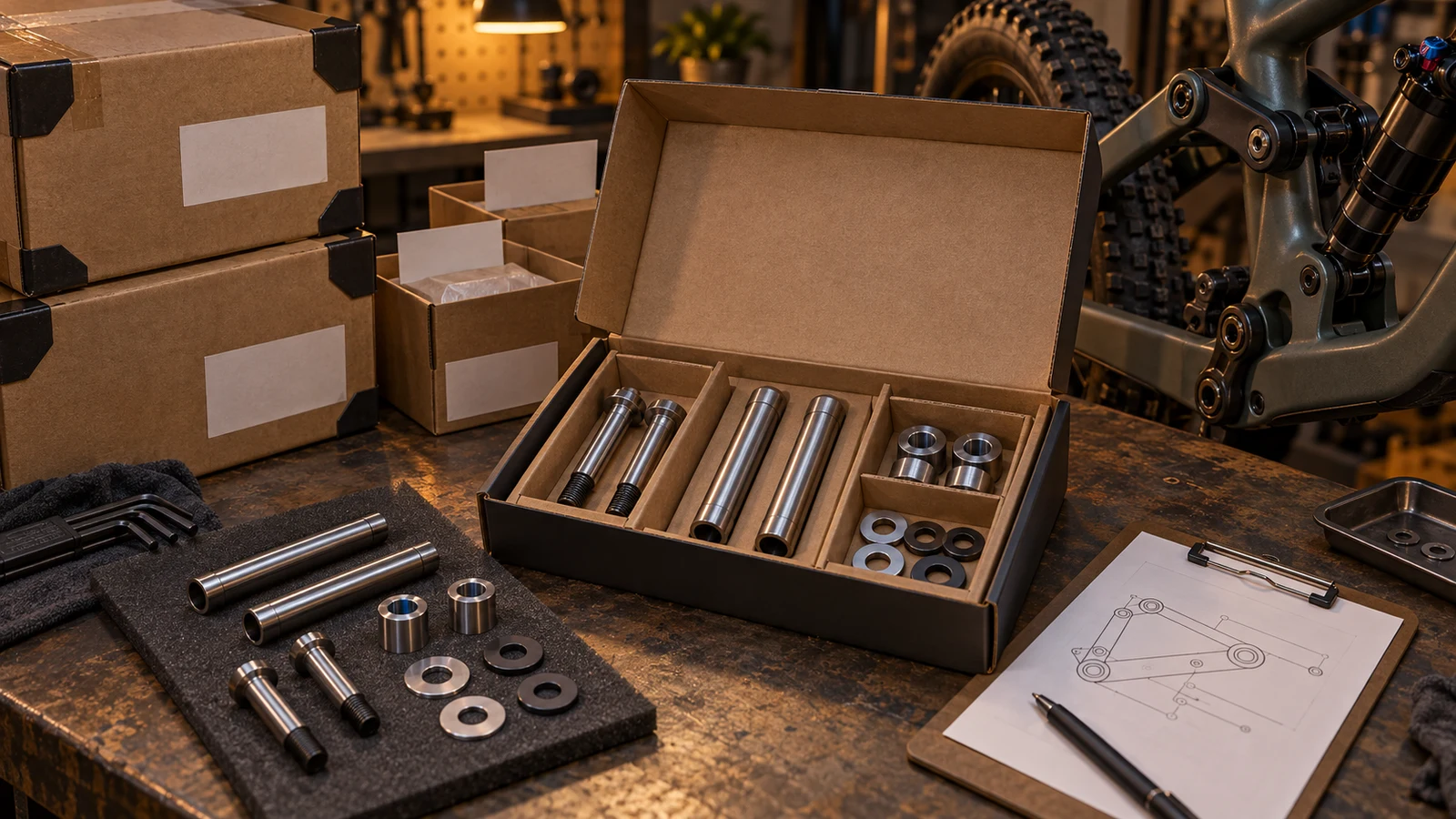
Hero: concept illustration of example hardware and its application. It is not a factory photograph, tested component or approved production geometry.
Start with the surfaces and mistakes that matter
Identify the consequences of movement inside the pack. A thread contacting a finished bearing seat presents a different concern from marks on a nonfunctional surface. Sleeves can nest together and conceal a missing piece; visually similar shoulder bolts can be mixed without obvious external damage. The drawing and BOM define what the receiving team must distinguish.
Review how the proposed inner packaging limits contact, movement and handling contamination for those particular parts. Compartments, individual separation or retained inner packs offer different tradeoffs in material use and unpacking effort. More padding is not automatically the right answer if it hides identity or lets heavy parts migrate within the carton.
Follow the surface-treatment requirements and specified materials into the protection discussion. Do not infer a universal corrosion-resistant shipping condition from the alloy name or a sealed bag. Agree relevant cleanliness, exposure and receiving criteria for the project.
Review the package through unpacking and line-side use
Ask how the shipment is opened and split after receipt. If a kit carton becomes several line-side bins, essential component identity must remain meaningful after the outer label is discarded. A pack count should specify pieces or complete sets and reconcile with the kit BOM, not rely on a generic hardware description.
The component, kit and shipping-label guide addresses field meanings. This audit adds a physical question: does the chosen protection arrangement preserve those meanings through handling? A removable identification sheet can separate from the parts it was supposed to identify.
Observe whether unpacking creates a new mixing or damage opportunity. Reusable trays may help preserve separation but need an agreed return condition and identity practice. Bulk packing may reduce handling materials yet shift sorting and contact risk to receiving. Compare the complete workflow rather than only the supplier's packing station.
| Evidence or arrangement | Useful decision | Risk left unresolved | Verification focus |
|---|---|---|---|
| Individual separation | Limit contact between critical surfaces | Wrong item or count remains possible | Review retained identity and BOM content |
| Compartmented kit tray | Keep component groups organized | Parts can move in an oversized cavity | Review retention and unpacking route |
| Sealed inner pack | Control the agreed handling exposure | Seal alone does not prove dry or clean parts | Confirm preparation and protection scope |
| Transport report | Assess represented product/package hazards | Changed route or pack may not be covered | Match configuration and test purpose |
| Carrier handover record | Establish actual dispatch event | Does not establish complete usable receipt | Check agreed receiving evidence |
| Receiving exception | Identify condition or quantity concern | Outer damage alone does not locate cause | Connect photographs, identity and inspection |
Choose transport evidence for the actual distribution route
The ISTA test-procedure overview distinguishes screening tests from simulations of transport hazards. That distinction matters when interpreting a package report: a screening result is not automatically evidence representing every intended route. Confirm the product/package configuration, distribution scope and purpose before discussing a test designation.
For the buyer's review, identify parcel handling, pallet movement, storage, repacking and route changes relevant to the shipment. Ask whether the submitted packaging evidence represents those conditions and the actual part mass, orientation and inner separation. A report for a different carton or product load may not answer the current protection question.
Specify how product condition will be judged, including the functional surfaces and identification state. An external carton photograph cannot establish those internal conditions. This article does not claim that PremFixer has passed an ISTA procedure or prescribe a universal drop height, vibration duration or moisture limit.
Measure the delivery event the buyer actually needs
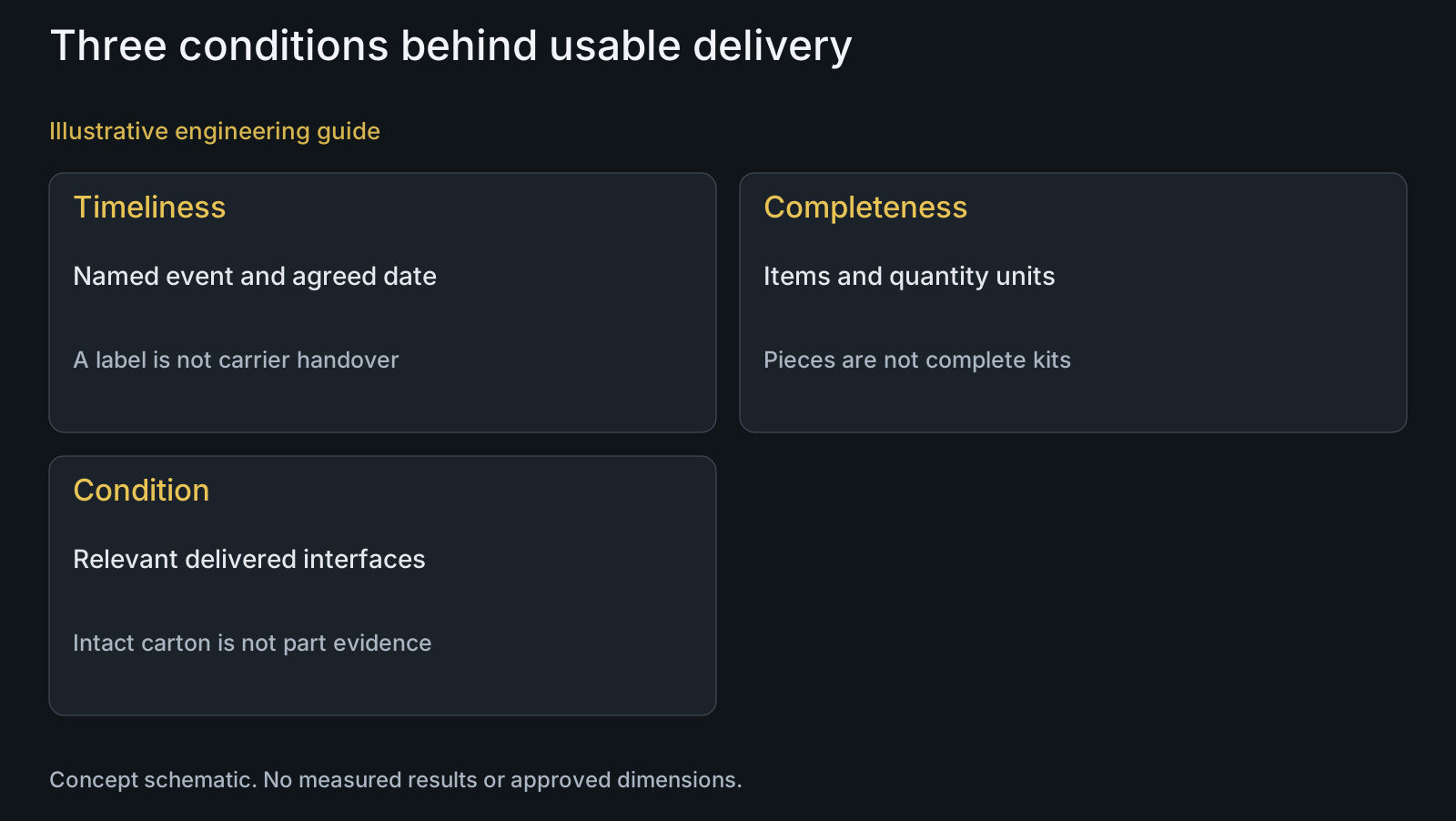
Name the event behind a delivery record: handover to carrier, arrival at a destination, receipt at the buyer's facility or availability of a complete usable kit. Record the agreed date, quantity unit and evidence for that event. Generating a shipping label is not proof that the carrier received the goods.
Separate timeliness, completeness and condition. A shipment of bolts can arrive as planned while its matching sleeves remain elsewhere. Likewise, a complete shipment can need quarantine at receipt because identity or condition is unresolved. Reporting these distinctions prevents a strong dispatch measure from concealing the buyer's shortage.
Keep the agreed baseline visible when dates or quantities change. A later revised promise should not silently overwrite the original commitment in a performance comparison. Explain who authorized a split shipment and how its cost and assembly implications were addressed; this is a review of evidence, not a claimed PremFixer delivery rate.
Follow exceptions to a justified change
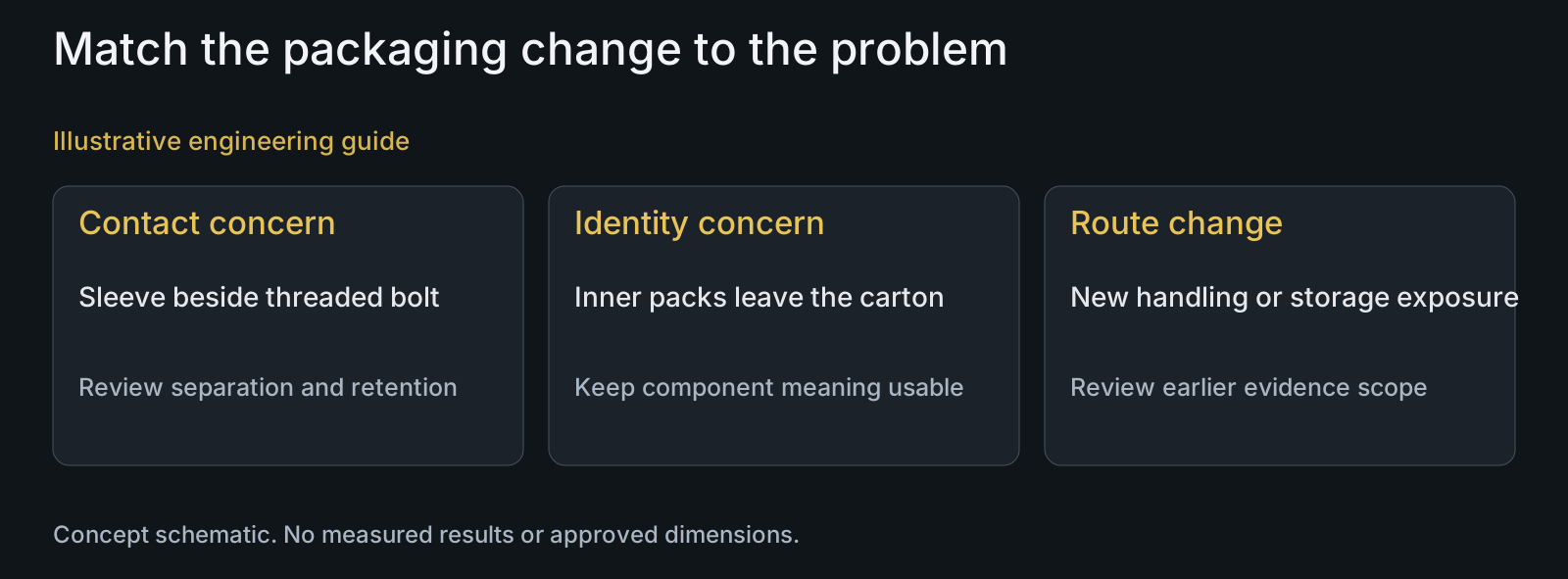
Review permitted records of damage, shortage, mixed identity and delay as different exception types. Ask what evidence locates the event: packing configuration, handover condition, carrier record, receiving photographs and inspected part condition. A dented carton does not by itself identify every cause or establish every component's status.
A packaging change should address the observed mechanism. Extra outer tape will not resolve contact between a threaded bolt and a bearing seat inside a shared compartment. A schedule change will not correct an inaccurate kit count. Keep the improvement tied to the exception it is meant to prevent.
ISTA's retesting guidance identifies product, package and process changes that can affect performance. Apply that scope when an earlier transport result is being relied upon. Do not assume that changing interior separation, packed mass or distribution mode leaves old evidence representative.
Illustrative review: timely cartons, unresolved sleeve condition
Illustrative engineering example: assume a buyer receives a pivot kit on the agreed facility-receipt date. The carton appears intact, but sleeves and threaded bolts share a compartment. During unpacking, the reviewer raises a concern about possible contact at the sleeve bearing surface. No actual damage, shipment history or measured rejection rate is supplied.
The first decision is to examine the relevant surfaces and clarify the accepted condition, not declare the entire shipment failed. The packaging review then compares separate sleeve retention with the existing shared compartment, considering orientation, movement and the assembly team's unpacking route. Delivery timing remains a separate observation.
If the inner configuration changes, earlier transport evidence needs a relevance review. The example supports a defined inspection and protection decision; it does not prove a transport-test pass or an improvement percentage. PremFixer can discuss drawing-defined hardware and project packaging requirements without turning a concept image into evidence of an approved shipping pack.
Questions buyers need to confirm
What should a packaging audit cover for bicycle pivot kits?
Cover relevant surface protection, retained part identity, BOM completeness and the unpacking route. Link each proposed arrangement to the risk it addresses. Also define which shipment and receiving evidence will establish delivery rather than relying only on carton appearance.
Does sealed packaging guarantee corrosion protection?
No. Review material and finish, preparation, cleanliness, moisture exposure and the protective arrangement. A seal alone does not establish the condition inside the pack or suitability for an unspecified storage period. Agree the project requirements rather than assuming a universal guarantee.
Is an intact carton enough to accept the hardware?
No. It provides limited evidence about the exterior. Check the required component identity, quantity and relevant surfaces under the agreed receiving criteria. Internal movement or mixing can be a concern without visible outer damage; do not invent a defect before examining the parts.
Does on-time dispatch mean an order was delivered on time?
Only if dispatch is the explicitly agreed event being measured. Facility receipt and availability of complete usable kits are different events. Identify the baseline date, quantity unit and supporting record so the percentage cannot change meaning between supplier and buyer.
Can an old transport report cover a revised inner tray?
Do not assume so. Compare the changed product/package configuration, retention, mass and distribution scope with the represented evidence. Relevant changes may require further testing under the applicable requirements. No blanket ISTA pass or certification is claimed here.
What packaging details belong in a pivot-hardware RFQ?
Send the drawing and finish requirements, kit BOM, quantities, critical surfaces, identification needs and receiving workflow. Add the proposed shipping route and any applicable customer testing criteria. These inputs support a focused packaging and delivery-scope discussion without a promised transport result.
Technical references and scope
ISTA, Test Procedures. Public distinctions between screening and transport-simulation procedures; not the complete test methods or proof of a specific packaging pass.
ISTA, When should a packaged-product be retested?. Official public guidance on changes in product, packaging and process affecting represented transport performance.
Explore related component, material and sourcing decisions in the customer decision knowledge center. For a drawing review, use the Drawing/BOM RFQ path.
Review protection and receipt requirements for your pivot kit
Share the drawings, BOM, finished-surface requirements, kit quantities, shipping route and receiving or line-side workflow through the Drawing/BOM RFQ path. PremFixer can discuss the proposed protection, identification and delivery evidence needed for the project; testing and shipping commitments require separate confirmation.
Discuss the drawing and BOM