
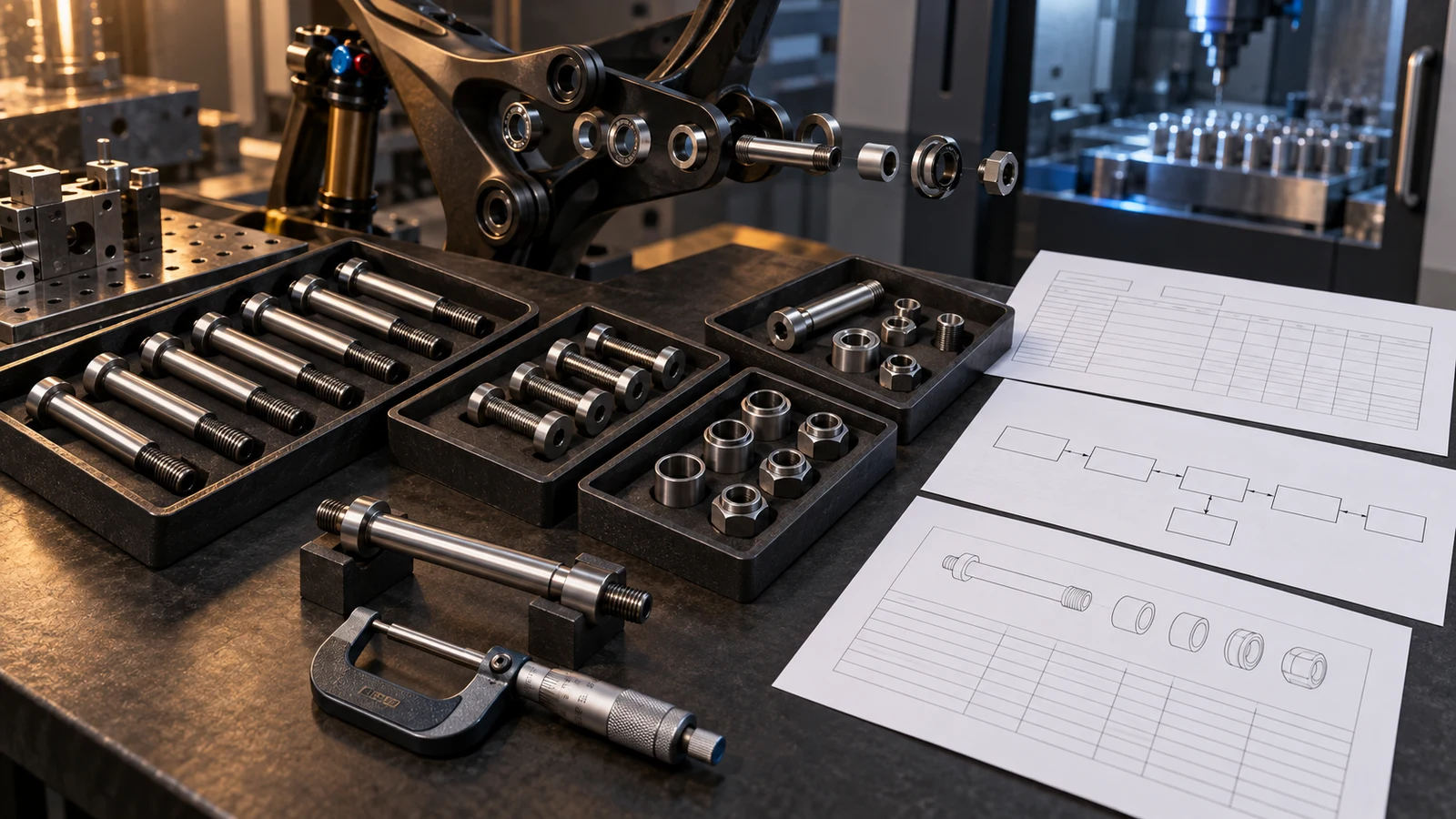
For bicycle pivot hardware, a PPAP Level 3 request needs an agreed submission scope, not a promise to send three familiar document titles. Specify the part revision, applicable manual and customer instructions, represented production route, required evidence and customer review process. Connect the process flow, process failure analysis and control plan to the same operations and critical interfaces. Confirm which evidence is submitted or retained and what constitutes customer approval. A completed-looking package cannot silently stand for a different production configuration. For OEM and SQE teams, the direct decision is whether the proposed evidence supports the actual part and route being purchased.
Hero: concept illustration of example hardware and its application. It is not a factory photograph, tested component or approved production geometry.
Define the customer's PPAP request before quoting it
Identify whether the customer requires conformity to the applicable PPAP manual or an adapted production-approval package. If an adapted scope is wanted, name it honestly and list the agreed deliverables; do not imply that a shortened collection establishes full manual conformity. A submission level is not a certificate of supplier quality or bicycle safety.
AIAG's Core Tools overview places PPAP alongside APQP, control plans, FMEA, measurement analysis and statistical controls. Its public summaries are useful for orientation, not a substitute for the applicable manual and customer requirements. Use those requirements to determine the actual submitted and retained evidence.
State the covered part numbers, revisions, manufacturing location and configuration. A kit may contain an axle, retaining bolt and spacers with different routes; one kit name does not explain which component the evidence represents. Confirm samples, review format, responsible customer contact and expected response before pricing a deliverable.
Trace a critical interface across flow, risk and control
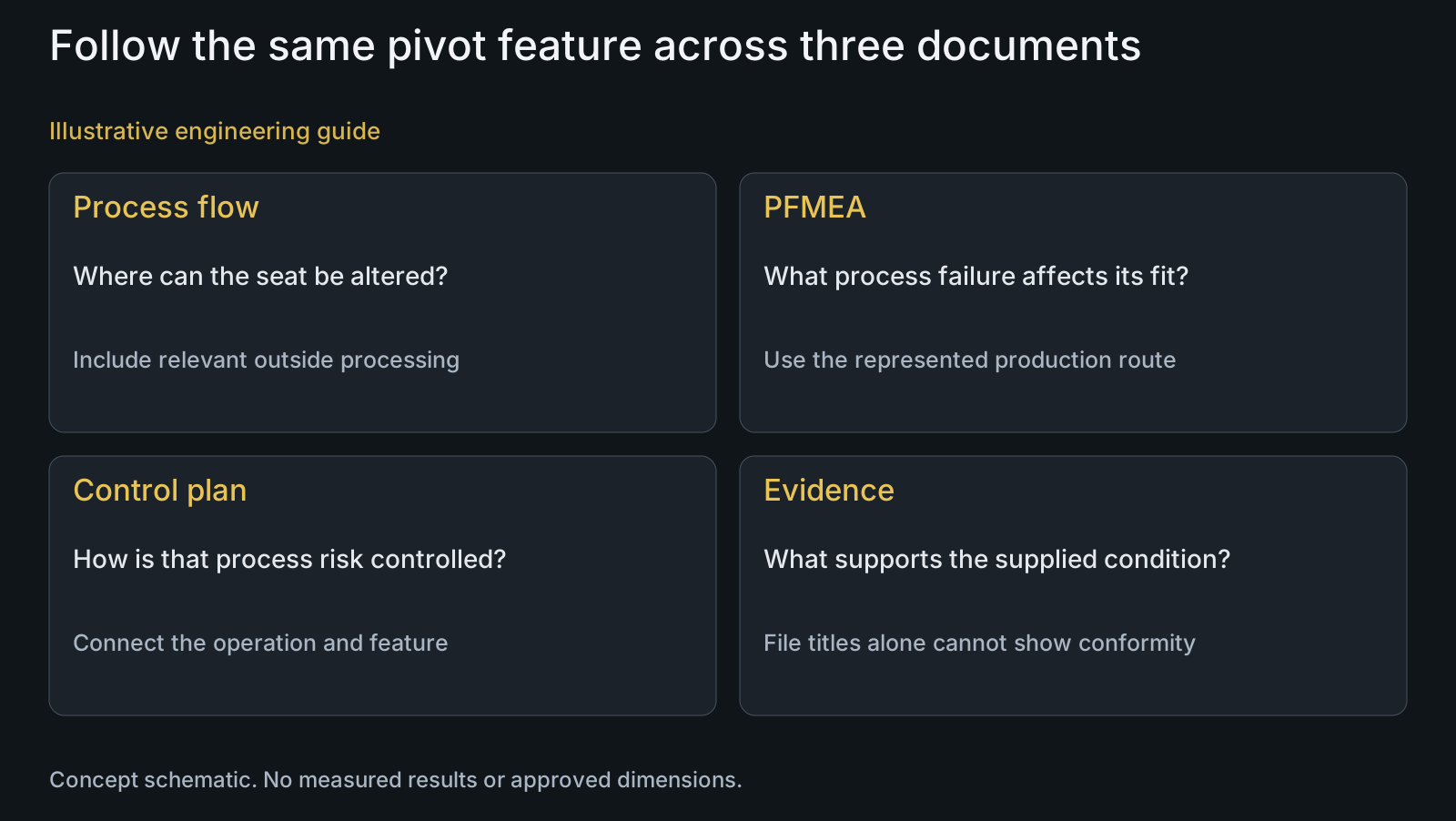
The process flow describes how the proposed part is made and handled. The PFMEA addresses relevant process failure modes and their effects and causes. The control plan makes the selected process controls operational. For a pivot's finished bearing seat, the three documents should refer to the same feature and the operations that can affect it.
If the flow ends at turning but the delivered part later receives a surface treatment, a machining-diameter control alone leaves a question about the final seat. Adding a finishing box is not enough if the risk discussion and controls still concern only the uncoated part. Follow the physical requirement rather than using matching file names as the acceptance test.
AIAG's APQP and Control Plan publication overview identifies the separate control-plan manual. Confirm the requested document editions with the customer rather than automatically reusing an old combined template. The manufacturing process path helps define the actual route to be represented.
| Evidence connection | Buyer question | Mismatch risk | Review method |
|---|---|---|---|
| Part scope and requirements | Which revisions and customer instructions apply? | Kit label hides different component routes | Reconcile covered parts and requested deliverables |
| Flow to PFMEA | Are relevant operations and risks represented? | Finishing or handling omitted | Follow one critical feature through operations |
| PFMEA to control plan | How is the identified process risk addressed? | Risk described without an applicable control | Compare feature, operation and reaction scope |
| Samples to production route | What configuration does the evidence represent? | Prototype substituted for production condition | Compare material, tooling, sequence and finish |
| Method to dimensional data | Can the method support the required relationship? | Report value does not accept the actual feature | Review datum, access and measurement evidence |
| Change to earlier approval | Which evidence remains representative? | Old approval silently expanded | Apply customer notification and review rules |
Represent production conditions rather than sample appearance
Record what made the submitted parts representative: relevant material condition, tooling, operation sequence, external processing and finished state. A prototype can answer a fit question while differing from the later production route. Do not relabel its measurements as production evidence without evaluating those differences under the applicable requirements.
Plan characteristic-specific evidence. A dimensional report addresses selected geometry; material results address their identified material or specimen; measurement-system evidence addresses the suitability of the data collection method. Process studies need the stated characteristic, specification and data conditions. None becomes a universal factory capability result by being placed in the same folder.
The AS9102-style first-article discussion deals with a separate reporting framework; a familiar FAI report is not automatically the customer's PPAP deliverable. Likewise, the ISO 9001 system guide supports a different supplier-assessment question. Keep their roles explicit.
Bring external processing and customer additions into scope
Identify outside heat treatment, finishing or specialized testing relevant to the proposed route, along with the requirements and applicable evidence. PremFixer's coordinated manufacturing path does not imply ownership of every partner laboratory or coating line. A partner name without a part and process connection cannot support the finished interface on its own.
As a public manufacturer example, the Alemite supplier quality manual hosted by SKF specifies its own submission and retained-document expectations. It illustrates why the buyer's instructions matter. Its sample quantities, approval rules and thresholds are not universal bicycle requirements and are not adopted here.
Ask about customer-specific substances reporting, special characteristics, checking aids, packaging and permitted document access where applicable. AIAG's PPAP errata notes customer-specific additions and clarifies that an example process flow is not the only mandatory route. Determine applicability rather than copying another manufacturer's complete checklist.
Illustrative review: finishing missing from the submission chain
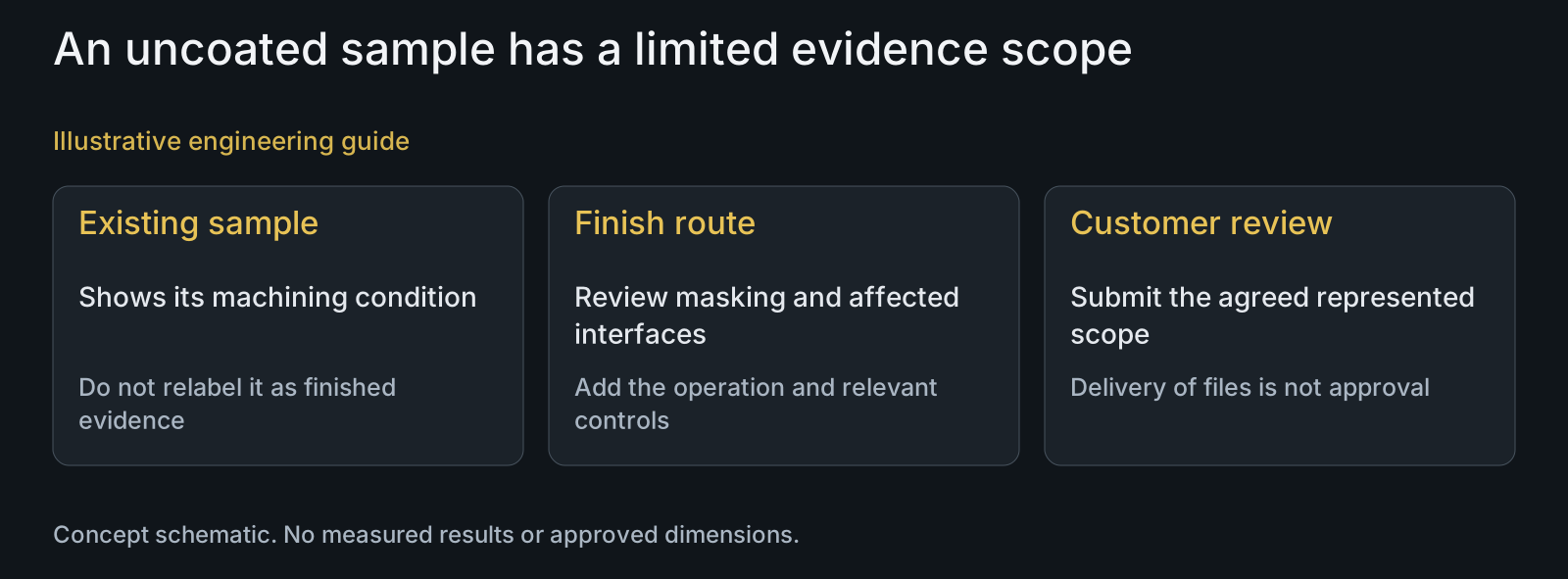
Illustrative engineering example: assume a customer requests a production-approval submission for an anodized pivot axle. The proposed flow and control plan describe turning and pre-finish gauging, while the dimensional sample is shown as an uncoated part. No actual approved submission, measurements or customer incident is provided.
The reviewer selects the bearing-seat requirement and follows it across the evidence. The turning result is relevant to machining but does not establish the delivered anodized seat. The route needs to identify the relevant finishing and any masking, and the risk and control discussion must address the supplied-state requirement rather than treating coating as cosmetic paperwork.
The resulting action is to agree the missing operation and representative evidence before submission. It is not to manufacture a passing result or copy a later date onto the old report. Whether the revised package meets the customer's PPAP obligations depends on the applicable requirements and authorized review, not on this illustrative analysis.
Separate submission, customer decision and later changes
Sending a package is an event, not proof of its acceptance. Keep the requested submission, review response, unresolved departures and authority to supply under a stated condition distinguishable. Do not infer customer approval from a completed warrant, an email attachment or the absence of an immediate objection.
After approval, evaluate proposed drawing, material, tooling, site and process changes against the customer's notification and resubmission requirements. The important question is which earlier evidence still represents the changed condition. A new finish supplier or altered machining route can need review even if the nominal drawing dimensions are unchanged; do not claim a universal resubmission trigger from a public summary.
PremFixer can review a requested production-approval scope, but availability of a complete customer-conforming Level 3 package requires project confirmation. The original topic is not independent proof of completed PPAP capability or IATF certification. Define documentary work, production samples and any additional tests in the quotation without promising automatic approval, a universal run quantity or a fixed lead time.
Questions buyers need to confirm
Does Level 3 mean a bicycle pivot is automotive-certified?
No. A requested PPAP submission level is not a product or supplier certification. Specify the applicable manual, customer instructions and represented part scope. Production approval and complete bicycle validation remain separate decisions.
Are a flow chart, PFMEA and control plan enough to promise PPAP?
Not by themselves. Determine the complete applicable evidence and submitted versus retained requirements. The three documents also need to describe the relevant production route consistently. Correct file titles cannot replace missing characteristic or production evidence.
Can an earlier prototype report be included as production evidence?
Only where its represented scope is valid under the applicable requirements. Compare revision, material, tooling, operation sequence and finish with the intended production configuration. Explain differences and agree what additional evidence is needed rather than renaming the sample.
Why should the finish partner appear in the submission planning?
Its operation can affect final interfaces and process requirements. Identify the specification, relevant features and linked evidence for the proposed route. A partner certificate or uncoated diameter alone does not establish the delivered finished seat.
Does submitting a completed package authorize shipment?
Do not assume it does. Establish the authorized customer's decision, any conditions and the relevant supply permission. Distinguish submission from acceptance and identify unresolved departures. A completed-looking warrant is not evidence of an unrecorded customer approval.
Can PremFixer confirm a full Level 3 package from this article?
Not as a blanket commitment. Send the part revisions, applicable requirements, requested evidence, representative production conditions and review instructions. Confirm documentary and test scope, responsibilities and feasibility for the project before placing the deliverable in an order.
Technical references and scope
AIAG, Quality Core Tools. Original public descriptions of the tools and their relationships; not the full licensed PPAP implementation procedure.
AIAG, APQP and Control Plan publication overview. Official separate APQP and Control Plan publication context; automotive implementation dates are not transferred to bicycle projects.
AIAG, PPAP 4th Edition errata. Original2006 clarifications about example flows and customer-specific reporting; limited errata, not the complete manual.
Alemite/SKF, Supplier Quality Manual Revision16. Public2022 manufacturer example of customer-specific submission, retained evidence and change review; no relationship, quantities or thresholds transferred.
Explore related component, material and sourcing decisions in the customer decision knowledge center. For a drawing review, use the Drawing/BOM RFQ path.
Specify the production-approval evidence your OEM needs
Send the pivot drawings and BOM, requested PPAP level and applicable manual, customer-specific requirements, special characteristics and submission instructions. Include production-route assumptions, outside processes, sample expectations and change-notification rules. PremFixer can review the actual evidence package and its quoted scope without assuming a universal checklist or automatic customer approval.
Discuss the drawing and BOM