
The grams saved by a titanium pivot kit cannot be stated without the baseline and proposed hardware sets. Calculate the difference as baseline mass minus proposed mass, using matching assembly functions, item counts and represented finished states. A CAD estimate can guide the design decision, but it is not a measured delivery result. For an OEM or product manager publishing a mass claim, the answer must identify whether it covers one bolt, one joint or the whole bicycle's pivot hardware. Include unchanged sleeves and washers in the appropriate kit boundary, exclude packaging consistently, and do not turn a gram difference into an unsupported handling or durability claim.
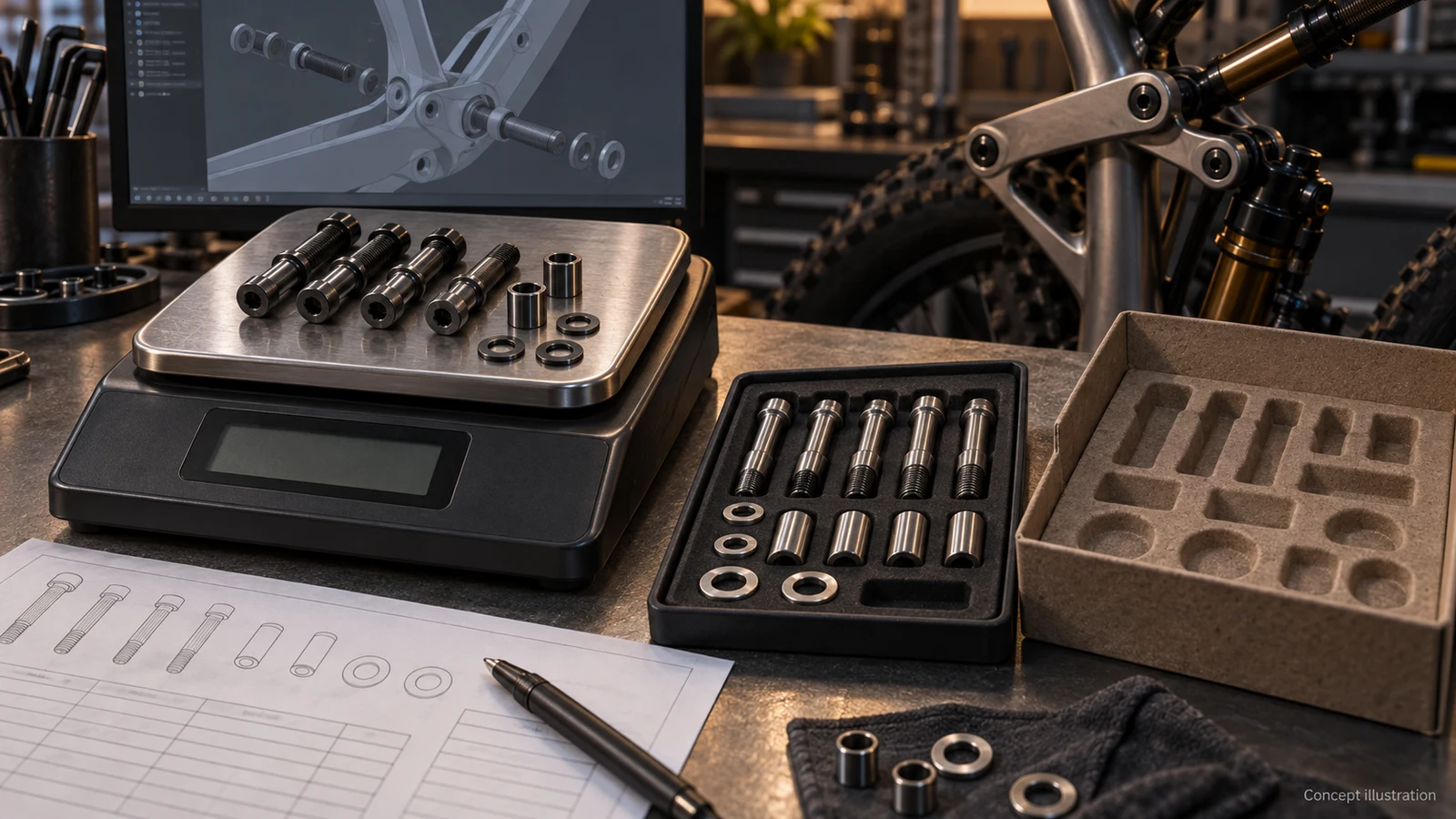
Hero: concept illustration of example hardware and its application. It is not a factory photograph, tested component or approved production geometry.
Freeze the two compared hardware configurations
Create a baseline item list and a proposed item list with part references, revisions and quantities. Include bolts, mating nuts, sleeves, spacers and washers that belong to the stated kit. A lighter set missing required items is not an equivalent functional comparison, even if the net scale reading is accurate.
State which items change and which remain. If only the bolts change, the retained hardware still belongs in a whole-kit mass denominator. If a sleeve or head geometry changes as well, identify that difference instead of describing the result as the effect of material substitution alone.
Define the claim boundary before obtaining the numbers. Per-bolt, per-joint, complete replacement kit and all pivot hardware per bicycle are different units. Keep different frame sizes or platform configurations separate where their item sets differ; a result for one defined set is not a universal typical-bike saving.
Use CAD as an estimate with visible inputs
An estimated component mass is its represented volume multiplied by the assigned density. Sum the modeled item masses at the required quantities. Check the model revision, material assignment, units and included component selection before reporting the total; an attractive model image does not establish those inputs.
Onshape's mass-properties documentation explains that assigned densities enter its calculations and that parts without a material assignment are omitted. It also permits mass overrides. This is a concrete reason to identify calculated and entered values rather than assuming every displayed total is a complete geometry-based result.
TIMET's 6-4 data sheet supplies a reference titanium density, not the mass of a supplied kit. When comparing a material-only change with a hollow or otherwise revised part, label them as separate alternatives. The density-to-component discussion covers that narrower early design comparison.
| Claim being made | Inputs that must match | Main risk | Useful verification |
|---|---|---|---|
| One bolt saves grams | Identified baseline and proposed bolt states | Kit benefit inferred from a single part | Component identities and represented masses |
| The pivot kit is lighter | Complete BOMs, quantities and functional scope | Omitted nuts, sleeves or washers inflate the claim | Reconcile each weighed set with its BOM |
| Percentage kit saving | Baseline kit total as denominator | Bolt-only denominator is used for the whole set | Explicit baseline, proposed total and difference |
| CAD-estimated saving | Current geometry, material assignment and selection | Missing materials or overrides hidden in the total | Represented model configuration and density inputs |
| Measured finished saving | Comparable finished state and net hardware boundary | Tray, packaging or unmatched state enters one side | Identified specimens, tare/net record and suitable method |
| Better ride or durability | Evidence specific to the additional claim | Mass difference presented as performance validation | Separate application assessment; grams alone are insufficient |
Measure the defined finished state, not the presentation tray
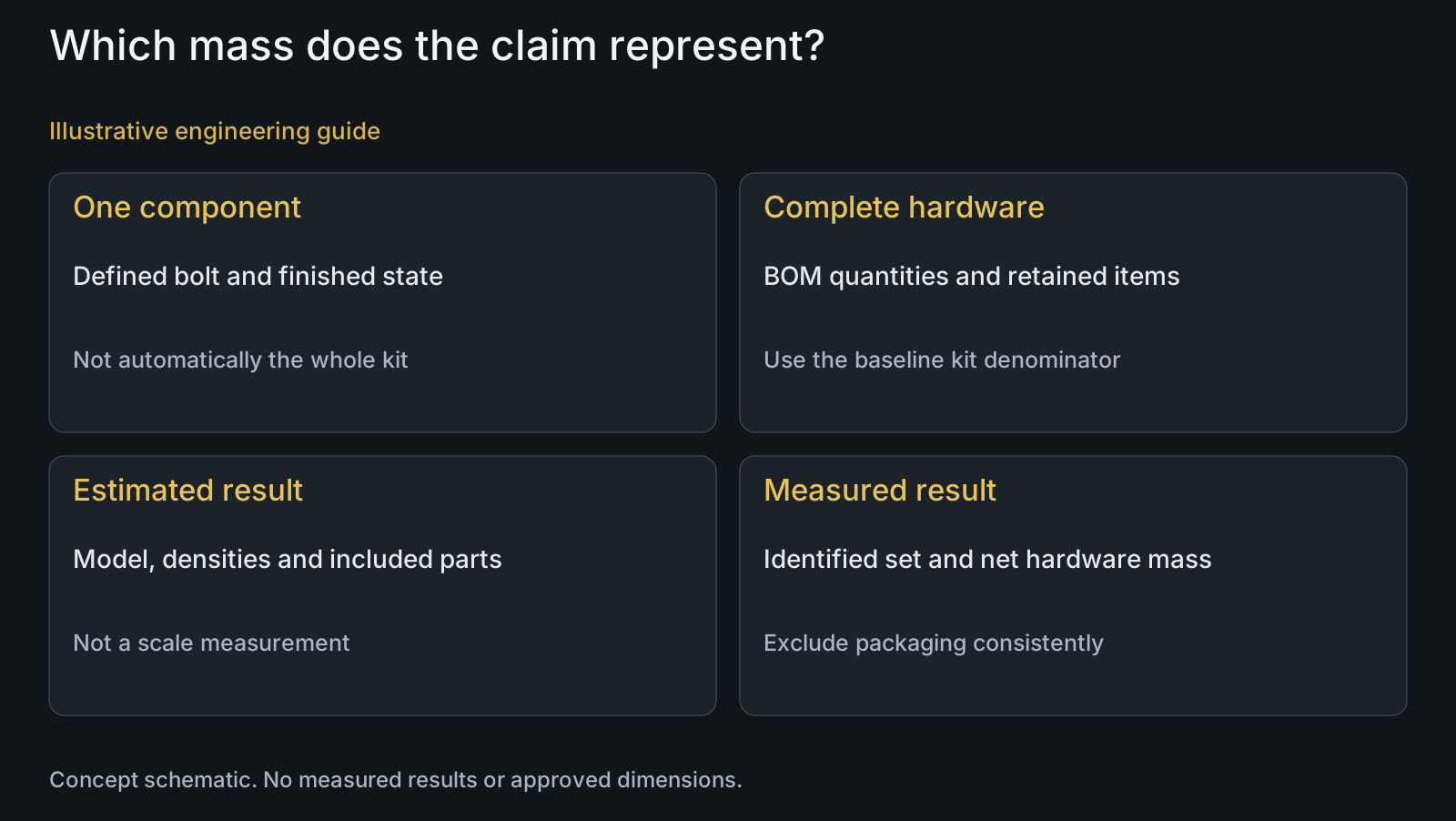
For a measured claim, identify the actual specimens and reconcile their contents with each comparison BOM. State whether the hardware is finished, clean and dry, or includes an agreed installation product. Use comparable states for both sides or explain the difference. Do not silently compare a bare baseline with a complete packaged replacement.
METTLER TOLEDO's precision-balance guidance distinguishes tare, net and gross results. Exclude the container consistently for a net hardware claim and retain the recorded item identity. A gross tray or shipping-box mass answers a different question from installed hardware mass.
The same guidance distinguishes readability from accuracy. Reporting more digits does not prove the proposed small difference is resolved reliably. Use a fit-for-purpose weighing method and record its relevant measurement basis without assigning a universal scale resolution here. The brand of the reference instrument does not imply PremFixer owns that equipment.
Calculate the saving using the correct denominator
For each configuration, total kit mass equals the sum of quantity multiplied by represented unit mass for all included items. Gram saving equals baseline total minus proposed total. Percentage saving equals that difference divided by the baseline total, multiplied by 100. A positive difference represents lower proposed mass; a negative difference is not a saving.
Use measured inputs for a measured claim and estimated inputs for an estimated claim. If some components have only modeled values, label the mixed basis rather than calling the entire result weighed. Round the stated claim consistently with its evidence, and retain enough underlying information to reconcile an item sum with a complete-set result.
A bolt-only percentage is not automatically a kit percentage. Unchanged components contribute to both totals while contributing no material-change saving. If the project also compares added cost per gram saved, use the comparable finished-kit price difference and the same represented mass difference; do not borrow a raw-material premium as the installed-set cost.
Illustrative review: the retained sleeves change the percentage claim
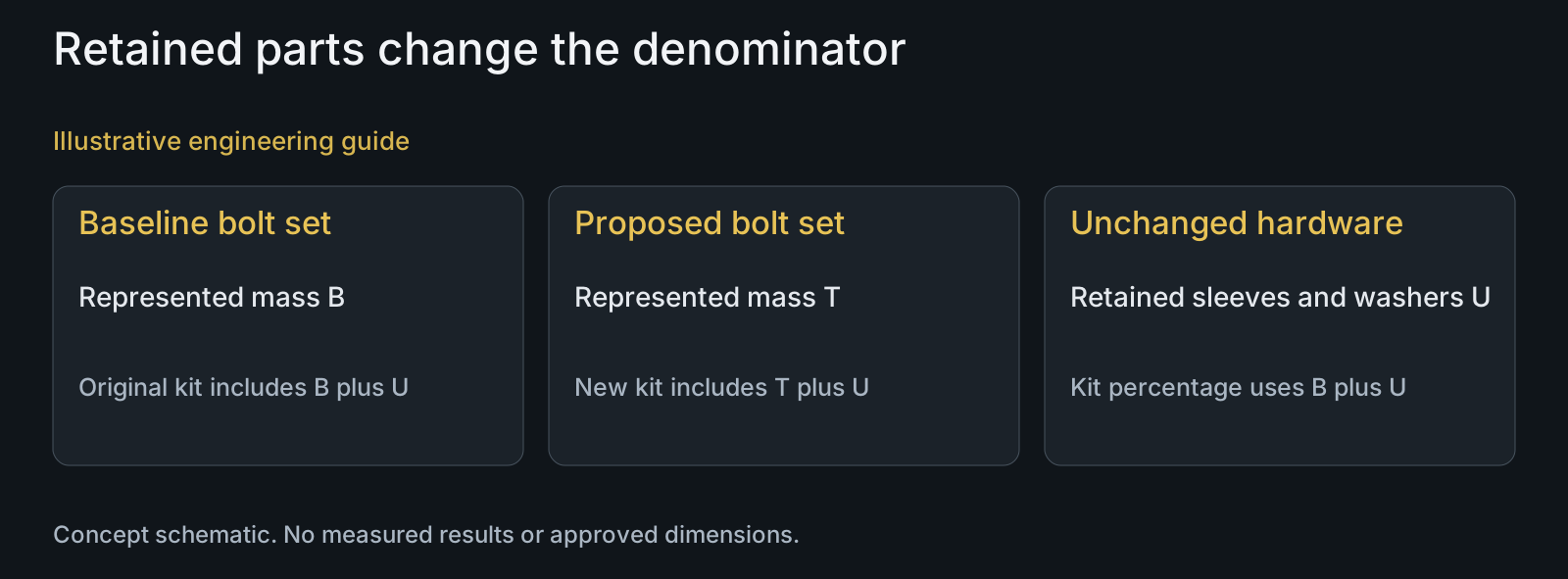
Illustrative engineering example: assume an OEM proposes titanium bolts while retaining the baseline sleeves and washers. Let B represent the baseline bolt-set mass, T the proposed bolt-set mass and U the retained hardware mass. All quantities are symbolic; no actual parts or scale readings are supplied.
The bolt saving is B minus T. The whole-kit saving in grams is the same difference if U truly remains unchanged, but the kit percentage uses B plus U as its denominator, not B alone. With retained hardware present and positive bolt savings, the kit percentage is lower than the bolt-only percentage.
The team labels the calculation as an estimate until the actual finished sets are represented by measurements. It also keeps any strength, stiffness or riding assessment separate. A mass record cannot establish a handling improvement, range increase or fatigue life, and this example does not reproduce a measured customer saving.
Questions buyers need to confirm
How many grams will a titanium pivot kit save on my bicycle?
Provide the actual baseline and proposed BOMs or identified sets first. Calculate baseline total minus proposed total and label the result as estimated or measured. No universal gram range is established without that configuration.
Can a bolt-only reduction percentage describe the whole pivot kit?
Not automatically. Include unchanged sleeves, washers and other kit members in the baseline denominator. They can leave the same absolute bolt saving but reduce the whole-kit percentage relative to the bolt-only figure.
Is a CAD mass total enough for a measured weight claim?
No. It is a calculation or entered-value result. Check assigned materials, selected items, quantities and overrides, then keep the modeled basis separate from represented finished-set weighing.
Should the packaging and tray be included?
Only for a clearly labeled packaged-mass claim. For installed hardware, use net component mass and exclude the container consistently on both sides. A shipping-box reading does not describe the installed kit.
Does a more detailed scale display prove a small saving is accurate?
No. Readability is not the same as measurement accuracy. Use a method suitable for the intended difference and state the represented specimen and measurement basis rather than relying on display digits.
Does a lighter kit prove better handling or longer life?
No. Mass is one result. Additional claims require their own relevant application evidence, and geometry or material changes still need assessment against the intended assembly requirements.
Technical references and scope
Onshape: Mass Properties Tool. Assigned density, omitted unassigned parts, selections and mass overrides explain calculation boundaries. Software calculation is not a factory measurement or component approval.
METTLER TOLEDO: Precision balances guidance. Net/tare/gross and readability-versus-accuracy distinctions. No ownership, specific balance model, numeric resolution or universal uncertainty claimed.
TIMET: TIMETAL6-4 data sheet. Reference material density only, not a weighed kit, generic bicycle saving or approved redesigned part.
Explore related component, material and sourcing decisions in the customer decision knowledge center. For a drawing review, use the Drawing/BOM RFQ path.
Build a mass comparison for the complete pivot hardware set
Send baseline and proposed item drawings, STEP models and BOM quantities, with material and finish states. Include available component masses or identified sample sets, the target claim boundary and unchanged acceptance requirements. PremFixer will review the manufacturing scope and inputs needed for a comparable finished-kit mass discussion.
Discuss the drawing and BOM