

A custom pivot hardware purchase agreement should make the connections between technical scope and commercial responsibilities usable. Identify the supplied drawing and BOM, finished condition and acceptance evidence, then connect them with delivery events, payment, price review, changes and tooling or information rights. A clause saying 'quality guaranteed' cannot resolve conflicting processing states in two attachments. A new drawing also does not explain what happens to existing stock or preparation charges. This is a practical engineering and purchasing discussion map, not a ready-to-sign contract or legal opinion. Applicable law, enforceability, remedies and dispute arrangements require qualified review for the actual parties and transaction.
Connect the order description with its technical attachments
Identify the exact parts, member quantities, revisions, material condition and final treatment the order covers. Include accepted alternatives and relevant mating definitions. A commercial kit name is not a substitute for those inputs when different configurations share it.
Compare drawings, models, quality attachments, quotations and proposed deviations for conflicting definitions. Ask the appropriate advisers to determine document priority and incorporation. Do not assume that a later email or a more detailed attachment automatically controls the entire agreement.
The controlled quotation template preserves each response and assumption. Use it to expose differences before agreement, while keeping legal acceptance separate from a reviewer's technical interpretation. A completed comparison sheet does not itself establish binding order terms.
Connect quality language with the feature and its delivered state
Specify which characteristics and evidence address the required finished component. If a drawing requires a treated bearing interface but an inspection attachment requests only pre-treatment measurements, the documents may address different states. Make that conflict visible instead of relying on general conformity language.
Define a sample's purpose and role alongside the current specification. Appearance, access, dimensional and application evaluations answer different questions. A sample reference should not silently replace the production definition or be treated as a promise about every later kit or the complete bicycle's lifetime.
For a disputed measurement, identify the item, feature, datum, method and process state involved. That technical comparison helps investigate what happened; it does not establish a legal burden of proof. Keep notification and containment arrangements distinguishable from a final allocation of responsibility.
| Connected subjects | Definition needed | Risk | Review basis |
|---|---|---|---|
| Order and attachments | Parts, revisions and document relationship | Conflicting descriptions silently merged | Engineering facts and legal document review |
| Drawing and quality evidence | Feature, datum and final process state | Report covers a different condition | Applicable acceptance subject |
| Sample and production | Sample purpose and specification role | Appearance becomes universal acceptance | Represented features and scope |
| Delivery and dependencies | Named event, location and open inputs | Dispatch confused with arrival | Actual proposed milestone |
| Revision and price | Changed work and offer treatment | New work assumed included | Affected operations and terms |
| Revision and inventory | Compatible existing states and disposition | Old stock left undefined | BOM dependencies and authority |
| Tool charge and rights | Physical resource versus permitted use | Payment mistaken for all ownership | Named asset and legally reviewed rights |
| Investigation and remedies | Facts, temporary response and decision roles | Containment treated as liability finding | Actual evidence and legal review |
Connect delivery commitments with their event and dependencies
Distinguish finished-part availability, dispatch and receipt at the agreed location. Identify the endpoint meant by a date and the unresolved drawing or external-operation inputs that affect it. A planning estimate for manufacture is not automatically an agreed arrival commitment.
Where a delivery rule is used, record its named place and edition along with the actual agreed arrangement. Delivery-related risk and cost allocation should not be treated as a substitute for acceptance, payment, warranty or dispute terms. Those subjects still need their own explicit scope.
Discuss delay notification, mitigation and proposed remedies through the appropriate commercial and legal reviewers. No universal penalty, automatic compensation or enforceability of a percentage clause is asserted here. Keep the operational response to a schedule issue separate from a legal determination about it.
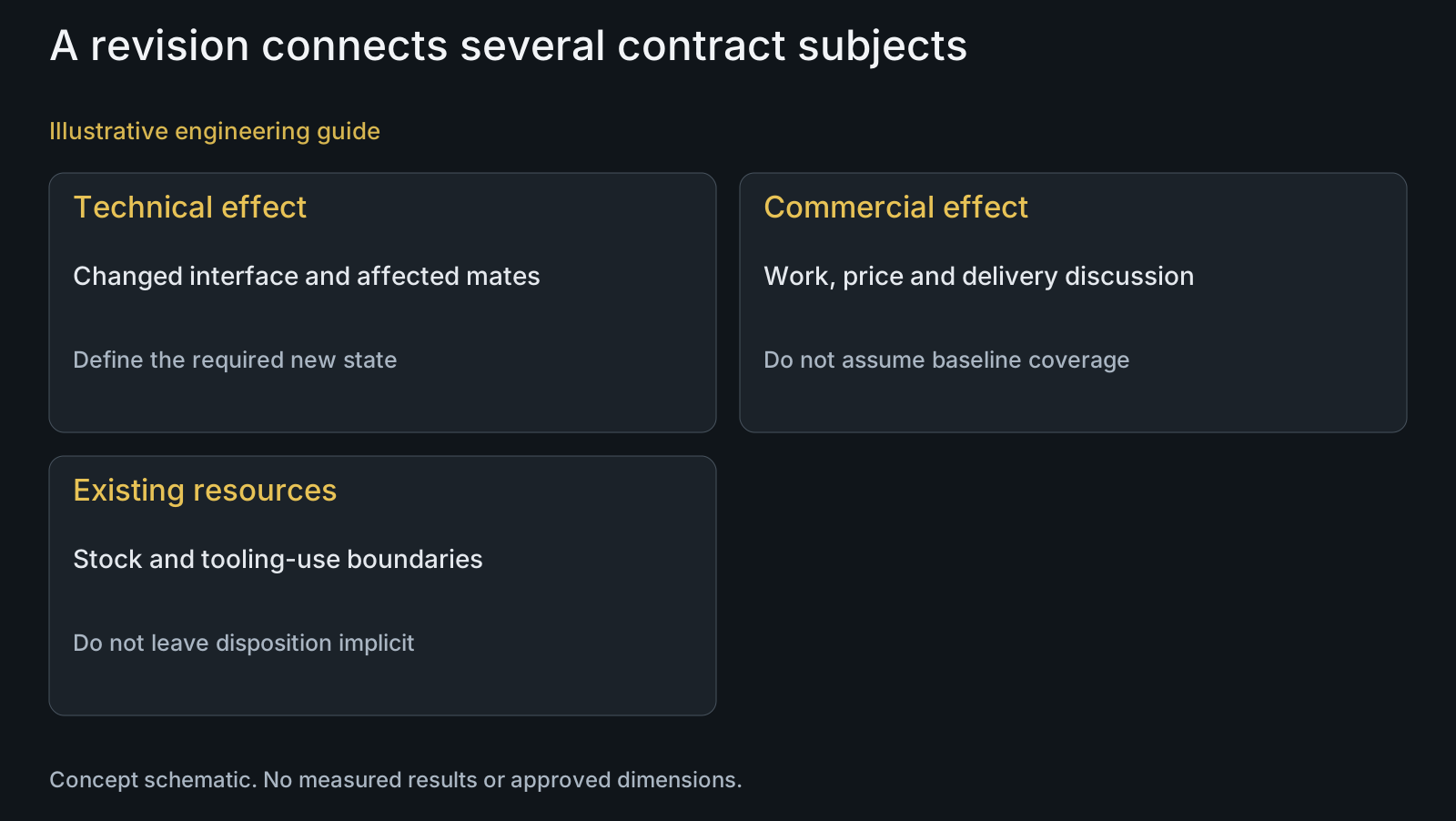
Connect a change request with price, timing and existing states
Identify who can request and authorize a changed drawing, quantity, evidence requirement or release pattern. State which manufactured, in-process or procured states are affected. A revised spacer requirement can alter kit compatibility even when the axle drawing remains unchanged.
Review the additional or avoided work and the resulting offer separately. A fixed baseline price does not by itself establish that every later engineering change is covered. Conversely, an administrative revision does not prove new tooling is needed. The revision compatibility guide helps identify the physical affected scope.
Agree how unresolved stock and work are handled while the change is assessed, without silently substituting the new definition into an old order. The ten-point negotiation review keeps changed production organization and commercial concessions visible rather than label them all engineering savings.
Connect tooling, drawings and information with the actual rights discussed
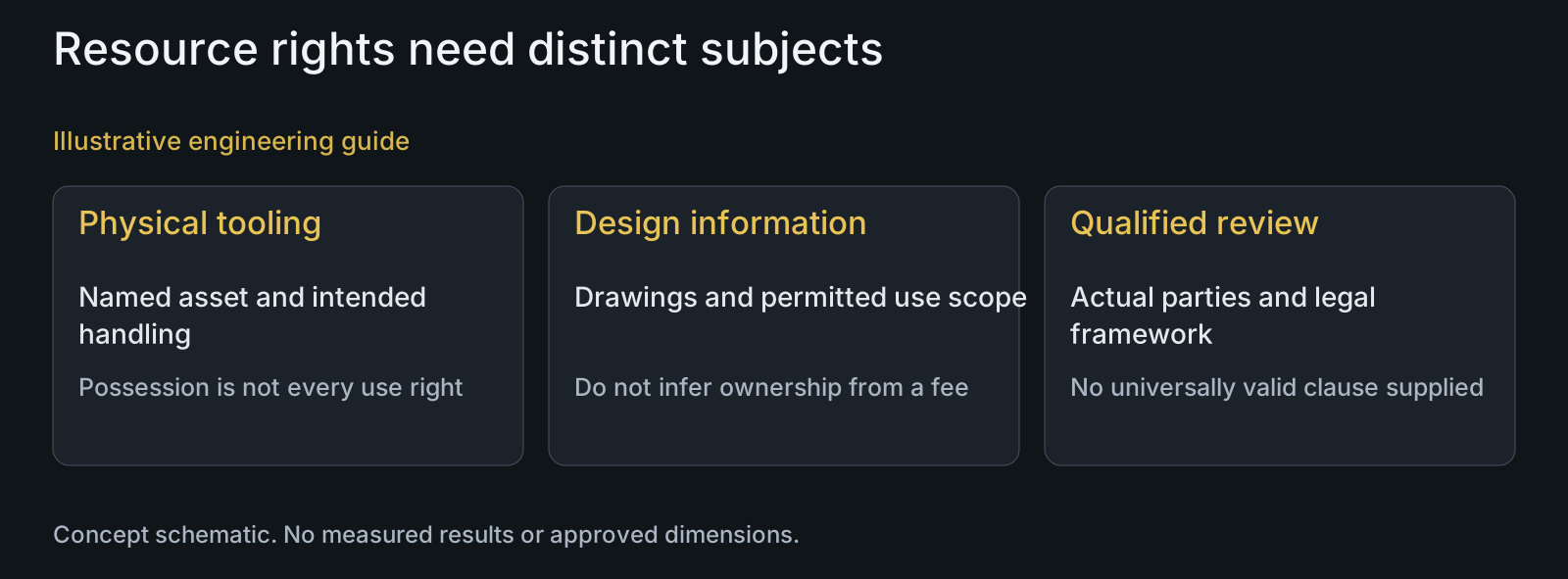
Separate the physical tool, payment for preparation, design information, process know-how and permission to manufacture. These are different subjects for agreement; payment of one charge should not be presented as proof of every ownership or use right. Identify which resource and permitted action the parties are discussing.
For customer-provided tooling or information, clarify intended use, access, maintenance, return and sharing boundaries as applicable. For a proposed alternate resource, establish the permitted use rather than infer rights from physical availability. The existing-resource review addresses technical suitability separately.
The UN's CISG introductory note explains that even when that Convention applies, validity and ownership effects are not all governed by it. That scope distinction supports obtaining transaction-specific legal review; it does not determine this order's applicable regime, intellectual-property rights or enforceable remedies.
Review example: a drawing revision leaves an old-stock question open
Illustrative engineering example: assume a pivot-kit order has a defined quality attachment and delivery milestone. The OEM proposes a spacer-interface revision after some work has been authorized, while the commercial discussion mentions keeping the same price and date. No actual contract, stock, charges or dispute is supplied.
The team identifies the changed spacer and affected mates, which existing states could still be relevant and what new evidence would be required. It separates the engineering decision from the proposed commercial treatment and clarifies which original commitments would actually remain unchanged.
The reviewer also asks how the referenced attachments and tooling-use discussion are updated. No party is declared liable and no remedy is prescribed. The example shows why agreement on a revised price alone cannot close the configuration, evidence, schedule and resource questions at the same time.
Questions buyers need to confirm
Is a standard purchase-order form always sufficient?
Only if the actual agreed scope and responsibilities are adequately addressed. Identify technical attachments, alternatives and unresolved subjects; qualified reviewers should determine the documents' legal relationship rather than rely on a generic form.
Can sample approval replace final-condition evidence?
Not automatically. Define the sample purpose, revision and evaluated features alongside the required finished state. An appearance or access sample cannot establish an untreated or unmeasured bearing interface.
Does a lead-time estimate promise arrival?
No automatic equivalence follows. Identify the starting dependencies, represented quantity and named endpoint. Manufacture, dispatch and destination receipt are different events for the actual agreement to address.
Does a revised drawing keep the original price and date?
Not by itself. Identify affected work, evidence, existing stock and interfaces, then clarify the offered commercial treatment. An unchanged commitment needs explicit agreement rather than an assumption from a file update.
Does paying a tooling charge transfer every right?
Do not infer that conclusion. Separate the physical asset, preparation work, design information and manufacturing permission, and obtain review of the actual agreed rights. This guide does not determine legal ownership.
Can a delay penalty be copied from another contract?
Do not treat it as universally valid or appropriate. Review the named obligation, relevant dependencies, remedy wording and applicable legal framework with qualified advisers; no enforceability or compensation guarantee is given here.
Technical references and scope
United Nations Audiovisual Library: CISG introductory note. Limited distinction between CISG coverage and validity/ownership effects; no historical participation figures or transaction-specific applicability applied.
Explore related component, material and sourcing decisions in the customer decision knowledge center. For a drawing review, use the Drawing/BOM RFQ path.
Clarify manufacturing facts before finalizing the agreement
Send identified drawings, STEP, complete BOM, final condition and evidence requirements, quantities and the requested delivery event through the Drawing/BOM RFQ path. Add the open manufacturing and commercial scope questions so PremFixer can clarify the offer while legal terms remain with the appropriate qualified reviewers.
Discuss the drawing and BOM