
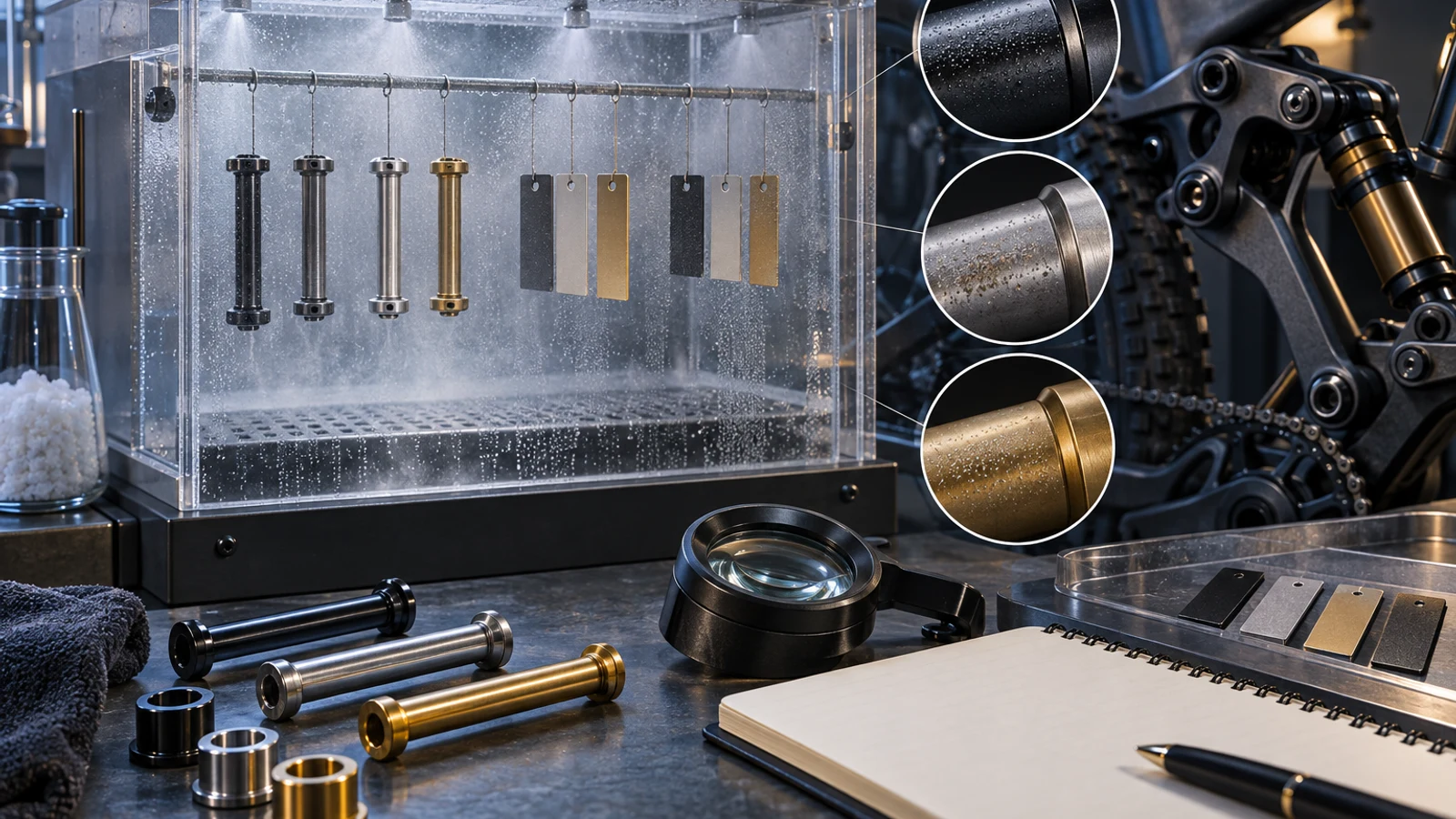
There is no universal salt-spray duration that a 304, 316 or titanium pivot bolt must pass merely because of its material name. Define the applicable test, the actual substrate and surface system, specimen condition, assessed areas and failure criteria together with the duration. ASTM B117's public scope does not prescribe product-specific exposure periods or acceptance interpretation. An order requesting only a number of hours is therefore incomplete. A longer recorded exposure is not a direct riding-life guarantee, and absence of red rust is not a complete acceptance criterion for every substrate, coating or joint. Choose an endpoint that answers the project's actual corrosion concern.
Hero: concept illustration of example hardware and its application. It is not a factory photograph, tested component or approved production geometry.
Distinguish a test practice from a product requirement
The laboratory procedure controls the exposure environment; the product requirement defines the decision to make from it. State the applicable edition and any customer specification. Do not substitute a supplier's familiar chamber recipe for a named order requirement without agreement.
ASTM's public B117 page also cautions against stand-alone prediction of natural-environment performance. This is a boundary on interpretation, not permission to invent a conversion factor. The neutral-versus-cyclic guide addresses method selection; this article addresses the separate question of what constitutes acceptance under the chosen method.
Describe the surface system the specimen represents
Identify base material, supplied condition, treatment and relevant additional layers. A generic black finish is not enough to compare two proposals. A coupon can help investigate a surface system, but its geometry and processing relationship to the delivered shoulder or thread must be explained.
State whether the evaluation concerns an untouched part, an intentionally damaged coating or an assembled interface. Define preparation, handling and any excluded locations before exposure. Introducing damage, masking a region or changing the specimen later changes the question and should not be hidden behind the same hour label.
| Decision field | Useful definition | Risk if missing | Verification |
|---|---|---|---|
| Procedure | Named method and applicable edition | Different environments compared | Match laboratory proposal |
| Specimen | Part or coupon and supplied system | Coupon becomes finished-joint proof | Explain represented geometry |
| Region | Visible and relevant contact locations | Hidden concern unexamined | Identify assessed areas |
| Endpoint | Defined deterioration or function | No-red-rust becomes all-purpose pass | Use system-specific criteria |
| Assessment state | Agreed handling and observation | Cleaning changes apparent outcome | Record applicable assessment basis |
| Duration | Requested exposure with its endpoint | Hours imply field lifespan | Bound conclusion to the test |
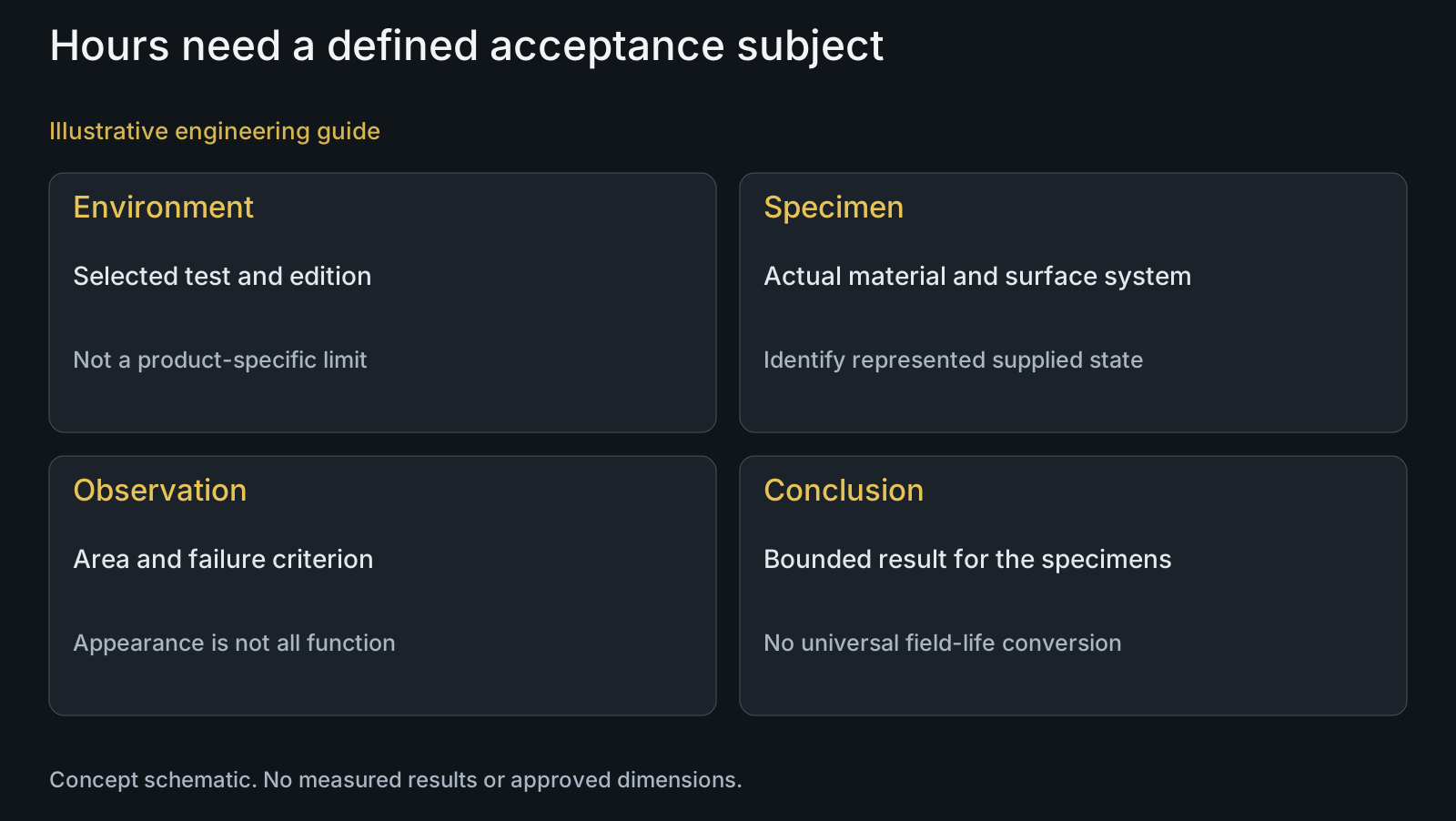
Name the observation, location and assessment condition
Separate substrate attack, coating deterioration, discoloration and post-exposure function. Choose criteria appropriate to the actual system rather than using red rust as the sole verdict for stainless, titanium and every protective layer. Specify how the observation is assessed and which regions count.
For a pivot, a visible head and a hidden contact region may present different concerns. If seat condition or disassembly is part of acceptance, state the relevant evaluation separately. A cosmetically acceptable photograph of the head cannot establish an unexamined receiver contact or prove that the joint still functions.
Make duration and interruptions interpretable
Specify the requested exposure duration or cycle count alongside the method, assessments and report scope. Identify how interruptions or departures are reported under the applicable requirements. Do not add an undocumented pause to a continuous procedure and describe it as an equivalent cyclic method.
Photographs should identify specimens and assessed areas, with the defined observation conditions. Keep observations distinguishable from the final disposition. A statement that testing ran for the requested period is not the same as a statement that the required endpoint was met.
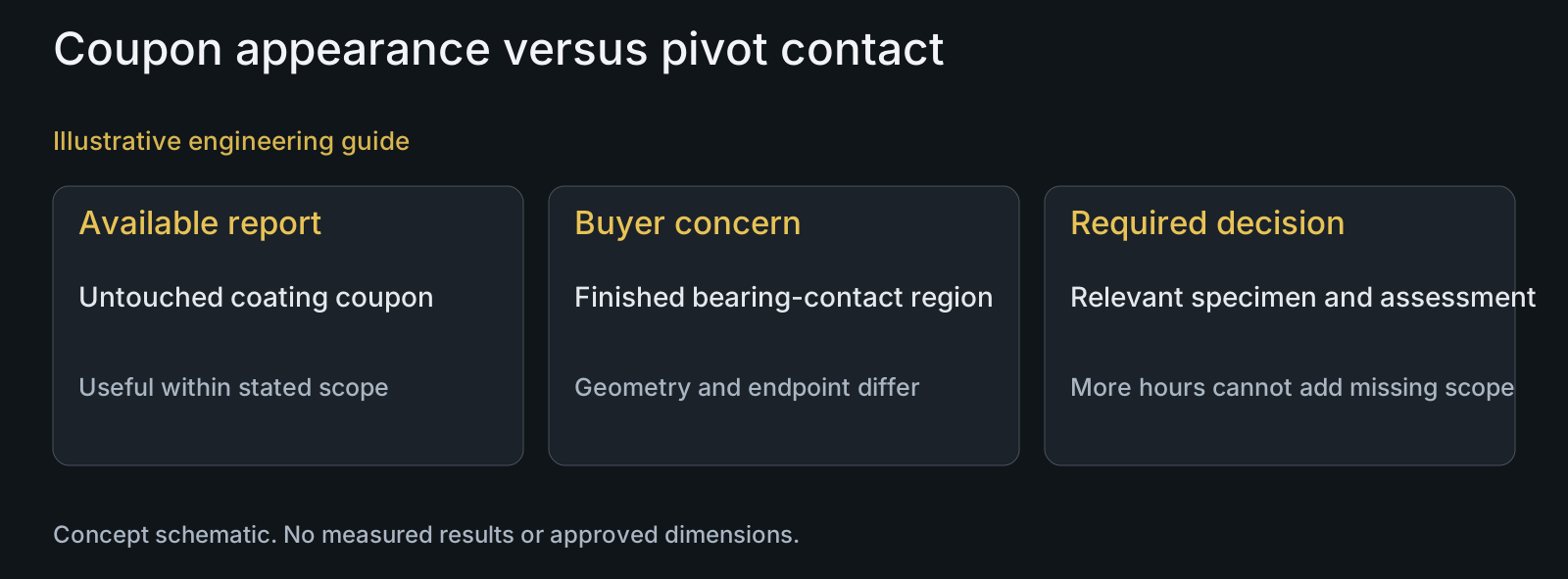
A long exposure can answer the wrong acceptance question
Illustrative engineering example: assume an OEM compares two pivot finish proposals. One report concerns untouched coupons assessed for visible appearance; the purchase question concerns a finished axle's bearing-contact region. No durations, observations or pass results are assumed.
The coupon report may inform finish development, but it does not automatically close the delivered-interface requirement. The team defines the relevant specimen and region, decides what deterioration or function needs assessment and agrees evidence for that scope. Increasing the coupon exposure time alone cannot restore the omitted geometry or endpoint.
Keep the purchasing claim within the evidence
A supported result identifies the actual specimens, surface configuration, procedure and observations. It should not become a promise that all later finish lots or every bicycle environment will perform identically. Production acceptance and service validation may require different evidence.
Discuss the proposed surface treatment and anti-corrosion application with the drawing and mating materials. PremFixer's qualified-partner model does not establish a company-owned chamber, universal tested duration or guaranteed coastal lifespan. Required test arrangements and deliverables must be confirmed for the order.
Questions buyers need to confirm
Should 304, 316 and titanium each have a fixed required hour count?
Not from the grade name alone. Define the actual material, surface system, specimen, procedure and endpoint. No universal values or completed PremFixer results are established here.
Does ASTM B117 set the pass duration for a pivot bolt?
Its public scope does not prescribe product-specific exposure periods or interpretation. The applicable product or customer requirement must provide those decisions. Confirm the named edition and requested acceptance scope.
Is no red rust sufficient for every finish?
No blanket criterion is appropriate. Identify the substrate and layers, relevant deterioration and assessed regions. A cosmetic observation should not silently accept hidden contacts, coating defects or required post-exposure function.
Can a coupon report release a finished bearing seat?
Only where the supported evidence and agreed requirements address that supplied interface. Compare geometry, processing and observation. A coupon result cannot independently prove a feature or contact absent from its specimen.
Can test hours be converted into years of coastal riding?
Not through a universal multiplier. Laboratory exposure and field service have different conditions. Keep the result bounded and obtain appropriate application evidence for any service-life claim.
What should a corrosion-test RFQ include?
Provide material and finish callouts, mating materials, proposed method, specimen definition, duration, assessed areas and endpoints. Identify required photographs, report scope and any post-exposure function so the testing proposal answers the actual concern.
Technical references and scope
ASTM, B117 public scope and significance. Publisher's public boundaries on product-specific duration, interpretation and stand-alone field prediction. Full paid procedure not reproduced; contractual edition remains project-specific.
Explore related component, material and sourcing decisions in the customer decision knowledge center. For a drawing review, use the Drawing/BOM RFQ path.
Specify a corrosion requirement that can be assessed
Send the drawing, finish specification, mating materials and proposed specimen and acceptance fields through the Drawing/BOM RFQ path. PremFixer can review manufacture and coordinated testing scope without turning a requested duration into an unsupported performance promise.
Discuss the drawing and BOM