
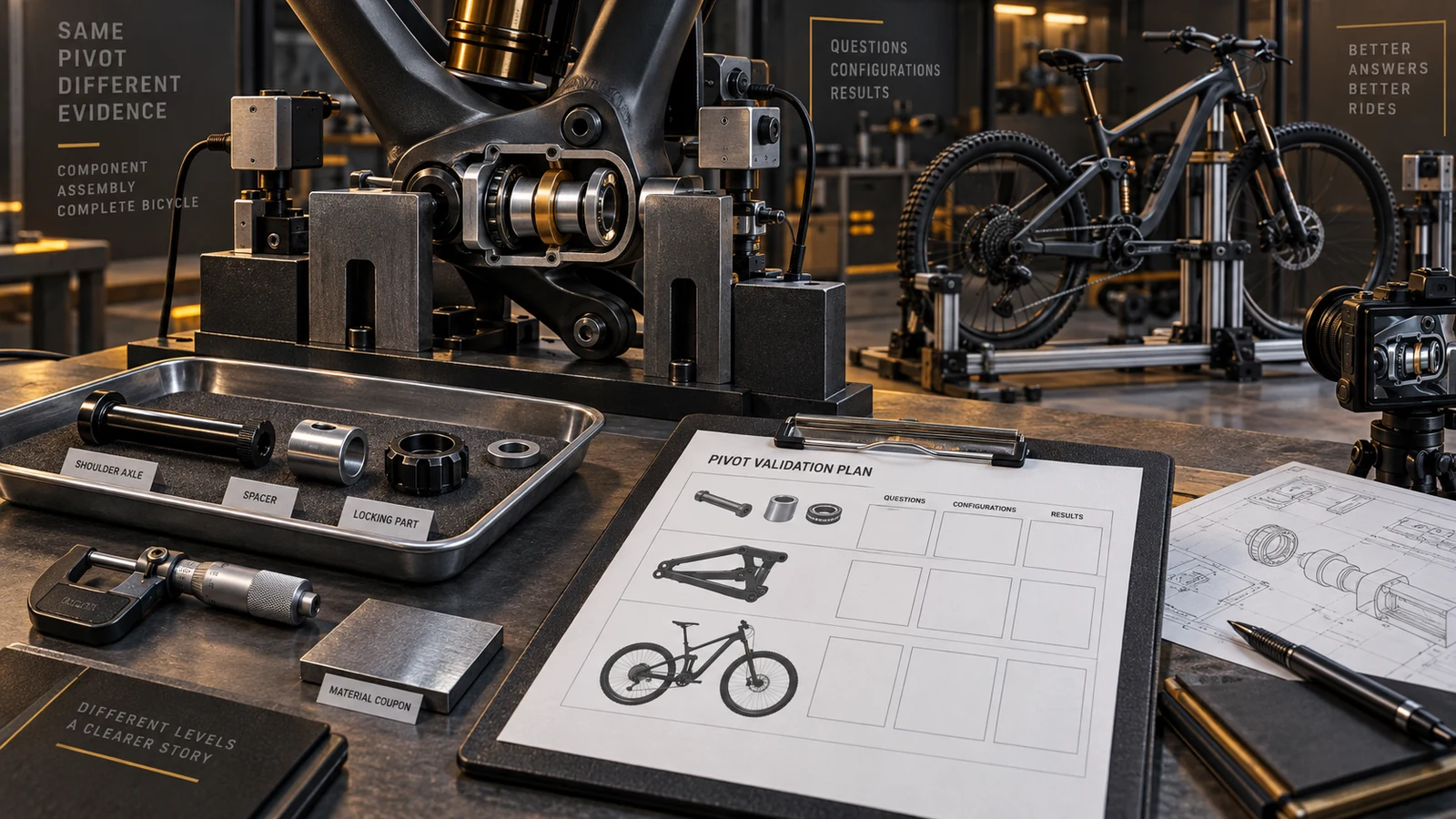
A pivot hardware validation plan should begin with design and application questions, not a fixed list of test machines. The OEM is deciding whether the supplied parts, assembled bearing-and-spacer joint and complete bicycle have evidence for their intended requirements and use. Assign each question to the appropriate evaluation subject and define the represented configuration, method and acceptance basis. Material strength evidence cannot by itself establish assembled clamping, and a joint comparison cannot silently become approval of every bicycle variant. Retain useful lower-level evidence while making the remaining questions explicit. No universal loads, cycle counts or passed validation program are established here.
Hero: concept illustration of example hardware and its application. It is not a factory photograph, tested component or approved production geometry.
Build a coverage map before selecting equipment
Name the decision each evaluation supports: material acceptance, a finished feature, an assembled interface or an application behavior. Link it to the requirement or engineering question rather than write tensile, fatigue and vibration as an unexplained package.
NASA's systems-engineering guidance distinguishes requirement conformity from intended-use validation and relates evidence to product levels. That is general planning context, not a NASA mandate for bicycle suppliers or a substitute for applicable bicycle requirements.
Separate routine supplied-part acceptance from development evaluation. The test-report interpretation guide explains the scope of returned evidence. This article addresses how to allocate the questions before commissioning the work, so a report summary does not conceal missing coverage.
Give material and component evaluations a bounded purpose
Identify whether the tested object is raw stock, a prepared specimen or a finished axle. Material condition and specimen geometry belong with the method. Do not describe a material result as an examination of every intact supplied component.
For finished parts, select the relevant characteristics and final manufacturing state. Dimensions after treatment, the actual thread feature and a component loading question need different definitions. A hardness or tensile result is not an independent explanation of bearing fit, usable engagement or assembly retention.
Use the mechanical-test scope guide for the distinction between test purposes. When comparing manufacturing routes, keep the proposed variables explicit. A part-level result should state the conditions it represents, not advertise an unqualified bicycle-life conclusion.
| Evidence subject | Useful decision | Scope not automatically covered | Define before evaluation |
|---|---|---|---|
| Identified stock or specimen | Material characteristic in its stated condition | Finished axle and assembled joint behavior | Material identity, state and method |
| Finished component | Required geometry or component question | Other kit items and all application variants | Revision, final route and evaluated feature |
| Assembled pivot | Behavior of the defined contacts and assembly | Every bicycle or changed spacer arrangement | Mates, installed state and intended outcome |
| Frame or bicycle configuration | Applicable application-level question | Unrepresented models and uses | Complete requirements and represented scope |
| Unexpected observation | Cause of a discrepancy | Automatic component-defect diagnosis | Evaluation validity and product evidence |
| Changed configuration | Whether retained evidence remains applicable | Blanket carryover or blanket retest | Affected questions and responsible decision |
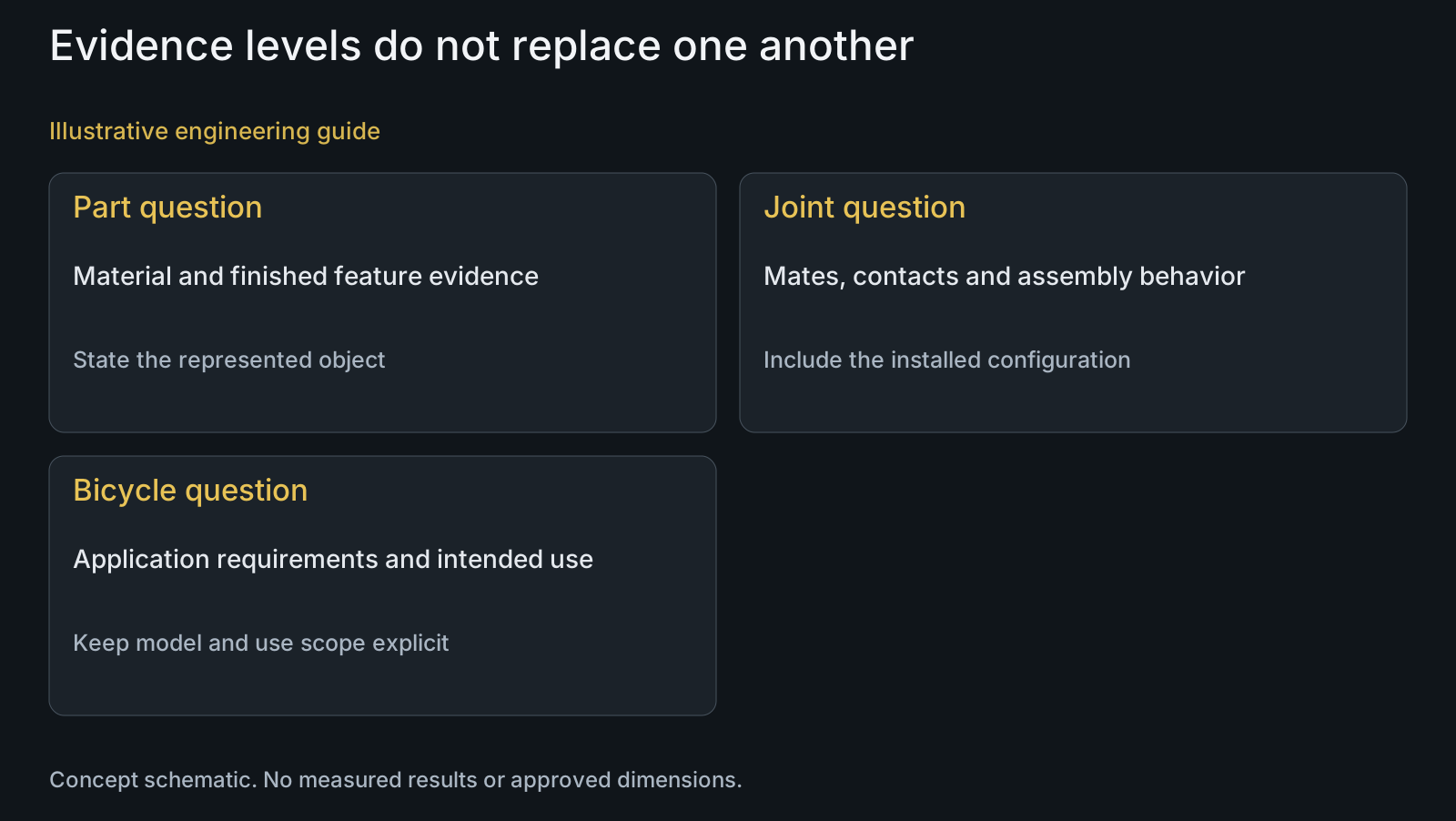
Evaluate the joint where contacts and assembly interact
An assembly question includes the axle, receiver, bearings, spacers and locking features that actually take part. Specify their revisions and the relevant installed condition. A fixture that omits a decisive contact can examine something useful without resolving the complete pivot question.
State whether the purpose concerns seating, freedom of movement, clamping behavior, rotational loosening or another outcome. Do not use removal torque as an all-purpose proxy. The vibration evaluation guide helps distinguish motion and joint evidence without prescribing one test for every design.
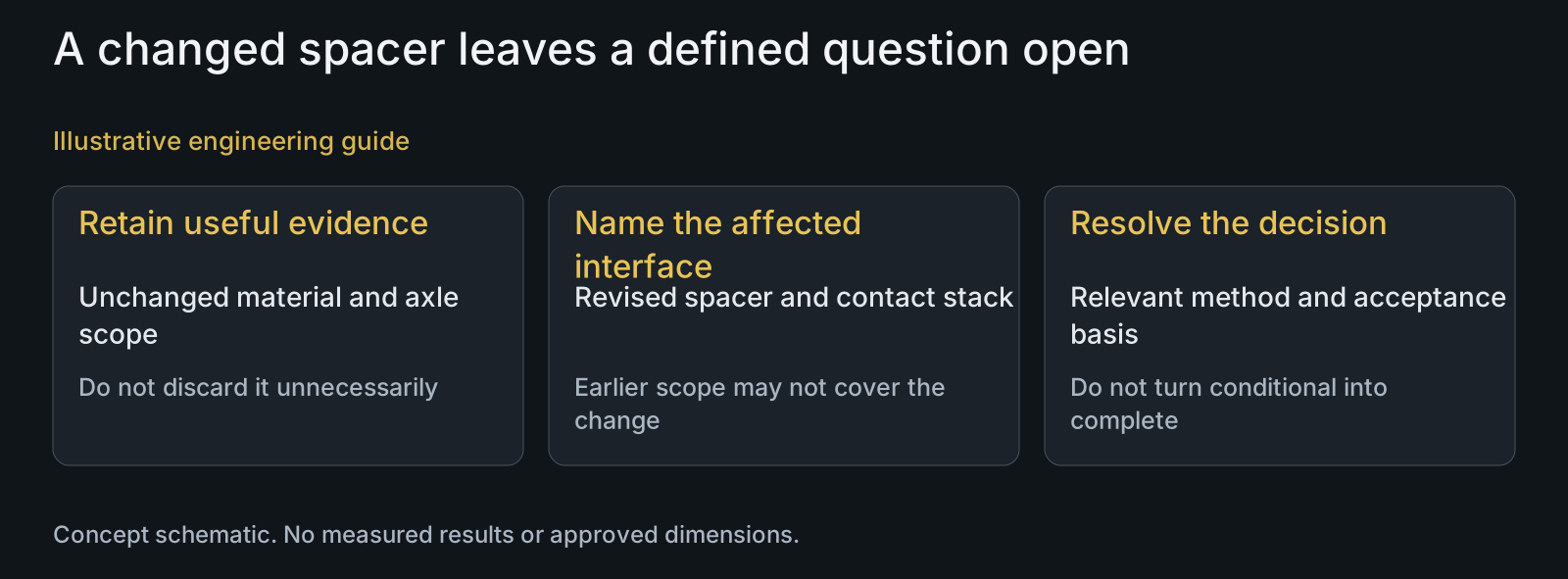
Keep assembly preparation, selected products and tightening basis with the represented configuration. If a spacer or surface state changes, assess whether the earlier evidence still answers the question. Retain it only with a reason, not because the new part has the same external thread.
Keep bicycle-level scope distinct from isolated hardware evidence
Identify the frame or bicycle configuration, intended-use conditions and requirements that control application evaluation. A successful component comparison does not establish every represented model, use category or surrounding assembly.
ISO's public description of ISO 4210-6:2023 identifies frame and fork test methods associated with ISO 4210-2. It is not a standalone pivot-bolt approval. Determine applicable requirements from the complete current documents and project scope; no paid clauses, numerical recipes or compliance result are asserted here.
Treat an informal ride observation and a defined controlled evaluation as different evidence. Record what the observation can show and what it leaves unanswered. The full-suspension application discussion supports interface review, not a claim that a generic road test establishes all safety requirements.
Use outcomes to close questions rather than rename uncertainty
Before evaluation, identify the acceptance basis and who can make the relevant design or supply decision. Afterwards, compare the actual evidence with that basis and retain the specimen and configuration identity. A pass label has meaning only for its stated question.
NASA's guidance distinguishes product shortcomings from problems in evaluation conditions or conduct. For a pivot project, that distinction matters when deciding whether to change the hardware, correct the evaluation or obtain additional evidence. Do not assume every unexpected observation is a component defect.
A conditional decision should name its permitted scope and unresolved conditions; it is not equivalent to full validation. If a revision is needed, identify which questions are affected and why retained evidence remains useful. Avoid both repeating every historical activity automatically and waiving all review after a small-looking change.
Review example: the material question is closed, the joint is not
Illustrative engineering example: assume a pivot project has material evidence for an axle and finished dimensions for its supplied state. A later proposal changes the spacer arrangement before assembly evaluation. No actual passed test, load value or durability result is assumed.
The reviewer keeps the applicable material and axle evidence but identifies the changed contact stack as an open assembly question. A material certificate is not discarded merely because it cannot answer that question, and it is not extended into proof of the new joint's behavior.
The plan names the revised combination, the assembly questions and the responsible acceptance team. It also leaves the relevant bicycle-level scope separate. This avoids spending on duplicate material work while leaving a real interface gap hidden beneath a general evidence-complete heading.
Questions buyers need to confirm
Does every pivot project need the same test package?
No. Identify the requirements, component and assembly questions, represented use and applicable standards. Select methods to answer those questions. A machine list cannot establish coverage or acceptance for every custom hardware project.
Can tensile evidence replace assembly evaluation?
No. It addresses its material or specimen question, not automatically the installed bearing-and-spacer joint. Keep that useful evidence and define the separate contacts, assembly conditions and outcomes needed for the joint decision.
Does a passed joint evaluation approve every bicycle model?
No. Its conclusion belongs to the represented configuration and conditions. Define the frame or bicycle application scope and any remaining requirements. Unrepresented models, mates or use conditions need an applicability basis.
Should an unexpected observation always trigger a hardware redesign?
Not automatically. Check the evaluation configuration, procedure and evidence before assigning the cause to the product. Distinguish an invalid setup from a genuine hardware issue so the next action addresses the actual problem.
Can unchanged material evidence be retained after a spacer revision?
Yes, where its scope remains applicable. Assess the changed assembly relationship separately rather than discarding all earlier evidence or carrying everything over. State the retained basis and the affected questions.
What should a validation-related RFQ include?
Send drawings and STEP, component and mate revisions, material and final surface requirements, intended use, BOM and sample quantities. Include the question-to-method map and acceptance responsibilities. Agree manufacture, inspection and specialist evaluation scope separately.
Technical references and scope
NASA systems-engineering product validation guidance. General requirement-versus-intended-use distinction and product-versus-evaluation discrepancy review. Aerospace guidance is not a bicycle mandate.
ISO 4210-6:2023 public scope. Published frame and fork test-method scope associated with ISO 4210-2; not standalone pivot certification or access to paid clauses.
Explore related component, material and sourcing decisions in the customer decision knowledge center. For a drawing review, use the Drawing/BOM RFQ path.
Define the evidence needed for the pivot decision
Provide part and assembly drawings, STEP, BOM, material and finish states, intended use and evaluation questions through the Drawing/BOM RFQ path. PremFixer can review sample manufacture and defined inspection or partner-testing scope while your team controls application requirements and acceptance.
Discuss the drawing and BOM