
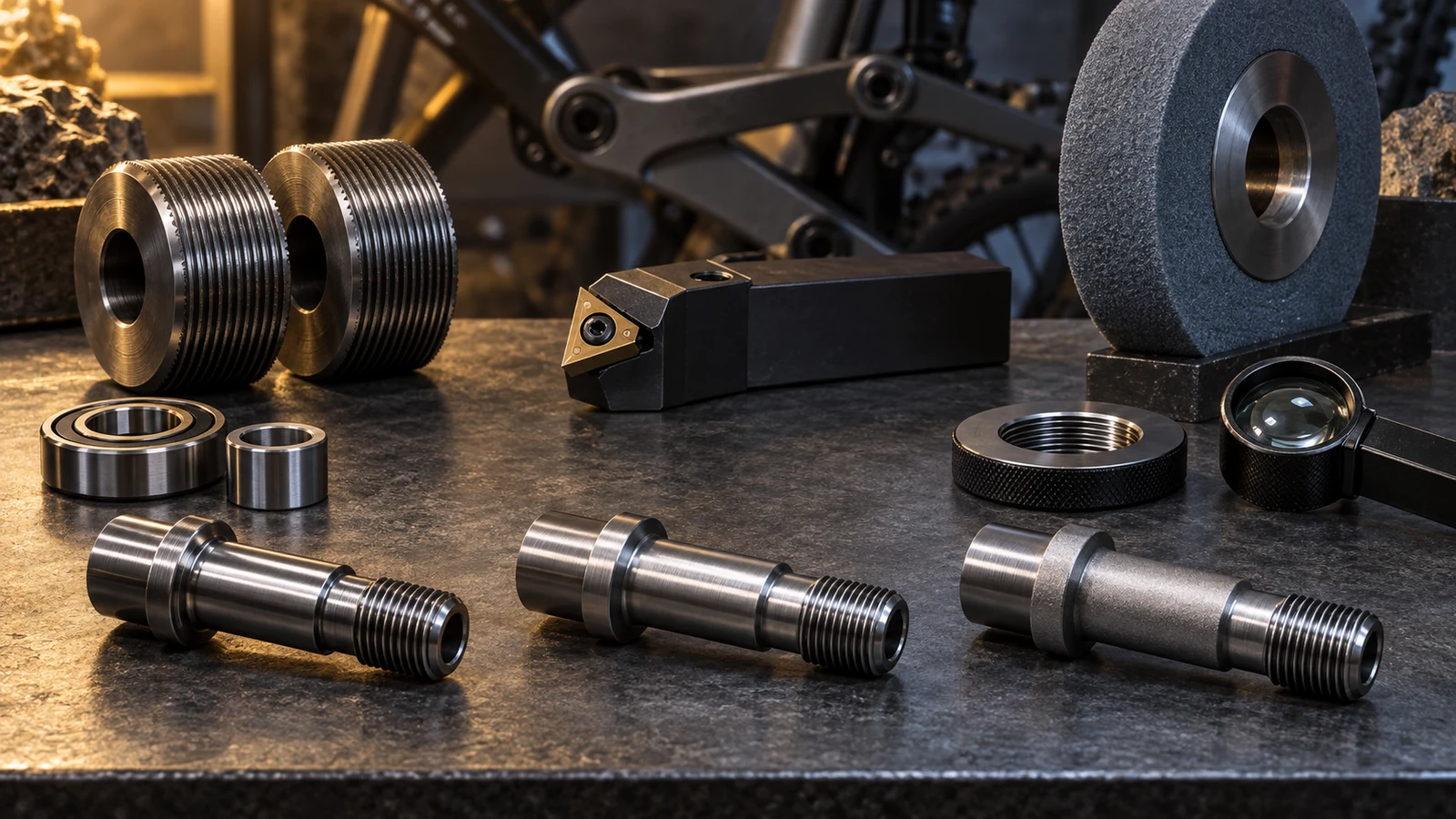
Choose pivot thread rolling, cutting or grinding by the finished feature you need, not by a fixed ranking of process quality. The decision concerns an external thread on a custom axle, its shoulder transition and the receiver that closes the assembly. First define material condition, thread form, usable full-thread length and available tool space. Then compare manufacturing proposals for the quantities and verification requirements of your project. A route can be attractive in one geometry and impractical in another. Passing a thread gauge does not, by itself, establish correct stack closure, fatigue performance or approval for a bicycle application.
Hero: concept illustration of example hardware and its application. It is not a factory photograph, tested component or approved production geometry.
Define the complete thread before comparing routes
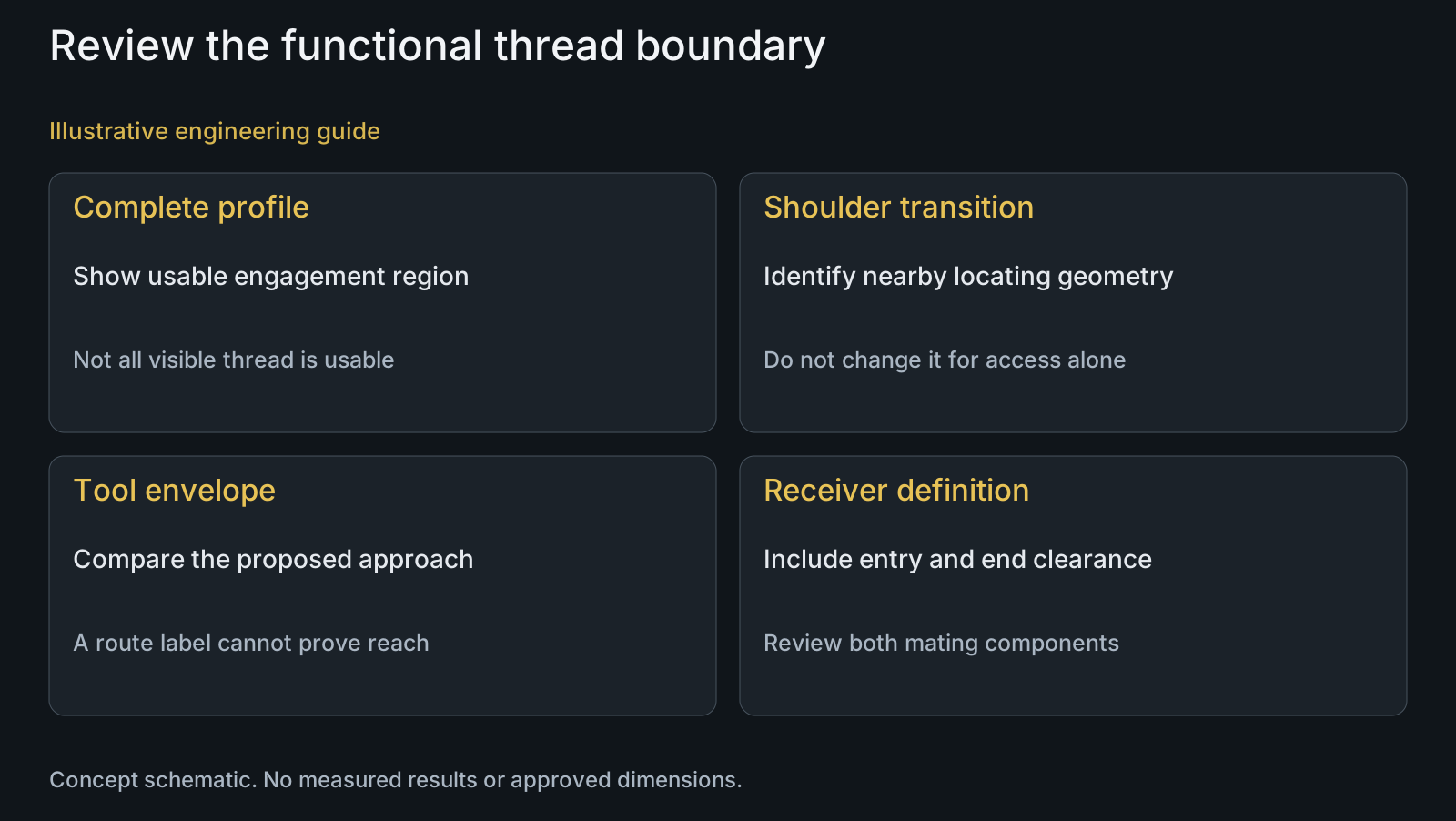
Show the thread start, required complete profile, runout and nearby shoulder on the drawing. A dimension to the end of a visibly threaded region is not necessarily the usable engagement available to the receiver. Keep any incomplete region outside the required engagement, subject to the actual joint design.
The receiver drawing supplies the other half of the decision: entry geometry, mating form, effective depth and any blind-end clearance. Review the assembly section as well as the axle model. The effective engagement guide explains why total bolt length cannot answer this question.
If manufacturing access requires a relief change, treat it as a drawing proposal. The designer must consider the shoulder's role, surrounding support and transition geometry. A shop preference is not authorization to remove functional material or move the load-carrying interface.
Rolling displaces a prepared blank; cutting removes material
Rolling forms the external thread by material displacement. Cutting creates it by material removal; thread turning is one cutting route, not the only one. Material condition and the actual tooling arrangement belong in either proposal. Do not treat a material family name as a complete manufacturing specification.
Landis's thread-rolling documentation discusses prepared blanks and shoulder access for its tools. The practical lesson is to review the proposed tool envelope against the part, not to copy historical speeds, numerical rollability rules or advertised strength gains into a pivot requirement.
Sandvik Coromant's thread-turning guidance identifies chip handling, tool alignment and vibration as machining considerations. A cutting proposal should explain its access and workpiece support. The process name alone does not demonstrate a clean runout or the required relationship to the axle shoulder.
| Route | Useful review condition | Risk to resolve | Requested evidence |
|---|---|---|---|
| Rolling | Defined formable condition and suitable tooling access | Prepared blank or tool envelope does not suit geometry | Proposed blank, tooling approach and complete-thread boundary |
| Cutting | Machinable condition and accessible cutting path | Chips, support or tool exit compromise the feature | Support and exit proposal; finished geometry assessment |
| Grinding | A stated form, finish or condition requirement justifies evaluation | Surface outcome or specialist supply scope is undefined | Operation responsibility and requirement-specific evidence |
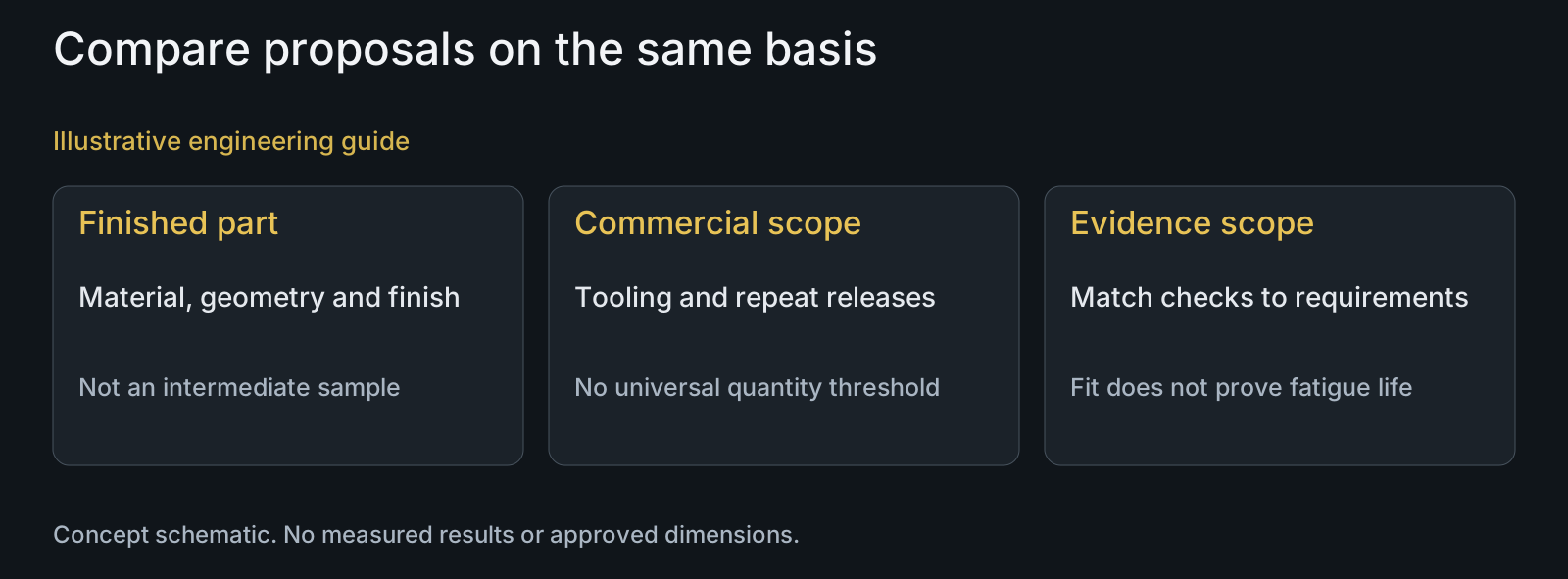
| Any route | Same delivered configuration and order releases | Unlike quotes or intermediate samples are compared | Common finished-state specification and itemized scope |
Grinding needs a defined reason and a controlled surface outcome
Thread grinding uses an abrasive process to generate or finish the specified thread. Ask what requirement makes it worth evaluating: a particular supplied material condition, form requirement or manufacturing constraint. Calling it the most precise option does not explain why this part needs it or prove the proposed result.
Norton's grinding-wheel selection guide relates wheel choice to material, required form and finish, contact and operating conditions. It also discusses damage risks from rubbing and dull grains. Its general guidance is not a wheel recipe or a thread-grinding capability statement for PremFixer.
Specify the finished thread's acceptance criteria and the surface-condition evidence the application requires. Confirm responsibility for any specialist operation in the quote. PremFixer's confirmed in-house CNC and thread-rolling capabilities do not establish an in-house thread-grinding line; an unconfirmed route must remain a feasibility question.
Compare tooling commitment with the actual order pattern
Separate one-time tooling and setup charges from recurring component costs. Ask which drawing revision the tooling represents, whether it is reusable for scheduled releases and what a geometry change would reopen. Compare total quoted scope, not only the cheapest first sample or nominal cycle time.
A stable recurring design and an exploratory design present different commercial risks. Dedicated tooling can be difficult to justify while thread location or geometry is still changing. That does not make cutting automatically cheapest or rolling automatically best above an invented quantity threshold. Obtain route-specific quotes for the same material, finished requirements and releases.
Include downstream finishing and inspection in each comparison. A lower price for unfinished threads is not directly comparable to a delivered, treated axle. The CNC manufacturing page and surface-treatment scope help separate the operations being requested.
A shoulder-access review can change the preferred route
Illustrative engineering example: assume a proposed axle has a short terminal thread beside a larger locating shoulder. The receiver needs complete engagement near that shoulder, while the drawing is still under development. A rolling proposal identifies an access conflict for its selected tooling; a cutting proposal offers a different exit arrangement. These are assumed proposals, not manufactured samples.
The review should first locate the required complete-thread region on the assembly section. If the rolling proposal cannot reach it, request a different tooling approach or a designer-reviewed geometry change. Do not accept a shortened effective thread merely because the overall threaded length appears unchanged. Assess the cutting alternative against the same finished geometry and evidence requirements.
Grinding is a third proposal only if its purpose, access and supply responsibility are established. This example selects no universal winner and reports no measured result. It shows why identifying the functional boundary can eliminate an otherwise attractive route before price comparison.
Keep dimensional acceptance separate from application evidence
State the thread form and tolerance designation correctly for each mating member. The 6g and 6H guide addresses external and internal thread definitions; the labels are not interchangeable process preferences. Agree the inspection methods and supplied finish state covered by acceptance.
Thread gauging, profile assessment and assembly review answer different questions. Identify which requirement each method covers rather than asking a single pass/fail result to prove everything. If fatigue is a decision driver, define the relevant comparison separately using the titanium rolled-thread evidence guide. No fixed fatigue improvement is established here.
Questions buyers need to confirm
Which of the three routes is best for a custom pivot axle?
The route that satisfies the finished feature and agreed evidence within the project scope. Provide material condition, thread form, shoulder geometry and quantity releases; there is no universal quality or price ranking.
Can the supplier change the relief to make rolling easier?
Only through an approved drawing change. Identify how the proposed relief affects the complete-thread boundary, shoulder support and transition geometry. Tool access does not authorize a functional design change.
Does a GO/NO-GO result prove the axle will assemble correctly?
Not by itself. Its evidence covers the requirements represented by the specified gauging. Effective engagement, seating, end clearance and shoulder relationships need their own drawing or assembly review.
Should every high-precision thread be ground?
No. State the feature requirement and ask why grinding is proposed. Require confirmation of the manufacturing arrangement and acceptance evidence rather than assuming the name guarantees conformity or an in-house capability.
Will the lowest sample quotation remain cheapest in production?
Not necessarily. Compare the quoted tooling commitment, revision exposure, recurring prices, finish, inspection and releases. A prototype quote may represent a different scope from the intended repeat supply.
What information supports a three-route RFQ comparison?
Send the controlled drawing and STEP file, material condition, external and mating thread definitions, usable engagement and runout, final finish and order schedule. Identify mandatory routes separately from routes you want the supplier to evaluate.
Technical references and scope
Landis thread-rolling documentation. Prepared blank and tooling-specific shoulder access, relevant pages45–46. Historical speed, strength and numerical rollability statements excluded.
Sandvik Coromant: Thread turning. External turning considerations including chip handling, alignment and vibration. No cutting settings or guaranteed performance adopted.
Norton: Grinding wheel specification factors. General material/form/finish selection and dull-grain rubbing risk. Not a thread-specific recipe or PremFixer capability claim.
Explore related component, material and sourcing decisions in the customer decision knowledge center. For a drawing review, use the Drawing/BOM RFQ path.
Compare feasible routes for your actual pivot thread
Send the axle and receiver drawings, STEP file, material condition, complete-thread boundary, finish and sample or repeat-order quantities. PremFixer will review feasible manufacturing scope and tooling questions against the intended delivered part; specialist grinding must be confirmed before it becomes part of the offer.
Discuss the drawing and BOM