
Choose a pivot tolerance-stack method according to the assembly decision and the evidence available. Worst-case analysis examines permitted extremes in the defined model; statistical analysis estimates a distribution under stated variation assumptions. RSS is a simplified statistical approach, not an automatic guarantee that every allowed combination fits. The buyer is deciding whether a proposed allocation supports assembly, interchangeability and the represented production scope. Drawing tolerances do not establish actual means, standard deviations or independence. Before accepting a narrower estimate, identify the functional output, participating surfaces, part-pairing rules and manufactured state. A method that suits selected serial parts may not represent unrestricted service replacements or a different supply population.
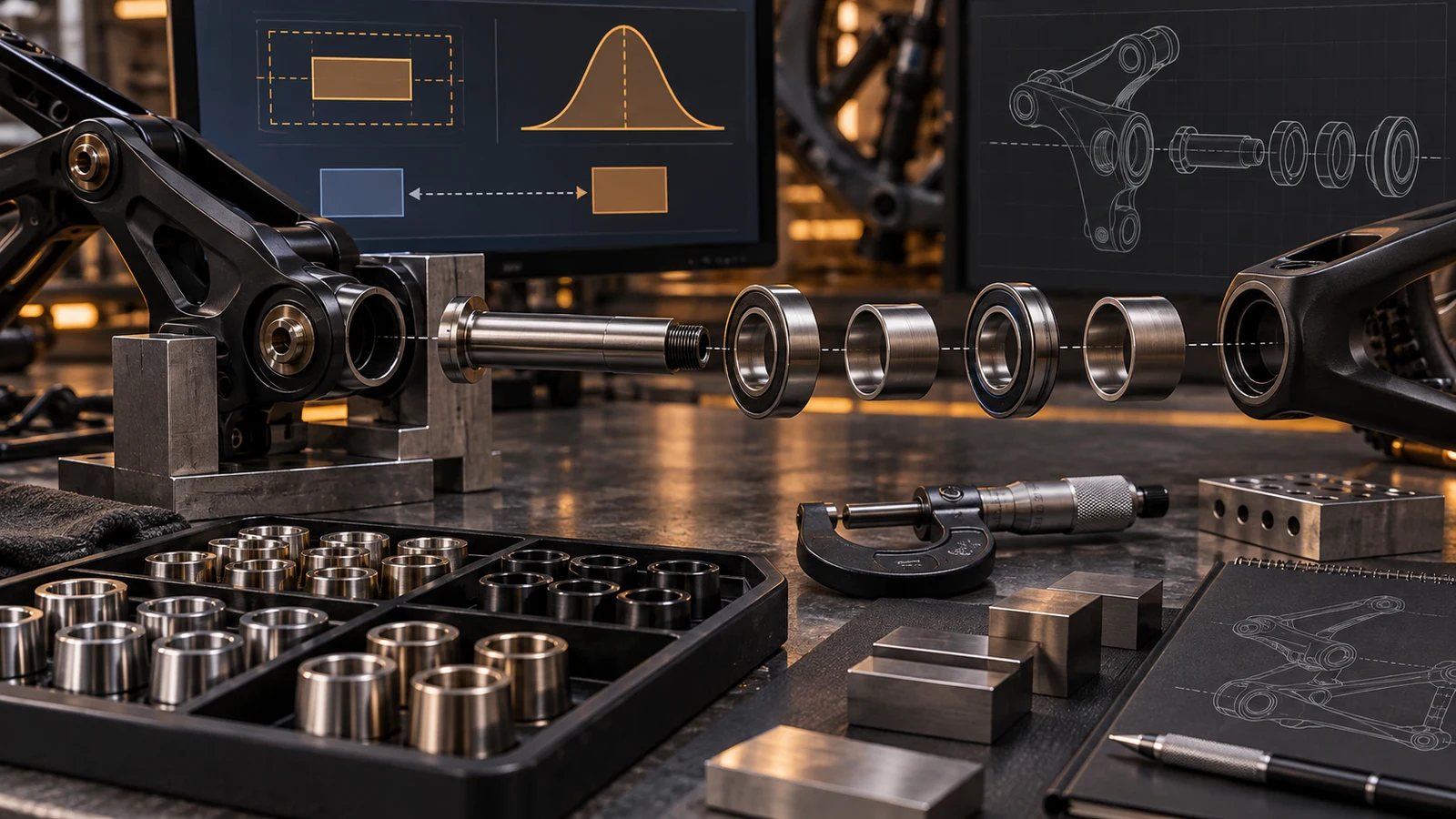
Hero: concept illustration of example hardware and its application. It is not a factory photograph, tested component or approved production geometry.
Define the output and population before the calculation
Name the gap, contact relationship or clearance being evaluated and its accepted interval. Identify the assembled condition and the participating faces. A list of dimensions without a functional loop can calculate a plausible number for the wrong relationship.
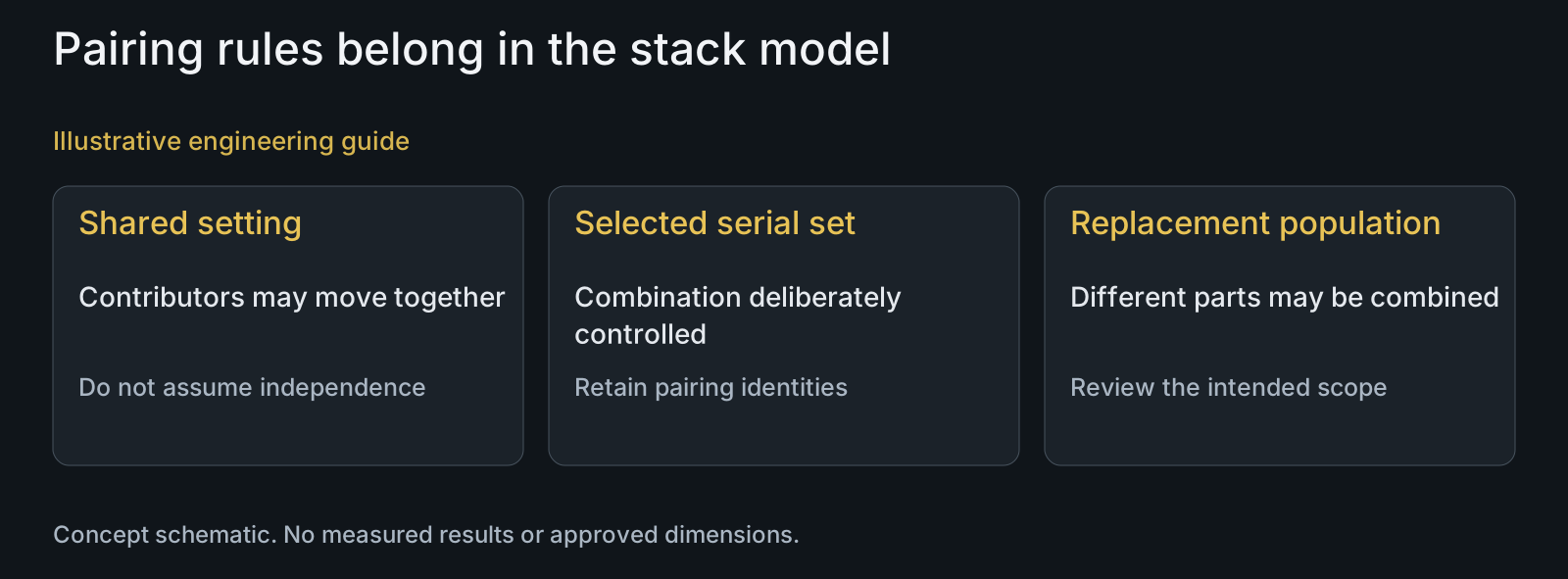
Then define which parts can be combined: unrestricted drawing-conforming parts, a known serial supply population or deliberately matched components. State whether service replacements must remain interchangeable. Pairing rules change the modeled population and cannot stay hidden behind a statistical result.
Use the functional stack guide to establish the signed loop and distinguish manufacturing references. This article selects the method and evidence assumptions used on that loop rather than treating one-dimensional analysis as complete joint validation.
Use worst-case limits for the modeled extreme question
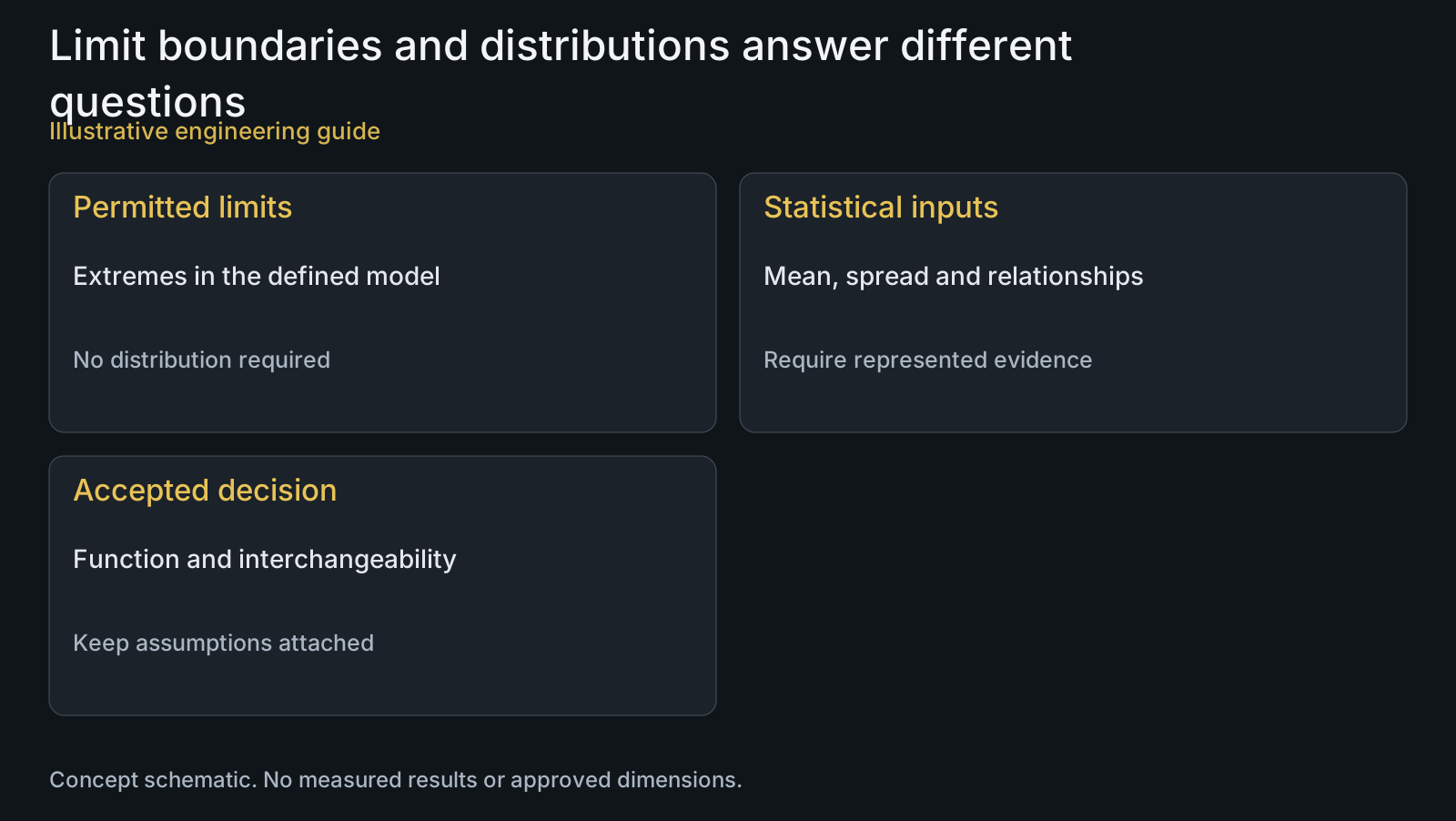
PTC's tolerance-analysis documentation describes worst-case analysis by placing contributors at limits that make the output largest or smallest. It does not require a distribution assumption. Apply the correct signs, unequal limits and actual relationships rather than adding nominal dimensions or treating every tolerance as symmetric.
The resulting boundary is conditional on the model being complete and physically meaningful. An axial length model does not establish face orientation, corner seating or elastic contact. Nor should a dependent dimension be counted as an unrelated free contributor.
When the modeled extremes fall outside the requirement, examine the nominal relationship and influential contributors before tightening everything. Geometry changes, revised allocation or a controlled pairing arrangement answer different questions. Any selected option needs an explicit drawing and assembly definition.
| Method or situation | Question addressed | Needed basis | Risk to retain |
|---|---|---|---|
| Worst-case limits | Modeled permitted extremes | Signed loop and actual limits | Omitted geometry or dependent inputs |
| General statistical model | Represented output distribution | Means, spread and relationships | Model mistaken for every-unit guarantee |
| Simplified RSS | Variation under simplifying assumptions | Justified common conversion basis | Drawing limits treated as measured spread |
| Shared process contributors | Effect of related variation | Evidence of covariance and loop signs | Convenient independence assumption |
| Matched serial sets | Behavior of controlled pairing | Selection and identity rules | Freely mixed parts leave modeled scope |
| Service replacements | Required interchangeability | Permitted source and part combinations | Serial sample evidence overextended |
Treat statistical inputs as evidence, not drawing defaults
A statistical calculation needs a represented variation model: means, spread, relevant distributions and relationships between contributors. PTC distinguishes predicted stack distributions from possible extremes and identifies software assumptions for its RSS implementation. Those defaults are not measured facts about PremFixer or a customer's process.
Do not convert a drawing tolerance into a standard deviation without stating and justifying the conversion model. Actual production may not target the midpoint or maintain the assumed spread across setups, time and suppliers. A short sample cannot by itself establish every future condition.
Retain the dataset's feature definition, finished state, measurement method, period and represented populations. Changes in tooling, treatment or part sourcing can change which data remains relevant. A narrower modeled distribution is not a forecast of yield unless the necessary model and evidence support that interpretation.
Keep covariance and measurement variation visible
NIST's process-characterization discussion shows that linear variance propagation includes covariance terms when contributors are related. Its independent-source example removes those terms; it does not declare every physical dimension independent. This principle matters when two features share a process, reference or pairing rule.
A common offset can move two occupying lengths together rather than cancel as unrelated random variations. The effect also depends on their signs in the functional loop. Check the actual relationship instead of omitting covariance because an RSS result is easier to calculate.
Measured variation can contain both process and measurement contributions. A measurement-system question and a process-distribution question therefore need separation. The SPC review helps retain populations and changes; neither a stable-looking chart nor a small sample establishes independence between all stack members.
Translate the chosen analysis into controlled requirements
Keep the functional requirement, component limits, final surfaces and statistical assumptions connected. If a proposed allocation changes a drawing limit, obtain the responsible design approval. A calculation report does not silently amend the accepted limits or establish an inspection concession.
Define how any pairing or selection rule is maintained in production, packaging and replacement supply. Otherwise parts that were analyzed as matched can be combined freely in service. The accepted arrangement must say whether it depends on controlled sets or true interchangeability.
Use the CNC turning review for feature control and the surface-treatment route for final-state contributors. Cost comparison should consider manufacturing and inspection consequences of the actual allocation; statistical analysis is not a universal cost-reduction instruction.
Illustrative review: two spacers from a shared process
Illustrative engineering example: assume an axial pivot stack contains two spacer lengths that may come from a shared process setting. The proposed statistical model treats them as independent and centered. No dimensions, measured covariance, capability or yield result is provided.
The reviewer first confirms how the spacers are actually paired and whether both lengths can shift with the shared setting. If that relationship is unknown, the independent model remains an assumption rather than an accepted description. A permitted-limit review still addresses the represented extreme boundary without establishing the missing distribution.
The team also asks whether service spacers can come from unrelated sources. Evidence for paired serial sets may not cover that replacement population. The example shows why method selection includes data and interchangeability decisions, without inventing a correlation value or claiming a cheaper approved tolerance.
Questions buyers need to confirm
Does RSS guarantee every drawing-conforming pivot stack fits?
No. It is a statistical approach with simplifying assumptions. Use a valid permitted-limit model for the extreme combination question, and retain separate geometry and contact reviews. Do not present a predicted distribution as an every-combination guarantee.
Can drawing tolerances be used directly as standard deviations?
Not without an explicit justified conversion model. Provide represented means, spread, process conditions and feature measurements. A tolerance interval is an acceptance definition, not evidence that production is centered or normally distributed within it.
Why can shared machining affect a statistical stack?
Contributors can be related through a common setting, datum or selection rule. Their covariance and signs affect output variation. Identify the actual feature relationships and pairing population rather than declare independence for easier RSS calculations.
Can a serial-set analysis cover any replacement spacer?
Not automatically. Compare the modeled pairing rule with permitted replacement sources and combinations. Selected serial sets and freely interchangeable spare parts can be different populations; retain that difference in drawing and service requirements.
Will statistical analysis always reduce machining cost?
No. Any benefit depends on a valid model, accepted functional risk and feasible allocation. Include inspection, pairing and replacement consequences. A narrower predicted range does not authorize relaxed component limits or prove a real cost saving.
What should accompany a tolerance-method RFQ?
Provide the assembly loop, named faces, signed contributors, final limits and surfaces, functional interval and permitted pairing rules. Include any relevant data with its measurement and production scope, and identify who approves the proposed allocation.
Technical references and scope
PTC, Types of Tolerance Stackup Analyses. Software documentation distinguishing permitted extremes, predicted distributions and RSS assumptions. Product defaults, capability values and promised cost effects are not made into pivot requirements.
NIST Engineering Statistics Handbook, Propagating Error. General linear variance propagation includes covariance for related sources; process and measurement contributions are distinguished. No measured pivot covariance or yield inferred.
Explore related component, material and sourcing decisions in the customer decision knowledge center. For a drawing review, use the Drawing/BOM RFQ path.
Review the assumptions behind your pivot stack
Send the assembly section, drawings and STEP, BOM revisions, finished dimensional limits, functional requirement and pairing or replacement rules through the Drawing/BOM RFQ path. Include available process data with its scope. PremFixer can discuss manufacturing implications; the designer retains method acceptance and tolerance-allocation approval.
Discuss the drawing and BOM