

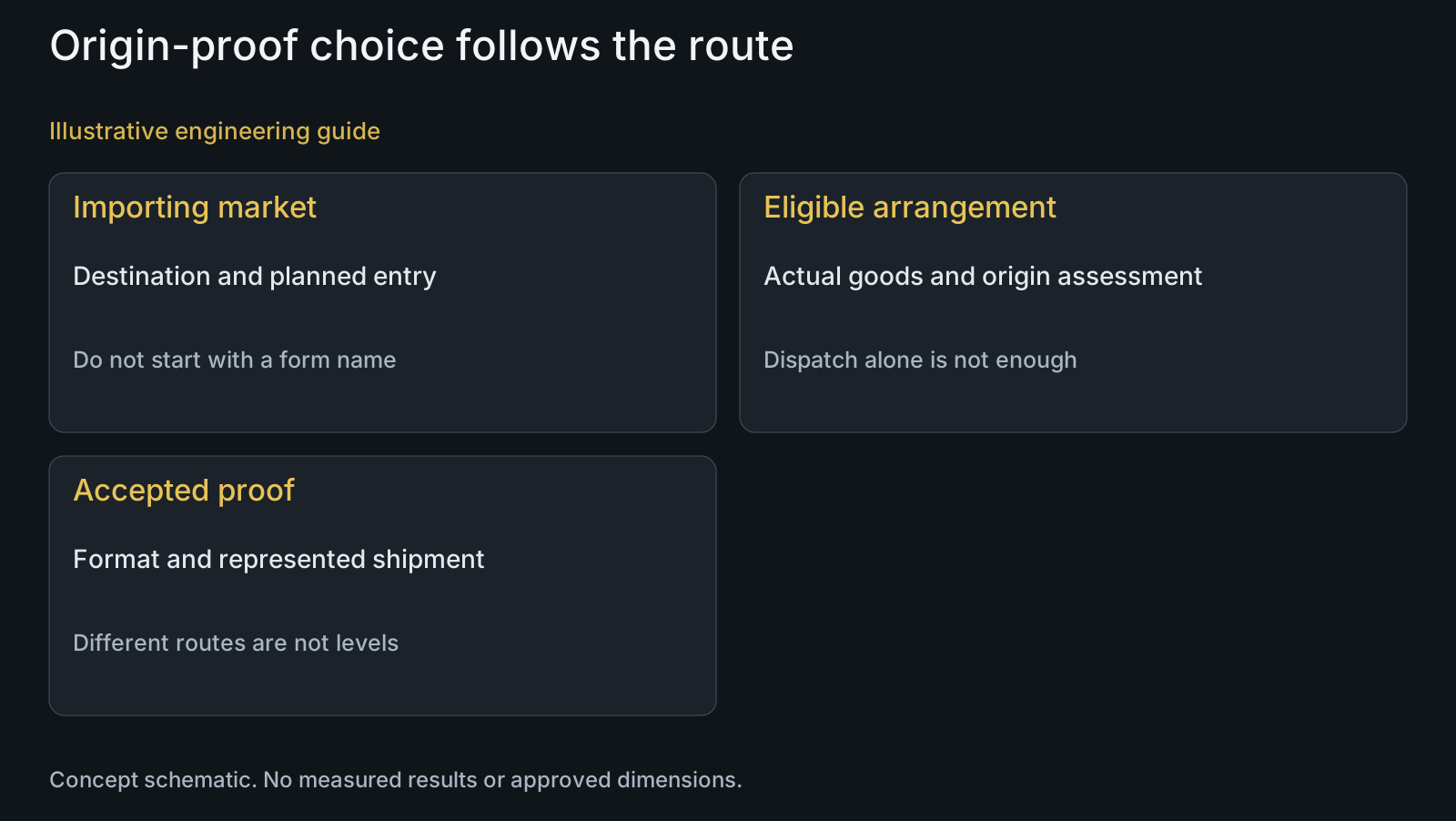
Do not request Form A, Form E or a ChAFTA certificate simply because pivot hardware ships from China. First identify the importing market, actual goods and entry context, then confirm an available preference arrangement and its origin requirements. The proof must belong to that route and represent the shipment. These document names are not interchangeable quality grades. For example, the European Commission's country list identifies no preferential arrangement for China, while Australia has a defined China-Australia agreement. PremFixer can discuss supporting manufacturing and shipment information; it does not promise that every custom pivot qualifies or that an origin document makes every import charge disappear.
Hero: concept illustration of example hardware and its application. It is not a factory photograph, tested component or approved production geometry.
Name the destination arrangement before the form
Begin the inquiry with the importing jurisdiction and intended entry, not a preferred certificate title. The customs classification guide covers describing the shipped goods and finding the applicable product treatment. This article adds the narrower decision of selecting a valid preference and proof route after those goods are identified.
Ask the importer or customs adviser to identify the arrangement it intends to claim and the applicable origin criterion. If there is no relevant preference, retain any separately required non-preferential origin information without presenting it as a reduced-duty entitlement.
Check the actual route for the planned shipment. A colleague's successful document request for another market is not evidence that the same form belongs in this purchase order.
Treat Form A as a scheme-specific question
The Commission describes GSP as a unilateral preferential facility whose donor-country origin rules can differ. Form A is therefore not a universal export certificate that makes Chinese goods preferential everywhere. Check the destination scheme, beneficiary eligibility and accepted proof rather than assume its name creates access.
For the EU context, the Commission's country list reviewed on 11 October 2026 records no preferential arrangement for China. Requesting Form A cannot itself create a China-EU preference. This statement does not classify a particular component or calculate its payable duty.
Keep a buyer's administrative request separate from a valid claim. If an old purchasing template asks for Form A by default, return the destination-specific question to the importer rather than manufacture an unsupported assurance to satisfy the template.
| Proposed request | Applicable discussion context | Risk of the wrong assumption | Buyer verification |
|---|---|---|---|
| Form A / GSP request | The destination's unilateral preference scheme | A form name is treated as universal eligibility. | Confirm beneficiary status and accepted proof. |
| Form A for Chinese-origin EU goods | No China preference shown in the Commission country list | An old template invents an unavailable arrangement. | Separate the required origin information from preference. |
| China-ASEAN Form E | The named China-ASEAN origin framework | The destination or product rule is left unspecified. | Confirm the intended claim and relevant rule. |
| ChAFTA certificate | Assessed China-Australia origin and certificate route | A generic certificate is substituted for the proper proof. | Confirm authorized format and represented goods. |
| ChAFTA declaration | Goods covered by an advance origin ruling | An unrestricted exporter statement is assumed enough. | Confirm the ruling route and matching assessed facts. |
| Non-preferential origin information | A separately defined destination need | Origin evidence is labelled duty-free approval. | State its purpose without inventing preference. |
Keep Form E inside its China-ASEAN context
China's Ministry of Commerce lists the Form E format with the China-ASEAN agreement materials and related origin-rule documents. That identifies a specific context, not proof that all hardware exported to every ASEAN destination qualifies or that the form can be reused for Australian entry.
Ask the importer which applicable arrangement and rule it is using for the actual product. Provide material and manufacturing information requested for that assessment. Do not copy a value-content percentage from an unrelated example into a pivot order's origin statement.
If the shipment involves an intermediary invoice or transit through another location, expose those facts early for the relevant procedure review. A commercially convenient route should not be left invisible until someone tries to match the document to the import entry.
Distinguish ChAFTA certificate and declaration routes
DFAT's ChAFTA guide connects preferential treatment to the goods' origin requirements and appropriate proof. It identifies an authorized-body certificate route and a declaration route for goods covered by an advance origin ruling. The latter is not a general permission for any exporter to replace certification with an unrestricted statement.
For a proposed Australian order, ask the importer which route applies and whether the underlying assessed facts match the planned goods. Imported stock, added components and processing history need to be represented where relevant to the selected rule; this article does not assign a product-specific origin criterion to an unspecified fastener.
Do not infer absence of all import charges from a preference claim. Keep the commercial landed-cost review distinct from the origin-proof decision. The supplier should provide supported facts within its role, while the importer confirms entry treatment.
Illustrative engineering example: one kit, two different markets
Illustrative engineering example: assume an OEM considers the same pivot kit for EU and Australian entry. A purchasing template requests Form A for both. The kit includes a custom axle and receiver, but no component classification, origin determination or actual duty result is assumed.
The reviewer does not order one generic certificate and promise two preferences. For the EU request, it separates non-preferential origin information from an unsupported preference assumption. For Australia, it asks the importer to assess the ChAFTA route, supporting production facts and applicable proof before the supplier agrees a document deliverable.
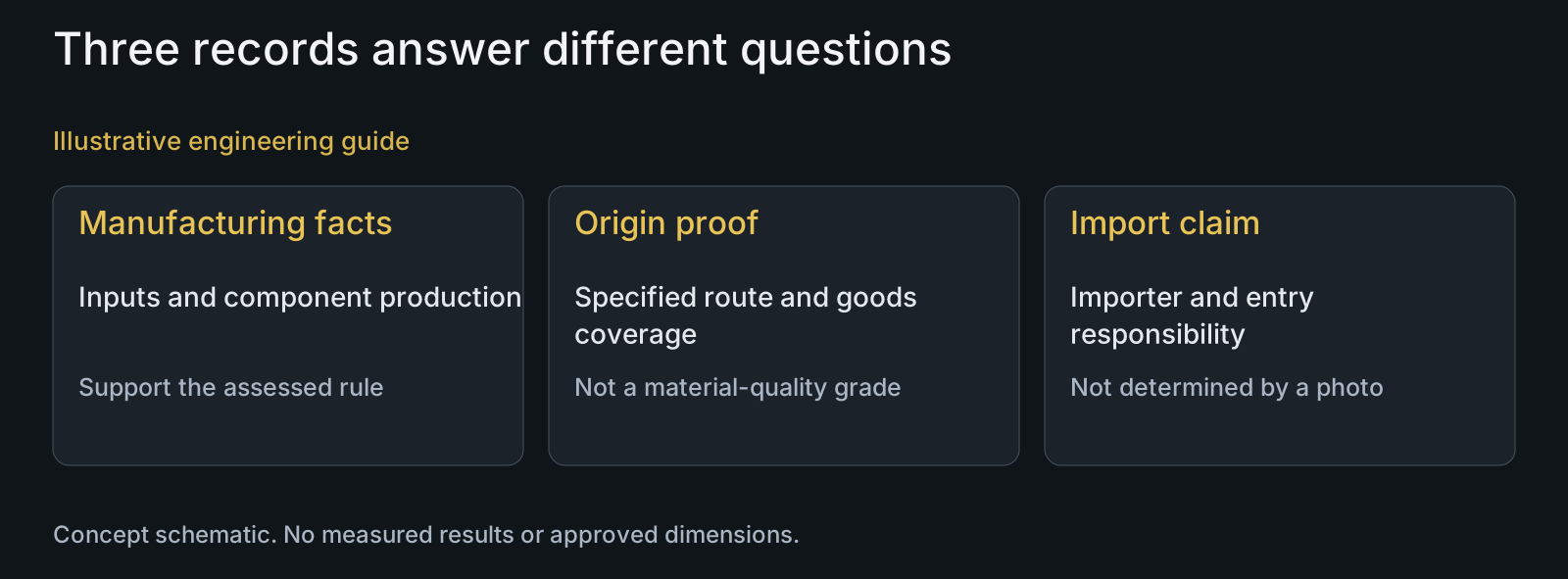
The hardware drawing can remain unchanged while the document request changes. That is the useful procurement conclusion: manufacture, origin assessment and destination proof are related but different work. The scenario reports no successful claim, customs ruling or savings.
Make the origin request describe the actual goods and transaction
Connect the named parts, material inputs, production route and shipment references in the information request. The manufacturing page explains component supply context; it is not evidence that every ordered product meets every agreement's origin rule.
State who obtains or completes the requested proof and who checks it against the entry. If a supplier can provide only part of the manufacturing evidence, keep that limitation visible. An MTC can describe material identity without independently resolving the selected preferential-origin criterion.
Use the material document guide and customer decision knowledge center to keep different evidence purposes separate. Agree the order's supported information package before shipment, without promising a certificate, origin status or tariff outcome that has not been assessed.
Questions buyers need to confirm
Can Chinese-origin pivot hardware automatically receive a preference?
No. Identify the importing market and available arrangement, then assess the actual goods and required proof. A familiar form or dispatch address does not independently establish eligibility; provide the facts requested by the responsible importer or adviser.
Can I request Form A for Chinese-origin goods to create an EU preference?
No. The Commission country list reviewed here shows no preferential arrangement for China. Clarify any separate non-preferential information needed for the shipment instead of treating an old form request as a reduced-duty entitlement.
Can Form E be used instead of a ChAFTA document?
Do not assume interchangeability. Form E belongs to the China-ASEAN discussion context, while the Australian request has its own route. Ask the importer to specify the agreement and accepted proof for the actual entry.
Can an exporter freely replace a ChAFTA certificate with a declaration?
No unrestricted substitution is described here. DFAT's guide ties the declaration route to an advance origin ruling. Confirm the applicable route and matching facts with the importer before agreeing the requested document.
Does a material certificate determine preferential origin?
Not by its title alone. It can describe the represented material, while the applicable origin rule may require different production and sourcing facts. Provide the requested supporting information without presenting an MTC as a universal origin decision.
What should accompany a preferential-origin RFQ?
Provide the destination, importer contact, drawings, item-level BOM and material requirements, planned shipment route and requested agreement or proof. Include existing advice and its assessed facts so PremFixer can discuss the supported manufacturing and document scope.
Technical references and scope
European Commission: GSP scheme context. Unilateral scheme and donor-rule context only; no future-law effective-date analysis or individual product eligibility asserted.
European Commission: non-EU country arrangements. China entry reviewed on 11 October 2026; no product classification, customs amount or other country entries adopted.
China Ministry of Commerce: China-ASEAN agreement documents. Official indexed listing associates Form E with the China-ASEAN framework. No full procedure, percentage rule or version applicability to an actual entry is inferred.
DFAT: using ChAFTA to export or import. Origin/proof context, authorized certificate and advance-ruling-linked declaration route; no part-specific rule, tax amount, refund period or successful claim inferred.
Explore related component, material and sourcing decisions in the customer decision knowledge center. For a drawing review, use the Drawing/BOM RFQ path.
Define the origin information for your actual shipment
Share the drawing or STEP files, BOM, materials and production requirements, destination, importer contact, shipment route and proposed preference arrangement. Include the adviser's origin and proof request so PremFixer can discuss available manufacturing facts and document responsibilities without promising an unassessed tariff outcome.
Discuss the drawing and BOM