
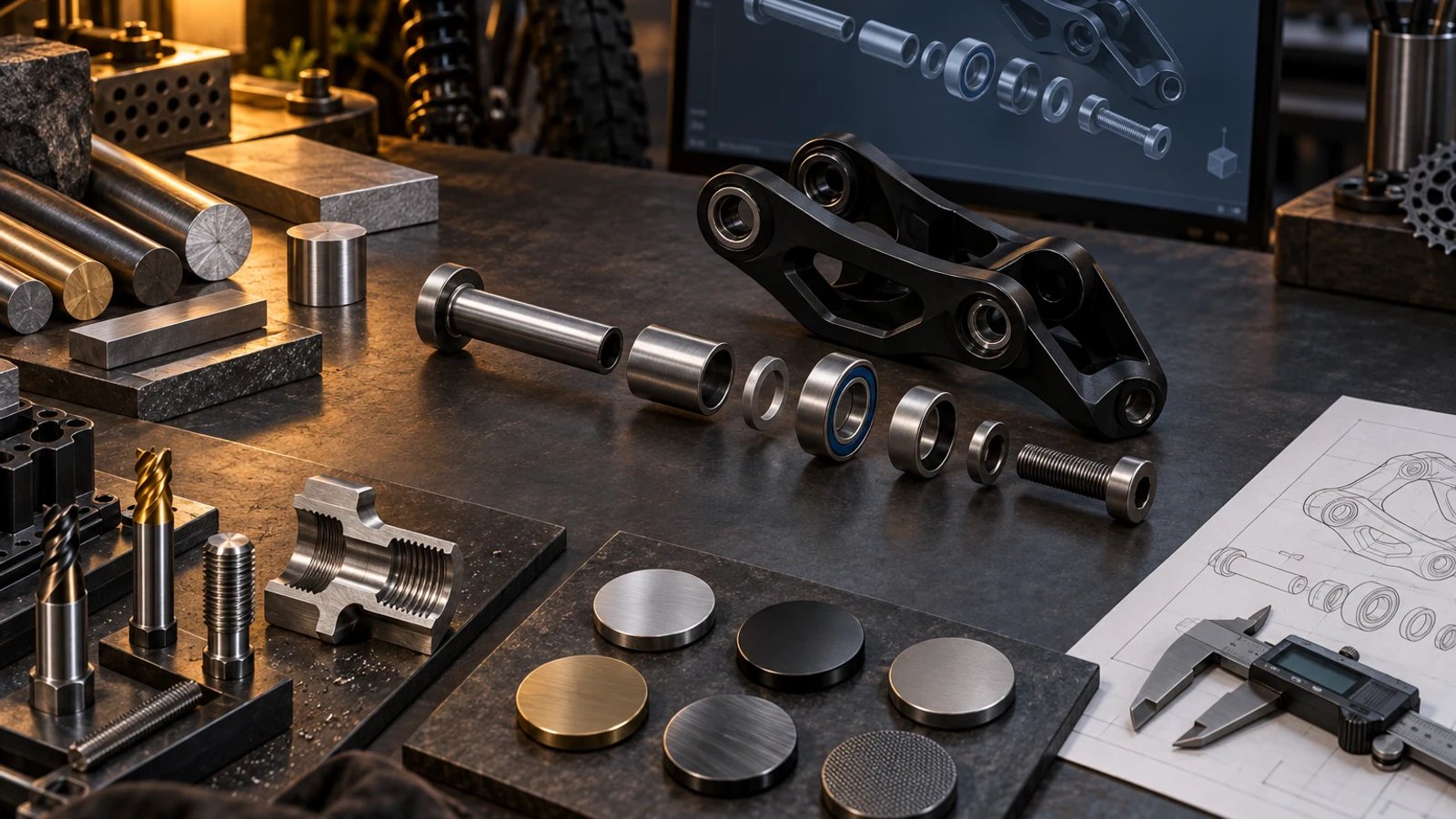
A useful engineering-support response explains which custom pivot feature is affected, what manufacturing or supplied-condition question it creates, and which customer decision follows. For PremFixer, discuss that response through the project contact rather than assume a headcount proves technical coverage. A shoulder-fit question may connect machining, a specified finish and final measurement; resolving only one operation can leave the interface unanswered. PremFixer coordinates relevant in-house and qualified partner operations, while the OEM retains design and bicycle validation responsibility. Support should make those relationships clearer, not imply that the supplier can approve an entire frame from a bolt drawing.
Hero: concept illustration of example hardware and its application. It is not a factory photograph, tested component or approved production geometry.
Send the feature question, not only the entire file set
Identify the issue your team needs to resolve: tool access, material condition, finished locating fit or the evidence requested for an interface. The drawing and STEP provide context, but a short question helps distinguish an open development issue from a released requirement.
Show the relevant mating part when the question concerns fit or contact. A pivot axle viewed alone cannot communicate every sleeve, bearing or frame relationship. Identify which interfaces are controlled by the customer and which information is available for manufacturing review.
Keep a suggested alternative separate from the required baseline. If you are asking for feedback, say which fields are open to discussion. This avoids turning an incomplete description into assumed permission to change a critical feature.
Match the technical input to the output the customer needs
A machining question should return an explanation of the affected geometry or proposed route. A material question should distinguish the specified grade and condition from a suggested alternative. An inspection question should identify the feature and supplied state the proposed record represents.
The answer need not contain every possible process. It should give the customer enough information to evaluate the specific proposal. 'We can optimize it' is less useful than a marked feature with its manufacturing consequence and the requirement that would change.
PremFixer's confirmed in-house scope includes heading, CNC machining, thread rolling and tool/die manufacture. Relevant testing, heat treatment and surface operations use qualified partners. Discuss the actual manufacturing scope; do not infer individual qualifications, staffing numbers or partner equipment ownership.
| Question | Connected input | Useful output | Authority to retain |
|---|---|---|---|
| Shoulder geometry creates access issue | Drawing feature and proposed operation | Affected feature and alternative explained | Customer approval of geometry change |
| Material alternative proposed | Grade, condition and functional requirements | Difference and manufacturing implication | Material requirement and qualification decision |
| Treatment affects locating surface | Seat, mating part and final condition | Processing and fit question linked | Required finished interface |
| Inspection scope unclear | Feature, supplied state and acceptance field | What the record will represent | Acceptance requirements and evidence review |
| Incomplete early drawing | Known geometry and unresolved decision | Targeted clarification, not invented scope | Design baseline and next development decision |
Keep coupled questions connected across disciplines
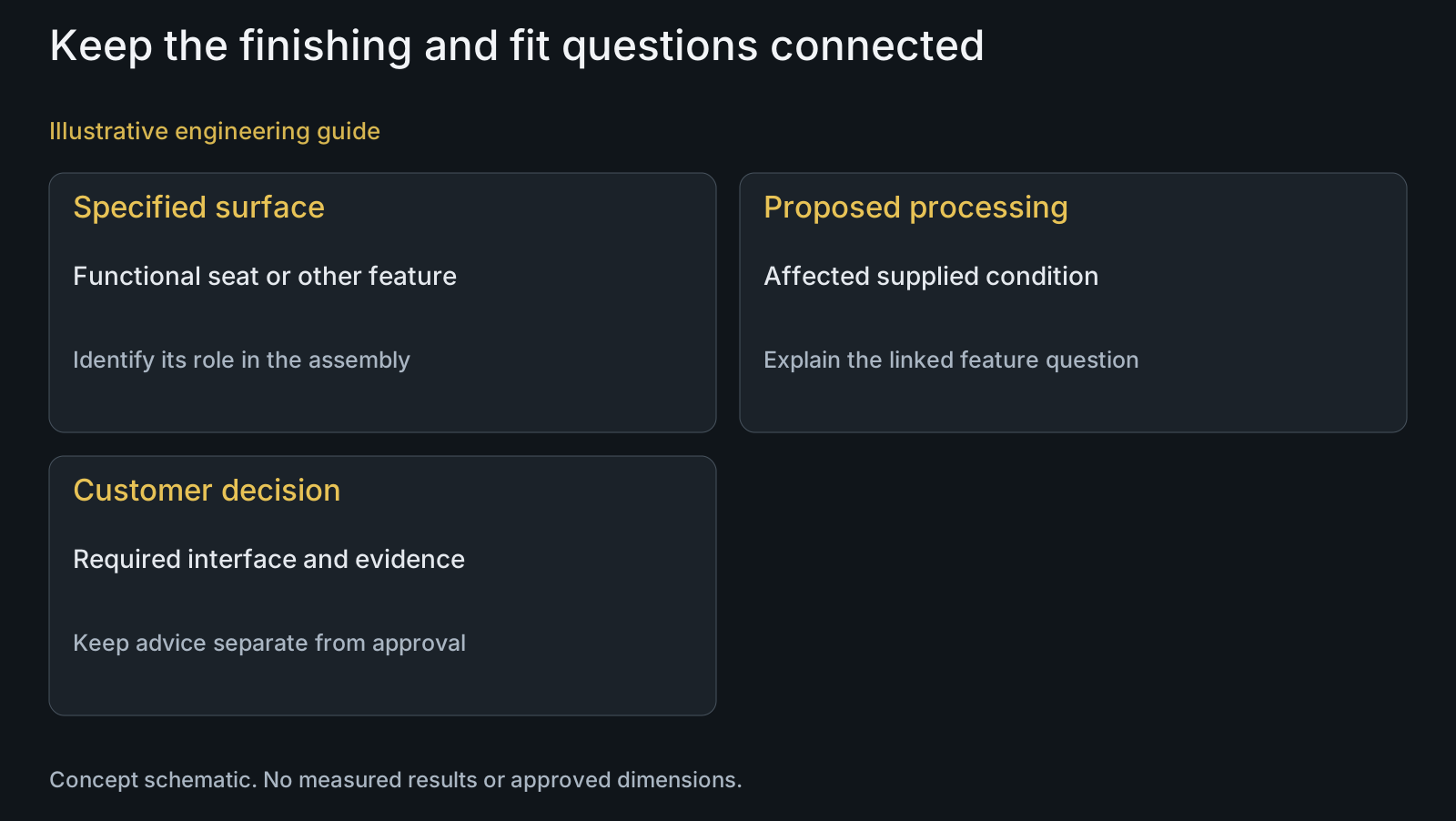
A finish can be specified for a surface that also locates a sleeve or bearing. A proposal about that finish may therefore create both a processing question and a finished-interface question. The support response should identify the link rather than treat finishing and fit as unrelated email subjects.
The NASA interface-management handbook section describes responsibilities and control where technical work is divided among parties. That is general systems-engineering context, not a bicycle standard or evidence that PremFixer uses NASA procedures.
For the pivot, keep the customer-defined interface and changed condition visible to everyone contributing input. Use the relevant surface-treatment discussion without assuming that a finish proposal automatically satisfies the mating requirement or grants design authorization.
Distinguish technical advice from authority to change the part
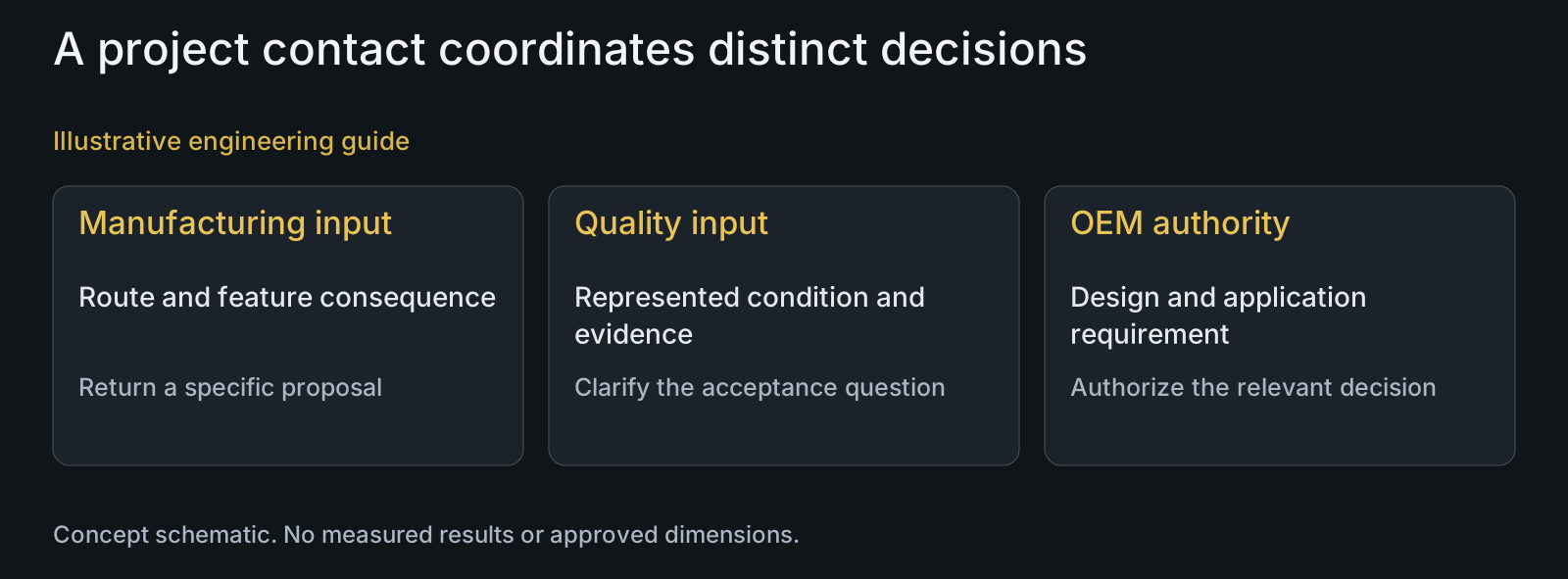
Manufacturing advice can explain an alternative, but the responsible designer decides whether the altered interface is acceptable. Purchasing can agree a price without being the authority for every technical field. Quality can request evidence without changing the intended design by implication.
Ask the response to state what remains unchanged and what requires a decision. If the proposal affects a locating diameter, its consequence differs from a nonfunctional marking change. Do not combine all comments into a general approval of a revised drawing.
The DFM guide explains feature-level proposals. For the wider program, the engineering partnership article addresses collaboration scope. Neither service description transfers complete bicycle design responsibility to the manufacturer.
Review a finished-seat question through one connected response
Illustrative engineering example: assume an OEM asks whether a proposed treatment can be used on an axle with a locating seat. The initial files show the axle but not the mating sleeve's required condition. No actual part, tolerance, coating change or test result is assumed.
A useful response first identifies the missing mating context and the intended final seat requirement. It then connects the processing proposal with the relevant manufacturing and measurement questions. A finish-only answer would leave the customer unable to judge the assembled interface.
The project contact can coordinate those inputs and return the defined alternative or clarification. That does not mean one person performs every activity or can authorize the change. The OEM still needs to decide the interface requirement and the scope of any application evaluation.
Evaluate support by the clarity of the next decision
A useful reply makes the next action identifiable: provide mating information, evaluate a stated alternative or agree a specific deliverable. A quick acknowledgement can confirm receipt without resolving the technical issue. Response timing and technical completeness should not be treated as the same measure.
For an early project, state what is unknown rather than fabricate a complete specification. For a released drawing, ask the supplier to identify any proposed departure explicitly. The right response depends on that information state, not a claim of unlimited engineering support.
Share the material requirements, expected quantity and intended bicycle application when relevant to the question. Agree the scope and any separate development work. No staffing count, named specialist credentials, free redesign service or universal response-time commitment is established here.
Questions buyers need to confirm
Does team size demonstrate engineering-support quality?
Not by itself. Evaluate whether the response identifies the feature, relevant specialist input and next customer decision. Staffing numbers do not establish coverage, availability or suitability for your specific interface.
Can one project contact answer every material and finishing question?
One contact can coordinate the discussion, but that does not mean one person performs every activity. Agree which relevant inputs and deliverables are needed, including qualified partner operations where applicable. Avoid inferring individual credentials or equipment ownership.
Why does a finishing question need the mating sleeve information?
If the finish affects a locating or contact surface, the required final interface must be understood. The axle drawing alone may not show the full relationship. Provide the mating condition so the proposal can address both processing and fit.
Does DFM advice authorize a changed pivot geometry?
No. The supplier should identify the affected feature and consequence, while the responsible customer designer decides on the change. Keep the original requirement as the baseline until the applicable approval is given.
Can manufacturing support validate the complete bicycle?
Do not infer that from component support. Manufacturing and inspection input can address the agreed part scope; the OEM retains design and application validation responsibilities. A supplier response to a bolt drawing is not complete frame approval.
What should I send for a targeted technical-support request?
Send the drawing or STEP, the affected feature, relevant mating information and supplied-condition requirements. State the unresolved question and project stage. This helps distinguish a clarification, alternative proposal or separate development task instead of assuming all engineering work is included.
Technical references and scope
NASA Systems Engineering Handbook: Interface Management. General interface definition, responsibilities and change coordination; not a bicycle standard, NASA affiliation or proof of PremFixer procedures.
Explore related component, material and sourcing decisions in the customer decision knowledge center. For a drawing review, use the Drawing/BOM RFQ path.
Send one connected pivot engineering question
Share the drawing or STEP, mating sleeve or bearing context and material/finish requirements. Mark the feature and decision your team needs so PremFixer can coordinate the relevant manufacturing inputs and clarify the proposal, evidence and customer approval boundary.
Discuss the drawing and BOM