
Evaluate a new material or process for custom pivot hardware by the problem it is meant to solve and the condition its evidence represents. A promising surface study does not automatically establish the required shoulder fit, assembled behavior or repeat manufacturing route. When discussing a candidate technology with PremFixer, distinguish a research idea, a bounded trial and an agreed production supply scope. Define the comparison baseline before interpreting any advantage. Novelty, investment figures and a convincing sample image are not substitutes for project-specific evidence. No new material breakthrough, university partnership or verified performance improvement is asserted by this guide.
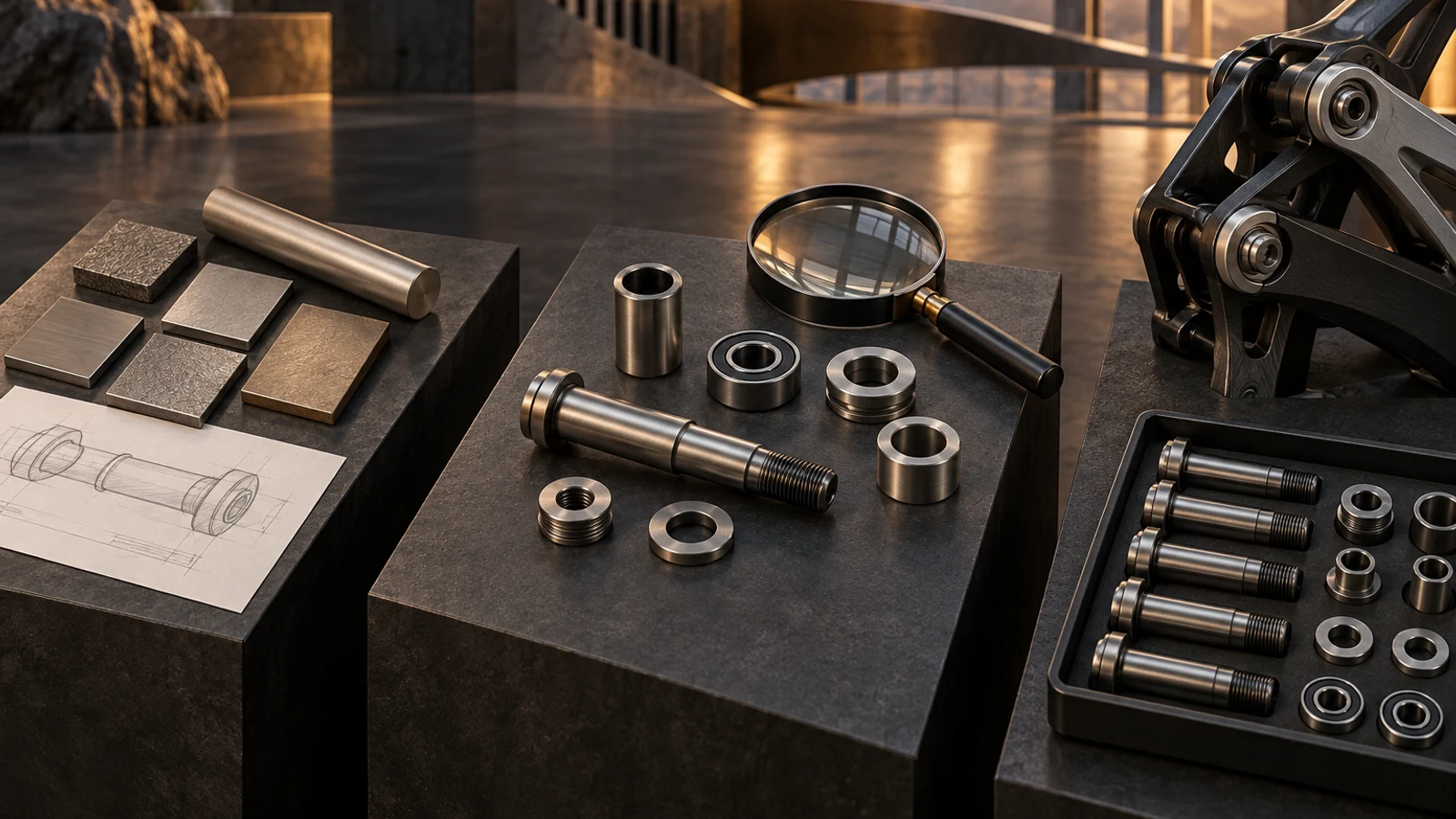
Hero: concept illustration of example hardware and its application. It is not a factory photograph, tested component or approved production geometry.
Name the technical objective before selecting a new process
Identify the actual constraint: wear at a contact, a manufacturing difficulty, a finish requirement or another defined concern. 'Better titanium surface' is too broad to guide a decision because it does not name the affected part, surface or use condition.
Keep the existing required configuration as the comparison baseline. State what the proposal would change and what must remain acceptable. An option that addresses one concern can still require separate review of a locating surface, retention feature or service condition.
The material-selection guide and surface-treatment discussion provide context for an inquiry. They do not make every possible research direction an available production service or authorize a substitution on a released drawing.
Describe maturity without converting it into a sales promise
An idea states an objective; a study produces evidence under its stated conditions; a component review addresses a particular geometry; production supply requires an agreed repeat route and deliverable. Those distinctions matter even if a proposal uses the same process name throughout.
The NASA ESTO technology-readiness definitions distinguish concept, laboratory, relevant-environment and final-system evidence. Use that as general maturity context, not a bicycle acceptance standard or a formal readiness rating assigned to PremFixer.
Ask what has actually been demonstrated and what remains a proposed evaluation. A high research budget or collaborator name would describe an activity, not independently establish the readiness of your part. Do not borrow a maturity label from an unrelated system to approve a pivot.
| Evidence object | Useful question | Unresolved risk | Next relevant review |
|---|---|---|---|
| Concept description | What objective is proposed? | No demonstrated performance | Define baseline and bounded comparison |
| Flat material coupon | What surface condition was represented? | Pivot geometry and coverage may differ | Affected shoulder, thread or recess |
| Finished component | What part and supplied state were assessed? | Mating and application scope may differ | Required assembly relationship |
| Assembled evaluation | What configuration and conditions were represented? | Other uses and repeat supply unproven | Retain the application limits |
| Proposed repeat route | What can be quoted and delivered? | Candidate process may lack agreed supply scope | Operations, records and delivered condition |
Understand why a coupon and a finished pivot answer different questions
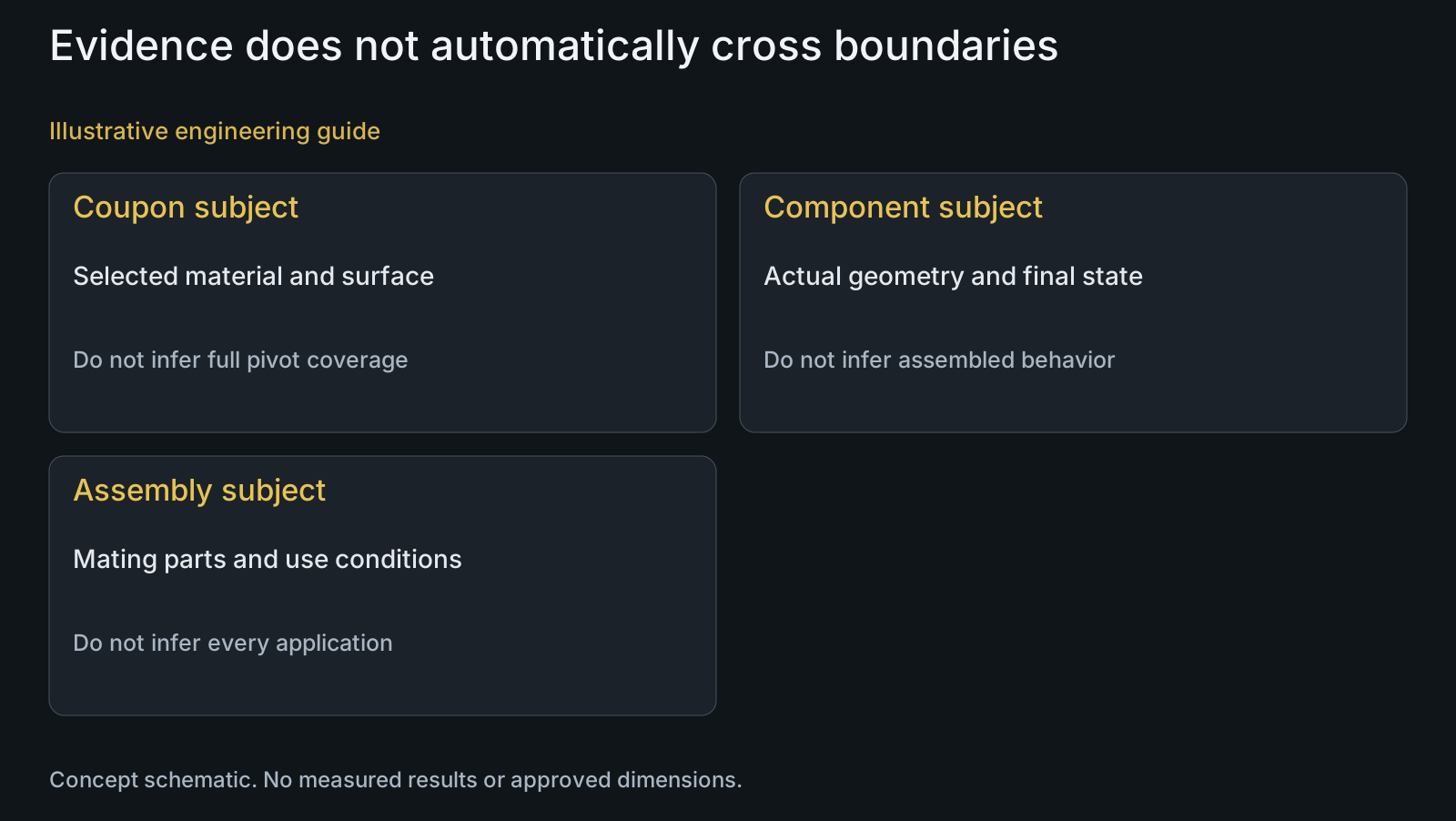
A coupon can isolate a selected material or surface condition, but its geometry need not represent a pivot shoulder, thread or recess. Ask which aspect of the component the study was intended to model. Avoid treating every result from a convenient specimen as a complete-part conclusion.
For the finished part, identify the relevant surfaces and the final dimensional or functional requirements. If the proposed process changes the supplied state, inspect the interface question at that state. A pre-process measurement cannot settle a new finished-condition requirement by itself.
Even a component result does not automatically represent the assembled joint. The bicycle application context includes mating parts and OEM validation decisions. Keep the evidence's represented subject visible rather than combine unrelated checks into one claim of proven technology.
Compare the alternative against a stated baseline
For a useful comparison, identify the baseline geometry, material state and treatment, then the specific change under evaluation. If several fields change at once, the result may not reveal which change caused the observed difference. Keep the question narrower when the available evidence cannot separate them.
Use comparable conditions for the aspect being judged and state the limits of that comparison. Do not invent a test method, acceptance value, service life or improvement percentage to make the proposal appear complete. The responsible engineering and quality teams should agree the relevant evidence for the actual requirement.
The engineering-support guide explains how coupled material, manufacturing and inspection questions can be connected. A study can justify further discussion without being sufficient to release a changed component.
Review a candidate titanium surface study as a bounded proposal
Illustrative engineering example: assume an OEM is considering a different surface process for a titanium-colored pivot concept, and a candidate proposal starts with flat coupon work. The actual alloy and treatment must be specified for any real evaluation. No PremFixer research project, experimental result or test condition is assumed.
The coupon work could address a named surface question under agreed conditions. It would not, on its own, establish treatment coverage around the shoulder or the finished mating relationship. The next relevant review would identify those component-specific conditions instead of declaring the complete pivot improved.
If the component question is later addressed, repeat supply remains a distinct issue: the proposed route, required records and delivered condition still need scope. The example illustrates the limits of inference, not a sequence of completed successful trials.
Separate an exploratory request from a production quotation
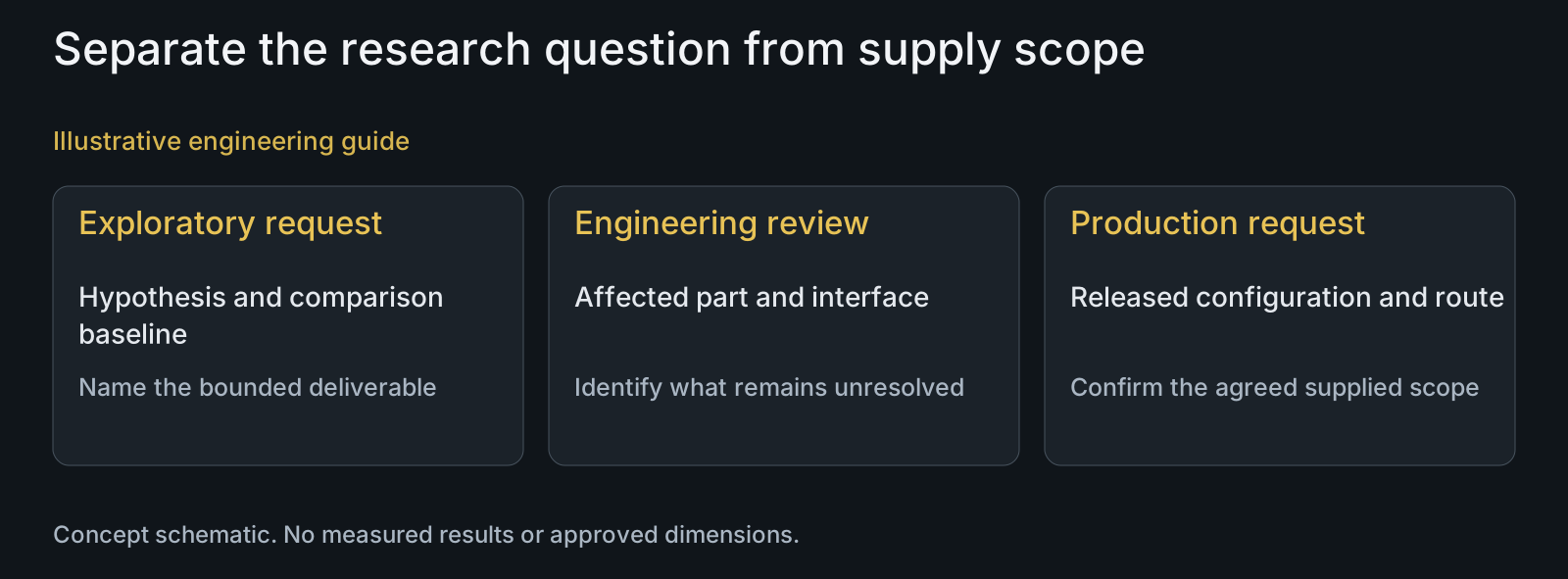
An exploratory request should name the hypothesis or comparison question and the proposed deliverable. A production request should name the released part and required supplied condition. Combining them can hide whether the supplier is being asked to investigate an option or commit to an already approved configuration.
PremFixer coordinates drawing-led manufacturing through confirmed in-house operations and relevant qualified partners. That service model does not establish ownership of a research laboratory, a new coating line or the industrialization of every candidate process. Ask for the proposal applicable to the specific drawing.
For any accepted change, retain the design and evidence scope with the new configuration. The DFM guide supports feature-level review. Future research direction and current production availability should remain separate purchasing decisions.
Questions buyers need to confirm
Does R&D spending prove a new process is production-ready?
No. Spending describes an activity, while readiness depends on evidence for the represented component and required supply route. Identify what has been demonstrated and what remains proposed rather than interpret an investment figure as product qualification.
Can a coating coupon prove a custom pivot will perform better?
Not alone. A coupon represents its material, surface and evaluation conditions, which may not cover the shoulder, thread or mating geometry. Identify the component and assembly questions left unanswered before making a broader claim.
Should buyers request a technology-readiness number?
Only if the program uses an agreed assessment with defined evidence. Do not invent or import a readiness rating from an unrelated system. For many inquiries, a clear statement of the represented condition and remaining questions is more useful than an unsupported number.
How should an alternative material or treatment be compared?
State the baseline geometry, material condition and finish, then the specific proposed change. Use evidence relevant to the aspect being judged and retain its limits. Multiple simultaneous changes can obscure the reason for a difference.
Does a component trial establish repeat manufacturing supply?
No. It addresses its represented component and conditions. The repeat route, records, quantity and delivered state need a separately agreed scope. Do not treat a trial result as automatic availability or a committed production schedule.
What should I send for an exploratory process discussion?
Send the drawing or concept geometry, actual material/finish definition, mating context and the problem you want to investigate. Identify the baseline, proposed alternative and evidence needed for the next decision. Keep that exploration separate from a released-part production order.
Technical references and scope
NASA ESTO: Technology Readiness Levels. General distinction among concept, laboratory, relevant-environment and final-system evidence; no bicycle acceptance rule or PremFixer readiness rating.
Explore related component, material and sourcing decisions in the customer decision knowledge center. For a drawing review, use the Drawing/BOM RFQ path.
Define the evidence needed for a candidate process
Share the drawing or STEP, actual material and finish requirements, mating context and the technical objective. Identify the comparison baseline and whether you need a bounded exploration or a released-part quotation so PremFixer can discuss the relevant manufacturing and evidence scope.
Discuss the drawing and BOM