
A PVD color request for a titanium pivot bolt needs more than a gold or black appearance sample. Define the coating system, the surfaces it should cover and the features that must retain their specified fit and assembly behavior. A decorative head and a coated bearing seat serve different purposes, even on the same axle. For an OEM choosing a finish, separate appearance acceptance from functional acceptance before quoting the process. Thin deposition and selective masking are not automatic evidence that threads, contact faces or material condition remain suitable. The delivered component must meet the agreed requirements in its actual finished state.
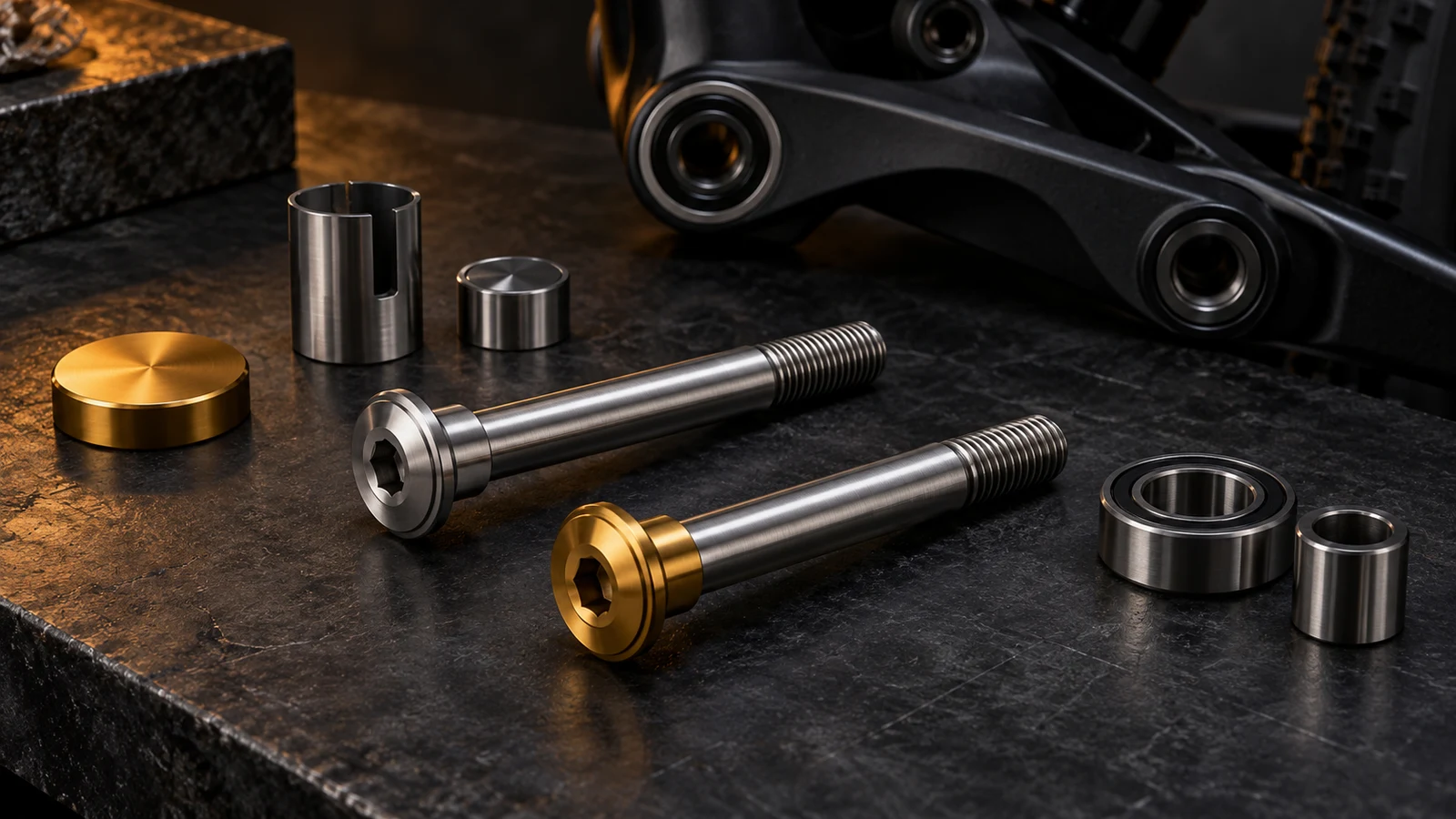
Hero: concept illustration of example hardware and its application. It is not a factory photograph, tested component or approved production geometry.
A color name does not identify the coating
Ask for the proposed coating system and its purpose rather than specifying black PVD as if it were a single material. Oerlikon's DOMINO portfolio lists gold TiN, several nonblack TiCN appearances and black DLC within named systems. Those examples show why a color cannot identify composition; they do not qualify any listed system for a titanium bicycle axle.
Keep the substrate and layer descriptions separate. Titanium pivot refers to the base component; a titanium-containing coating is not proof that its substrate is TC4. Likewise, coating hardness and the bulk strength of the axle answer different questions. No finish is a substitute for the required material and geometry.
For the broader appearance comparison, see PVD oil slick versus titanium anodizing. This review focuses instead on how the selected deposition proposal is assigned to individual pivot features.
Divide visible surfaces from load and fit surfaces
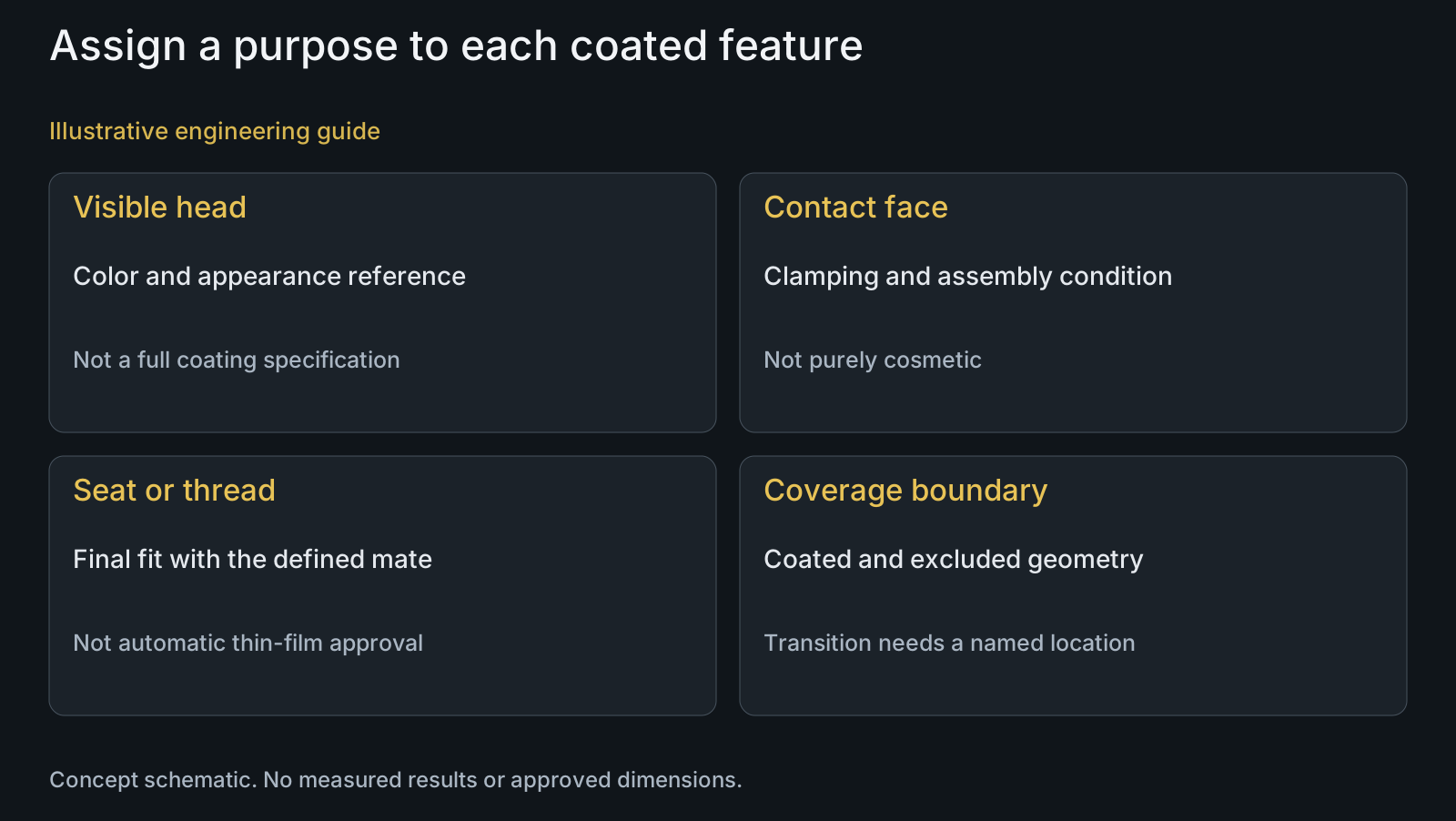
Mark the visible head, drive recess, under-head bearing face, cylindrical seats, shoulder transitions and threaded region on the drawing. A feature can serve more than one purpose: an attractive head still has a tool interface and a contact face. Do not let a cosmetic zone silently include the clamping surface.
A head-only proposal may leave the shaft and thread outside intended coating coverage. A functional coating proposal on a sliding surface requires the mating material and contact motion to be defined. A seat intended to locate an inner ring is not automatically a sliding wear surface. State what moves relative to what before claiming a wear benefit.
Oerlikon's design and coating guidance emphasizes considering component design, manufacturing, material and heat treatment together. It supports early process discussion, not an approval of this particular coverage map. PremFixer's surface-treatment route provides the project discussion path; coating arrangements remain subject to an agreed scope.
| Surface or proposal | Useful purpose | Risk to resolve | Verification question |
|---|---|---|---|
| Visible outer head | Agreed appearance | Color name mistaken for chemistry | Which coating and reference viewing conditions? |
| Drive recess | Tool interface with possible appearance coverage | Coverage and tool contact differ from outer head | Is recess coverage defined and tool engagement acceptable? |
| Under-head face | Clamping contact | Cosmetic scope changes tightening interface | What finished contact and assembly condition is represented? |
| Cylindrical locating seat | Required final fit | Coating proposal ignores final feature size | How is finished size accepted against its mate? |
| Thread and runout | Receiver engagement | Mask boundary leaves transition undefined | Which features are excluded and how is final thread accepted? |
| Sliding contact coating | Defined tribological objective | Hardness used as a universal wear guarantee | Which motion, counterface and assessment support the purpose? |
Specify the mask boundary, not simply masked threads
Identify which complete features are excluded and where a permitted transition can lie. A note saying mask thread may leave the runout, shoulder or adjacent contact face ambiguous. Use the actual geometry and assembly contacts to keep an undefined boundary away from a feature whose final condition matters.
Ask the coating provider how fixtures, masking and access affect this part. An inaccessible recess and an exposed face need not share the same coverage. A flat appearance coupon cannot establish deposition on every recess or prove the boundary location on a stepped axle.
Masking is a process provision rather than the whole acceptance decision. Excluding deposition from a thread does not, on its own, establish that all preparation and processing effects on the substrate are acceptable. Discuss process compatibility with the specified titanium condition and retain the thermal-history distinction. No process temperature or masking tolerance is prescribed here.
Evaluate fit and assembly in the finished configuration
For a coated cylindrical surface, define the required finished feature size and the mating interface. Do not subtract a catalog layer figure from the machining drawing without agreeing how the actual deposition and dimensional requirement will be assessed. A general thin-film description cannot replace a final-size acceptance criterion.
For threads, identify the governing form, class and final acceptance state. Coating a threaded feature and leaving it uncoated are different proposals, but neither excuses incomplete usable engagement or an incorrect receiver. The thread-class guide addresses the mating definition separately.
Where a coated face is part of tightening contact, review assembly preparation as well as dimensions. A previously accepted torque condition should not be transferred solely because the axle geometry appears unchanged. This is an engineering configuration concern, not a claim that a particular PVD treatment increases or reduces friction by a known amount. Compare the actual counterface, lubrication and retention requirements.

Illustrative review: gold head with an unchanged locating seat
Illustrative engineering example: assume a drawing uses a titanium shoulder to locate a bearing inner ring and requests a gold visible head. One finish proposal covers the whole axle; another intends coverage only on the exposed head. No coating thickness, test result or final torque is assumed.
The designer first distinguishes the visible outer head from its under-head contact and drive recess. The locating seat and complete thread retain named final requirements. The team asks whether the selective proposal can keep its transition outside those functional regions and what part-level observations will demonstrate the agreed coverage.
The selective proposal is not accepted merely because the mask concept looks simpler. The buyer still needs an achievable boundary, compatible process and final component acceptance. Conversely, whole-part coating is not rejected just for being whole-part: it would need evidence and allowances appropriate to every affected interface. The outcome is a defined comparison, not a claimed successful production run.
Questions buyers need to confirm
Does black PVD always mean TiCN?
No. Color alone does not identify coating composition or architecture. Obtain the actual proposed system and intended surface function rather than buying by a color label.
Should every titanium pivot thread be masked?
There is no universal rule. Compare the specified finished thread, receiver and coating objective. A selective proposal needs a clear exclusion boundary; a coated-thread proposal needs appropriate final acceptance.
Does masking prove the existing assembly torque remains valid?
No. Identify every tightening contact and its finished condition, not just the male thread. Confirm the represented lubricant, counterface and retention arrangement before transferring an assembly instruction.
Can a gold head sample prove coverage inside the drive recess?
No. Define the recess coverage separately and assess the actual feature. An outer-face appearance reference cannot demonstrate every recessed surface or tool-contact condition.
Does high coating hardness guarantee longer pivot life?
No. Coating hardness is not complete joint performance or substrate strength. A functional wear proposal needs the actual relative motion, counterface, support and assessment; no lifetime improvement is established here.
What should a selective PVD RFQ include?
Send the titanium condition, drawing and mating requirements, identify covered and excluded features and permissible boundaries, and state appearance versus functional acceptance. Include the intended assembly preparation and any supported wear-validation scope.
Technical references and scope
Oerlikon Balzers: DOMINO coating portfolio. Named examples distinguish appearance from chemistry; no coating properties or applicability transferred to a bicycle pivot.
Oerlikon Balzers: Design and coating interplay. Early integration of design, material, manufacturing and treatment. Feature-map analysis is illustrative engineering, not a supplier-approved masking instruction.
Explore related component, material and sourcing decisions in the customer decision knowledge center. For a drawing review, use the Drawing/BOM RFQ path.
Review PVD coverage against the pivot interfaces
Send the drawing or STEP, titanium condition, mating BOM and an appearance reference. Mark the surfaces proposed for coating, excluded features and transition locations. PremFixer will review manufacture and the agreed treatment scope so the quote addresses final fit and assembly requirements as well as color.
Discuss the drawing and BOM