
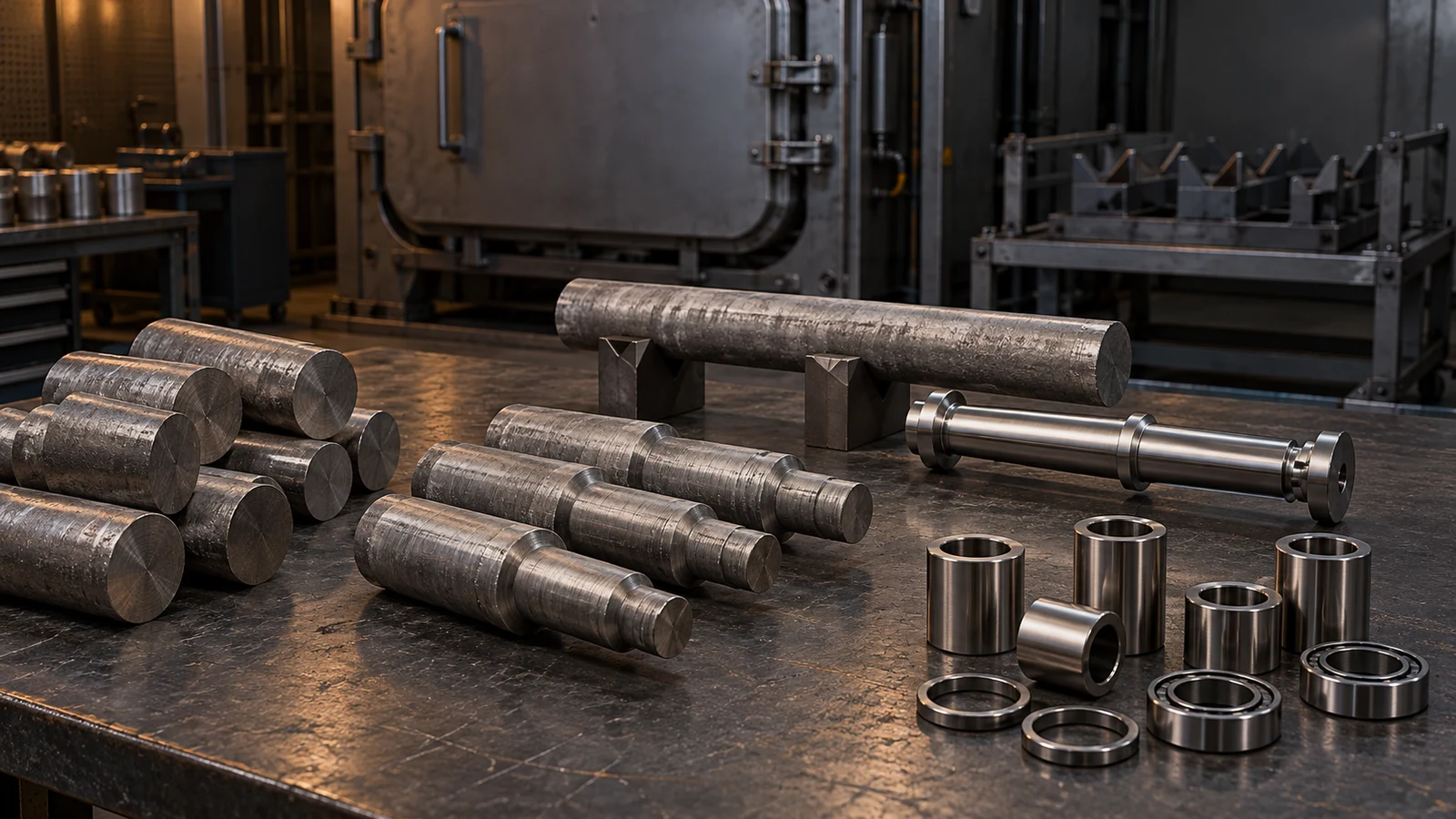
Not every machined TC4 pivot bolt needs an additional annealing cycle. The correct decision starts with the supplied titanium condition, the manufacturing history and the properties required at delivery. Stress relief, annealing and a strengthening treatment are different objectives, and vacuum or argon describes an atmosphere rather than the whole process. For an OEM reviewing a drawing or RFQ, state what a proposed cycle is meant to change and how final geometry and material acceptance relate to it. A generic temperature range cannot establish suitability, zero distortion or a guaranteed improvement for every solid, hollow or stepped pivot.
Hero: concept illustration of example hardware and its application. It is not a factory photograph, tested component or approved production geometry.
Establish the starting state before requesting another treatment
Identify the governing material specification, stock form and supplied condition. A note saying TC4 alone does not establish the material history on which the design relies. Ask whether the order calls for specified stock properties, separate finished-part properties or both; those are not automatically the same purchasing requirement.
TIMET's 6-4 data sheet explains that microstructure and thermomechanical history affect properties, and distinguishes condition and product context in its data. Its historical reference entries do not approve a new processing cycle or provide current finished-pivot allowables.
Do not assume annealed stock means either that no later treatment can be needed or that another anneal is mandatory. The later manufacturing route and final requirement determine that decision. The titanium material-specification guide addresses stock definition separately from the finished component's application approval.
Name the intended material change, not just the furnace atmosphere
TIMET's design and fabrication handbook distinguishes stress relief from annealing in the represented fabrication context. The two terms do not identify an interchangeable goal. A strengthening proposal likewise needs its own specified material output rather than being described loosely as heat treatment.
The practical question is what the proposed operation should accomplish for this component: a defined residual-stress objective, a required material condition or another stated change. Then establish the controlled process appropriate to that purpose. No numeric thermal recipe is provided here, and a handbook range should not be copied into a purchase order as a qualified pivot cycle.
Atmosphere is one process attribute. Vacuum and inert-gas conditions are not synonyms, and neither word independently establishes the final properties or treatment objective. Keep contamination control, material-state requirements and process evidence identifiable. The hydrogen-control article addresses the separate chemical-evidence question.
| Proposal or condition | Decision it addresses | Risk of an incomplete label | Acceptance connection |
|---|---|---|---|
| Annealed incoming stock | Starting material requirement | Assume the entire finished route is decided | Identify stock specification and later operations |
| Stress-relief proposal | A stated residual-stress objective | Treat it as any desired material condition | Define purpose, represented process and required output |
| Annealing proposal | Specified material-state objective | Use atmosphere as the whole treatment definition | Connect process specification to the required final condition |
| Strengthening proposal | Different requested property condition | Assume a higher strength entry is always preferable | Review complete material and application assumptions |
| Thermal step before final machining | Sequence with remaining dimensional finishing | Assume final machining solves every material question | Retain material acceptance and final feature checks |
| Thermal step after final machining | Sequence acting on already-defined features | Assume a named cycle guarantees unchanged geometry | Assess relevant final dimensions and surface state |
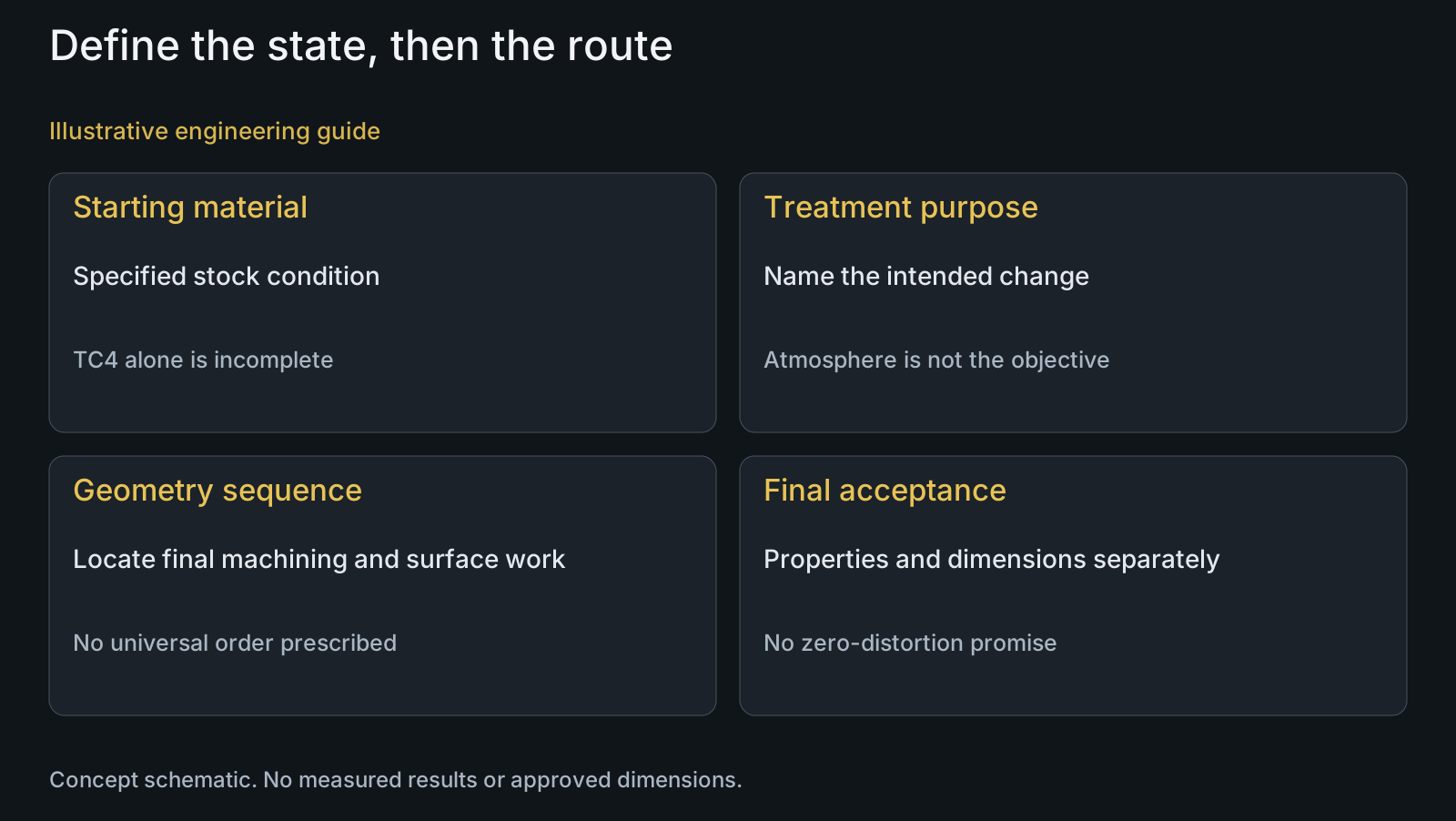
Compare sequence choices against the actual geometry
As manufacturing analysis, a cycle before final machining and one after final machining answer different sequence questions. Earlier processing may permit later dimensional finishing; later processing acts on already-defined features. Neither sequence is universally correct. Review the purpose, stock allowance and features whose accepted state matters.
A hollow axle, thin section or stepped shoulder needs a route appropriate to its support and material removal. No process label proves that the part will retain every dimension. Identify the finished locating diameters, contact faces and thread relationships that must meet the drawing after the relevant operations.
Include thread making and surface work in the actual sequence, not as unrelated quotation notes. If a thermal operation is proposed after another process whose accepted condition matters, assess whether the prior evidence still represents the delivered part. This article does not prescribe a universal order for rolling, machining, annealing and finishing.
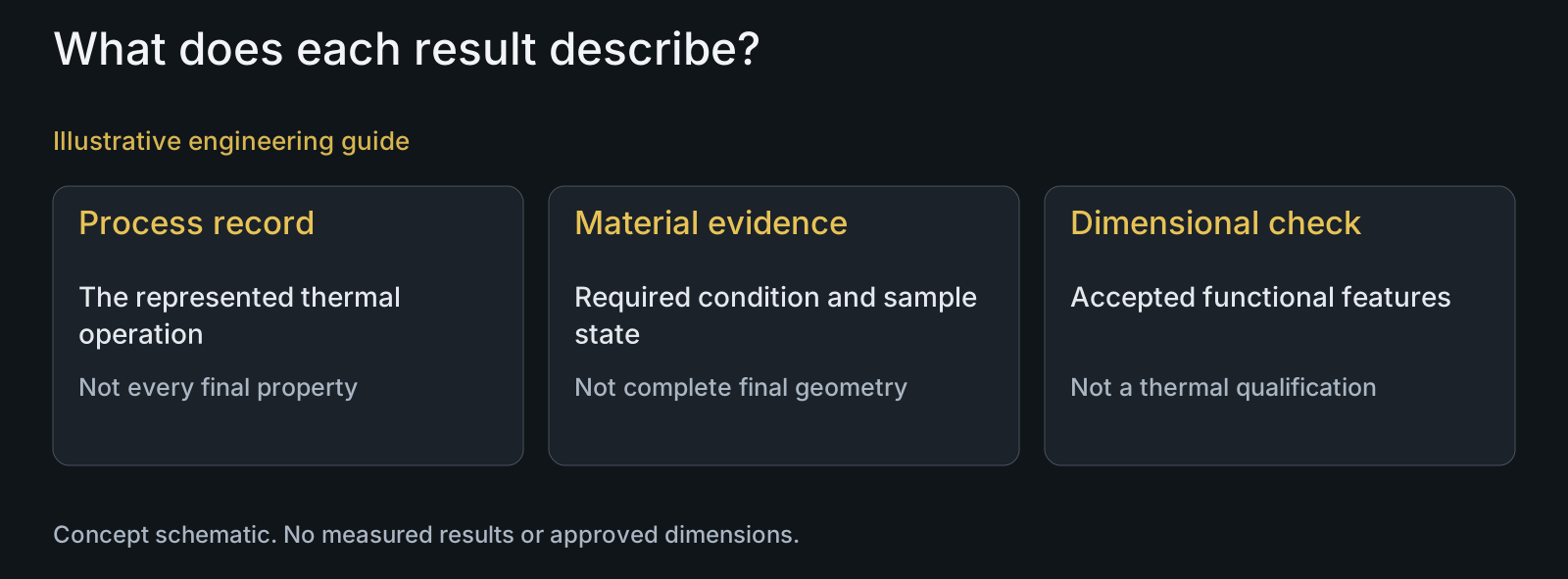
Define final properties and dimensions as separate acceptance items
A represented thermal-process record documents its operation. It does not measure every final property or dimension. Identify the applicable material condition and the required acceptance evidence, with the sample or component state that each result represents.
A finished geometry check cannot establish the material's full mechanical suitability, and a material-property report cannot establish shoulder alignment or fit. A hardness observation should not silently replace all the properties required by the specified condition. Agree on the relevant checks rather than requesting an undefined certificate of heat treatment quality.
If a route change is proposed, compare its final output with the original design assumptions. A higher strength entry is not automatically a better complete pivot, and a different condition should not be substituted without approval. PremFixer's manufacturing review can coordinate the defined component and partner-supported processing scope; no in-house thermal facility is claimed here.
Illustrative route review: adding a cycle after the shoulder is finished
Illustrative engineering example: assume an OEM specifies an annealed titanium stock condition and a precision shoulder on a hollow pivot. A supplier proposes an extra thermal operation after machining but describes it only as vacuum annealing. No measured distortion or material-property result has been supplied.
The review first asks what change the extra cycle is intended to achieve and whether that output matches the final material requirement. It then compares a route with the proposed operation before final dimensional finishing against the later-cycle proposal. Support, allowance, surface state and acceptance endpoints must be explicit; neither option is declared successful without evidence.
The sample request identifies the actual process condition and the dimensions that will be assessed. The prototype scope can therefore answer a named sequence question. This assumed example establishes no zero-movement promise, percentage reduction, universal cycle or approved hollow geometry.
Questions buyers need to confirm
Does every TC4 pivot need heat treatment after machining?
No universal additional cycle follows from machining. Identify the supplied state, actual processing and required final properties, then state why any proposed thermal operation is necessary.
Are stress relief and annealing interchangeable descriptions?
No. They describe different intended objectives. The controlled process and required final output must match the stated purpose rather than using heat treatment as an undefined catch-all.
Does vacuum annealing mean the same thing as argon processing?
No. Those words describe different atmosphere conditions, not a complete treatment objective. Specify the relevant process and final condition without treating the two terms as a universal recipe.
Does annealed bar prove that a finished pivot remains in the intended state?
It establishes the represented incoming condition. Later processing and the final requirement determine what additional acceptance is relevant; the stock note does not describe every subsequent operation.
Can an extra thermal cycle guarantee that a hollow pivot will not distort?
No. Geometry, material history, support and sequence must be assessed. Define the relevant final dimensions and evidence instead of relying on a zero-movement claim or an unsupported improvement percentage.
What should a TC4 thermal-processing RFQ state?
Include the stock specification and condition, drawing, final property requirements and purpose of any proposed cycle. Identify the machining and surface sequence, accepted dimensions and requested process or material evidence so the delivered state is clear.
Technical references and scope
TIMET: TIMETAL 6-4 data sheet. Property dependence on history and condition/product distinctions. No current design allowables or numeric thermal recipe transferred.
TIMET: Titanium design and fabrication handbook. Treatment-purpose, contamination and atmosphere distinctions. No generic temperature-time schedule or guaranteed distortion reduction adopted.
Explore related component, material and sourcing decisions in the customer decision knowledge center. For a drawing review, use the Drawing/BOM RFQ path.
Specify the final titanium condition, not an unexplained cycle
Send the controlled drawing or STEP file, supplied titanium state, required final properties and intended purpose of thermal processing. Include the relevant sequence and dimensional acceptance requirements. PremFixer will review coordinated manufacture and sample scope without promising a generic cycle or distortion reduction.
Discuss the drawing and BOM