

A general REACH or RoHS statement does not automatically cover every custom pivot bolt, axle or finish variant. For an OEM buying hardware for a European project, first identify the supplied configuration: substrate, treatment, subsequent layers and any supplied lubricant. Then define which legal or contractual question the document answers, its information basis and reference date. REACH article communication and RoHS substance restrictions do not use an interchangeable assessment unit. A finish change can leave an earlier statement unrepresentative even when the geometry is unchanged. Request configuration-specific information and have the responsible compliance team determine applicability, rather than assume a company-wide certificate settles the order.
Hero: concept illustration of example hardware and its application. It is not a factory photograph, tested component or approved production geometry.
Start with the actual component and destination
Describe the part number and revision, material specification, complete finish and delivery condition. If a lubricant, topcoat or other layer is supplied, identify it within the information request. A document naming only the base alloy may not describe the delivered configuration.
Distinguish the EU requirement from another destination's requirements or a customer's purchasing specification. The phrase e-bike hardware is not enough to settle legal scope for every component and finished product. The customer or responsible economic operator should establish that applicability with qualified compliance support.
PremFixer's material review and surface-treatment coordination can be approached with the defined configuration and requested information. This article does not declare that every PremFixer product or every available finish is compliant, tested or certified.
REACH communication is a specific question, not every REACH obligation
ECHA's article communication explanation describes information duties when a Candidate List substance is present above 0.1% by weight in an article. The relevant subject is the article and the specified substance-information duty, not an unrestricted certificate for all chemical obligations.
Ask what Candidate List reference date and component scope the supplied information addresses. Do not infer that below-threshold information answers every restriction, authorization or other applicable question. Those subjects need their own defined scope rather than a single unqualified REACH-compliant sentence.
For procurement analysis, identify the evidence behind the statement: represented material and finish information, relevant supply-chain declarations or a specifically scoped analysis. A chemical-bath document alone does not identify the full delivered part and its retained surface system.
| Request | Subject to identify | Risk if generalized | Useful information |
|---|---|---|---|
| REACH Candidate List information | Represented article and list date | Called complete REACH certification | Scoped article and substance information |
| RoHS substance assessment | Applicable equipment and homogeneous materials | Whole-kit average hides material scope | Sampling and interpretation basis |
| Finish declaration | Actual substrate and full treatment | Earlier variant covers every replacement | Configuration and evidence reference |
| Laboratory report | Specimen, methods and assessed subjects | Report title replaces scope review | Identified sample and stated limitations |
| Exemption claim | Provision, application and applicable date | Old claim treated as permanent | Responsible compliance review |
| Buyer requirement | Contractual information request | Contract and legal applicability confused | Agreed documentation and responsibilities |
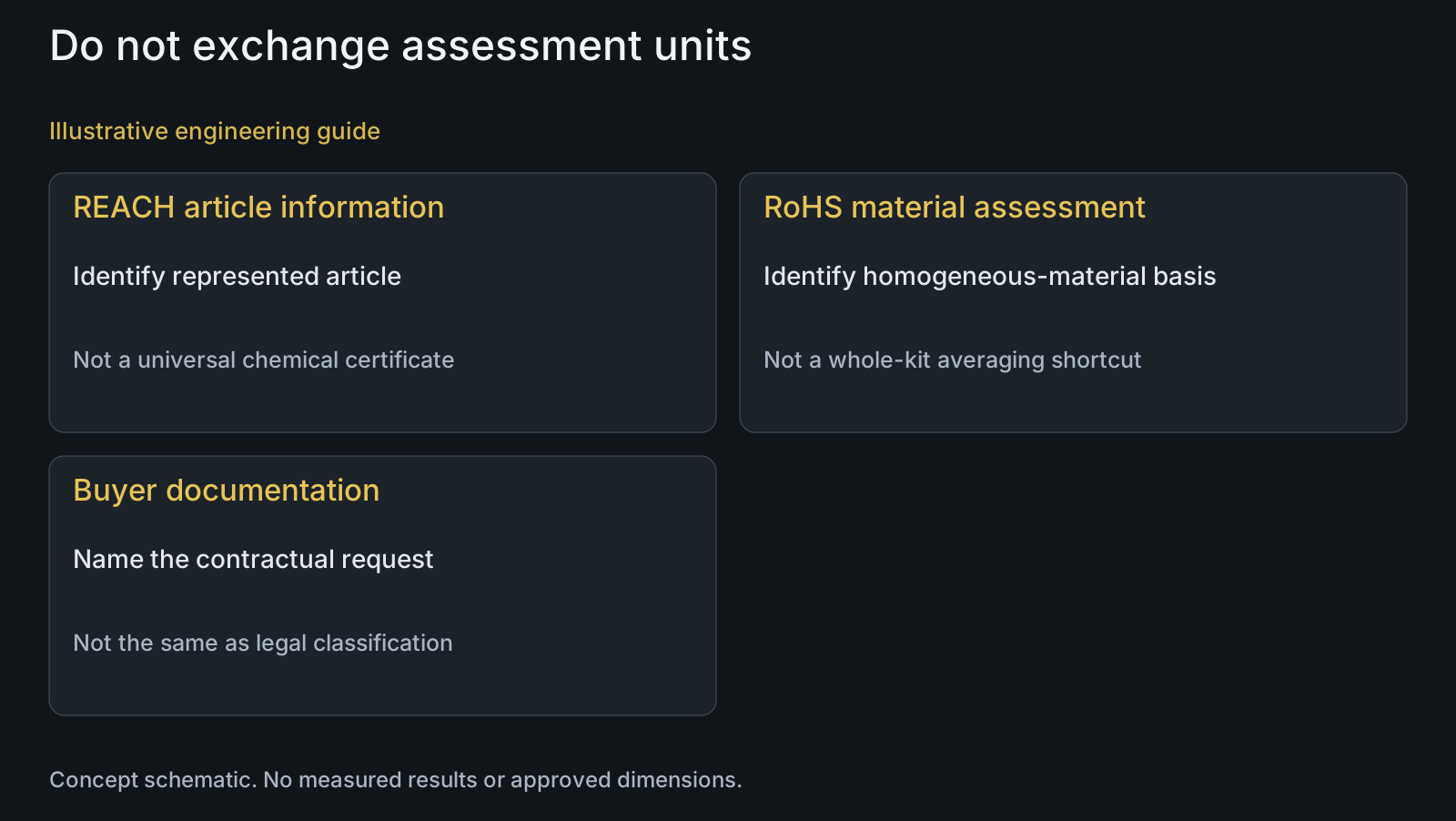
RoHS assessment is not a whole-kit average
The European Commission's RoHS overview places the substance restrictions within electrical and electronic equipment and identifies scope and annex information. Establish whether the actual equipment and use fall within the applicable provisions; do not classify every mechanical bolt solely from its application label.
The Commission's RoHS FAQ, questions 9.8 and 9.10 explains the homogeneous-material basis and coating considerations. Combining different materials into one averaged sample can obscure the substance question for a particular material.
For engineering review, ask the analyst how the substrate and relevant surface materials are represented. A whole assembly report needs a clear sampling and interpretation basis. The historical FAQ is used here for that distinction, not for a current exemption entitlement, complete substance list or present testing prescription.
Make each document answer a defined question
A useful statement identifies the supplied configuration, applicable request, reference date, issuer and information basis. A laboratory report should identify its specimen and methods sufficiently to understand what was assessed. Neither becomes broader evidence just because its filename contains both regulations.
Keep any claimed exemption explicit: the relevant provision, application and applicable date need review by the responsible compliance team. Do not treat a prior exemption, supplier letter or generic test package as permanent coverage for another substrate or finish.
Customer purchasing requirements may request substance information even where legal applicability differs. Document that contractual request separately. Supplying supporting component information does not transfer every finished-equipment or importer responsibility to the fastener manufacturer.
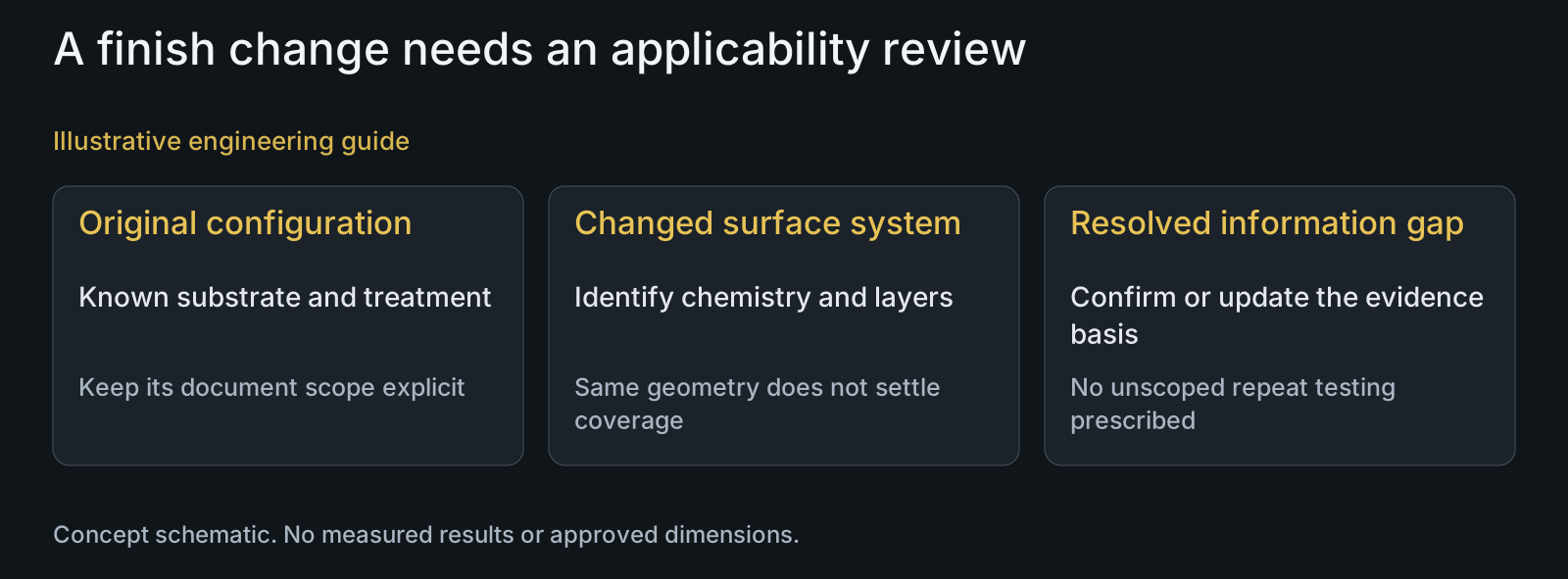
A finish substitution can change the represented information
Compare what changes when a processor, chemistry, topcoat or substrate is substituted. Retain the component identity and identify which material or surface information the earlier document represented. Do not assume that keeping the same drawing revision automatically preserves the chemical-information basis.
Request updated applicability information where the change affects that basis, rather than order an unspecified repeat test for every change. The review may confirm existing coverage or identify a particular gap. State which outcome is supported instead of renewing a blanket declaration without assessment.
Link the information requirement to the manufacturing scope and customer BOM. The titanium alternative-finish review explains why the proposed system first needs a clear identity before either function or documentation can be compared.
An unchanged kit description can hide a coating change
Illustrative engineering example: assume an OEM orders a pivot kit with an aluminum axle, stainless receivers and a specified dark surface treatment. The finish proposal changes, but the supplier document still identifies only the earlier configuration. A report describes a combined kit sample without explaining its material basis. No substance content or compliance result is assumed.
The reviewer separates two questions: whether the declaration covers the changed finish, and whether the report's sampling basis addresses the requested requirement. An unchanged kit name does not answer either. The compliance owner defines the needed information and any targeted analysis.
The example demonstrates document applicability, not a detected violation or an approved shipment. Keep final legal interpretation with the responsible parties. PremFixer can discuss the specified component-information request; the availability and adequacy of supporting evidence must be established for the actual order.
Questions buyers need to confirm
Does one statement cover every finish variant?
Not automatically. Match it to the substrate, complete treatment and delivered condition, with its requirement, evidence basis and reference date. Review coverage when those configuration inputs change.
Is a REACH article threshold the same as a RoHS material limit?
No. Article communication and homogeneous-material substance restrictions address different subjects. Have the compliance reviewer establish the applicable unit and question rather than use a whole-kit average for both.
Does an e-bike application settle RoHS scope?
No application label alone determines every requirement. Identify the actual equipment, intended use, destination and applicable provisions with the responsible party. A customer can also request supporting component information contractually.
Is a finish-bath document enough for the delivered pivot?
Not by itself. It describes its own subject, which may not cover the substrate, retained surface system or supplied lubricant. Identify the complete delivered configuration and what the requested statement or analysis represents.
Must every finish change trigger a new laboratory test?
No universal repeat-test rule is prescribed here. Review whether the existing evidence covers the changed configuration and applicable request. Target any additional analysis to a defined gap rather than assume either full coverage or automatic retesting.
What should a compliance-information RFQ include?
Send BOM and part revisions, drawing, material and full finish, supplied lubricant if any, destination, equipment context and requested legal or contractual information. Include the required reference dates and existing statements or reports for a scoped applicability review.
Technical references and scope
ECHA: Communication in the supply chain. Candidate List article-communication basis; not a complete REACH assessment or a declaration about PremFixer products.
European Commission: RoHS overview. EEE scope and legal-information context; no specific bicycle classification or exemption granted.
European Commission: RoHS FAQ, December 2012. Questions 9.7-9.10 on finished-product, homogeneous-material and coating distinctions only; historical thresholds, exemptions and timelines not treated as current approval.
Explore related component, material and sourcing decisions in the customer decision knowledge center. For a drawing review, use the Drawing/BOM RFQ path.
Define the substance-information request for your configuration
Provide drawing and BOM, material and finish references, delivered treatment variants, destination and the customer's documentation request. Include existing reports and reference dates. The review will identify what component information is available, which configuration it covers and what must remain with the responsible compliance team.
Discuss the drawing and BOM