

A quotation for a titanium chemical conversion finish is not enough to approve an alternative to anodizing on a pivot bolt or axle. Ask what process is actually proposed and whether the treated surface will remain exposed, support a subsequent coating, or prepare a bonded interface. Those are different delivery requirements. A lower processing price does not establish equivalent appearance, corrosion behavior, wear or thread function. For purchasing and engineering teams, compare the named system on the specified alloy and surface zones, with its complete downstream route. Do not accept a percentage of anodizing cost or protection without a defined commercial and technical comparison.
Hero: concept illustration of example hardware and its application. It is not a factory photograph, tested component or approved production geometry.
Resolve the process identity before comparing alternatives
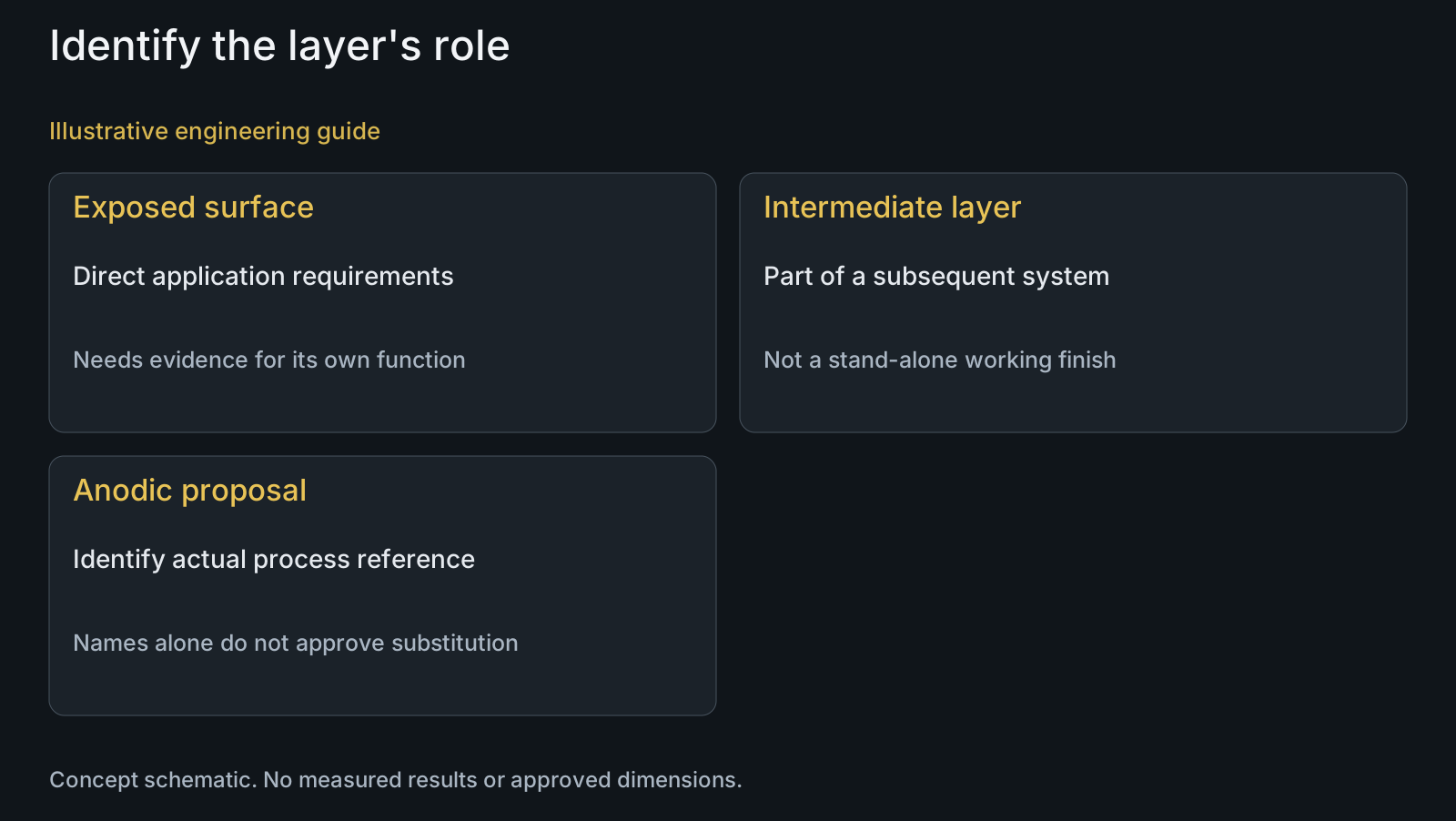
Request the process reference or proprietary system, substrate scope and purpose. Chemical conversion is an incomplete description if it leaves the provider's actual treatment unidentified. Do not fill that gap with an aluminum conversion specification or assume every process with similar wording creates the same titanium surface.
The public scope of SAE AMS2488F identifies an anodic coating on titanium and titanium alloys. This is a process-specific reference, not evidence that an unnamed chemical proposal is outside anodizing or is an approved substitute. The public scope does not provide the complete production requirements.
If a quotation calls the process both conversion and anodic, clarify the intended system rather than decide from the wording alone. Compare it with the titanium finish-function guide, which separates color generation, deposition and preparation. This review addresses unidentified substitution proposals, not a new list of approved finishes.
An intermediate bonding layer is not an exposed pivot finish
3M's AC-130-2 application guide describes a sol-gel surface preparation for adhesive bonding on substrates including titanium. Its stated interaction involves the metal, pretreatment layer and primer. This is a named example of a bonding system, not a definition of every conversion finish.
That distinction matters when a supplier offers a surface preparation as a cheaper replacement for the delivered finish. Evidence about a bonded interface does not, by itself, establish the behavior of an exposed bearing contact, working thread or visible bolt head.
Ask whether primer, adhesive or another subsequent layer is part of the proposed supply scope. If it is, identify who applies it and what complete system is assessed. If it is not, request evidence relevant to the intended exposed surface rather than transplant a bonding result.
| Proposal | Function to establish | Risk of false equivalence | Useful evidence |
|---|---|---|---|
| Unnamed chemical conversion | Actual titanium-compatible system | Generic wording treated as a specification | Identified process and substrate scope |
| Bonding pretreatment | Interface within a complete bonded system | Bond result called exposed wear performance | Named downstream layers and relevant joint basis |
| Anodic treatment reference | Specified anodic surface requirement | Reference title called complete approval | Applicable revision and required acceptance scope |
| Visible head treatment | Defined appearance on represented surface | Color match approves working threads | Reference conditions plus separate feature checks |
| Whole-part replacement | Actual functional-zone coverage | Uniform treatment assumed suitable everywhere | Surface map and delivered-fit requirements |
| Lower price | Same complete finished deliverable | Omitted operations called process savings | Matched quantities, route and evidence scope |
Compare functions instead of a percentage of protection
Define the requested outcome before comparing treatments. An appearance match, adhesion to a subsequent layer, exposure resistance and sliding-contact behavior need different questions. Passing an appearance comparison does not demonstrate the other functions.
For a corrosion claim, ask which substrate condition, complete surface system, exposure method and endpoint were compared. A statement such as partial anodizing protection has no clear meaning without that basis. No universal price ratio or percentage of corrosion performance is established here.
For a working contact, identify the mating material, contact zone and assembly state. Do not approve friction or galling behavior from an adhesion brochure. The dry-film and anti-seize discussion addresses that separate assembly question, while the anti-corrosion solution scope provides the project context.
Map the proposed system onto the delivered features
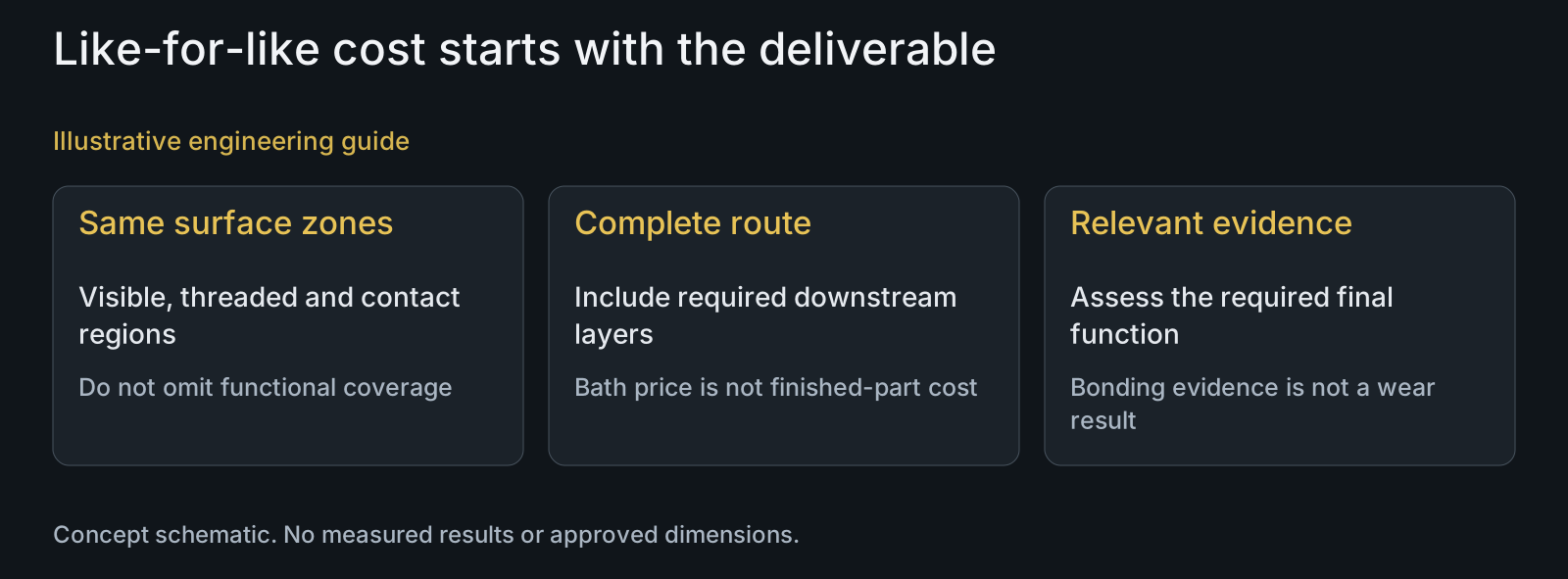
A surface map should distinguish visible heads, threads, bearing contacts and any genuinely bonded region. State where each treatment is intended, excluded or followed by another layer. A whole-part process name leaves too much room for a supplier and designer to assume different boundaries.
Keep final dimensional acceptance tied to the actual route. Preparation, masking and subsequent layers need review for the controlled features. Do not prescribe a universal allowance or declare a layer dimensionally irrelevant solely because it is described as thin.
A sample can establish a defined appearance reference but cannot silently approve an unidentified treatment across all functional surfaces. Have the surface-treatment review address the proposed zones and finish condition alongside the material requirements.
Compare complete quotation scope before claiming savings
Engineering and purchasing analysis should compare the same finished deliverable, quantities and requirements. Include the necessary preparation, masking, subsequent treatment, assessment and protective handling. An omitted operation can create a lower quote without providing an equivalent component.
Distinguish a development proposal from a repeat-order price. If the replacement system has not been assessed for the relevant surfaces, name that open work and its commercial scope. Do not present a speculative processing reduction as a verified customer saving.
Where the original requirement is unnecessarily broad, the design owner may consider narrowing its coverage. That is a deliberate requirement change, not proof that another chemistry performs identically. Compare the revised function and risks explicitly before interpreting the price difference.
An attractive lower quote can describe a different product
Illustrative engineering example: assume an OEM requests a visible titanium axle head plus controlled working threads. A cheaper quotation names a chemical pretreatment and cites bonding performance. The proposal does not identify a subsequent layer or evidence for the exposed surfaces. No coating or assembly test result is available.
The reviewer asks whether the supplier intended a bonding preparation, an exposed finish, or an anodic system described loosely. Until that identity is resolved, the quote cannot be compared like-for-like. The next review maps the actual system to the head and threads, and requests only the evidence needed for those functions.
The result is a clearer decision boundary, not a demonstrated successful replacement. PremFixer can coordinate a partner-supported specified finish with manufacturing from customer drawings and BOM. This does not claim ownership of a conversion line, use of a named chemical product, or an approved low-cost titanium recipe.
Questions buyers need to confirm
Is chemical conversion one fixed titanium process?
No complete process identity follows from that label. Request the actual chemistry or proprietary reference, specified substrate and intended function. Avoid assigning a familiar aluminum requirement to titanium without an applicable basis.
Can a sol-gel bonding preparation replace an exposed finish?
Not on bonding evidence alone. A named sol-gel can prepare an interface in a larger system. Establish whether subsequent layers are required and whether the proposed exposed contact or appearance has relevant evidence.
Does an AMS2488 reference prove an alternative is cheaper or equivalent?
No. Its public scope identifies a titanium anodic coating, not commercial savings or universal equivalence. Identify the applicable process revision and required properties, then compare the actual proposal against the order.
Can matching color approve working threads?
No. Color concerns an appearance reference. Working threads need the specified final fit and contact condition after the complete route. Identify treated and excluded zones rather than extend head appearance approval to every feature.
How should two finishing prices be compared?
Compare matched quantities and the same finished requirements, including preparation, masking, subsequent layers, relevant assessment and handling. Separate unresolved development work from a price for an already defined repeat route.
What should a titanium alternative-finish RFQ include?
Send drawing, STEP and BOM, titanium specification and condition, current finish reference, proposed system, surface map, appearance reference, mating materials and required final function. Include quantities and available technical documents without presenting untested equivalence as approved.
Technical references and scope
SAE AMS2488F: Public scope. Identifies titanium anodic-coating requirements; no full paid method, approval or comparative price claim reproduced.
3M AC-130-2: Application guide. Named sol-gel bonding-preparation example and system interface, not a classification of all conversion processes or an exposed pivot-finish qualification.
Explore related component, material and sourcing decisions in the customer decision knowledge center. For a drawing review, use the Drawing/BOM RFQ path.
Clarify the titanium finish before comparing quotes
Submit drawing, STEP or sample and BOM with the existing finish, proposed alternative, visible and functional zones, mating materials, quantities and available process documents. The review will establish whether the proposals describe the same delivered surface system and which fit or functional evidence remains necessary.
Discuss the drawing and BOM