

Do not declare a stainless or titanium pivot SVHC-free from its alloy-family name. An OEM needs substance information for the actual supplied article, including relevant finishes and added materials, against an identified Candidate List basis. State the part and finish revision, represented supply and assessment scope before relying on a declaration. A new document date cannot automatically cover a changed coating or a later list update. ECHA distinguishes supply-chain communication, notification and related article obligations; one attachment does not establish that every applicable duty has been fulfilled. PremFixer can discuss requested evidence for a defined order, but no universal substance-free claim is made here.
Hero: concept illustration of example hardware and its application. It is not a factory photograph, tested component or approved production geometry.
Identify the supplied article and finish system
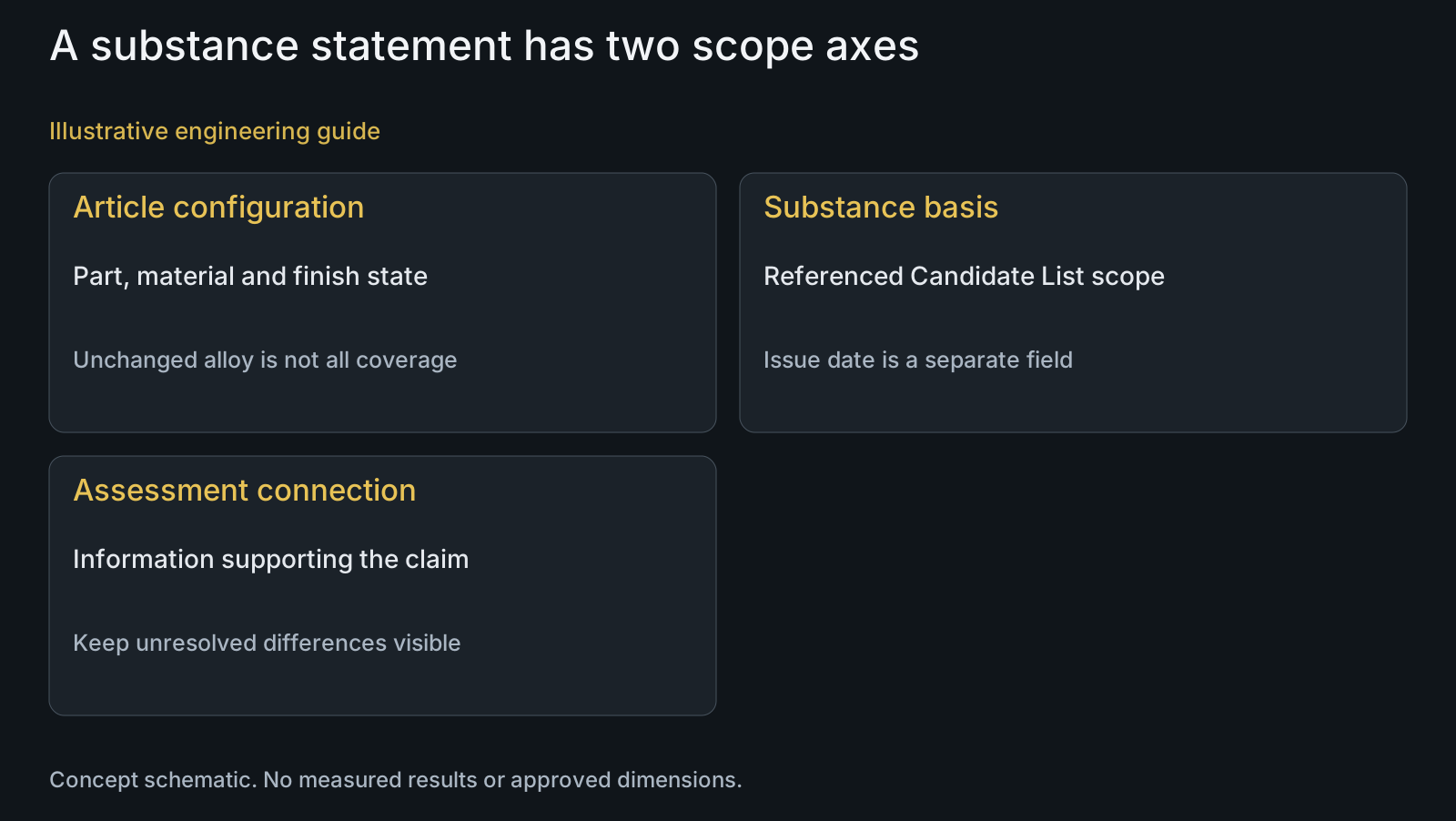
Identify the exact part number, revision and delivered state. A bare axle, finished axle and axle supplied with an added locking material may represent different information needs even if the nominal metal remains unchanged.
Include the relevant substrate, finish layers and other supplied materials in the review request. A stock-material record cannot independently describe a later treatment. A declaration that explicitly excludes coatings answers a narrower question than one intended to represent the complete finished article.
The order-document guide separates chemical, material and dimensional evidence. This review follows the chemical statement's configuration and list coverage over change, not the entire shipment document package.
Separate the declaration basis from its issue date
Ask which Candidate List basis the statement addresses and when it was assessed. Preserve that basis separately from the file's issue date. Reissuing an older statement does not independently establish that newly relevant substances were considered.
Likewise, a reference to a recent list does not show which product configuration was reviewed. Keep both axes visible: article/material/finish coverage and the referenced substance scope. Do not quote an unverified current substance count as a shortcut for either.
When list coverage changes, ask what existing information supports the updated assessment and what remains unresolved. This is not a universal instruction to retest every part after every list change; the required evidence depends on the actual information gap and intended claim.
| Change or statement | Coverage question | Risk | Useful review |
|---|---|---|---|
| Stainless or titanium label | What is included in the finished article? | Alloy family called SVHC-free proof | Identify materials and relevant treatments |
| New document issue date | Which list and configuration were assessed? | Fresh date called fresh assessment | Keep issue and assessment bases separate |
| Changed finish supplier | Does existing evidence represent the new route? | Same color called chemical equivalence | Review affected finish/material information |
| Updated list reference | What supports the expanded scope? | Unreviewed substances assumed covered | Identify applicable information gaps |
| Complete pivot kit | Which constituent articles are represented? | Whole-kit mass used as assumed denominator | Resolve actual article basis |
| Selected analytical result | Which substance and specimen were assessed? | One test called every obligation fulfilled | Keep test and downstream duties distinct |
Keep communication and notification obligations distinct
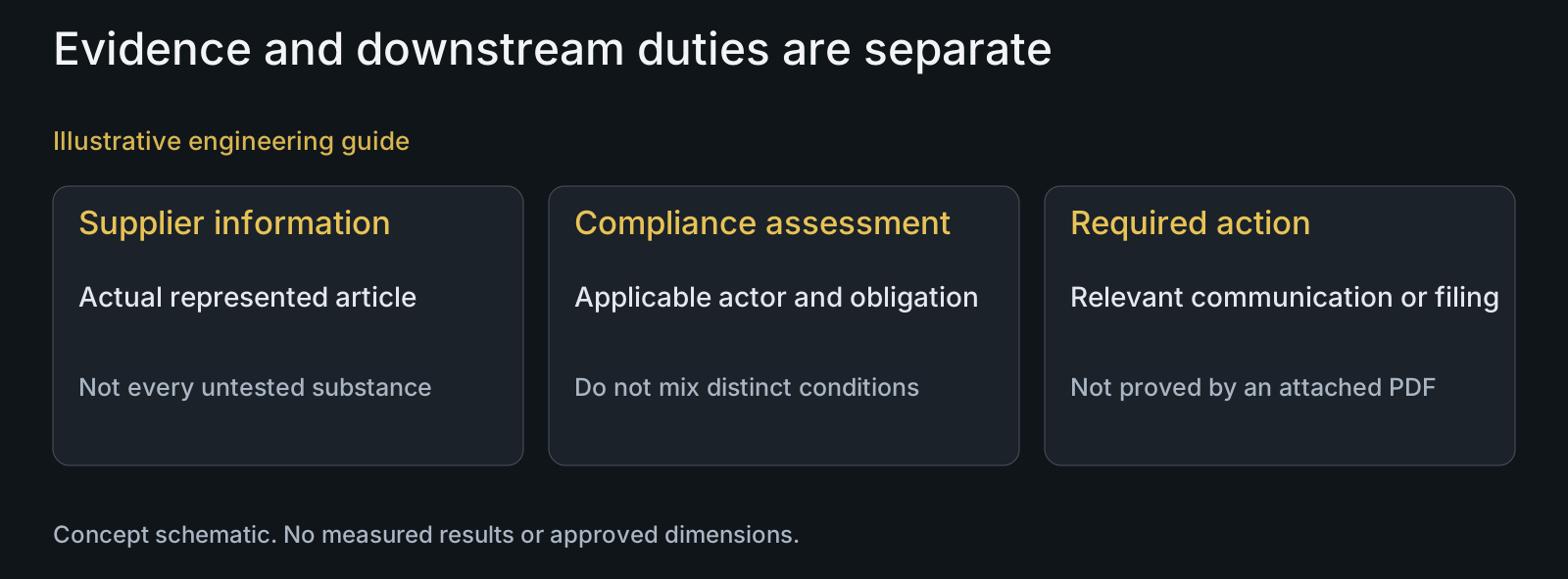
ECHA's Article 33 explanation describes safe-use information to recipients where an article contains a Candidate List substance above 0.1% weight by weight, including at least the substance name. The responsible supply-chain actor must assess its actual duty.
ECHA's Article 7(2) notification overview separately identifies concentration above 0.1% and substance quantity over one tonne per year, with stated exemptions. Do not borrow the tonnage condition to dismiss a separate communication question.
ECHA's SCIP supplier guidance describes a distinct information duty under the Waste Framework Directive for relevant EU article suppliers. A manufacturer's substance statement is an input to review, not evidence that another actor submitted a notification or fulfilled every legal requirement.
Review the article basis rather than dilute a kit average
For a kit, keep the axle, washer, sleeve and any other relevant articles identifiable. ECHA's substances-in-articles guidance addresses constituent articles within complex objects. Do not assume the combined kit or bicycle mass is an appropriate denominator for every constituent-article question.
The responsible compliance review must identify the actual article and any relevant concentration basis. A calculation with a guessed mass or an unrelated test subject is not made reliable by using a familiar percentage threshold.
A targeted analytical report may answer its named substance and specimen question. It does not automatically cover untested substances, other kit articles or another supplied state. Preserve the assessed subject instead of presenting one selected result as complete REACH certification.
Reassess coverage when a supplier or treatment changes
A finish-supplier change is a prompt to review whether the existing information still represents the delivered article. Identify the actual change in specified treatment, supplied materials or evidence basis; do not assume equivalence merely because the color remains the same.
Ask whether the declaration covers the new route and affected part revision. Retain the prior scope for goods it actually represents, while keeping unresolved new coverage visible. Do not silently extend a statement from one finishing arrangement to another.
Discuss the defined treatment through surface-treatment coordination, materials and manufacturing. The confirmed partner model does not itself establish substance composition or a universal compliance declaration for all partner processes.
Review an unchanged axle with a changed topcoat
Illustrative engineering example: assume an OEM keeps the axle material and geometry but proposes a different topcoat supplier. The available declaration identifies the previous finished configuration and an earlier Candidate List basis. No substance presence, absence, laboratory value or actual customer change is assumed.
The reviewer asks two questions: does the information represent the new finish, and does its substance scope support the requested list basis? A new PDF date or unchanged base-alloy certificate answers neither automatically. Request the relevant updated information and identify any remaining gap.
The downstream compliance owner separately assesses applicable duties using that information. Send the drawing and BOM RFQ package with finish revision and declaration purpose so the manufacturing request and substance review refer to the same supplied article.
Questions buyers need to confirm
Does an alloy name establish that the finished pivot has no SVHC?
No. Identify the actual article, relevant treatments and added materials, plus the statement's assessment basis. No universal substance-free claim follows from stainless or titanium shorthand.
Does a newly issued declaration cover the newest list?
Not automatically. Read the referenced list and assessment scope separately from the issue date, then resolve any relevant difference rather than assume a recent file date proves an updated review.
Can the old declaration cover a new finish supplier?
Only when its represented scope and supporting information justify that use. Identify the actual route and material changes, and request updated coverage where the existing basis no longer supports the claim.
Can I average all kit materials using the whole bicycle weight?
Do not assume that is the relevant article basis. Identify constituent articles and resolve the applicable concentration assessment with the compliance owner before using a denominator.
Does one chemical test complete every REACH obligation?
No. It supports its named substance, specimen and method scope. Applicable communication, notification and other duties are separate questions for the responsible supply-chain actor.
What should an OEM send for an SVHC evidence discussion?
Provide part/BOM and material/finish revisions, delivered state, destination, referenced list basis and requested claim. Identify supplier/process changes and available substance information so the review can target actual coverage gaps.
Technical references and scope
ECHA Article 33 supply-chain communication. Public recipient information overview, not a case-specific compliance conclusion.
ECHA substances-in-articles notification. Separate concentration/tonnage conditions and stated exemptions; no notification made.
ECHA SCIP supplier guidance. Distinct relevant EU supplier information duty; no completed filing inferred.
ECHA guidance in a nutshell on substances in articles. Constituent-article context; not a project concentration calculation or current-list count.
Explore related component, material and sourcing decisions in the customer decision knowledge center. For a drawing review, use the Drawing/BOM RFQ path.
Request substance information for the actual supplied state
Send the drawing, STEP or sample reference and BOM with substrate, complete finish system, part revision, destination and referenced Candidate List basis. Identify changed suppliers or treatments and the intended declaration purpose so PremFixer can discuss the relevant order evidence while downstream compliance decisions remain with the responsible owner.
Discuss the drawing and BOM