
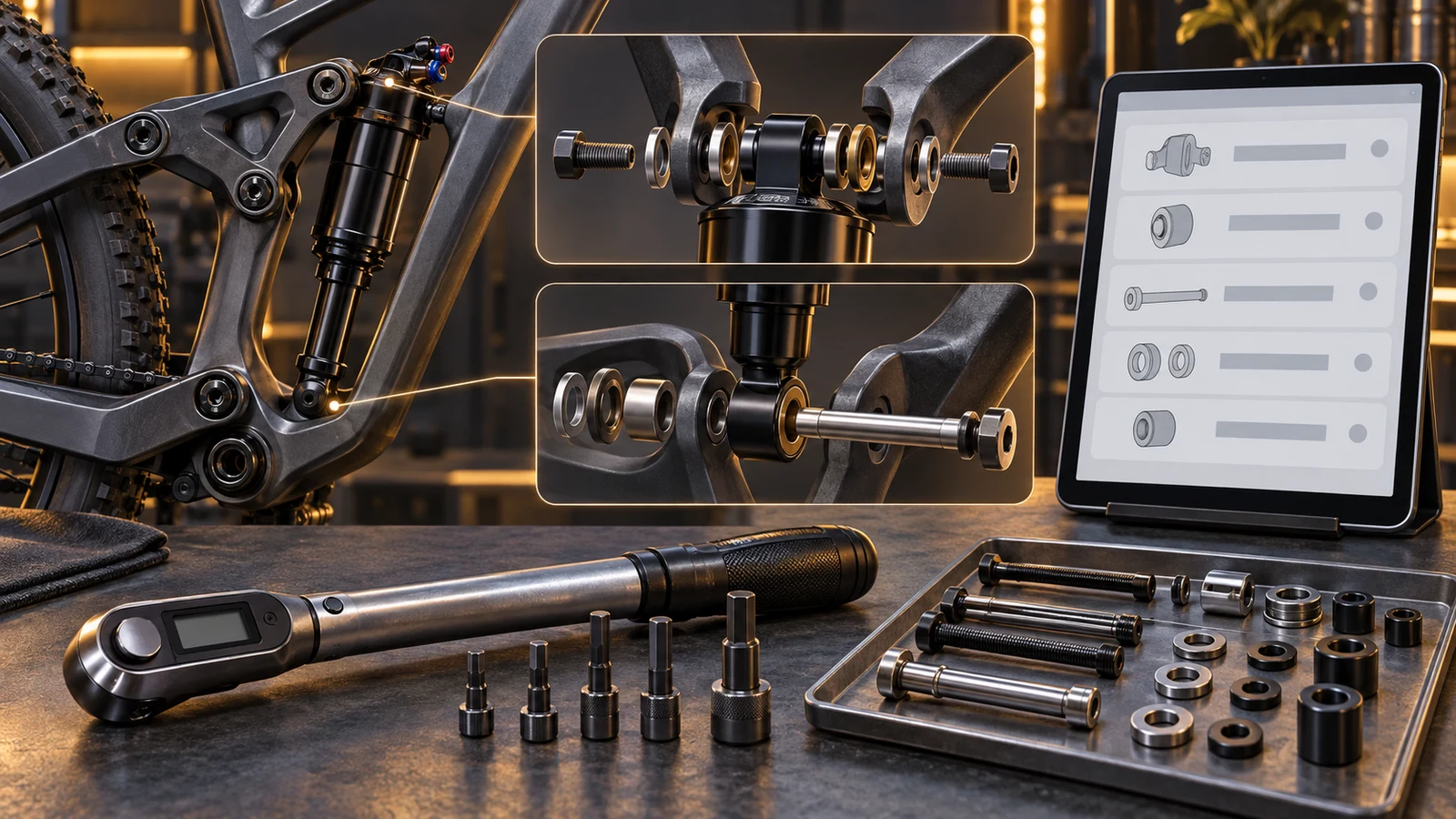
Rear-shock mounting bolts and suspension pivots cannot share a torque value simply because they belong to one bicycle brand. Identify the exact model, configuration, mounting position and hardware revision, then use the applicable official installation instruction with its units, preparation and sequence. The shock's fitment guide does not automatically supply the frame's bolt setting. A replacement that looks similar may also change the instruction's applicability. PremFixer can review drawing-defined replacement hardware and specified surfaces; it does not publish a universal installation number for unknown frames. Keep a missing or conflicting instruction unresolved until the responsible manufacturer or technical authority clarifies it.
Hero: concept illustration of example hardware and its application. It is not a factory photograph, tested component or approved production geometry.
Distinguish the shock mount from the neighboring pivots
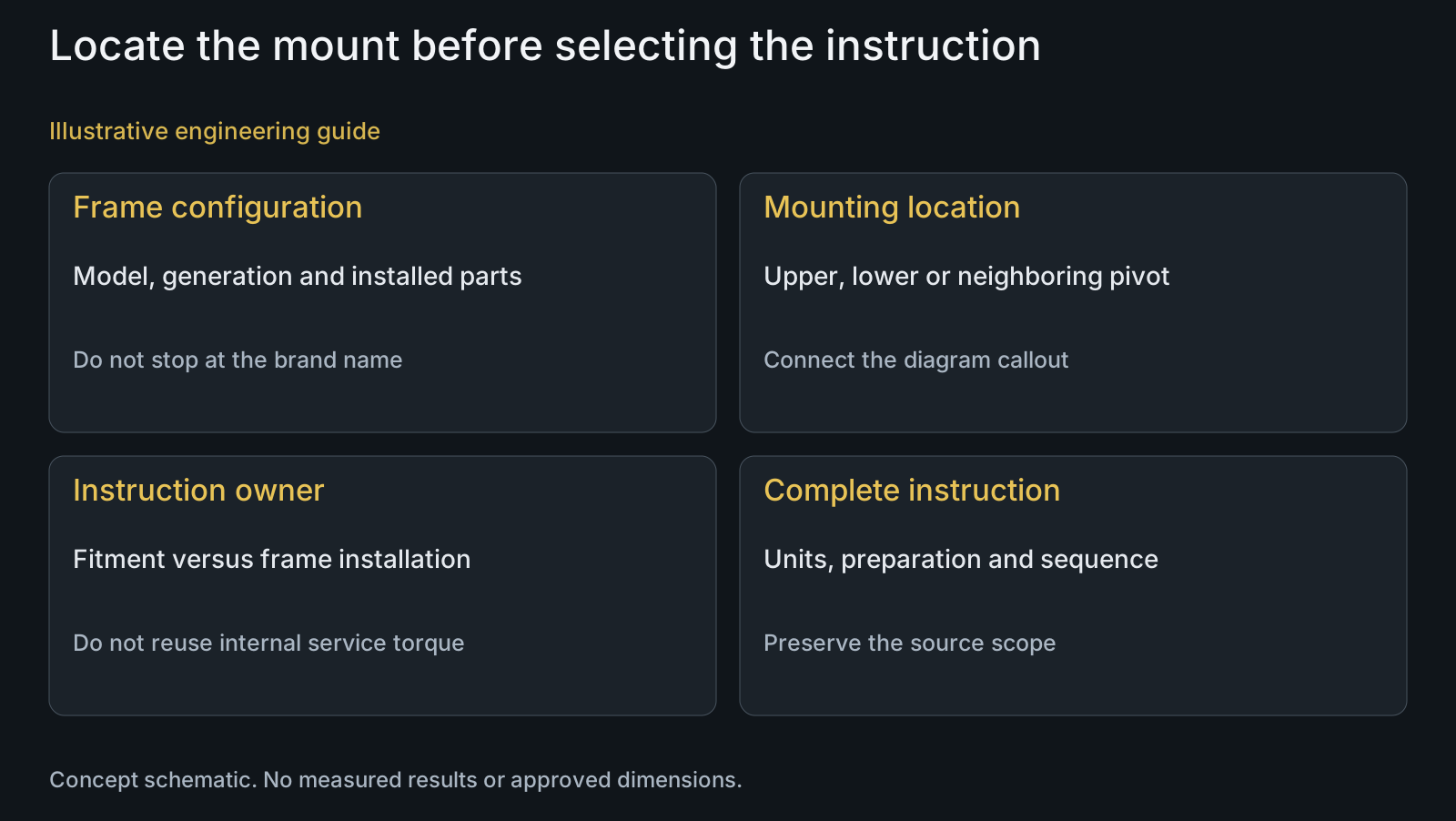
Start with a frame assembly view, not a brand name. Identify the upper shock connection, lower shock connection and neighboring rocker or main pivot as separate locations. The same page or mechanism can contain different fasteners, receivers and installation notes.
Check model identification, year or generation and the actual installed hardware. Record any aftermarket shock, replacement shaft or revised mounting parts. A frame name without its configuration can leave the applicability of an otherwise genuine manual unresolved.
Do not select a value by whichever bolt is easiest to recognize. Locate the diagram callout and connect it to the part description. Thread diameter alone does not establish the mounting position, receiver or complete assembly condition.
Resolve which instruction governs the installed connection
A shock supplier can describe shock dimensions, eyelet style and its component-service requirements while the frame manufacturer defines the installation interface. SRAM's rear-suspension fitment explanation states that mounting hardware type and specification depend on the frame design. That fitment guidance is not a universal frame-bolt torque table.
Engineering analysis: read the documents for the task each one governs. A shock service torque for an internal component is not automatically the setting for the bolt attaching the shock to the bicycle. Keep part identity and operation visible when comparing two documents.
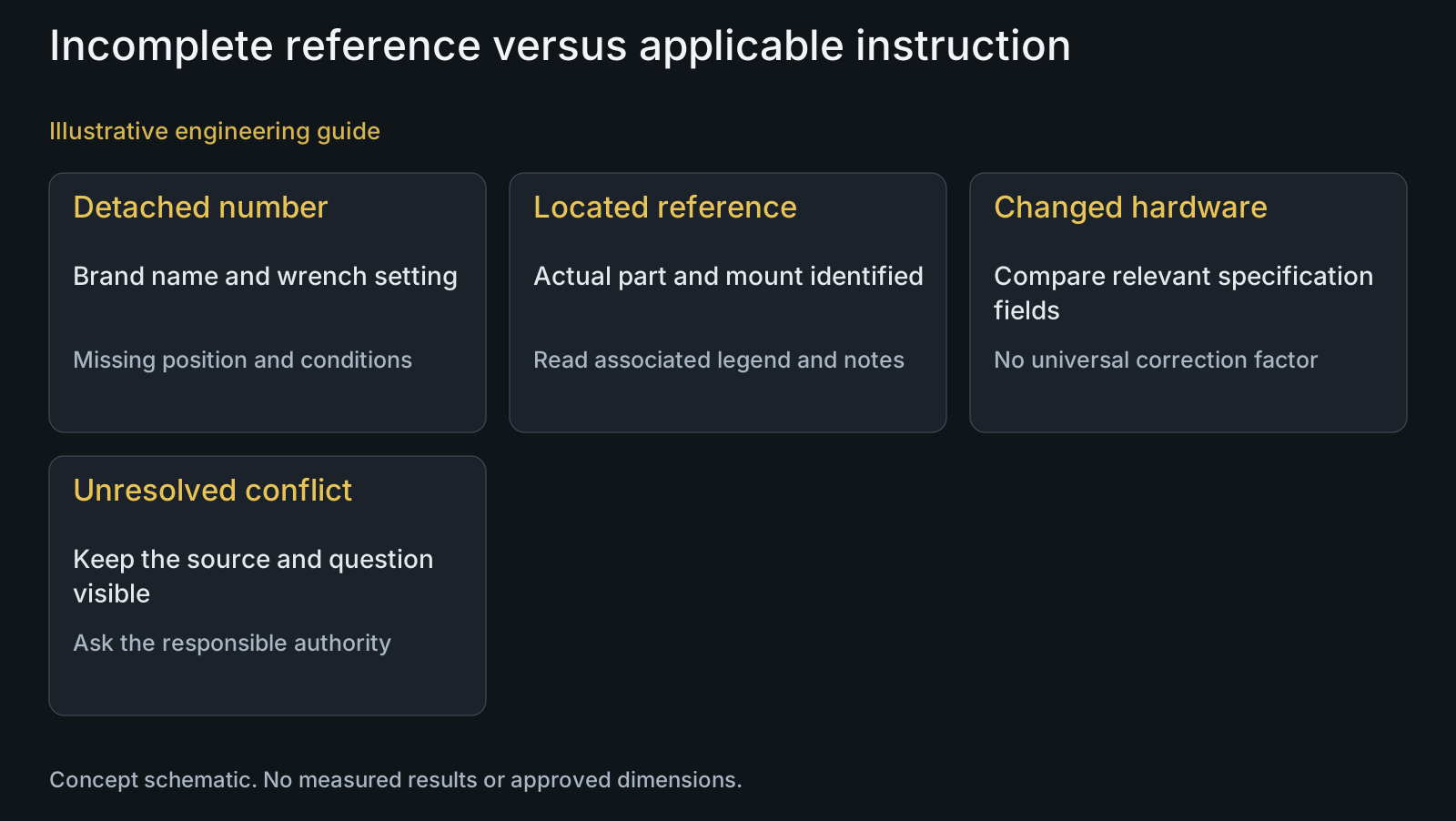
Where applicable instructions conflict or do not cover the represented hardware, ask the responsible manufacturer or competent technical authority to resolve the scope. Do not choose the larger number, average the values or treat the newer-looking document as automatically applicable to every older configuration.
| Available reference | Useful scope | Risk | Required action |
|---|---|---|---|
| Brand-only torque list | Search starting point only | Wrong model or mounting location | Locate exact official model instruction |
| Shock fitment guide | Shock dimensions and interface context | Confusing fitment with frame bolt setting | Check applicable frame installation document |
| Model-specific mount diagram | Represented part and location | Detached callout or omitted legend | Read diagram, preparation and operation together |
| Generic diameter/material table | Not proprietary-mount approval | Ignoring receiver and surface conditions | Use approved joint-specific instruction |
| Changed replacement treatment | Identify a changed condition | Automatic percentage correction | Resolve instruction applicability with authority |
| Conflicting or missing instruction | An unresolved service question | Guessing, averaging or using highest value | Obtain authoritative clarification before use |
Keep preparation and sequence attached to the setting
A usable reference preserves the specified thread and contact preparation, locking product where required, tool and tightening sequence alongside the setting. Distinguish what a manual explicitly instructs from an operator's preferred practice. A wrench setting is only one part of the installation definition.
Do not interpret a page's list of grease and tools as permission to apply grease to every surface. Check the legend, diagram markers and written instructions for the represented location. If a condition is not clear, retain the original source and ask for clarification.
For custom hardware, identify material condition, finish and any supplied friction or locking treatment in the enquiry. The torque-specification development guide addresses establishing a new project instruction; this reference article addresses locating and preserving an already applicable instruction.
Use official model documentation without exporting its scope
Trek's 2023 Fuel EX Service Manual, Rev 2 October 2023, separates rear-shock hardware from rocker and main-pivot sections. Its rear-shock diagram identifies upper and lower parts and carries distinct installation callouts. This is a documented example of location-specific information, not a recommendation for all Trek models.
Use the named manual's rear-shock section, legend and associated operation when checking that represented configuration. A copied callout loses meaning if its position or preparation is omitted. Follow the applicable manufacturer documentation rather than this article for an actual installation.
For Salsa, Specialized, Norco or another brand, use the same source discipline but obtain the corresponding model document. No numeric entry is supplied here for an unrepresented model. A familiar brand or visually similar mount is not permission to extend the example.
Treat changed hardware as an applicability question
A different finish, lubricant, locking product, receiver or replacement geometry can change the conditions represented by the original instruction. Identify exactly what changed and who can approve its use. Do not apply a generic percentage correction to a borrowed setting.
If the approved replacement preserves the relevant definition, document that basis rather than assuming every replacement invalidates the manual. Conversely, a component's dimensional conformity does not prove that an unapproved substitution preserves the original assembly requirements.
Connect the part and kit to the revision-compatibility guide, materials and surface treatment. For manufacture, send the specified final condition through CNC turning; do not ask the supplier to infer a frame's service setting from an alloy label.
Review example: upper callout copied to a lower mount
Illustrative engineering example: assume a workshop reference contains only a brand name and a torque copied from an upper shock callout. A technician needs the lower-mount instruction for a represented configuration. No actual installation, applied value or damage outcome is described.
The reviewer locates the applicable official manual, distinguishes upper and lower parts and checks preparation and the relevant operation. It rejects the copied entry as incomplete instead of assuming the number is correct or incorrect in isolation. A different mounting location needs its own applicability check.
The revised reference links each represented location to the source section and full instruction, with any unresolved condition visible. That prevents a brand-level entry from acting as an unsupported installation command. The useful outcome is a correctly scoped reference, not a new torque calculation or test result.
Questions buyers need to confirm
Can one brand's rear-shock bolts all use the same torque?
No. Match the actual model, configuration, mount and hardware to its official instruction. Keep preparation and operation notes with the setting. A brand-level number is not a complete rear-shock installation reference.
Does the shock maker determine every frame mounting bolt setting?
Not automatically. Distinguish shock fitment and component-service information from the frame's installation requirements. Identify the exact part and operation each document governs, and resolve missing or conflicting instructions with the responsible authority.
Can upper-shock torque be copied to the lower mount?
Not by assumption. Locate the lower part and callout in the applicable model instruction, including preparation and the relevant operation. The two locations may use different interfaces; their common connection to one shock does not establish one setting.
Does a grease listing mean grease goes on all the threads?
No. Read the legend, diagram markers and written instructions for the specific location. A supplies list is not a surface-by-surface instruction. Ask for clarification if the required preparation remains ambiguous.
Should a changed coating or threadlocker get a percentage torque adjustment?
Not from a generic rule. Identify the changed surface or product and review the original instruction's applicability. Obtain an approved basis for the represented configuration rather than borrowing a correction from another joint.
What should accompany a replacement shock-hardware RFQ?
Send the model and mount identification, assembly and component drawings or represented sample, BOM and quantities. Include the applicable installation reference, receiver, material condition, finish and any supplied locking treatment. Identify substitutions and unresolved instruction fields.
Technical references and scope
Trek 2023 Fuel EX Service Manual, Rev 2 October 2023. Location-specific rear-shock parts and callouts, legend and associated adjustment operation. Used as a named document example; no numeric torque exported to unrepresented models.
SRAM RockShox rear-suspension fitment. Frame-design dependence of mounting hardware and distinction between shock interface types. No universal frame-bolt setting inferred.
Explore related component, material and sourcing decisions in the customer decision knowledge center. For a drawing review, use the Drawing/BOM RFQ path.
Connect replacement shock hardware to its applicable instruction
Send the frame configuration, mount location, assembly and component drawing or represented sample, BOM and quantities. Include the official instruction reference and specified material, surface and locking conditions. PremFixer can review hardware manufacture and replacement scope; the responsible technical authority must confirm installation applicability for changed configurations.
Discuss the drawing and BOM