

Shot peening is not a cheaper way to manufacture the same thread that rolling produces. On a stainless pivot bolt, it is a proposed surface treatment whose relevance depends on the fatigue-critical feature and the finished manufacturing route. Before comparing cost, identify whether the concern lies at a thread root, runout or shoulder transition, and whether that region can receive the specified treatment without compromising nearby interfaces. Intensity and coverage answer different process questions; neither establishes a universal fatigue improvement. An OEM needs a controlled treatment scope and relevant component evidence, not a life multiplier borrowed from another shape or material.
Hero: concept illustration of example hardware and its application. It is not a factory photograph, tested component or approved production geometry.
Separate thread manufacture from the surface treatment
Rolling forms a thread through displacement of the prepared material, while a cut route creates it by material removal. Peening does not replace that geometry-producing operation. A proposal for cut threads followed by peening is a different complete route, not rolling at a discounted price.
Curtiss-Wright's shot-peening explanation describes local cold working by shot impacts and compressive residual stress near the surface. The mechanism supports considering a controlled fatigue treatment. It does not establish a numerical improvement on a specified 304 pivot.
Keep the rolled-versus-cut thread comparison focused on thread manufacture. This decision adds a targeted surface operation and asks which feature it treats, how the treatment is controlled and what happens afterward. The two questions can interact without becoming interchangeable.
Intensity and coverage are different requirements
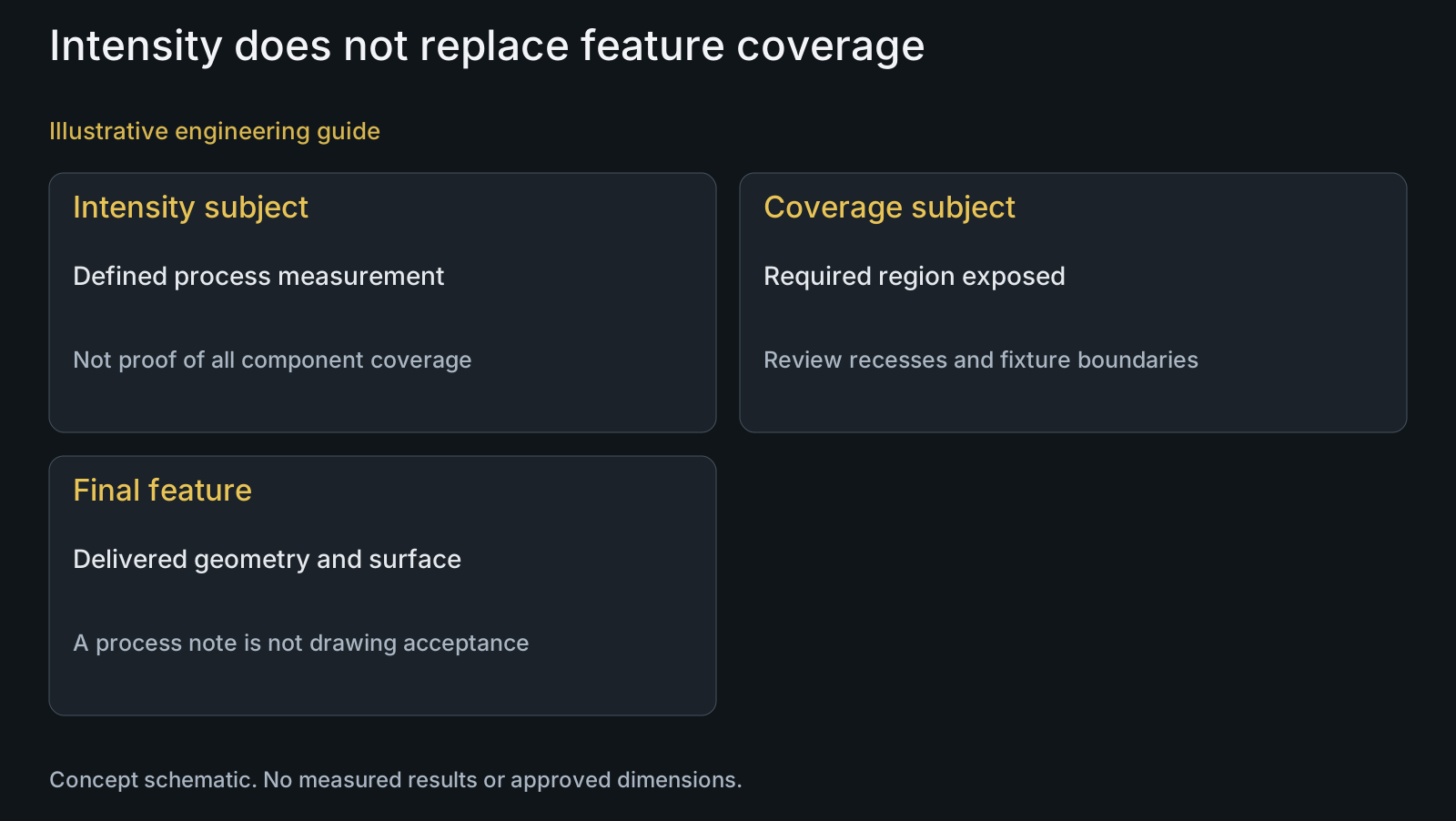
The public scope of SAE J443_202512 concerns deriving and verifying peening intensity. SAE J2277_202301 instead addresses coverage and its relationship to exposure. Its scope cautions that inadequate or excessive coverage can be detrimental.
For engineering review, request both subjects explicitly. An intensity record does not by itself describe which regions of the actual component received the required coverage. Conversely, a visually treated surface does not establish that its process intensity was determined and maintained as specified.
Have the processor define the applicable method and acceptance requirements. This article does not prescribe strip type, arc height, media size, exposure time or a universal coverage percentage. The public scopes establish the distinction, not the full controlled procedure for your part.
| Decision | What it establishes | What remains open | Useful review |
|---|---|---|---|
| Thread rolling or cutting | Geometry-producing route | Whether a separate treatment is needed | Required profile, root and runout |
| Peening intensity | Specified process-intensity subject | Coverage at the component feature | Applicable intensity method and record |
| Coverage | Exposure of the intended region | Final dimensional acceptance | Required coverage method and surface scope |
| Masking and access | Treated versus excluded zones | Unseen fixture shadow or exposed seat | Geometry-specific boundary review |
| Later operation | Delivered route after peening | Whether evidence represents that state | Affected feature and sequence assessment |
| Fatigue comparison | Result for defined complete routes | Universal life or cost advantage | Matched test basis and complete quote |
Target the limiting feature without treating every interface alike
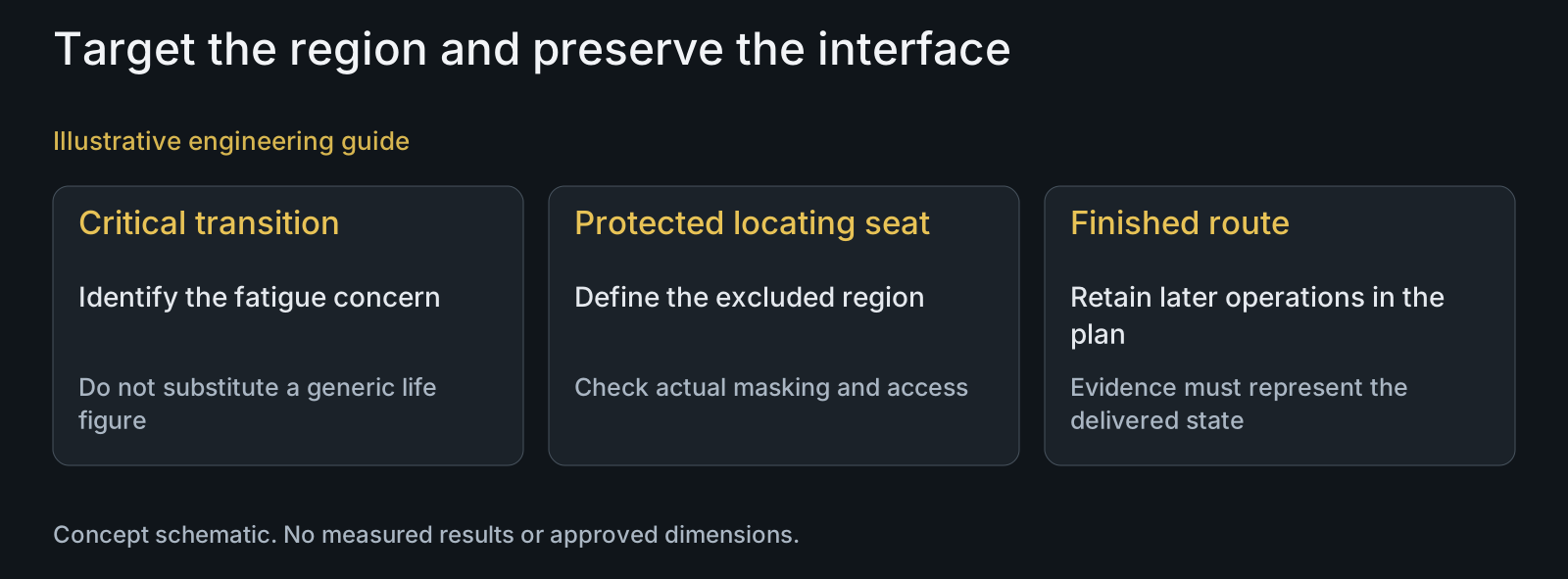
Locate the fatigue concern before specifying a treated zone. A thread-root issue and a shoulder-transition issue do not necessarily need the same access or masking arrangement. If the available failure evidence identifies neither, do not select a whole-part treatment merely to give the proposal a process name.
Ask how the intended region is exposed to the media stream and how nearby bearing seats, contact faces or other excluded regions are protected. A fixture, recess or protective collar can change which surface is actually accessible. Review the treatment boundary rather than assume an open flat coupon represents it.
The processor should assess media suitability and the cleanliness of the represented route for the specified stainless material. Do not infer a universal media choice from the word stainless. The post-manufacturing cleanliness guide addresses contamination scope separately from a fatigue claim.
Keep later operations attached to the peened state
Identify whether peening occurs before or after thread formation, finishing and any permitted corrective machining. Engineering analysis should ask whether a later operation changes the intended treated region or introduces a different final surface. A report for an intermediate state should not be labeled evidence for a different delivered route.
Do not assume that every later treatment removes the benefit, or that none can affect it. Describe the actual operation and region, then request the relevant process assessment. A change in sequence is a technical question, not an automatic reason to reject all finishing.
Keep final thread fit, seat geometry and required surface condition separate from the peening record. A controlled surface operation can still be proposed on a component that does not meet the drawing. The surface-treatment coordination scope should identify those independent acceptance subjects.
Compare evidence for complete routes, not generic gains
Identify the component condition, geometry, assembly or fixture, load definition, relevant failure location and stopping criterion. If the comparison changes thread manufacture and peening together, label it a comparison of complete routes. It cannot isolate the contribution of peening alone.
A specimen that reaches a stopping point without the defined failure provides bounded evidence under that test. It does not establish unlimited service life. Likewise, a material fatigue-strength statement cannot be converted directly into a multiplier for years of riding.
For cost, compare the same functional deliverable and evidence scope, including required masking and subsequent operations. A unit price that excludes the evaluation needed for an unassessed route is not a demonstrated saving. The high-strength application review can connect the manufacturing proposal to the actual component requirement.
A passing intensity note leaves a shoulder question open
Illustrative engineering example: assume an OEM reviews a stainless shoulder bolt whose fatigue concern is at a transition adjacent to a locating seat. The proposal includes an intensity record, but its treatment drawing does not show whether the transition is exposed or covered by a protective fixture. No component fatigue result is supplied.
The reviewer requests the coverage and masking description for that region, while retaining the locating-seat requirement. More exposure everywhere is not selected as an automatic solution. The team first resolves access, then agrees which final-route evidence addresses the transition concern.
The example claims no life improvement or successful process. PremFixer's manufacturing review can coordinate a specified partner-supported treatment with the customer drawing and BOM. It does not imply an owned peening line, a standard intensity or a guaranteed comparison against rolling.
Questions buyers need to confirm
Can peening replace thread rolling?
It cannot replace forming the required thread geometry. Cut threads plus peening may be evaluated as a different complete route, but equivalence requires the specified final features and relevant evidence, not a price ratio.
Does an intensity record prove complete coverage?
No. Intensity and coverage are different process subjects. Identify the required region, applicable coverage method and actual exposure or masking arrangement, rather than infer them from an intensity note.
Is more coverage always better?
No. SAE J2277's public scope cautions that inadequate and excessive coverage can be detrimental. Use the applicable defined requirements; this article does not set a universal percentage or exposure time.
Should bearing seats also be peened?
Do not assume that they should. Identify their surface and fit requirements, the intended treated zone and any excluded regions. Have the processor assess whether masking or another arrangement preserves those requirements.
Can a fatigue-strength increase predict riding life?
Not directly. Keep material or specimen evidence attached to its geometry, final route, loading and outcome definition. A finished suspension joint needs its own relevant validation basis; no universal life gain is claimed.
What should a stainless peening RFQ include?
Send drawing and STEP, stainless grade and condition, relevant failure-location evidence, treated and excluded zones, thread route, subsequent operations and final-fit requirements. Include the specified intensity and coverage references where available, quantities and desired component evidence scope.
Technical references and scope
SAE J443_202512: Public scope. Intensity determination and verification subject; no full paid method or numerical intensity prescribed.
SAE J2277_202301: Public scope. Coverage and exposure subject, including caution about inadequate or excessive coverage; no acceptance percentage reproduced.
Curtiss-Wright: Shot peening. Cold-working and residual-compression mechanism; provider performance ranges, equipment and certifications not transferred to PremFixer pivots.
Explore related component, material and sourcing decisions in the customer decision knowledge center. For a drawing review, use the Drawing/BOM RFQ path.
Review a targeted peening requirement
Share drawing, STEP and BOM or samples, with stainless condition, critical region, proposed thread route, masking boundaries, subsequent finish and available test definition. The review will separate intensity from coverage and connect the proposed treatment to the actual delivered interfaces.
Discuss the drawing and BOM