
Stainless pivot bolts can be considered in an aluminum frame, but the material pair alone does not establish a safe or unacceptable joint. Galvanic corrosion requires an electrical connection and a conductive liquid path between the coupled materials. Review where water reaches the contacts, which surfaces are exposed and whether coatings or isolation remain effective in the actual assembly. An insulating washer is not a complete answer if the thread or sleeve provides another connection, and it must not disturb the intended fit or clamped stack. Evaluate the assembled configuration before choosing an isolation detail or changing only the bolt grade.
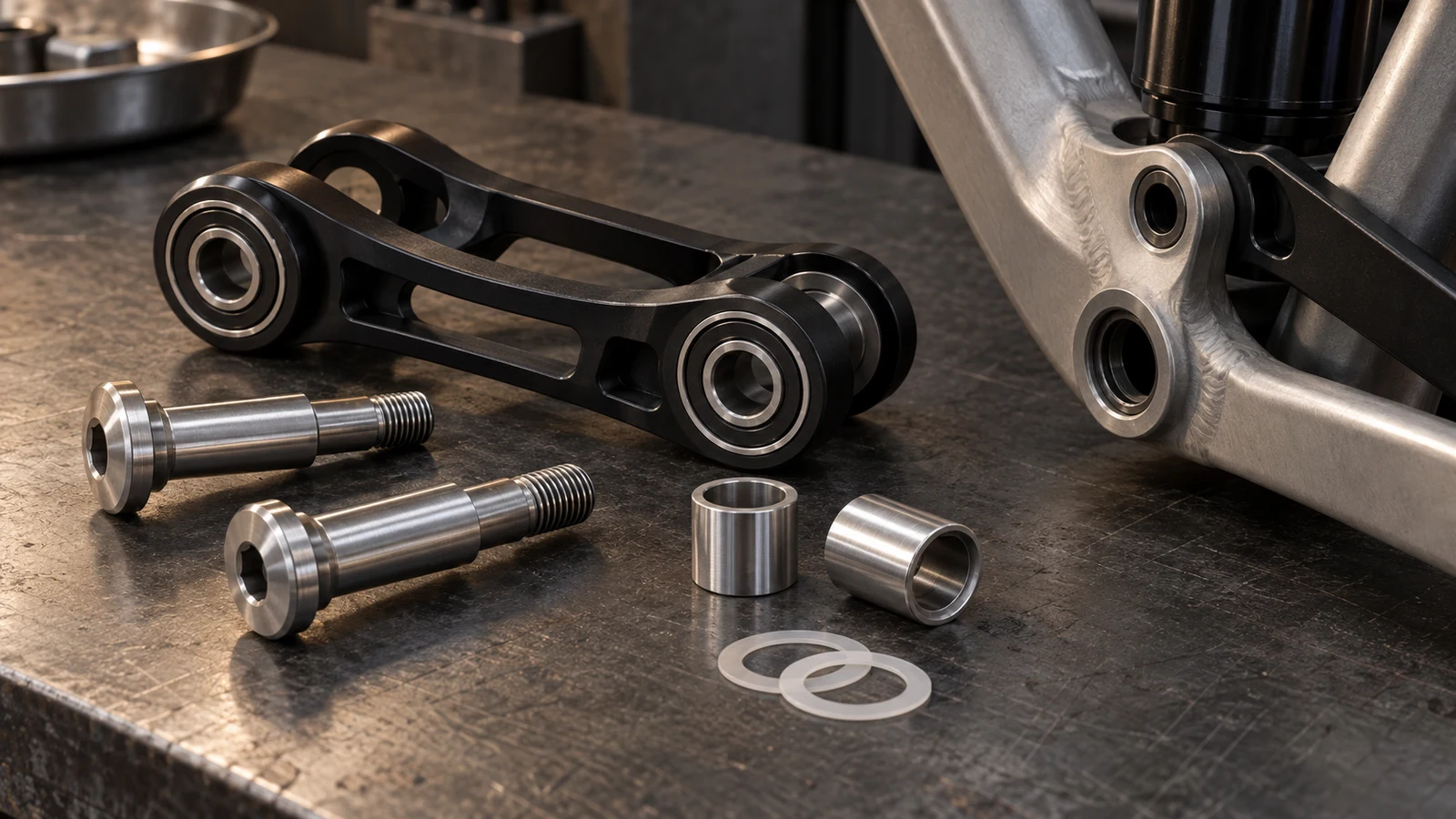
Hero: concept illustration of example hardware and its application. It is not a factory photograph, tested component or approved production geometry.
Map the coupled metals and the liquid path
Start with a contact map of the bolt, washer, sleeve, bearing and receiving frame feature. Mark the materials and delivered surface conditions rather than labeling the whole joint steel against aluminum. A sleeve can change which parts touch, while a coating can change the exposed contact without removing every electrical connection elsewhere in the assembly.
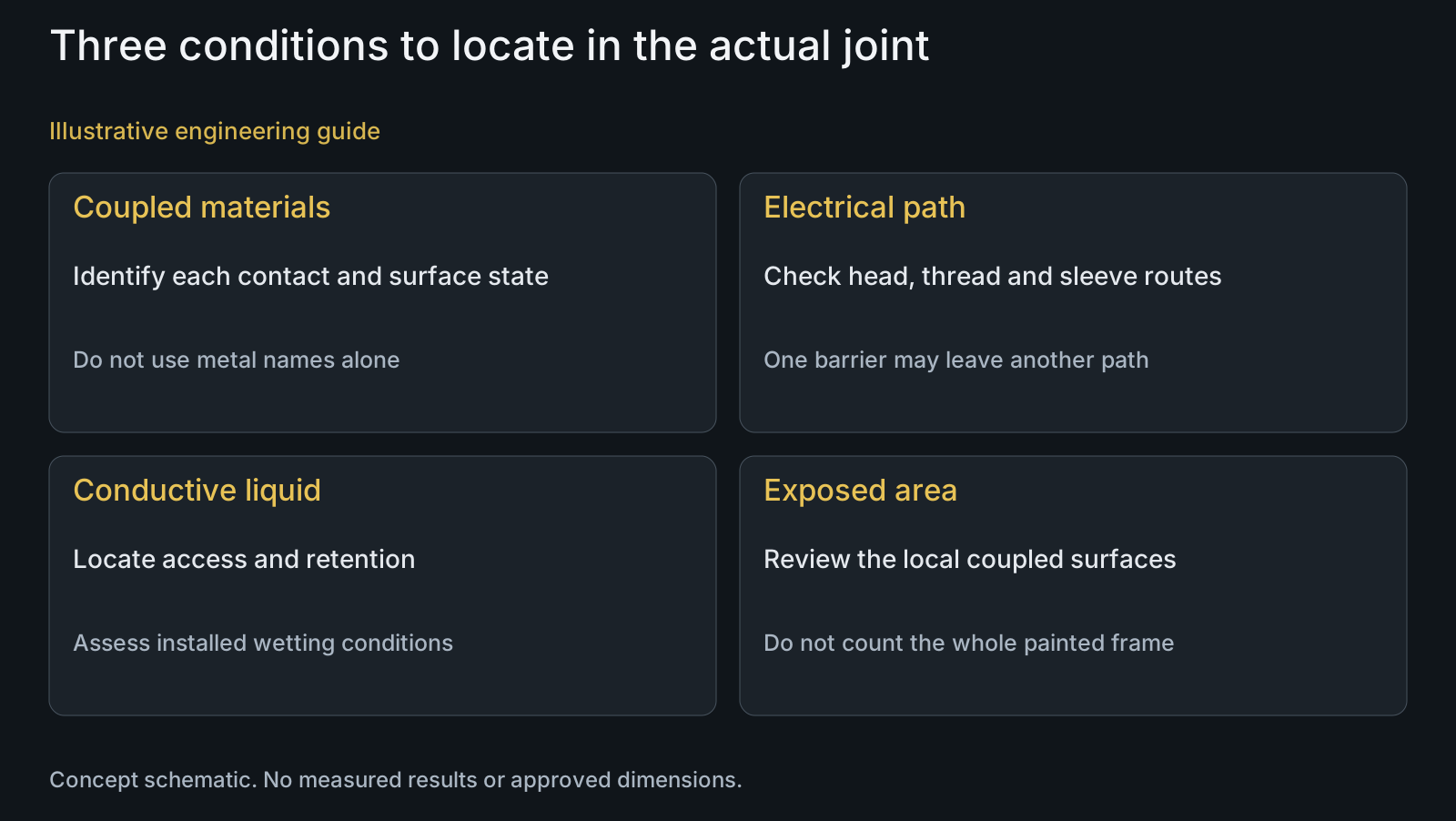
BSSA describes the electrical and liquid connections required for bimetallic corrosion. Identify wetting during riding, washing or storage and where moisture remains after an exposed surface dries. Salt-laden water is a different condition from a dry joint. Do not presume every mixed-metal contact corrodes simply because it appears in a galvanic series.
Locate damage or deposits on both members if the review begins with a returned assembly. A clean stainless bolt does not prove the surrounding aluminum is unaffected. Record the receiving thread and washer contact before cleaning. If the stainless itself is stained, 316L staining diagnosis addresses a separate deposit-versus-substrate question.
Assess exposed areas locally rather than using the whole frame
Relative exposed areas matter in galvanic behavior. BSSA identifies the risk associated with a large cathodic area coupled to a smaller anodic area. For a pivot, examine the surfaces sharing the relevant electrolyte exposure. The full painted frame area is not automatically the exposed aluminum area participating in a small wet contact.
A localized coating defect near a washer or thread deserves attention because it can expose a small region while surrounding metal remains protected. Its significance depends on the actual contact, wetting and materials. Do not assign a corrosion rate from a photograph or apply a general area ratio as a pass threshold without the appropriate analysis.
Compare alternatives under the same assembly and exposure definition. Replacing a bare demonstration coupon with a coated complete joint changes the comparison boundary. A favorable result for the coupon cannot establish behavior at a damaged coating edge in the actual frame. This is a reason to define the relevant contact, not a reason to promise that all coating defects cause failure.
| Proposal | Condition it may address | Risk or unresolved path | Review evidence |
|---|---|---|---|
| Insulating head washer | Head-to-frame electrical contact | Thread or sleeve path; altered clamp stack | Complete contact map and seating assessment |
| Identified protective layer | Specified exposed contact region | Discontinuity or damage after assembly | Coverage and relevant installed-state assessment |
| Specified compound | Defined assembly or barrier objective | Conductivity and locking compatibility unknown | Product data and assembly requirement |
| Drainage or sealing change | Electrolyte access or retention | Different geometry and maintenance conditions | Actual wetting path and functional review |
| Bolt-material change only | One member's material selection | Receiving aluminum and wet paths remain | Complete configuration comparison |
Check whether isolation interrupts every relevant connection
A nonconductive washer may separate the head from the frame face while leaving the threaded connection intact. A sleeve may create another metal path between the same coupled components. Review the complete electrical path before describing an isolated head as an isolated assembly. Where electrical continuity is checked, define the assembled state and relevant contact points.
A proposed coating or compound must be identified by product and intended function. A dry-film lubricant is not automatically an electrical insulator, and an assembly lubricant is not automatically a lasting water barrier. Obtain the relevant manufacturer's information and confirm compatibility with the locking and maintenance instructions. Do not select a generic substance solely from the term anti-corrosion.
Consider barrier continuity after installation and during intended service. Contact pressure, movement and maintenance can affect the areas that remain protected. A visible layer on a loose part does not prove an intact barrier in the tightened joint. Define the conditions that the proposal must withstand and the evidence needed to evaluate it.
Preserve the mechanical interface while changing protection
Adding a washer changes the axial stack unless the design explicitly accommodates it. Review usable engagement, shoulder position, seating contact and available clearance. An added polymer element also raises a load-bearing and long-term dimensional question; its material behavior must be suitable for the actual contact. Do not insert a soft isolation element into a clamp stack without engineering review.
The isolation proposal should identify which part rotates and which contacts remain clamped. If a barrier changes the bearing or sleeve support, the mechanical assessment may reject an otherwise promising electrical arrangement. Pivot-system solutions and the customer's assembly drawing establish the component roles; no generic washer size or torque correction is supplied here.
Write the final configuration as a coherent BOM and assembly requirement. Include finish, protective materials and any maintenance limitations. PremFixer's manufacturing review can assess the supplied hardware features and proposed scope, while the responsible design team evaluates protection and mechanical function in the complete joint.

Illustrative assessment of corrosion near an aluminum boss
Illustrative engineering example: assume a stainless bolt clamps a sleeve in a coated aluminum pivot boss, and wet contamination is found near the head washer. The coating condition beneath the washer and the thread contact are not yet documented. An insulating head washer is proposed as the correction.
The team maps the head, sleeve and thread contacts, then records the local coating condition and moisture path. If the threaded connection remains conductive, the head washer alone does not establish complete isolation. Engineering also checks whether the proposed washer changes seating, engagement or the intended clamp stack. A barrier alternative is compared against those same mechanical requirements.
No field failure cause or successful protection result is asserted. The useful outcome is a defined assembly to assess, with corrosion and mechanical questions both visible. A proposal that interrupts one path but creates an unacceptable stack change is not automatically the better joint, and a visually clean bolt does not close the receiving-frame assessment.
Questions buyers need to confirm
Does every stainless bolt in aluminum create galvanic corrosion?
No. Evaluate electrical contact, conductive liquid exposure and the actual coupled surfaces. A dry contact is not the same exposure case as a salt-wet sheltered interface; metal names alone do not establish the severity or acceptability.
Can a washer isolate the whole pivot joint?
Not automatically. A washer may interrupt the head contact while the thread or sleeve still connects the materials. Map the assembled paths and review any change to seating, shoulder position and usable engagement.
Is a dry-film lubricant always an insulating barrier?
No. Use the identified product's electrical and compatibility information rather than assuming the function from its name. Confirm its role with the locking method and installed contact conditions.
Why does exposed area matter when the frame is much larger than the bolt?
The relevant area is the surface participating in the coupled wet exposure, not automatically the total painted frame. Inspect local exposed aluminum and coating damage near the contact; a nominal overall size comparison can miss that condition.
What should be supplied for an interface-protection RFQ?
Provide the joint drawing and BOM, materials, finish boundaries, proposed barriers or compounds, assembly method and wetting or cleaning conditions. Identify the corrosion and mechanical acceptance objectives so protection is not assessed independently of the clamp stack.
Technical references and scope
BSSA: galvanic risks with aluminum and stainless steel. Electrical/liquid conditions, relative exposed areas and isolation principle; no pivot-specific rate or service life is derived.
Outokumpu: stainless corrosion resistance. General corrosion context; the proposed configuration and barriers require project evidence.
Explore related component, material and sourcing decisions in the customer decision knowledge center. For a drawing review, use the Drawing/BOM RFQ path.
Review the steel-aluminum interface as an assembly
Send the pivot section or STEP assembly, material and finish specifications, contact photographs and any proposed isolation or compound. PremFixer will review the hardware interfaces and RFQ scope without treating a loose washer or material change as a complete system approval.
Discuss the drawing and BOM