
TC4 titanium microstructure matters to material behavior, but one micrograph cannot establish the strength or complete quality of a finished pivot bolt. Identify the governing material specification, product form and condition, then locate the sample within the stock or part. Its section direction and preparation are also part of the interpretation. For an OEM buyer, the useful question is which specified condition or investigation the image addresses and which complementary evidence remains necessary. An alpha-beta label, an apparent phase fraction or a visually tidy section is not a universal acceptance rule for every axle region or item in the shipment.
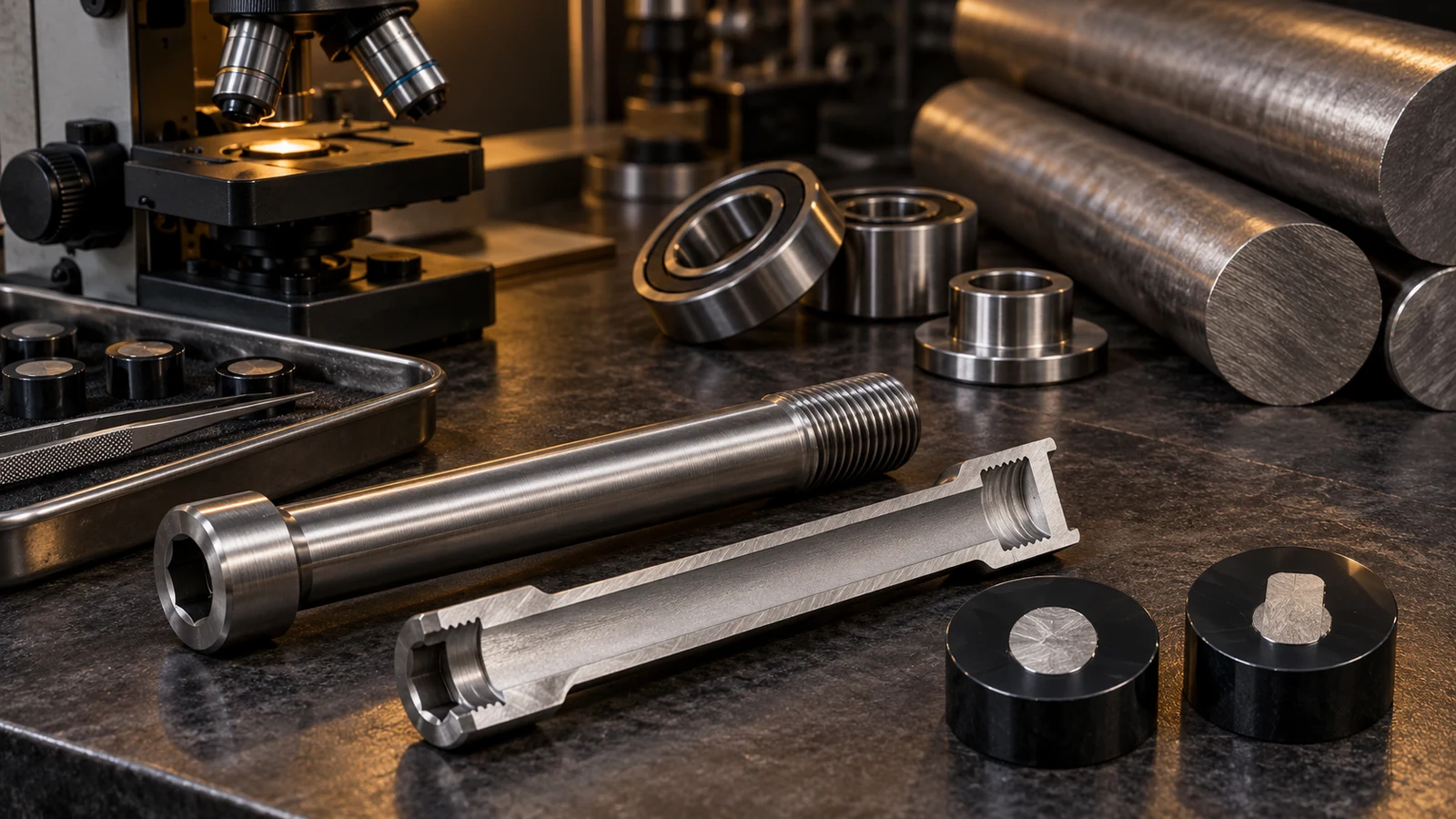
Hero: concept illustration of example hardware and its application. It is not a factory photograph, tested component or approved production geometry.
Alpha-beta identifies an alloy family, not a complete property state
TIMET's TIMETAL 6-4 data sheet describes the alloy as alpha-beta titanium and explains that microstructure and thermomechanical history affect properties. Its condition-specific data illustrates why a material name alone is not the full property definition. Historical reference entries are not current design allowables for a custom pivot.
Do not turn the presence of beta phase into a simple rule that more beta always makes a better axle. The relevant material condition and processing history need to be specified before an observed feature can support a property comparison. A claimed strength-toughness balance needs an identified basis, not a percentage copied from an unrepresented image.
Define the incoming stock condition and the final-part requirement separately. A later operation may need consideration in the supplied history. The TC4 thermal-processing guide addresses treatment purpose and sequence; this page addresses what an observation can establish about the sampled material. No heat cycle or preferred phase percentage is prescribed.
Choose the section to answer the material question
ASTM's public E3-26 scope concerns metallographic specimen preparation and emphasizes specimen selection, location and orientation. Its public explanation identifies inspection, investigation and development uses. It is not a universal titanium pivot microstructure acceptance specification, and no paid preparation procedure is reproduced here.
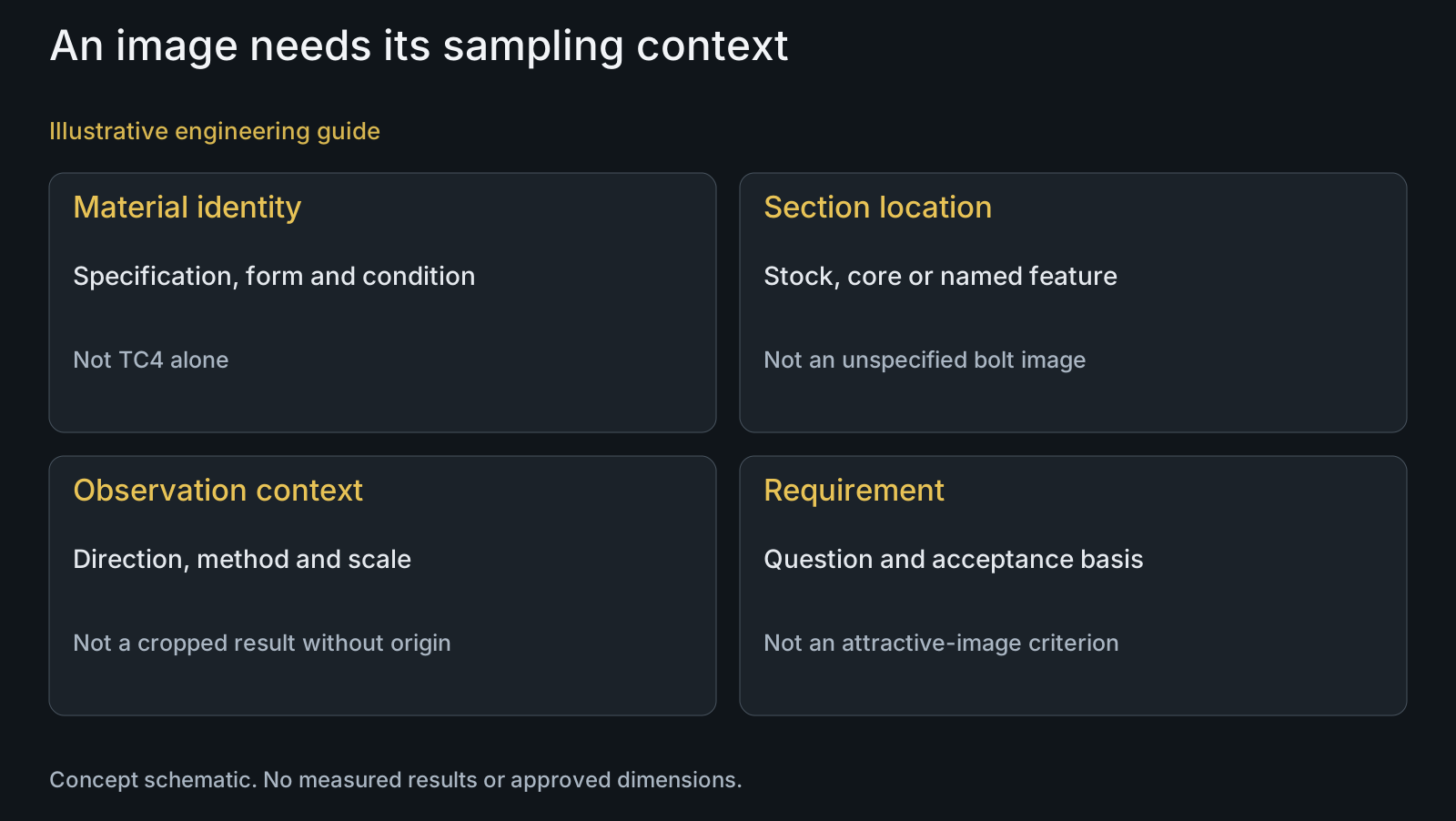
A section through a stock sample, axle core or manufactured thread region represents a different location. Record the actual origin rather than labeling every photograph TC4 bolt. If the concern is local to a feature, an unrelated section cannot be assumed to answer it.
Show the section direction relative to the stock or component geometry. For a stepped pivot, locating the observation against the shoulder and thread distinguishes it from a generic transverse stock image. The question determines the useful location; no mandatory sample count or destructive section plan is invented here.
| Evidence offered | Potential useful scope | Missing or overextended conclusion | Buyer clarification |
|---|---|---|---|
| Incoming-stock micrograph | Identified stock section and condition | Every later finished region has the same state | Connect stock identity, location and subsequent route |
| Finished shoulder section | Named local region after represented processing | Every thread and axle is identical | State orientation, method and represented population |
| Apparent phase proportion | Observation under a defined assessment | Universal strength-toughness ranking | Identify measurement basis and applicable requirement |
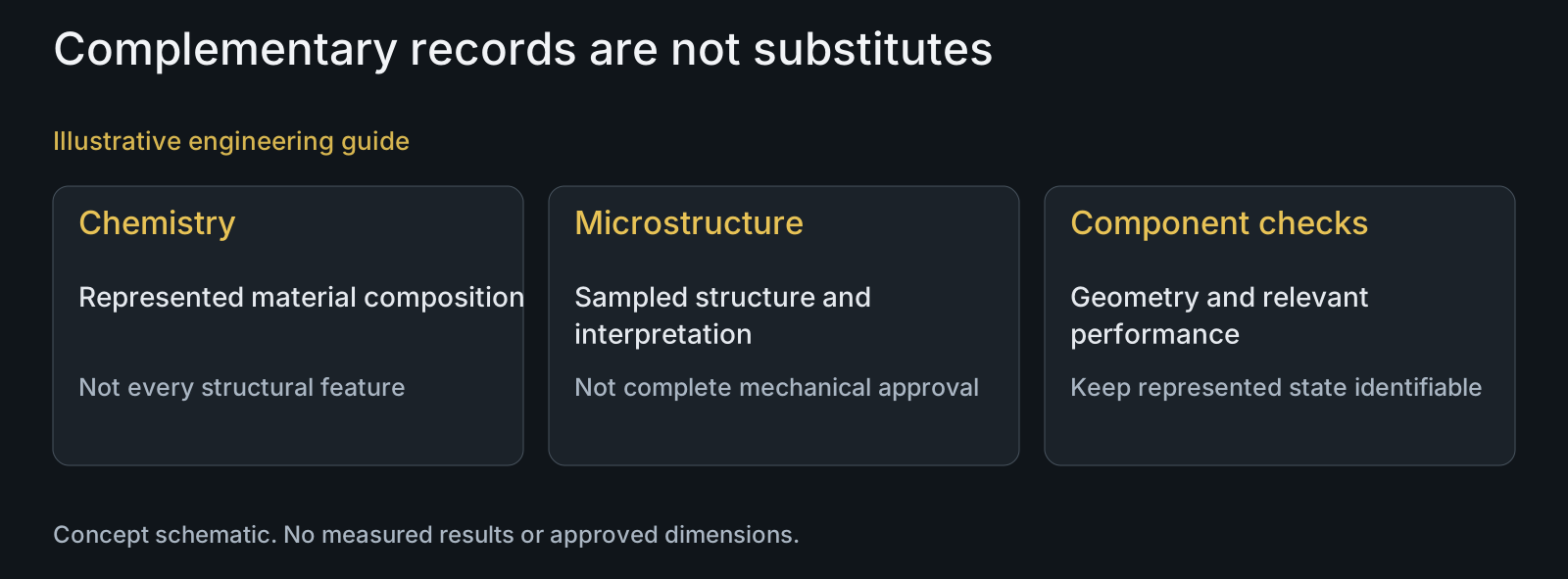
| Chemical material record | Represented composition information | Microstructure or final geometry is approved | Keep chemical and structural evidence distinct |
| Mechanical specimen result | Named specimen, condition and test | Every complete joint has the same performance | Explain specimen-to-component relevance |
| Concept microscopy illustration | Explains an investigation topic | Actual inspected lot or factory capability | Use only as a labeled concept, not acceptance evidence |
Preparation and image context belong with the observation
Identify the specimen preparation, observation method and scale information with the image. A cropped photograph without its scale and location prevents the reviewer from knowing the represented size or region. Keep the image connected to the sample record rather than treating a caption as proof of origin.
A visible light or dark region is an observation, not an automatic chemical phase measurement. If phase identification or quantitative assessment matters to acceptance, specify an appropriate method and interpretation basis. An apparent fraction in one pictured field should not silently become a whole-part percentage or a strength prediction.
Retain the original observation context when images are resized or selected for a report. A detail may illustrate a local feature while omitting its relation to the specimen. No generated concept image on this page is a micrograph, etch result, grain measurement or evidence of an actual inspected titanium lot.
Match each evidence type to its own requirement
A chemical record addresses its represented material composition. A microstructure observation addresses the sampled structure under its method. A mechanical result addresses its specimen and test conditions, while a finished-part dimensional check addresses geometry. One report should not be made to answer every requirement merely because it is attached to the same order.
For purchasing, define whether a microstructure requirement is actually present and how it will be assessed. If no requirement is named, a generic good microstructure photograph supplies no agreed pass criterion. A specification reference and an appropriately represented result are more useful than an unexplained request for laboratory pictures.
Connect the sample to the applicable lot and processing branch. The titanium traceability discussion explains why common stock origin does not imply identical later treatment. A local observation cannot establish every branch or every component without an appropriate sampling and evidence scope. No universal batch-wide coverage is promised.
Illustrative review: stock image and finished shoulder section
Illustrative engineering example: assume an OEM receives a transverse image described as incoming titanium stock and requests information about a shoulder region after a proposed thermal operation. The images and requirements in this scenario are hypothetical; no real micrograph or test result is supplied.
The incoming-stock image can be read only in its represented starting-state context. It cannot independently establish the local finished condition after an unrepresented operation. The reviewer asks where the proposed finished sample would be taken, in which direction and against what requirement its observation would be assessed.
The team keeps chemical, microstructural, mechanical and geometric questions separate while connecting them to the same specified supply state. PremFixer's manufacturing review can define the component and agreed evidence deliverables, including any arranged specialist assessment. This example does not claim an in-house metallography laboratory, approved sampling plan or successful material transformation.
Questions buyers need to confirm
Does TC4's alpha-beta description establish a finished axle's strength?
No. Define material specification, form and condition together with relevant processing and final requirements. The family description is not a universal finished-part property state.
Can one micrograph demonstrate the condition of every pivot in a lot?
Not by itself. Identify sample origin, location, orientation and the represented population. A batch-wide conclusion needs an appropriate agreed sampling and evidence basis.
Is more beta phase automatically preferable for a pivot bolt?
No universal ranking is established. Specify the material condition and property question and use a supported interpretation; do not infer a preferred strength-toughness balance from a lone apparent fraction.
Can a stock section replace a finished-feature observation?
Only to the extent that its represented scope answers the question. An incoming image does not independently describe an unrepresented later operation or another local component region.
Does a micrograph replace chemical, mechanical or dimensional records?
No. Each addresses different requirements and represented states. Link them where relevant without expanding a structural observation into every property or geometry conclusion.
What should a microstructure assessment request identify?
State the material specification and condition, actual stock or part origin, process history and question to resolve. Identify proposed section location and orientation, observation basis and applicable requirement with any complementary evidence needed.
Technical references and scope
TIMET: TIMETAL 6-4 data sheet. Alpha-beta family and property dependence on microstructure/history. No numeric allowables, preferred phase fraction or finished-pivot qualification transferred.
ASTM: E3-26 public scope and significance. Specimen preparation, selection/location/orientation and uses of metallography. No paid procedure or universal Ti acceptance criterion reproduced.
Explore related component, material and sourcing decisions in the customer decision knowledge center. For a drawing review, use the Drawing/BOM RFQ path.
Define the material question before requesting a micrograph
Send the titanium specification and condition, stock or finished-part drawing, relevant process history and the material requirement or investigation question. Identify the region of concern and requested evidence scope. PremFixer will review manufacture and agreed assessment deliverables without treating a concept image or unlocated stock section as complete pivot acceptance.
Discuss the drawing and BOM