
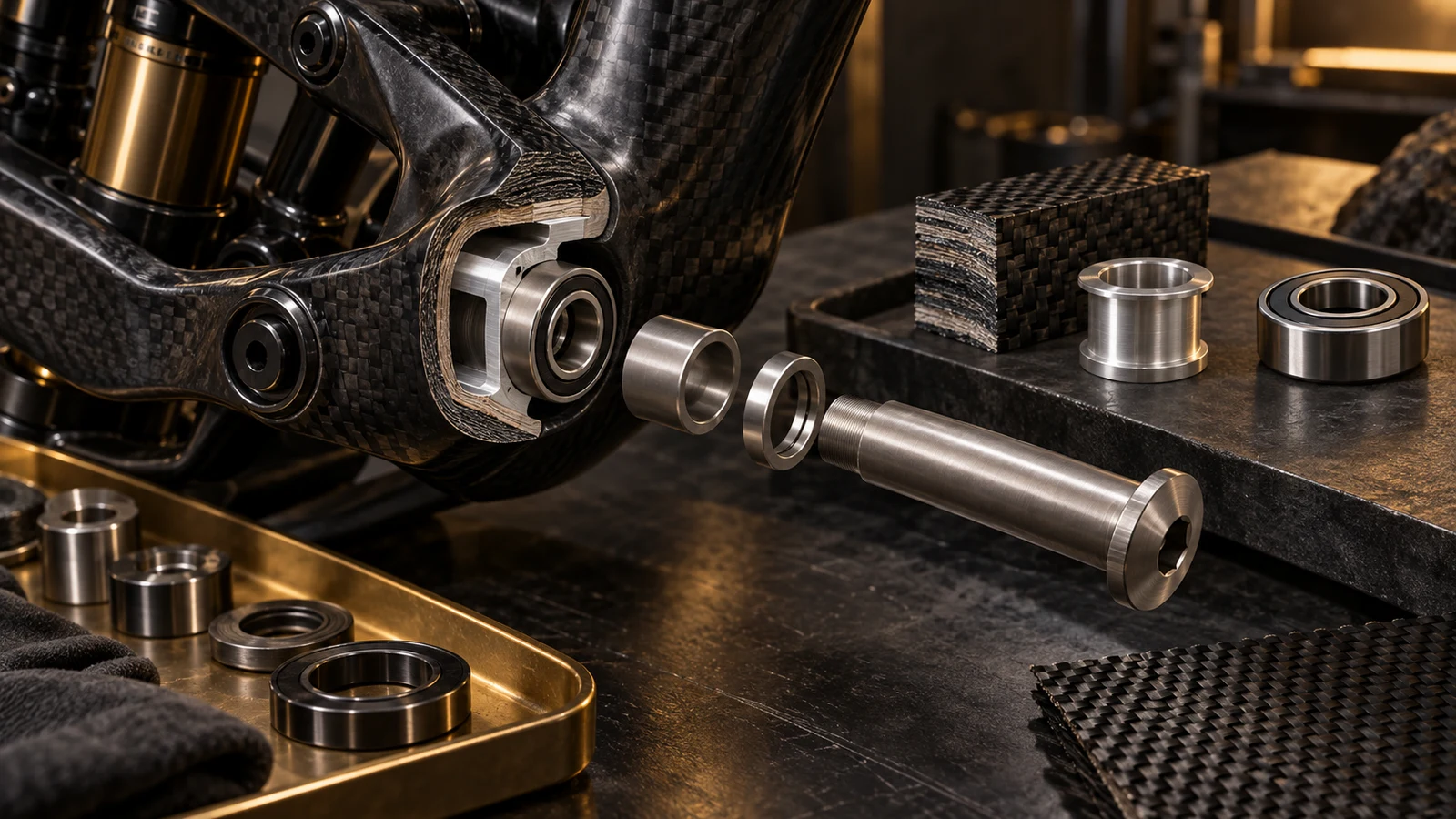
Titanium pivot hardware may be suitable for a carbon bicycle frame, but titanium and carbon are not a complete compatibility specification. A carbon-frame joint can also contain metal inserts, bearings, sleeves, contact rings and surface layers. The buyer needs to know which component receives the thread and where tightening transfers load, not just whether the bolt resists corrosion. Review the complete interface for environmental exposure and mechanical contact as separate questions. A clean-looking titanium part does not establish that a neighboring insert is protected or that the composite structure can accept the proposed clamp arrangement. Frame-specific approval remains necessary.
Hero: concept illustration of example hardware and its application. It is not a factory photograph, tested component or approved production geometry.
Identify what the titanium part actually touches
Start with a section through the pivot rather than an exterior photograph. Locate the receiving thread, shoulder support, bearing rings, sleeve ends and head contact. Record each mating material and finished surface. A titanium bolt threaded into an aluminum insert presents a different review from a bolt supported by a separate sleeve and threaded into another titanium component.
Distinguish direct laminate contact from load transferred through a designed metal insert or contact component. The carbon appearance outside the boss does not reveal its internal construction. An external STEP model may establish envelope geometry without identifying laminate, bonded interfaces or the intended contact footprint.
Specify the delivered scope: bolt only, matched bolt and sleeve, or an assembly-defined hardware set. A full-suspension hardware review can address manufacturing of the defined components. It cannot infer the hidden frame construction or approve a replacement from nominal thread size alone.
Do not judge corrosion from the bolt alone
TIMET's corrosion guide explains that passive titanium coupled to another metal can accelerate attack on that metal in the described environment. Its seawater discussion also identifies exposed-area effects. These are bounded material principles, not a predicted rate or service life for a bicycle pivot. No universal titanium-carbon potential difference is established here.
For the actual frame, map which conductive surfaces could be connected and where moisture or contamination can remain. Include inserts and neighboring hardware rather than treating the carbon exterior as the entire assembly. A claimed barrier needs a defined location and continuity; a visible coating on the outside does not prove that the internal contact is isolated.
Assess the relevant part when deterioration is reported. An intact titanium axle beside a damaged aluminum receiver does not prove that the joint passed a corrosion review. Conversely, a mark near the pivot does not identify a galvanic mechanism without examining the affected material and exposure. The 7075/carbon interface guide addresses the aluminum-centered decision separately.
| Interface condition | Decision that changes | Risk of a material-only shortcut | Useful verification |
|---|---|---|---|
| Titanium thread in a metal insert | Receiver material, geometry and finished contact | A healthy axle conceals a vulnerable receiver | Identify insert and inspect the relevant contact and thread |
| Head or ring near laminate | Footprint and supported contact region | Bolt strength mistaken for composite acceptance | Review section geometry and the intended load path |
| Sleeve and bearing stack retained | Support, seating and assembled clearance | Nominal thread size mistaken for complete fit | Check the actual mating stack and finished dimensions |
| Protected internal interfaces | Barrier location, continuity and exposure | Exterior finish assumed to isolate hidden contacts | Define protected surfaces and assess the represented assembly |
| Proposed washer or ring change | Footprint, grip and clearance | Generic protection changes another critical interface | Compare contact and stack dimensions before approval |
| Suspected composite damage | Frame assessment rather than bolt appearance | Clean hardware mistaken for a safe frame | Stop use and obtain the frame manufacturer's appropriate service assessment |
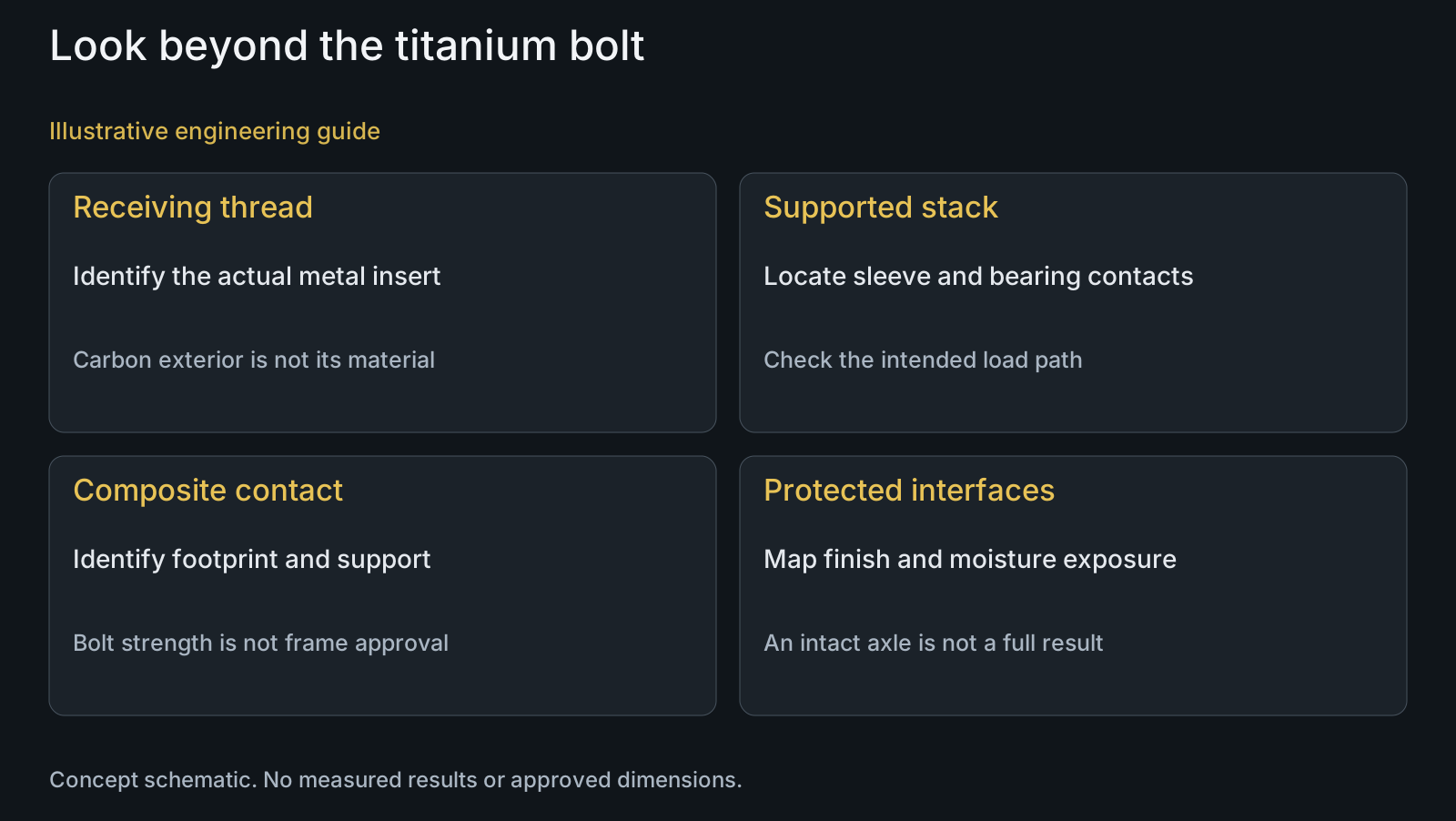
Compatibility also requires the intended composite load path
As engineering analysis, the same total clamp force acting through different contact footprints can produce different local contact demands. Actual pressure distribution depends on geometry, stiffness and contact behavior; it cannot be reduced to bolt material alone. Identify the head or ring's contact face, edge clearance and supported region before changing the hardware.
A stronger bolt does not establish the acceptable load for a laminate or bonded insert. Adding a washer is not automatically protective either: it changes the footprint and can also alter stack length, thread engagement and clearance. Treat a proposed contact component as a geometry change requiring design review, not a universal service remedy.
Follow the assembly conditions for the represented frame and hardware. Trek's torque guidance warns that over-tightening can damage components and directs users to model-specific information. It supplies no titanium retrofit setting. The torque and clamp-force discussion explains why a changed friction condition deserves its own assessment.
Separate manufacturing checks from frame acceptance
A finished-part inspection can verify the specified axle diameter, thread, head face and surface condition within its agreed scope. It does not establish insert-bond integrity, laminate acceptance or complete pivot durability. Match the inspection question to the component whose behavior matters.
For an OEM sample review, use the identified mating assembly and define which observations concern seating, clearance, rotation or structural behavior. A sample that can be screwed into the receiver has answered an initial fit question, not every loading or environmental question. Record whether the tested configuration actually includes the proposed surface and contact parts.
Do not use a normal exterior appearance to clear suspected composite damage. Trek's carbon care guidance notes that carbon damage can be concealed and advises stopping use and obtaining appropriate service when damage is suspected. No tap-test recipe, field repair or safe-to-ride diagnosis is supplied here.
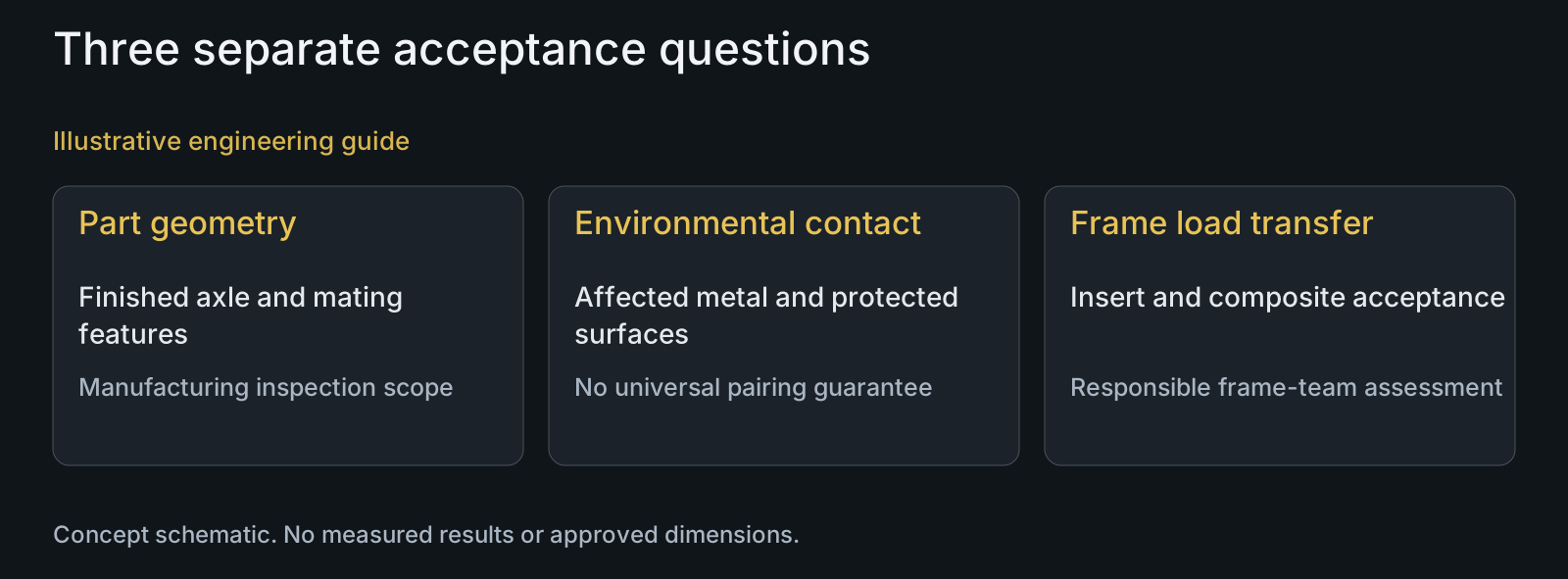
Illustrative review: the titanium axle is only one acceptance item
Illustrative engineering example: assume a proposed carbon-frame pivot has a titanium axle, an aluminum threaded insert and a separate contact ring. The OEM wants to replace the existing axle while retaining the receiver. The exterior drawing does not show the insert bond or the intended ring footprint, and no test has been performed.
The review separates three decisions. First, compare the new axle's controlled geometry with the original supported stack. Second, identify the metal contact and environmental-protection assumptions. Third, confirm how the retained ring and insert transfer clamp load into the composite. The titanium material name closes none of those decisions by itself.
The manufacturing RFQ can proceed with the available axle definition while the responsible frame team supplies the missing interface requirements. PremFixer's CNC turning scope concerns the drawing-defined machined part, not composite-frame qualification. This assumed review reports no customer result, corrosion improvement, pressure limit or validated replacement.
Questions buyers need to confirm
Must a carbon frame use titanium pivot bolts?
No. The frame label does not select the hardware material. Identify the receiver, support and contact arrangement, then evaluate the proposed material and assembly against the actual platform requirements.
Can a titanium axle remain intact while its aluminum receiver deteriorates?
Yes, that possibility should be considered. The actual mechanism requires evidence about the affected material, conductive contact and exposure; an unaffected titanium surface is not proof that the entire interface is protected.
Does titanium prevent carbon-frame crushing?
Not by its material name. The relevant contact footprint, support, clamp condition and composite construction determine the mechanical review. A stronger axle cannot establish laminate or bonded-insert acceptance.
Should I add a washer between titanium hardware and the carbon frame?
Not as a universal remedy. A washer can change contact geometry, stack length, engagement and clearance. Use the frame team's controlled interface definition rather than adding an unapproved part.
Does a torque value from a similar carbon bicycle apply?
Not automatically. Identify the actual hardware revision, contact arrangement and specified friction or locking condition. A similar appearance does not establish the same tightening requirement or permitted substitution.
What information is needed for a titanium carbon-frame pivot RFQ?
Provide the axle and assembly drawings, mating BOM, insert material and geometry, contact-ring and sleeve details, finished surfaces and approved assembly conditions. Identify which frame-interface details remain unavailable so manufacturing review is not mistaken for application approval.
Technical references and scope
TIMET: Corrosion resistance of titanium. General galvanic discussion and seawater area effects. No bicycle corrosion rate, universal titanium-carbon potential or service-life claim transferred.
Trek: Owner's manual torque guidance. Over-tightening risk and model-specific instruction boundary. No numeric setting or titanium substitution approval reproduced.
Trek: Carbon care. Potential concealed composite damage and appropriate service referral. No warranty claim, test recipe or remote structural diagnosis adopted.
Explore related component, material and sourcing decisions in the customer decision knowledge center. For a drawing review, use the Drawing/BOM RFQ path.
Define the titanium-to-frame interface before ordering
Send the controlled part drawing or STEP file with the pivot section, mating BOM, receiver material, sleeve and contact-ring details, surface requirements and assembly conditions. PremFixer will review drawing-defined manufacture and sample supply; the responsible frame team retains composite-interface and application approval.
Discuss the drawing and BOM