
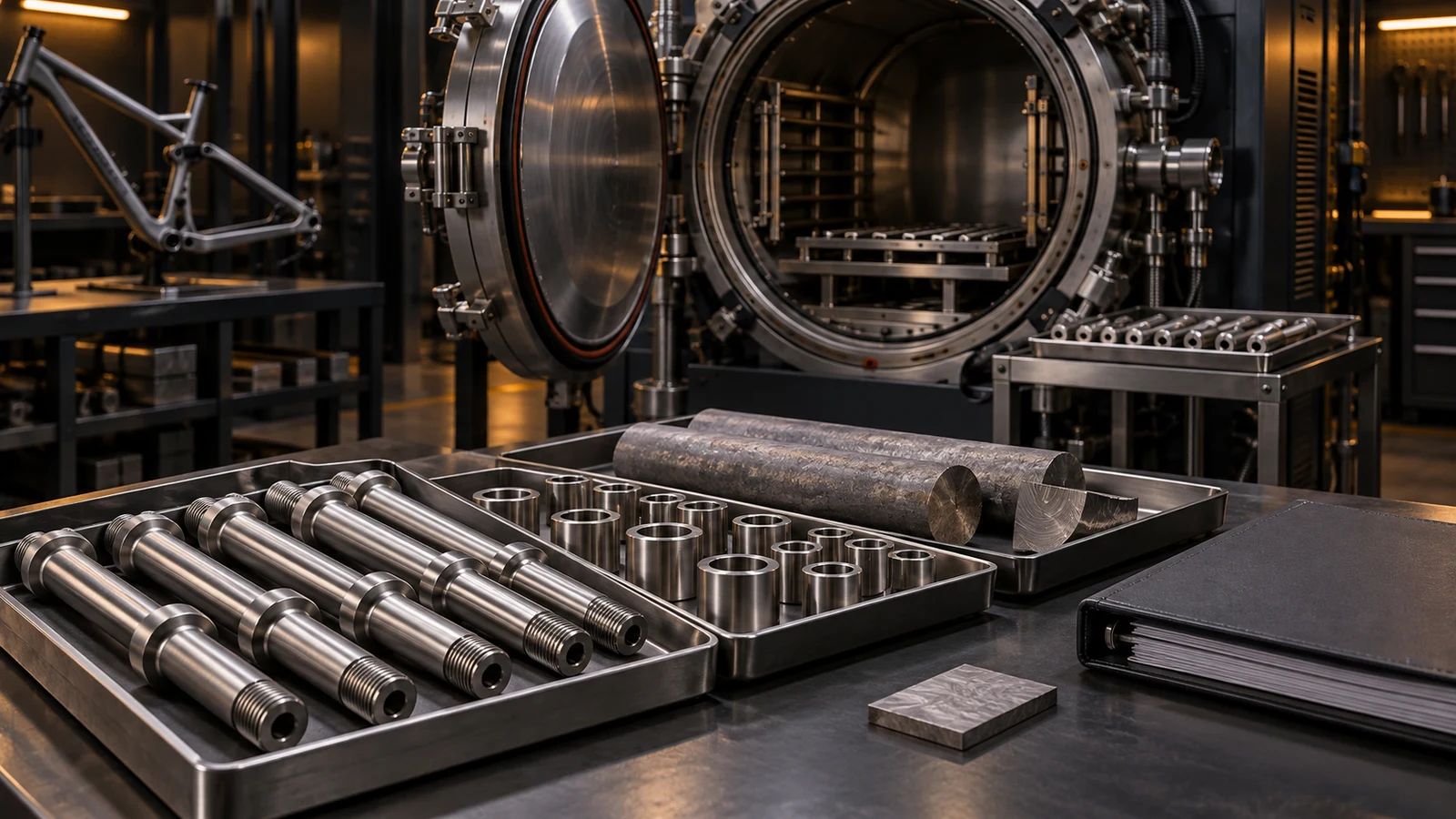
Titanium pivot bolts require hydrogen-related processing control when the manufacturing route presents relevant exposure; the material name does not make the issue disappear. For an OEM or SQE, the decision is whether the specified stock, surface operations and any thermal treatment produce the required final condition. Vacuum annealing is not a universal acceptance certificate, and a treatment borrowed from high-strength steel is not automatically suitable for titanium. Identify the exposure and intended treatment first, then distinguish chemical evidence from mechanical and dimensional acceptance. No comparative failure rate, zero-hydrogen claim or standard PremFixer vacuum-annealing route is established here.
Hero: concept illustration of example hardware and its application. It is not a factory photograph, tested component or approved production geometry.
Identify exposure instead of ranking materials by a slogan
Hydrogen risk is a question about material and conditions, not simply whether titanium is better than steel. TIMET's corrosion manual describes hydrogen absorption and hydride-related embrittlement under particular conditions. Those industrial observations do not supply a universal probability for TC4 bicycle bolts or prove that every observed fracture involves hydrogen.
For manufacturing review, identify which operations actually contact or heat the specified material. Surface cleaning, chemical treatment, furnace atmosphere and sequence deserve different questions; listing every possible operation is not proof that an order uses them. Ask the supplier to define the proposed route and the controls relevant to that route.
Keep alloy, stock form and starting condition visible. The AMS 4928 and ASTM B348 discussion explains why the material requirement must name its scope rather than relying on TC4 alone. This article does not reproduce paid material limits or select a universal hydrogen acceptance value.
A controlled atmosphere and a dehydrogenation claim are different
TIMET's design and fabrication guide discusses contamination control during heating and distinguishes stress relief from annealing. It also warns about hydrogen pickup with unsuitable atmospheres. The presence of vacuum equipment does not, by itself, establish why a part was heated or what condition resulted.
If a proposed operation is intended to reduce hydrogen, state that purpose explicitly and obtain a process definition appropriate to the material and component. Do not call every vacuum cycle dehydrogenation or assume that stress relief proves a chemical endpoint. No temperature, duration, pressure or acid-bath recipe is provided here.
A thermal operation may also affect the required material state and later manufacturing sequence. Compare its intended output with the specified final properties and geometry. Adding an undefined cycle after finish machining is not automatically an improvement; it introduces another condition that the responsible process and design teams must assess.
| Evidence or proposal | Question it can address | What it does not establish | Buyer action |
|---|---|---|---|
| Incoming chemistry report | Composition of its represented stock sample | Effects of unrepresented later exposure | Identify stock relationship and sampling state |
| Controlled surface route | Conditions applied at the defined operation | Finished hydrogen content merely from the process name | Identify chemistry, route controls and applicable acceptance |
| Vacuum-cycle record | The represented thermal operation | Automatic dehydrogenation or correct final properties | State intended treatment and material-condition requirements |
| Hydrogen analysis | Represented sample result under the selected method | Universal part durability or dimensional approval | Connect method, sample, criterion and batch scope |
| Mechanical acceptance | Specified property of the represented material or component | Replacement for chemical or final-fit evidence | Define the relevant condition and assessment |
| Finished dimensional inspection | Controlled geometry in its inspected state | A hydrogen-risk assessment | Check threads, shoulders and contact features at the agreed endpoint |
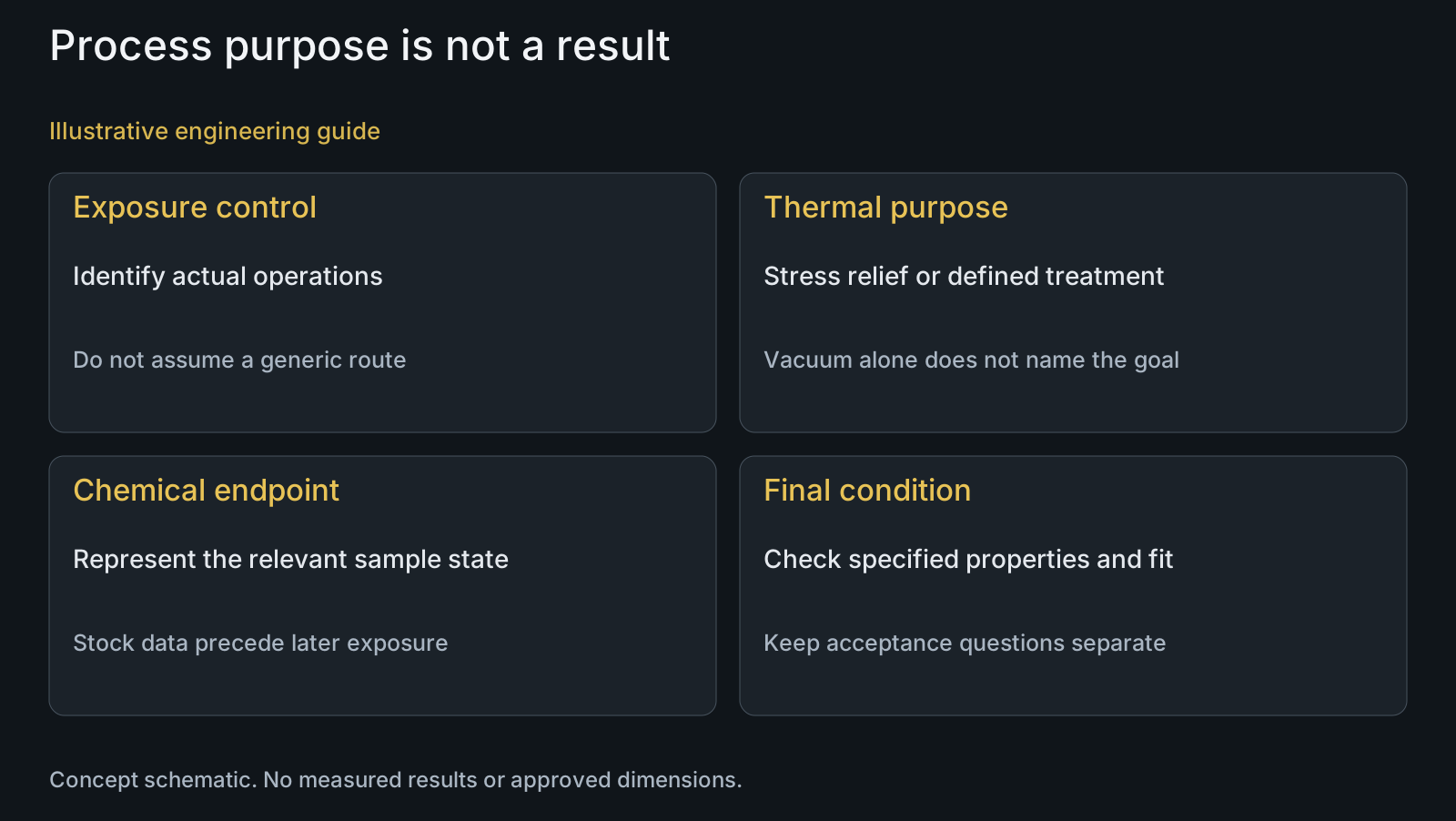
Choose evidence that answers the chemical question
ASTM's public scope for E1447-22 describes hydrogen determination in reactive metals and alloys, particularly titanium and zirconium, by inert gas fusion with the stated detection methods. It is an analytical-method scope, not a hydrogen limit for a finished bicycle pivot or a complete application qualification. The paid procedural clauses are not reproduced here.
Define what a submitted result represents: incoming stock, a process sample or a specified finished-part sample. Identify the material or batch relationship, sampling point, method and acceptance requirement. An incoming-stock result cannot describe chemical changes from operations performed afterward unless the approved evidence plan establishes that relationship.
A numerical report without an identifiable sample or applicable criterion cannot close the purchasing decision. Conversely, a furnace record and an analysis report answer different questions and should not be treated as substitutes. Agree on the necessary evidence before quotation; do not assume every order automatically includes destructive chemistry testing.
Do not let chemistry approval swallow the other requirements
A chemistry result within its specified scope does not measure finished thread geometry, shoulder alignment or every required mechanical property. Define those checks separately. The same part can raise a dimensional or surface question even when the represented chemical result is acceptable.
Match inspection to the final manufacturing state. If subsequent operations alter the surface, geometry or material condition, determine which prior evidence remains applicable and which question must be evaluated again. This is a sequence-specific decision, not a rule to repeat every check after every harmless operation.
PremFixer's manufacturing scope combines drawing-defined production with agreed partner-supported operations and inspection. A hydrogen-control requirement needs an explicit supply and evidence scope. This page does not claim an in-house vacuum facility, hydrogen laboratory or a routine treatment for every titanium order.
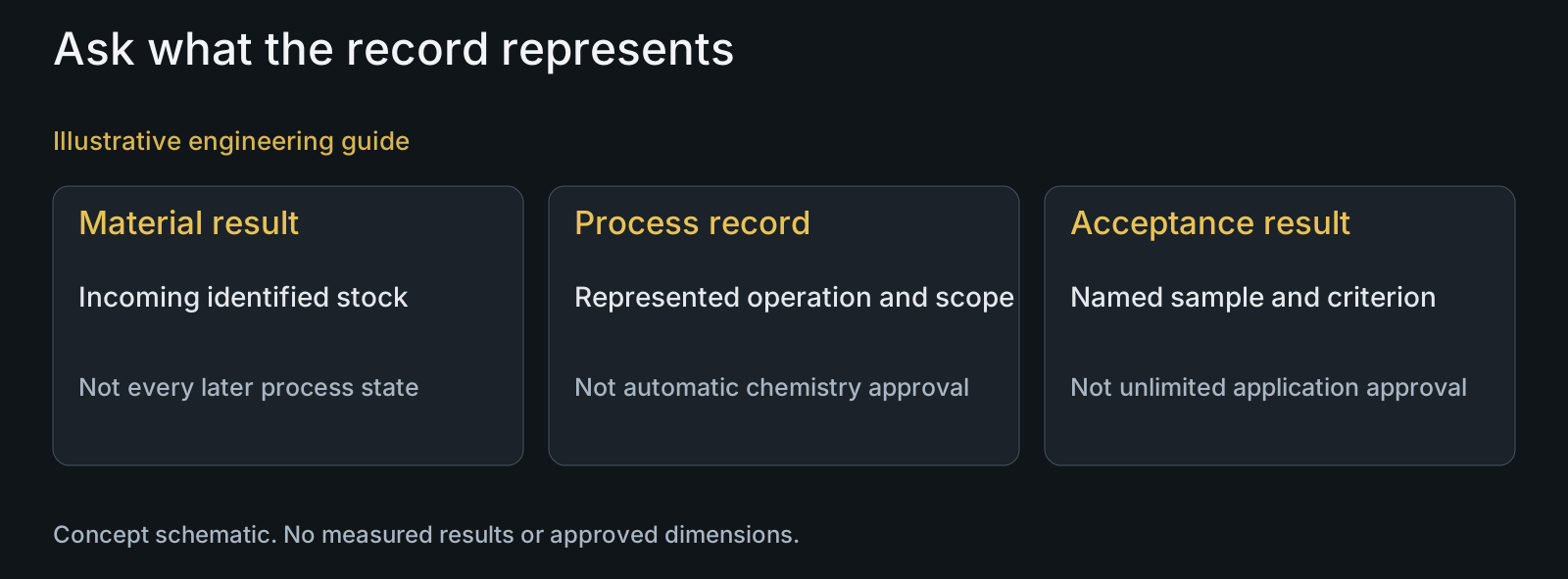
Illustrative review: a stock report does not describe the later surface route
Illustrative engineering example: assume an OEM has a titanium bar chemistry report and proposes an additional chemical surface operation after machining a pivot axle. The quotation mentions vacuum annealing but does not state its purpose or where final acceptance occurs. No actual hydrogen measurement or process qualification is available.
The SQE separates the incoming material result from the later exposure and asks what the proposed thermal step is intended to accomplish. The material team checks whether its output is compatible with the required condition. The evidence plan then identifies the sample state for the chemical question and the final dimensions for the geometry question.
The result is a defined review scope, not a demonstrated removal percentage or a released process recipe. Surface-treatment coordination can be discussed against those requirements, while material acceptance stays with the responsible specification. This assumed example provides no passed test, supplier capability proof or prediction of riding life.
Questions buyers need to confirm
Can titanium suffer hydrogen-related embrittlement?
Yes, under relevant conditions. Identify the alloy, exposure and material state before judging a particular manufacturing route. No universal probability or comparison with high-strength steel is established by the titanium label.
Does vacuum annealing guarantee acceptable hydrogen content?
No. State the treatment's intended purpose and represented conditions, then define the chemical acceptance evidence. A vacuum-cycle record is not a measured finished hydrogen result.
Can a steel hydrogen-relief baking instruction be copied for TC4?
Not automatically. The alloy, starting condition, process objective and required final properties differ. Use an appropriate controlled titanium process rather than transferring an unrelated temperature-and-time recipe.
Is the incoming titanium chemistry report enough after additional surface processing?
Not by itself for an unrepresented later condition. Identify the subsequent exposure and the approved evidence relationship. The applicable requirement determines whether and how later-state analysis is needed.
Does E1447 define a safe hydrogen limit for every pivot bolt?
No. Its public scope concerns an analytical method for the represented materials. The applicable material or purchasing specification must establish the acceptance criterion and required sample scope.
What should a titanium hydrogen-control RFQ include?
Provide the material specification and starting condition, drawing, proposed surface and thermal sequence, final property requirements and chemical acceptance scope. Identify requested reports and sample state, rather than asking for an undefined hydrogen-free guarantee.
Technical references and scope
TIMET: Corrosion resistance of titanium. Condition-dependent hydrogen absorption and hydriding discussion. No universal TC4 risk ranking or numerical bicycle limit adopted.
TIMET: Titanium design and fabrication handbook. Heating contamination, atmosphere and treatment-purpose distinctions. No chemical bath, thermal recipe or automatic dehydrogenation claim reproduced.
ASTM: E1447-22 public scope. Analytical method and represented material scope only. Paid clauses, acceptance limits and universal sampling rules not claimed.
Explore related component, material and sourcing decisions in the customer decision knowledge center. For a drawing review, use the Drawing/BOM RFQ path.
Specify hydrogen-control evidence with the manufacturing route
Send the controlled drawing, specified titanium condition, planned surface operations and any intended thermal treatment. Include the applicable chemical and mechanical requirements and requested report scope. PremFixer will review manufacture and coordinated processing; no routine vacuum treatment or zero-hydrogen promise is implied.
Discuss the drawing and BOM