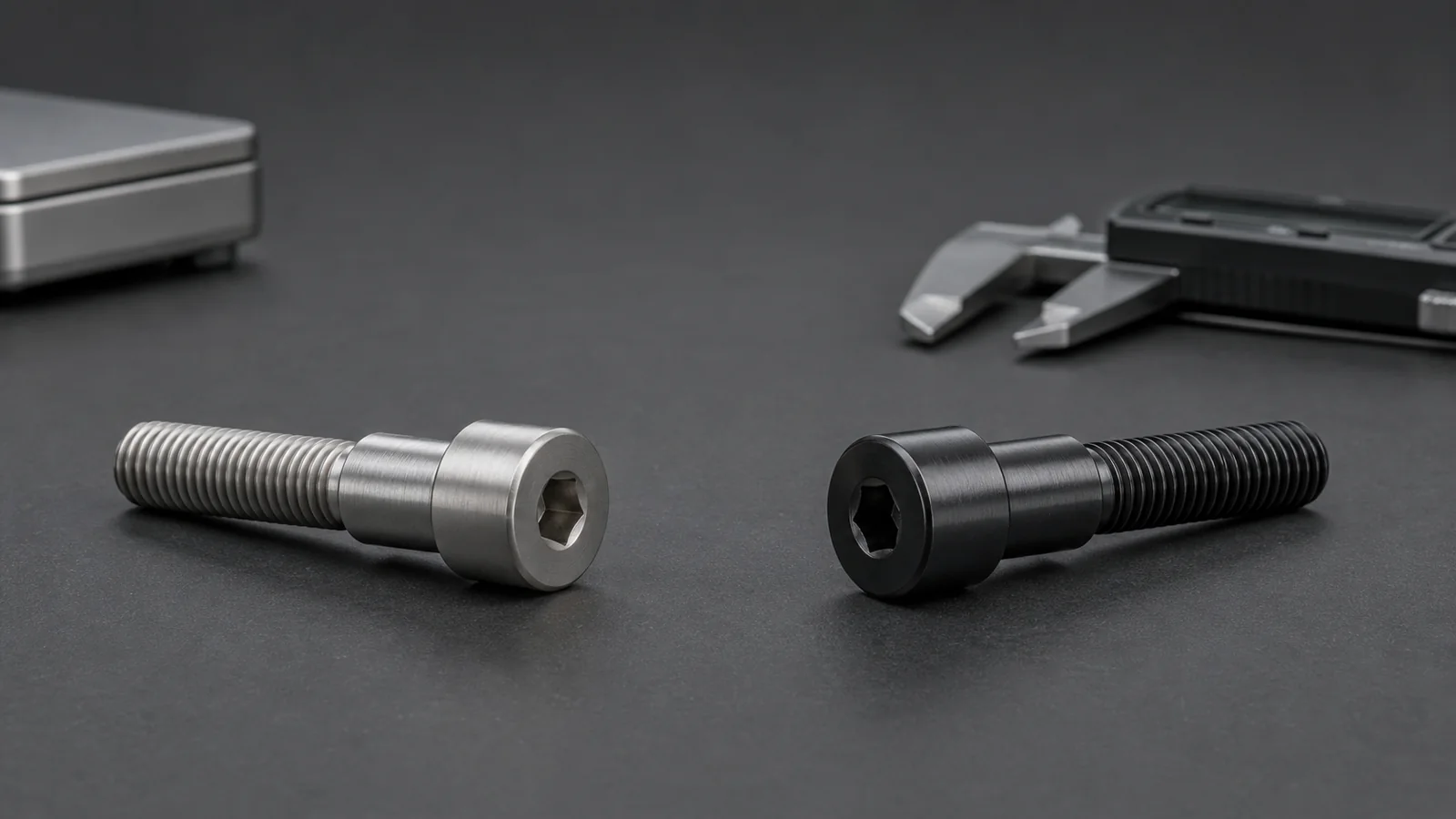
Engineering guide to material selection for bicycle fasteners
## The Question Every Frame Engineer Asks
Two materials dominate bicycle fastener specification: **42CrMo quenched-and-tempered alloy steel** and **A2/A4 austenitic stainless steel**. They serve fundamentally different engineering requirements, and choosing the wrong one for a critical interface creates either a corrosion risk or a fatigue risk.
This guide helps frame engineers, sourcing managers, and product designers make an informed material selection based on the actual loading conditions, environment, and cost requirements of their bicycle program.
## Material Properties at a Glance
| Property | 42CrMo (1.7225 / SCM440) | A2 Stainless (304 / 1.4301) | A4 Stainless (316 / 1.4401) |
|---|---|---|---|
| Tensile strength | 900–1100 MPa (QT) | 500–700 MPa | 500–700 MPa |
| Yield strength | 650–850 MPa (QT) | 200–300 MPa | 200–300 MPa |
| Hardness | 28–36 HRC | ≤20 HRC | ≤20 HRC |
| Elongation | 12–15% | 40–50% | 40–50% |
| Fatigue strength | ~450 MPa (rotary bending) | ~240 MPa | ~240 MPa |
| Corrosion resistance | Requires coating | Naturally passive (CRC III) | Marine-grade (CRC V) |
| Magnetic | Yes | No (slightly magnetic after cold work) | No |
| Cost (relative) | 1.0× | 1.8–2.5× | 2.5–3.5× |
## When to Choose 42CrMo Alloy Steel
42CrMo is the workhorse of high-strength bicycle fasteners. After quenching and tempering, it delivers tensile strength approaching 1100 MPa—roughly double that of cold-worked stainless steel.
### Best Applications for 42CrMo
- **Suspension pivot bolts** — fatigue-critical joints under cyclic bending and shear
- **Disc brake mount axles** — high clamp load and brake torque reaction
- **Folding hinge axles** — bending and shear through the frame fold mechanism
- **Motor mount bolts** — torque reaction and structural loading in e-bike applications
- **Chainring bolts** — cyclic tension in the drivetrain
### Strength Comes with a Trade-Off
42CrMo must be coated for corrosion protection. An uncoated 42CrMo bolt in a wet environment will rust. Common coating strategies:
| Coating | Salt Spray (NSS) | Typical Application |
|---|---|---|
| Zinc plating (blue/white) | 72–96h | Indoor / dry climate |
| Zinc-nickel plating | 240–480h | Mixed weather use |
| Dacromet / Geomet | 480–720h | Wet climate, MTB use |
| ED coating (black) | 240h+ | Aesthetic + corrosion |
| Nickel plating | 96h+ | Decorative |
## When to Choose Stainless Steel
A2 (304) and A4 (316) stainless steels offer inherent corrosion resistance without coating. This makes them ideal for fasteners where coating damage during installation is a concern, or where the aesthetic requirement prohibits coating.
### Best Applications for Stainless Steel
- **Water bottle cage bolts** — exposed to sweat and rain, low structural load
- **Fender and rack mounts** — wet environment, moderate load
- **Cable guide screws** — low torque, cosmetic visibility
- **Brake caliper mounting bolts (A4)** — moderate strength with corrosion protection
- **Stem faceplate bolts** — visible, moderate torque
### The Strength Limitation
A2/A4 stainless fasteners max out at approximately 700 MPa tensile strength and have significantly lower fatigue strength than 42CrMo. This makes them unsuitable for:
- Suspension pivot bolts under cyclic fatigue loading
- Motor mount bolts under torque reaction
- Any application where the bolt is the primary load-carrying element
Attempting to substitute an A2 stainless bolt for a 42CrMo bolt in a fatigue-critical application will result in premature failure.
## Head-to-Head Decision Matrix
| Application | Recommended | Acceptable Alternative | Avoid |
|---|---|---|---|
| Suspension pivot | 42CrMo QT | 17-4PH SS | A2/A4 SS |
| Brake mount boss | 42CrMo QT | 17-4PH SS | A2 SS |
| Bottle cage bolt | A2 SS | 42CrMo + Dacromet | — |
| Rack mount bolt | A2/A4 SS | 42CrMo + Zn-Ni | — |
| Motor mount bolt | 42CrMo QT | 17-4PH SS | A2/A4 SS |
| Stem bolt | A2 SS | Ti-6Al-4V | — |
| Chainring bolt | 42CrMo QT | Ti-6Al-4V | A2 SS |
## The Galvanic Corrosion Consideration
When a stainless steel bolt threads into an aluminum frame, galvanic corrosion is a real concern in the presence of an electrolyte (water + road salt). The solution is not to avoid stainless—it's to use:
- Thread locking compound as an electrical insulator
- Anti-seize compound on the thread engagement
- A4 (316) stainless for better galvanic compatibility with aluminum
- Anodized frame interfaces where possible
Carbon frames eliminate the galvanic concern but introduce different challenges with thread insert pull-out and crush strength.
## Submit Your Material Preference
Every PremFixer RFQ starts with your drawing and material specification. Our engineering team will review your application and confirm material compatibility within 24 hours.
Discuss Material Selection
## Related Knowledge
- [Forging vs CNC for Bicycle Hardware](/knowledge/forging-vs-cnc-bicycle-hardware)
- Surface Treatment Guide (coming soon)
- Thread Tolerance for Bicycle Fasteners (coming soon)
## Related Series
- [PS-D Suspension Pivots & Linkage Bolts](/products/ps-d-suspension-pivots-linkage-bolts)
- [PS-R E-Bike Motor Mounts](/products/ps-r-motor-mounts)
- [PS-B Disc Brake System Accessories](/products/ps-b-disc-brake-system-accessories)