

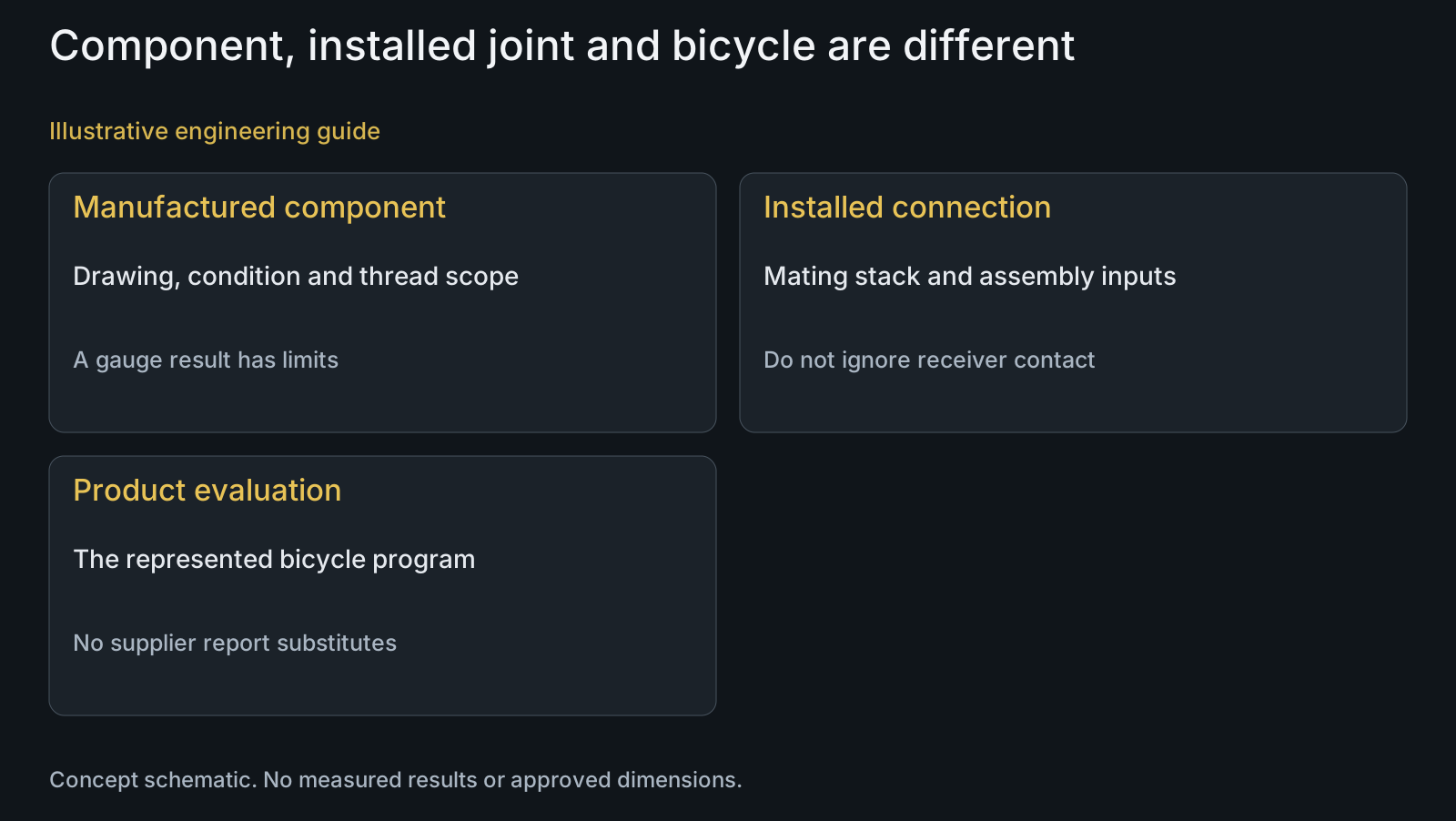
For a US bicycle program, define the pivot hardware and its installed connection before asking the supplier for evidence against 16 CFR part 1512. CPSC's public guidance says attachment screws, bolts and nuts must not loosen, break or fail during the required testing. That is an assembly-performance question, not a universal standalone bolt certificate. The supplier needs a drawing, specified material and finished condition, mating-part information and installation assumptions. The bicycle team must connect those inputs to its product evaluation. A thread gauge result, strength designation or stock certificate can support a limited question, but none independently demonstrates the behavior of the complete pivot joint.
Hero: concept illustration of example hardware and its application. It is not a factory photograph, tested component or approved production geometry.
Start with the attachment's intended function
Identify what the pivot hardware secures and which surfaces carry the load. An axle may locate bearing inner rings while a receiver closes the clamped stack. A spacer can maintain the intended separation. Describe these functions rather than assume that a bolt's nominal diameter explains the complete connection.
CPSC's business guidance places attachment-hardware behavior within bicycle testing. The 2025 official CFR publication also addresses threaded hardware suitable for adjustment and maintenance. Use the responsible product team's applicable requirements and current assessment plan; this guide is not an individual compliance finding.
Keep the actual product and intended use clear. The export-document guide handles destination and certification responsibilities. This article focuses on converting a selected connection requirement into useful component and assembly inputs.
Write a purchasable component specification
Give each axle, receiver and spacer its own controlled identity. Specify dimensions, interface limits, thread designation, material condition and required finish. Include acceptance criteria for the features that influence engagement, seating and the represented load path.
An instruction reading meet 16 CFR 1512 does not select the bearing-seat diameter, receiver engagement or clamped stack. Those decisions belong in the drawing and assembly definition. The drawing and fit guide explains how to make inspection correspond to the actual interface.
Choose evidence for the specified delivered state. Stock identity is relevant to material sourcing; it does not report a finished bearing seat or evaluate an assembled receiver. Request the agreed component results without claiming they represent every bicycle-level characteristic.
| Connection question | Supplier input | What it can support | What still needs evaluation |
|---|---|---|---|
| Will the specified parts mate? | Thread and finished-interface definition with agreed measurements | Represented component conformity | Actual mating parts and assembled contact |
| Does the receiver close the intended stack? | Axial geometry, engagement and spacer configuration | The defined component relationship | Bottoming, seating and assembly behavior |
| Is the stated material supplied? | Specified condition and linked material evidence | Represented material identity or results | Finished geometry and joint performance |
| Does installation create the intended joint? | Surface, lubrication and installation assumptions | A defined assembly input | Project-specific clamp and retention assessment |
| Does attachment retain its function during product evaluation? | Identified production-representative hardware and records | The hardware configuration used | Applicable bicycle evaluation and disposition |
| Can old evidence cover a changed stack? | Old and revised interface definitions | A basis for comparing represented configurations | Impact on contact, engagement and prior conclusions |
Do not confuse thread quality with mechanical properties
The official 2025 publication of section 1512.4(d) refers to Handbook H28 for recommended thread form and separately names mechanical-property recommendations. It does not describe H28 as a universal pivot-strength test. DLA's public FED-STD-H28 scope concerns screw-thread dimensional and acceptability requirements.
Agree the actual thread standard, size, pitch, class and finished inspection condition in the purchase definition. Do not silently replace a historical regulatory reference with a current document and assume the product reviewer has accepted the substitution. The applicable reference and supplier specification need an explicit relationship.
Passing the agreed thread inspection can support interchangeability within that scope. It does not establish clamp load, resistance to loosening or the strength of the receiver and surrounding structure. Keep those functional questions visible rather than add an unsupported certified-thread label.
Represent the installed joint, not only the loose bolt
Identify the mating thread, engagement, bearing and spacer stack, contact surfaces, finish and any specified lubrication or retention method. A nominally correct axle can bottom out in a receiver or contact the wrong stack surface, creating a different joint from the one intended.
Make assembly assumptions available to the supplier and the evaluation team. A torque number without its surface and installation conditions is incomplete. The torque-development guide addresses that relationship without offering a universal value for all pivot designs.
Engineering review should distinguish fracture, loss of clamp and inability to perform the intended attachment function. These are different possible outcomes. Raising a material property class alone does not explain which mechanism is controlled or whether the assembled configuration has been represented.
Illustrative engineering example: a conforming axle meets the wrong stack
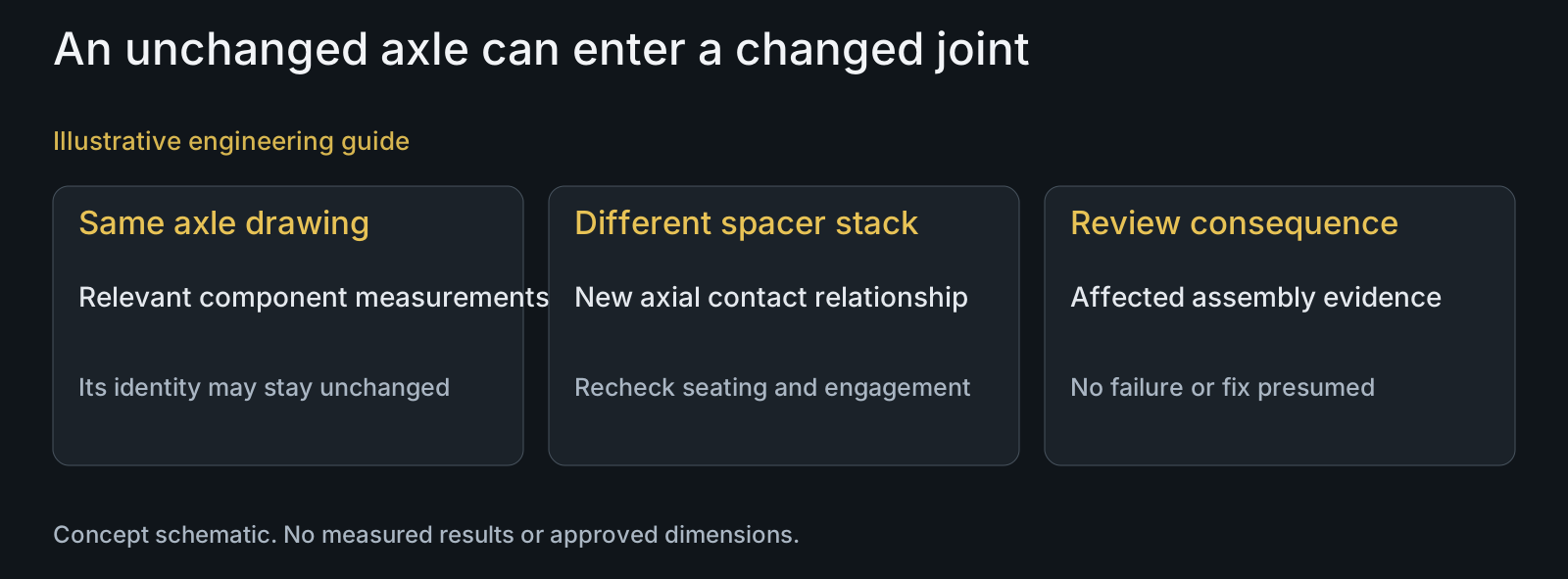
Illustrative engineering example: assume an OEM specifies an axle and receiver for a bearing-and-spacer stack. The component drawing is unchanged, but the assembly team substitutes a different spacer arrangement. No failed bicycle test, injury or real customer event is assumed.
The supplier's agreed axle measurements may remain relevant to that axle. They cannot show that the altered stack retains the intended contact and engagement. The reviewer compares the revised axial interfaces, confirms where the receiver seats and identifies which installation assumptions need another evaluation.
The corrective decision is to reconcile the component and assembly definitions before claiming equivalent attachment behavior. Ordering another copy of the material certificate would not answer the mismatch. The example demonstrates a possible evidence gap, not a verified failure mechanism or a proven fix.
Assign evidence to the decision it supports
Connect each requested result to the represented object: supplied stock, finished component, installed joint or bicycle configuration. State who provides samples and component records, who evaluates the assembly and who owns the product disposition. Do not treat a supplier's dimensional report as the latter decision.
When a finish, receiver or spacer changes, assess which prior inputs no longer represent the joint. Retaining the same axle part number does not automatically preserve the assembly evidence. Keep the change and resulting scope decision visible to purchasing and the bicycle team.
PremFixer can discuss component manufacturability and agreed evidence through its manufacturing scope and rapid-prototyping route. No universal US approval service or passed product test is claimed. The customer decision knowledge center connects the drawing, assembly and acceptance questions.
Questions buyers need to confirm
Does writing 16 CFR 1512 on the RFQ define the pivot bolt?
No. Specify the actual geometry, material condition, finish, thread and mating stack. Relate those inputs to the bicycle team's requirements rather than use a regulation number as the complete manufacturing definition.
Is Handbook H28 a universal mechanical-strength certificate?
No such conclusion is supported. The official 2025 attachment-hardware text refers to it for recommended thread form, while mechanical properties are addressed separately. Agree the actual thread and property specifications with the responsible reviewer.
Can a passing thread gauge establish resistance to loosening?
No. It supports the agreed thread inspection scope. Review the installed surfaces, engagement, retention method and evaluation conditions separately; dimensional thread acceptance does not test the complete attachment function.
Does a stronger axle resolve every connection risk?
No. Seating, receiver engagement and the spacer stack can remain wrong even if the axle material changes. Identify the mechanism at issue before deciding whether a property change addresses it.
Can the same component report cover another spacer arrangement?
It may still represent the unchanged component within its stated scope. It does not independently validate the altered joint. Compare axial contact, engagement and installation conditions to identify affected assembly evidence.
What inputs should a US bicycle program send to PremFixer?
Provide drawings or STEP and BOM, the complete pivot stack, thread and material specifications, finish and installation assumptions, plus the requested component evidence. Identify the product evaluation owner and represented configuration so supplier work supports a defined decision.
Technical references and scope
CPSC: Bicycle Requirements Business Guidance. Current public bicycle assembly and attachment-hardware testing context. No standalone universal bolt certificate or project approval asserted.
Official CFR 2025 publication: section 1512.4. Dated official attachment-hardware and thread-reference text. A project reviewer must confirm the applicable current requirements; not presented as a newly verified complete 2026 legal text.
DLA ASSIST: FED-STD-H28 public document scope. Public screw-thread dimensional and acceptability scope. No automatic substitution for a historical regulatory reference or full clause interpretation.
Explore related component, material and sourcing decisions in the customer decision knowledge center. For a drawing review, use the Drawing/BOM RFQ path.
Turn the attachment requirement into defined supplier work
Share the axle, receiver and spacer drawings or STEP files, assembly stack and BOM, specified condition and finish, and the bicycle team's requested evidence. PremFixer can discuss manufacturing and sample inputs while the responsible team defines the installed-joint and product evaluation.
Discuss the drawing and BOM