

Review a 3TG declaration for pivot hardware through its supporting information, not the words stainless or titanium. Map the actual supplied materials and treatments to the customer's requested products and reporting period. Then ask what supports each answer and whether another attachment contradicts or narrows it. Do not assume every stainless alloy contains tin or that a machining tool establishes tungsten content in a finished titanium pivot. The buyer needs a bounded supplier response, with unresolved questions identified for follow-up. PremFixer can discuss item-specific information, but no universal conflict-free declaration or verified mine-to-part chain is claimed here.
Hero: concept illustration of example hardware and its application. It is not a factory photograph, tested component or approved production geometry.
Keep the four-mineral request distinct from other disclosures
RMI identifies the Conflict Minerals Reporting Template, or CMRT, with tin, tantalum, tungsten and gold. It describes its reporting templates as tools for transferring supply-chain information about mineral origin and smelters or refiners. A customer's request should name the intended template and accepted version rather than use minerals form as an unspecified deliverable.
The responsible-minerals scope guide distinguishes the wider reporting frameworks and product boundaries. This review takes a defined 3TG request and checks whether the answers are internally supported. Do not add other minerals to that response silently; clarify a separate or broader request.
The SEC's disclosure framework concerns specified reporting companies and minerals necessary to product functionality or production. A supplier questionnaire and the customer's legal filing responsibilities are different matters. This article does not determine current filing or audit duties for any particular company.
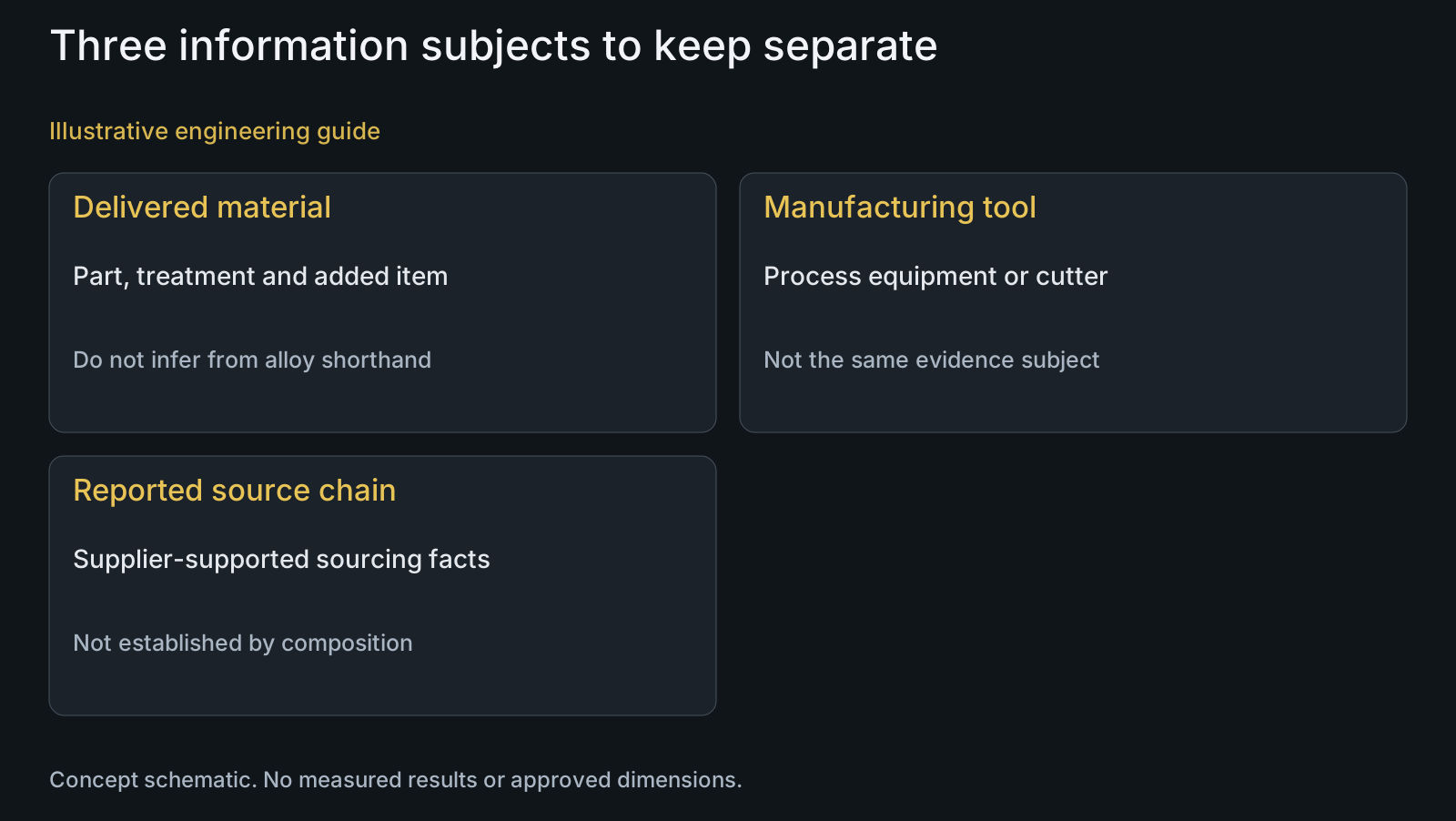
Separate product material from a tool used to make it
Begin with the delivered part and its specified materials, including relevant supplied treatments or added items. Identify the information that actually describes them. A broad alloy designation can be a starting point for locating records, but it cannot independently answer every content question.
Keep machinery and tool references in a separate category. The SEC's adopting release distinguishes a mineral in a physical manufacturing tool from the mineral-content question for the product it makes. Do not infer finished-part composition solely from a tool's composition, or extend that distinction into proof that a particular part contains none of the requested minerals.
For the CNC turning process, the purchased stock and delivered component are material subjects; a cutter is a process tool. If a customer expressly requests information about the broader process supply, identify that extra scope rather than rewriting it as product-content evidence.
| Information condition | What it can support | What remains unresolved | Focused buyer action |
|---|---|---|---|
| Alloy-family label only | A starting material description | Requested content and source answers | Ask for the relevant represented material information. |
| Tool composition reference | Information about that process tool | Delivered part content | Keep the tool separate and request part evidence. |
| Product-content statement | Its named parts and materials | Upstream source facts not included | Identify the distinct sourcing information request. |
| Company response plus unrelated product list | The company's declared broader coverage | Connection to the ordered pivot | Ask which entries represent these parts. |
| No-content answer with conflicting attachment | A discrepancy that needs explanation | Which statement is accurate within scope | Ask for a corrected answer and supporting connection. |
| Incomplete supplier information | A defined information gap | The unsupported requested conclusion | Keep the limitation visible and target the missing fact. |
Read each answer against the information it represents
For every response, identify the represented product range and period before examining its reasoning. A company-level statement may include supplies unrelated to the requested pivot. A part-specific statement may be narrower than the OEM's kit request. Neither boundary is repaired by changing the file name.
Locate the supporting supplier information for the stated answer. Is it a material-content statement, a response about upstream sources, or a record referring to other goods? The answer and the evidence need to describe the same question. A source-location answer cannot independently establish absence of a mineral.
If the declared scope is wider than the supporting records, request the missing connection or a corrected scope. Do not copy facilities from an unrelated supplier attachment just to make the response look complete. Preserve original responses so the reviewer can explain why a clarification was required.
Resolve contradictions without inventing a negative answer
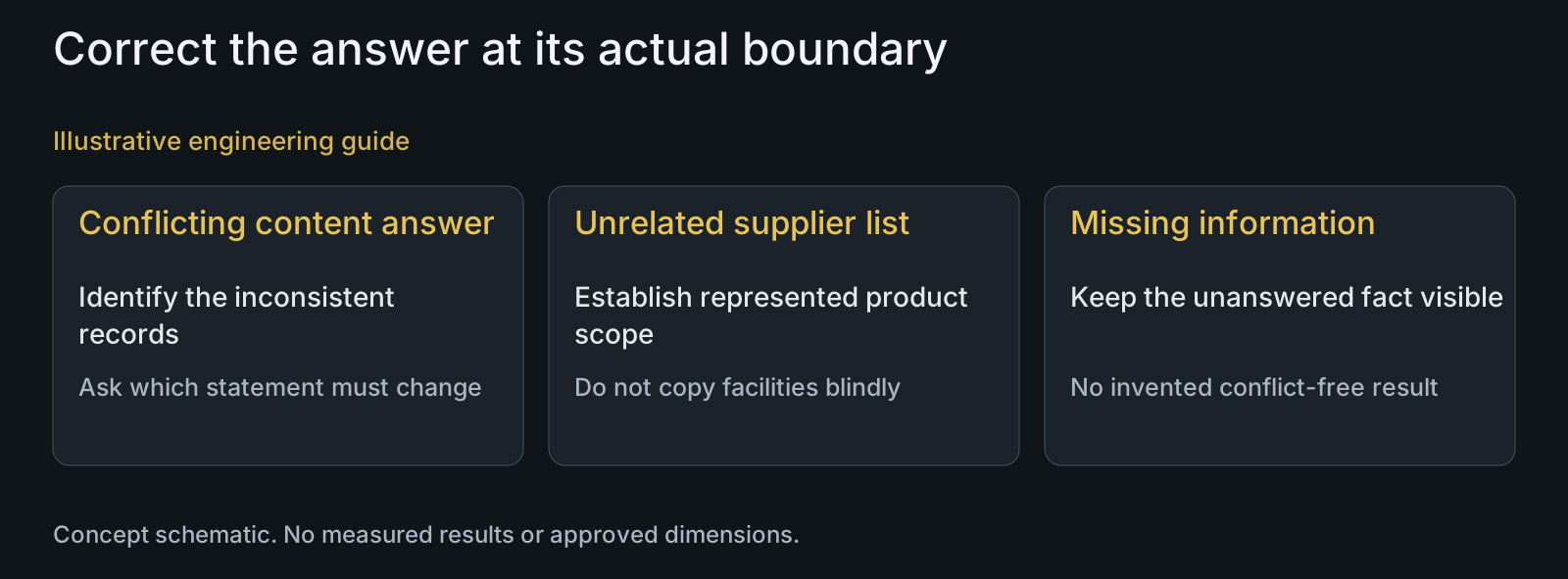
Compare the response with its own part list, material statements and supplier attachments. A no-content answer paired with a document explicitly describing a relevant mineral in the represented part deserves clarification. A facility list for other products deserves a different clarification about scope. Neither discrepancy independently proves an adverse sourcing outcome.
Ask the supplier to identify which statement should change and why. If the information is incomplete, preserve that uncertainty instead of replacing it with a confident no. If the answer is supported within a narrower range, retain the explanation and do not expand it to the remaining kit.
Separate correction from acceptance. The supplier provides an accurate bounded response; the customer's responsible sourcing team decides how that information fits its program. A manufacturing capability page or ISO quality-system certificate does not supply missing minerals evidence.
Illustrative engineering example: a tooling reference creates confusion
Illustrative engineering example: assume an OEM requests a product-specific 3TG response for an axle and receiver. One supplier attachment describes a tool used in machining; another describes the stock material. The response does not explain which attachment supports its product answer. No actual mineral content, facility, origin or audit result is assumed.
The reviewer separates the tool reference from the delivered-material information and asks the supplier to explain its product answer using records that represent the axle and receiver. The tool reference is not relabelled as evidence about part composition. If the customer's request separately includes tooling supply, that question receives its own stated boundary.
The practical result is a targeted clarification, not a fabricated completed template. The OEM can see whether the remaining gap concerns product content, represented suppliers or sourcing information. Those require different follow-up owners and cannot be resolved with the same generic conflict-free sentence.
Request a usable correction rather than another attachment
Send the supplier the exact inconsistent fields, their evidence references and the named products affected. State the requested reporting period and accepted template version. Ask for corrected coverage or an explained limitation, not a new date on unchanged unsupported wording.
Review later source or configuration changes against the corrected response's boundary. An unchanged drawing does not independently explain a different supplier arrangement. Keep the actual material chain visible when revising an order's information package.
The material-document guide helps separate other order records from this sourcing task. Use the customer decision knowledge center to connect the request with component choices and manufacturing, while keeping unverified sourcing conclusions out of the product description.
Questions buyers need to confirm
Does stainless steel automatically mean tin is present?
No such conclusion is supported by a broad family name. Review the actual material specification and relevant supplier information for the requested part. Do not replace content evidence with an assumption about every stainless alloy.
Does a tungsten-containing machining tool settle the pivot's 3TG answer?
No. The tool and delivered component are different information subjects. Request evidence representing the actual part materials and clarify any separately requested process-tool scope; the tool reference does not establish either presence or absence in the part.
Can a company-level response cover my specific kit?
Only within explained represented coverage. Compare the part range, supplies and reporting period with the kit BOM. If attachments concern different products, request the connection rather than treating the broad company name as a complete explanation.
What if a no-content answer conflicts with an attachment?
Ask the supplier to reconcile the exact statements and their represented products. Preserve the discrepancy until the corrected answer and its supporting basis are clear. The discrepancy requires review; it is not independently proof of an adverse origin.
Should I add facilities from another supplier's response to fill a blank?
Not without supported relevance. Establish which supplied materials and product range those entries represent. An unrelated list can make a form appear complete while introducing unsupported source information into the customer's review.
What should I provide for a 3TG clarification request?
Send the named part list, drawings and material or finish requirements, reporting period, requested template version and existing responses. Mark the exact contradictory or missing fields so the discussion can resolve product content, scope or sourcing gaps separately.
Technical references and scope
RMI: Minerals Reporting Templates introduction. CMRT mineral scope and information-transfer purpose only; no workbook reproduced, specific supplier answer validated or facility status inferred.
SEC: conflict-minerals disclosure framework. Context for specified reporting companies and necessary product minerals. The historical guide is not used here to determine current filing, audit or enforcement duties.
SEC adopting release 34-67716: product and manufacturing-tool distinction. Pages 89 to 91 discuss production and tools; no actual product composition or broader contractual scope is decided by this source.
Explore related component, material and sourcing decisions in the customer decision knowledge center. For a drawing review, use the Drawing/BOM RFQ path.
Clarify the minerals information for the actual supplied parts
Share the drawings or STEP files, BOM and finish requirements with the requested 3TG template version, reporting period, represented product list and available supplier attachments. Identify unresolved answers so PremFixer can discuss the component supply boundary and the specific information needed for the customer's review.
Discuss the drawing and BOM