

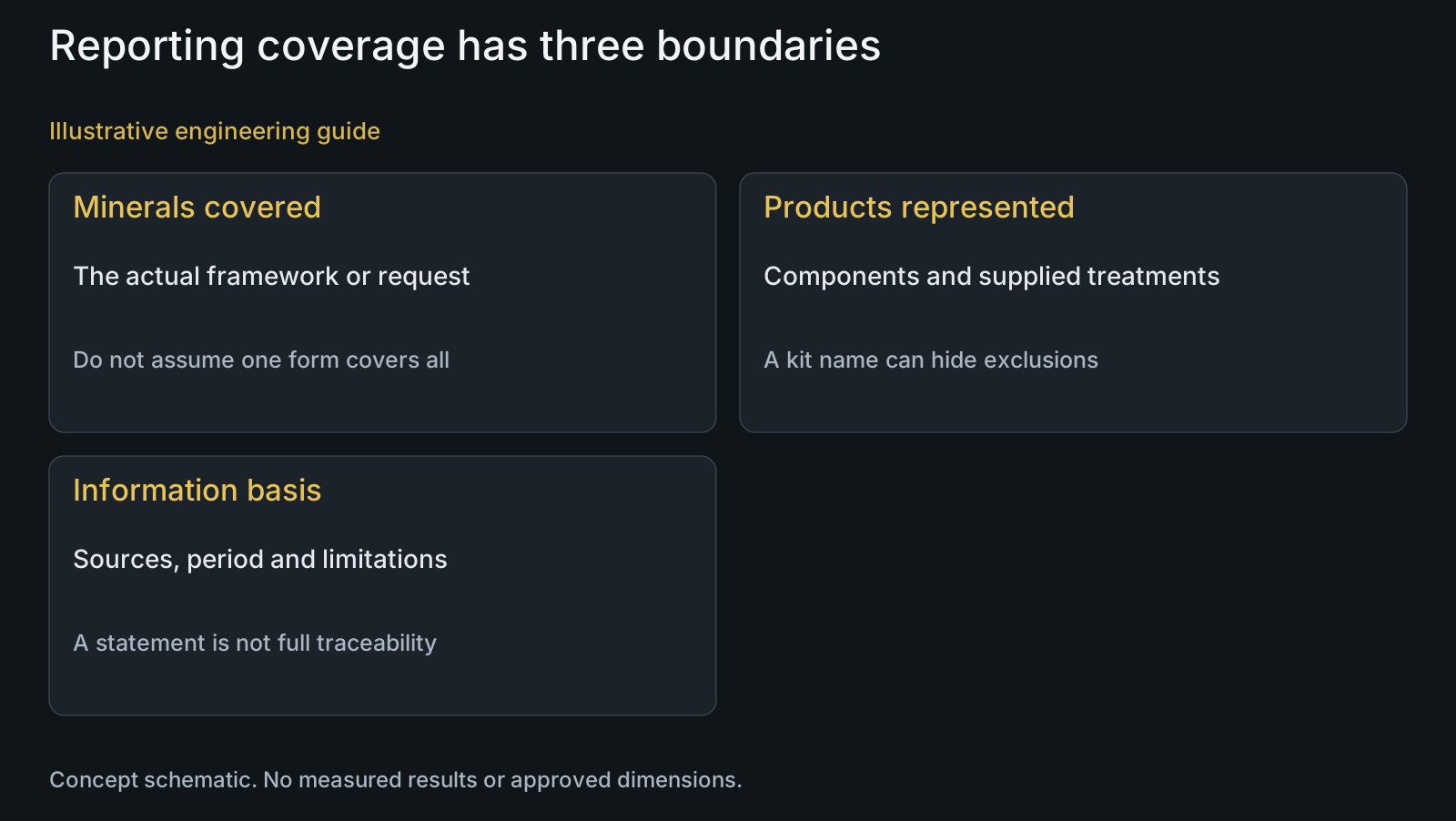
A stainless or titanium label does not complete a responsible-minerals request for custom pivot hardware. Identify the reporting framework, minerals covered, represented products and information period before answering. The customer may request a defined template or a broader contractual disclosure, and those scopes are not automatically identical. Include the actual component materials and supplied treatments rather than assume one alloy name describes the complete kit. A mill record can support material identity without establishing the full upstream sourcing chain. State what the available information covers and what remains unknown; do not replace an evidence gap with a blanket conflict-free claim.
Hero: concept illustration of example hardware and its application. It is not a factory photograph, tested component or approved production geometry.
Identify the mineral question before filling in a form
RMI's reporting-template introduction identifies CMRT's scope as tin, tantalum, tungsten and gold, commonly called 3TG. It distinguishes EMRT's defined mineral scope and AMRT's user-selected scope. The existence of several templates is a reason to clarify the request, not to choose one by the part's commercial name.
A customer questionnaire may add its own mineral or supplier requirements. Confirm those explicitly instead of assuming a standard form answers every line. The reporting period, product boundary and requested response format should be clear before upstream information is assembled.
A reporting tool and a legal obligation are different subjects. The OECD guidance's public scope describes responsible supply-chain recommendations across minerals. It does not decide a particular manufacturer's legal duties from the fact that it makes bicycle components.
Map the request to the complete supplied configuration
List the items represented by the response and connect them to their actual material and surface requirements. A titanium pivot, stainless receiver and treated spacer are distinct information subjects. Avoid attaching a bolt-only response to the entire kit without reviewing that coverage.
Include supplied coatings or ancillary products where relevant to the customer's question. Do not infer either presence or absence of a requested mineral from an alloy family label. Use the material and treatment information appropriate to the actual supplied configuration.
The materials overview helps identify material choices for manufacture, while the REACH information guide addresses a different substance-information question. Neither a familiar material description nor a separate chemical disclosure establishes the answer to a responsible-minerals request.
| Information | Useful subject | Unresolved risk | Buyer review |
|---|---|---|---|
| Alloy designation | Named material choice | Complete mineral scope inferred | Identify actual request and configuration |
| Allocated stock record | Material identity and stated properties | Upstream chain assumed complete | Check what the record represents |
| Supplier declaration | Its identified reporting coverage | Confident wording mistaken for evidence | Read products, period and basis |
| Reporting template | Defined minerals and declared scope | Template treated as certification | Compare with customer question |
| Changed material source | New source relationship | Old statement reused unchanged | Review affected coverage |
| Unknown sourcing fact | Specific information gap | Blank replaced with unsupported no | Explain and target follow-up |
Distinguish material identity from upstream sourcing evidence
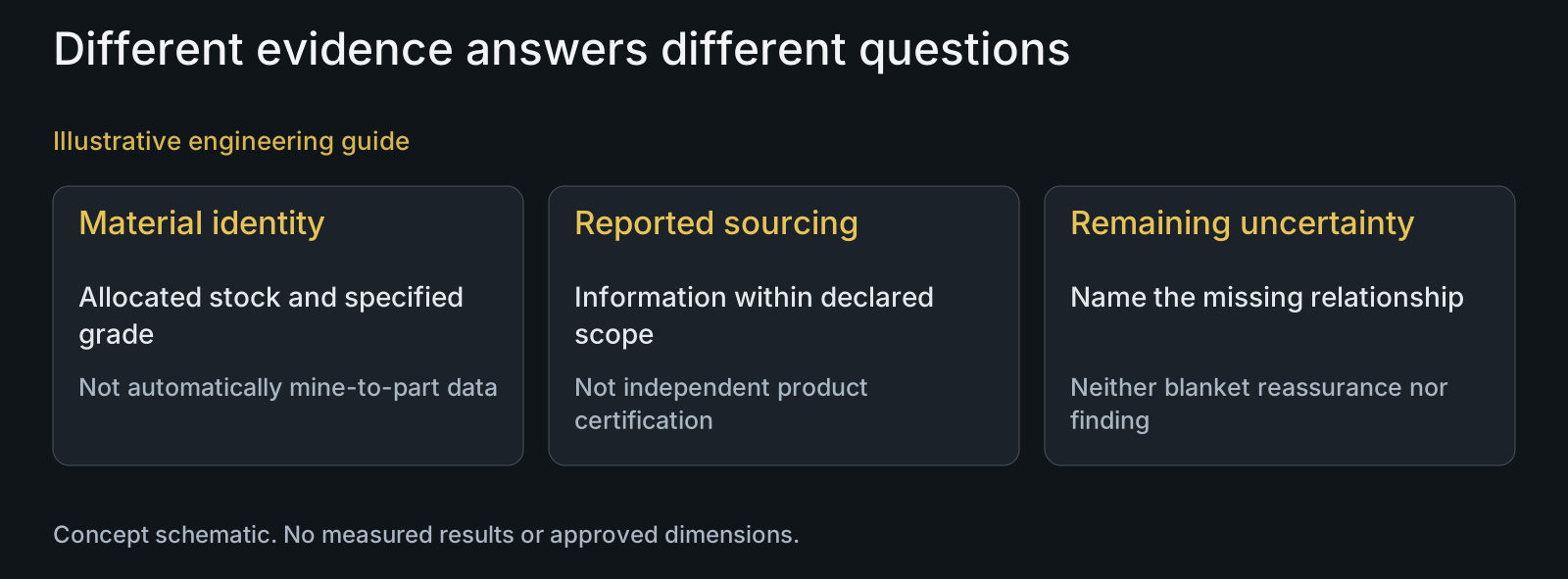
A stock record can connect an allocated material to the part supply and describe its stated grade or condition. That is useful evidence for material identity. It is not automatically a record of every mine, trader, processor or sourcing risk upstream of that stock.
A supplier declaration should state its represented products, information basis and limitations. A confident company-wide sentence is not more informative than a carefully scoped response if it does not show which goods and source information it represents.
RMI's CMRT overview describes an information-transfer tool concerning mineral origin and smelters or refiners. A completed template should not be described as independent certification of every pivot. Read the response as evidence within its declared coverage, not as a universal assurance badge.
Keep unknowns visible without inventing a negative answer
Not known and not applicable are different answers. If the available supplier information does not establish a requested fact, state the gap and why it matters to the coverage. Do not write no simply to make a questionnaire appear complete.
Conversely, an information gap is not proof that the parts involve an adverse sourcing outcome. Identify the missing relationship or evidence and determine the appropriate follow-up. A review should distinguish unsupported reassurance from an unsupported accusation.
Agree which supplier can provide which information and what the customer needs to decide. PremFixer can discuss the requested documentation with the manufacturing supply scope. Availability must be established for the actual source arrangement; no all-product responsible-minerals declaration or audited upstream chain is promised here.
Review source changes even when the drawing is unchanged
A component can keep the same geometry and grade while its material source changes. That means an earlier response may no longer represent the current source information. Review the changed relationship instead of assuming an unchanged part number makes every sourcing statement permanent.
A changed reporting request can also matter without a hardware change. The customer may broaden its mineral scope or represented product range. Compare the old response with the new question before deciding what additional information is needed.
Maintain a practical connection between response scope and the parts supplied. The stock-specification guide concerns grade, form and condition; this review adds the distinct reporting boundary. Neither task replaces the other, and a quality-system certificate does not fill missing upstream facts.
Illustrative review: a narrow response for a broader request
Illustrative engineering example: assume a customer requests information for a mixed pivot kit and additional minerals beyond its previous reporting request. The available supplier response covers only an earlier, narrower question. No actual mineral content, source facility or adverse finding is assumed.
The reviewer maps the kit's components and treatments to the current request, then identifies which information is covered and which new questions remain unanswered. The team does not extend the earlier response because the kit name stayed the same, nor conclude that the missing information proves a sourcing violation.
The outcome is a scoped follow-up to the relevant supplier and an accurate customer explanation. It is not a fabricated completed CMRT, a certified conflict-free product or an actual mine-to-part traceability result. Any declaration for a real order must be supported by that order's information basis.
Questions buyers need to confirm
Does a titanium label make a minerals questionnaire unnecessary?
No. Identify the actual request and supplied configuration. An alloy-family name does not establish the reporting boundary or every sourced input. Provide supported information for the requested scope rather than infer a universal exemption.
Is a completed reporting template a product certification?
No. It communicates information within its declared scope. Read which products, sources and period it represents and any limitations. It is not automatically an independent assurance that every item in a kit meets every sourcing requirement.
Can a material certificate prove the entire upstream chain?
Not from its title alone. It may support allocated material identity and stated properties. Determine whether it contains the sourcing information actually requested. Do not turn a stock conformity document into evidence it does not provide.
Should unknown information be answered as no?
No. State the actual information gap and the affected scope. An unsupported negative answer can conceal the need for follow-up. Equally, missing information does not by itself establish an adverse sourcing outcome.
Can an unchanged drawing retain its old supplier declaration after a source change?
Not automatically. The declaration may represent the earlier source arrangement. Review the changed material or treatment supply relationship and its reporting coverage. Dimensional equivalence does not establish equal sourcing information.
What should accompany a responsible-minerals request?
Send the requested framework and version, mineral scope, reporting period and represented part list. Include material and treatment requirements, existing responses and known source changes. These inputs make follow-up specific without inventing declarations or upstream records.
Technical references and scope
RMI: Minerals Reporting Templates introduction. Distinct template mineral scopes and information-transfer context; no completed report, legal applicability or product certification inferred.
RMI: CMRT overview. Purpose of mineral-origin and smelter/refiner information transfer; no template reproduced or actual facility assurance claimed.
OECD minerals guidance, third edition public scope. Responsible-supply-chain recommendations across minerals; not a determination of PremFixer legal duties or certification.
Explore related component, material and sourcing decisions in the customer decision knowledge center. For a drawing review, use the Drawing/BOM RFQ path.
Define the reporting request and represented hardware
Share the customer questionnaire or template requirement, mineral scope, reporting period and item-level BOM. Add material and surface requirements and existing supplier information. PremFixer can review the requested documentation scope without claiming unsupported all-product sourcing certification.
Discuss the drawing and BOM