
7075 aluminum pivot hardware can corrode even though iron-style red rust is not the right description for the aluminum itself. Anodizing and an appropriate sealing requirement can form part of a protection strategy, but their names do not guarantee a salt-spray duration or riding life. Define the finished surfaces, masked areas, mating materials and places that retain moisture. Then specify the specimen and what the corrosion assessment must observe. A result for a flat coupon or an isolated coated bolt does not automatically describe a clamped receiver, damaged surface or complete bicycle joint in use.
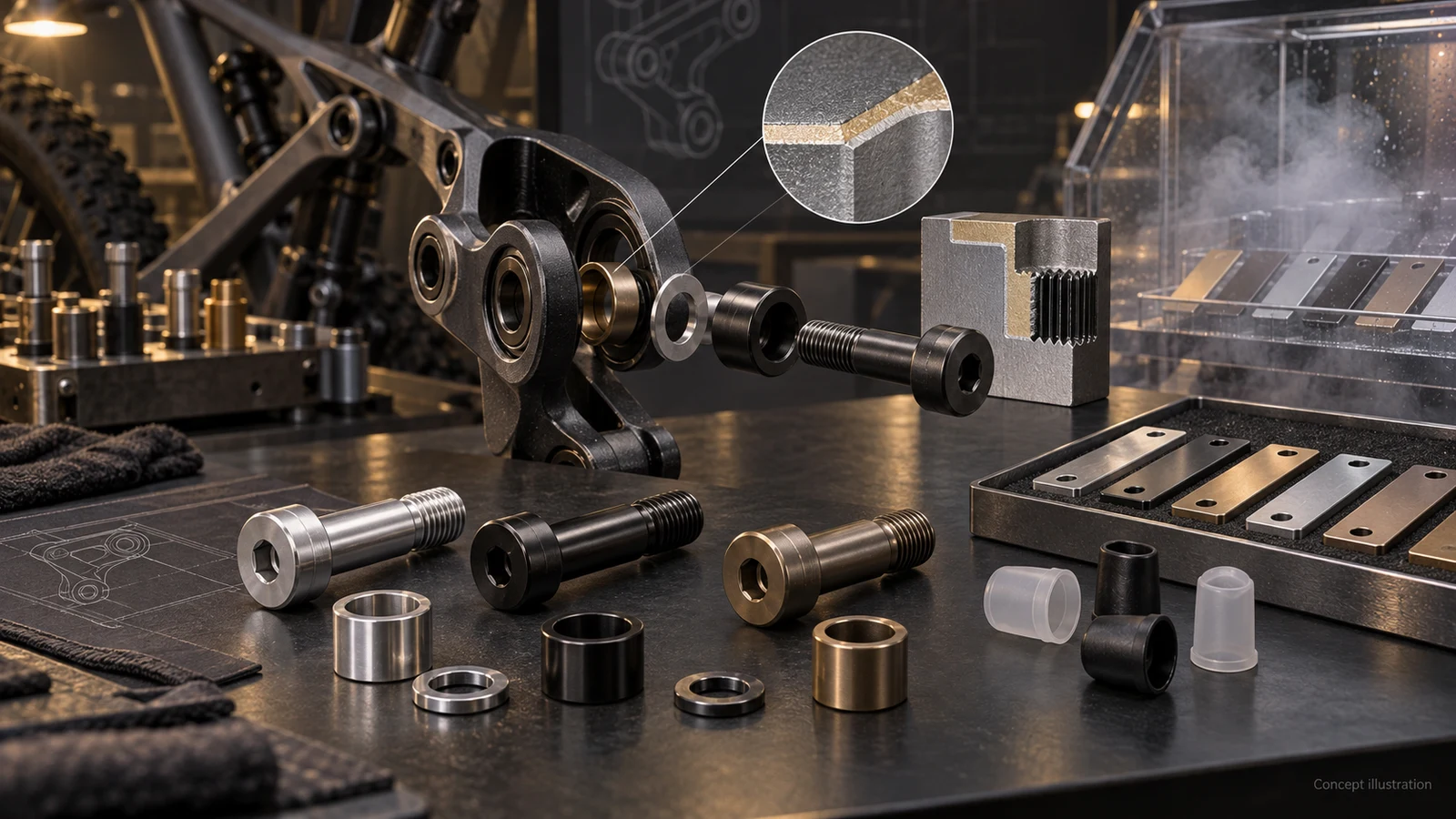
Hero: concept illustration of example hardware and its application. It is not a factory photograph, tested component or approved production geometry.
Describe the observed problem before selecting protection
Distinguish discoloration, deposits and actual substrate attack. A white deposit, a dark mark or a red stain is not by itself a complete diagnosis of which component is degrading. Preserve the location and material identity of affected surfaces and inspect the relevant interface using the customer's approved assessment method. Do not infer remaining structural capacity from color alone.
Map the exposure into the joint. A visible head can dry while a washer contact or sleeve gap retains liquid and contamination. State wetting, cleaning, storage and access conditions for those locations. The appearance of the outer surface does not establish the condition inside a receiver or beneath a clamped washer.
Include the mating BOM and barrier provisions. Where aluminum contacts stainless steel or titanium, consider the connected metal pair and electrolyte path rather than only the bolt finish. The mixed-metal BOM review addresses that pairing decision; this article focuses on whether the chosen protection and specimen evidence cover the delivered aluminum part's actual zones.
Define a protection route by surface zone
Specify the intended anodic finish, sealing requirement and treated surfaces. The Aluminum Anodizers Council's guidance distinguishes finish selection by application and describes sealing of clear anodized coatings for protection. Do not convert that general explanation into a claim that every finish, alloy or geometry has the same corrosion response.
Mark threads, bearing seats, shoulders and electrical or contact interfaces that are masked or otherwise treated differently. Masking may protect a dimensional requirement while leaving another corrosion question. Likewise, machining a feature after anodizing can expose substrate locally. The protection plan should identify that final state rather than describe the whole part as fully anodized without qualification.
Coordinate the surface-treatment specification with final dimensions and assembly access. A corrosion-oriented change cannot silently alter the bearing fit, head seating or finished thread requirement. Hardcoat contact and wear questions are treated separately in the hard-anodized pivot guide; abrasion performance is not established by a corrosion observation.
| Evidence configuration | Useful question | Important omission | How to close the decision |
|---|---|---|---|
| Flat processed coupon | Compare a defined alloy and finish route | Actual recesses, threads and assembly contacts | Match process identity and identify geometry-specific questions |
| As-delivered finished pivot | Assess its treated and exposed surface zones | Installed contacts and retained moisture | Document masked areas and representative assessment locations |
| Selected assembled joint | Assess the stated mating configuration | Other assemblies, service histories or load conditions | Define mating BOM, contact state and test purpose |
| Intentionally damaged specimen | Review protection at a specified exposed zone | Unknown field damage or all service scenarios | Control and record the introduced condition |
| Exposure duration alone | Identify one part of a test description | Acceptance criterion, geometry and outdoor life | Request the full scope and observed condition |
Choose a specimen that answers the purchase question
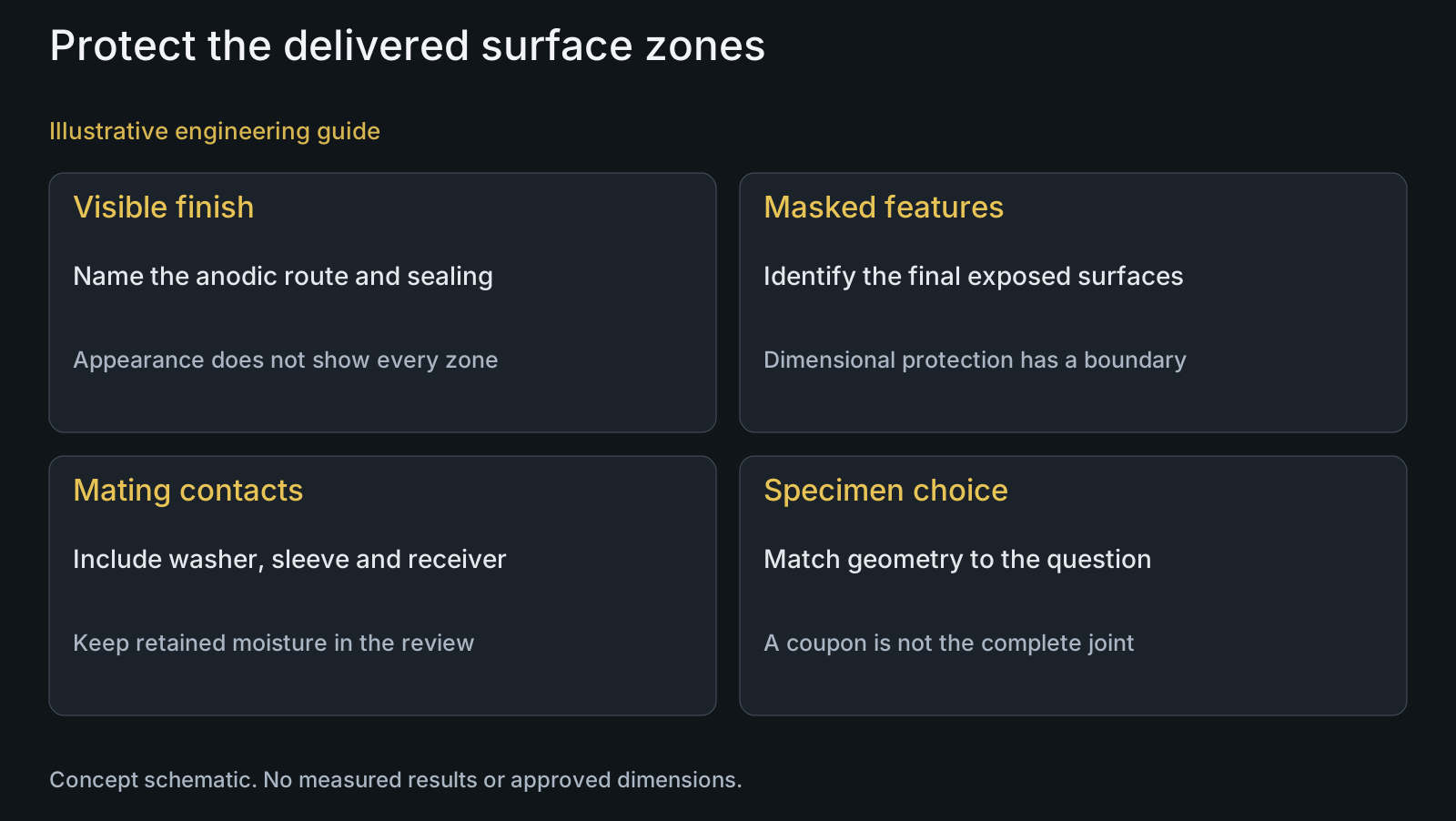
A coupon can help compare defined material and processing routes, but its flat surface may not include the part's masked thread, recess, sharp transition or contact crevice. A finished bolt adds representative geometry. An assembled specimen adds selected contacts and moisture-retaining spaces. None is automatically the correct choice for every question.
State whether specimens represent the as-delivered condition, an assembled condition or an intentionally damaged condition. Record any defined scratch or exposed area instead of allowing incidental handling damage to become an unexplained variable. Use the selected condition consistently across candidate routes, or explain why differences prevent a direct ranking.
Agree the observations: discoloration, localized attack at identified zones or another controlled criterion. If a functional post-exposure check is needed, name it separately. A visual corrosion assessment is not automatically a test of clamp retention, thread removal force or remaining component strength. Keep the specimen revision and process identity attached to the result.
Treat exposure duration as part of the method, not the verdict
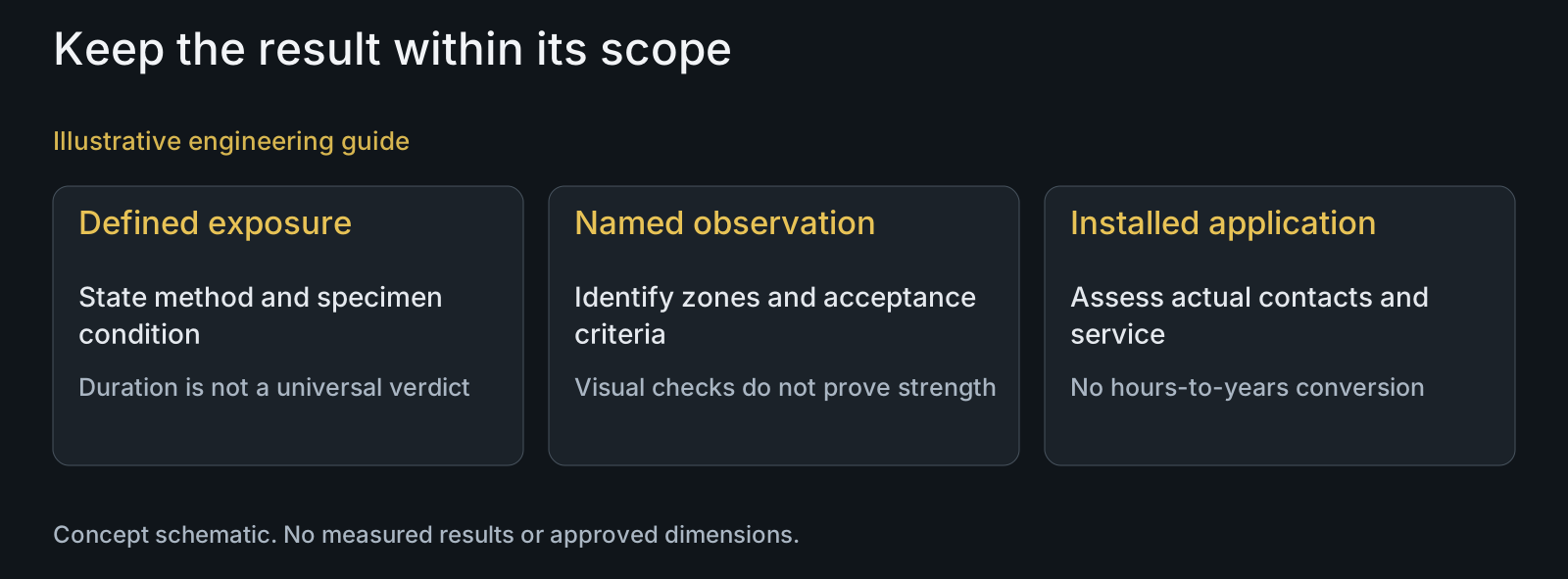
ASTM B117's public scope describes the salt-fog environment and does not prescribe a product-specific specimen, exposure period or interpretation. Its published significance notes the limits of using stand-alone salt-spray data to predict natural exposure. Those boundaries are why a requested duration still needs a defined part condition and assessment criterion.
Use the governing method and edition required for the order. Report duration with the actual observed condition and criterion, not simply passed salt spray. A longer exposure is not a sound reason to rank two suppliers when the specimens, finish state or failure definitions differ. Unreported processing or inspection differences can change what the comparison means.
Do not convert chamber hours into years of coastal riding. A bicycle joint experiences a particular combination of wetting, drying, contamination, contact movement and maintenance. A controlled corrosion comparison can inform the design team's protection decision, but the service claim needs evidence appropriate to that broader environment and configuration.
Illustrative review: coupon evidence and a masked pivot thread
Illustrative engineering example: assume an OEM considers a sealed anodized 7075 pivot for a wet-use assembly. The proposal includes a coupon corrosion report, while the actual bolt drawing requires a masked external thread under a mating washer. No report duration, coating thickness or failure observation is assumed.
The reviewer asks whether the coupon represents the specified alloy and route, then identifies what it omits: the masked thread and relevant contact geometry. A finished-part or selected assembly specimen may be useful for those questions, with assessment locations agreed in advance. The existing coupon remains evidence within its own scope; it is not discarded or relabeled as a complete-joint result.
The resulting action is to align protection zones and evidence with the drawing, not to promise a longer life. PremFixer can coordinate the specified manufacturing, finishing and inspection scope. Any requested corrosion evaluation needs an agreed specimen and assessment basis; this example does not imply an in-house test, supplier report or completed OEM approval.
Questions buyers need to confirm
Does 7075 aluminum rust?
It can corrode, but iron-style red rust is not the correct description for aluminum itself. Identify affected substrate, deposits and contact location before choosing a response. A stain alone does not establish the material's condition or remaining structural capacity.
Do anodizing and sealing guarantee a fixed salt-spray duration?
No universal duration is established by the process names alone. Define the actual finish, surface zones, specimen condition and criterion. A supported result belongs to the identified configuration, not every 7075 part made with a similarly named route.
Can a coupon report approve a pivot with masked threads?
Not automatically. The coupon may support the finish-route comparison but omit the exposed thread and contact geometry. Identify those missing zones and decide whether a finished-part or assembly specimen is needed for the purchase question.
Should a salt-spray requirement include an intentional scratch?
Only when that condition serves the defined evaluation and is agreed in the method. State its location and preparation rather than mixing damaged and undamaged specimens without explanation. The result does not represent every possible service damage.
Does passing a visual corrosion assessment prove that the joint still clamps correctly?
No. Visual condition and joint function are different observations. If post-exposure removal, clamp retention or another functional assessment is required, specify its method and acceptance basis separately instead of assuming it from surface appearance.
What inputs are needed for a corrosion-focused quotation?
Provide the alloy and condition, finish and masking drawing, mating BOM and intended exposure description. Include the required specimen, method and assessment locations if testing is requested. Those fields determine which manufacture, treatment and evidence tasks belong in the scope.
Technical references and scope
ASTM B117-26a public scope and significance. Active catalogue page checked2026-10-09; apparatus scope does not set product specimen, duration or interpretation, and stand-alone salt-spray data has natural-exposure limits. No full paid procedure copied.
AAC: Specifying Anodized Finishes on Aluminum. Finish selection by application and protective role of sealing in the clear-anodizing discussion. No universal7075 corrosion duration or numeric coating acceptance adopted.
Explore related component, material and sourcing decisions in the customer decision knowledge center. For a drawing review, use the Drawing/BOM RFQ path.
Align protection and corrosion evidence with the joint
Send the part and assembly drawings, material conditions, mating BOM and finish or masking requirements. Describe the wet-use and cleaning conditions and any requested corrosion method, specimen and criterion. PremFixer will review the manufacture and coordinated finishing inputs and clarify the evidence scope without assigning an unsupported lifetime.
Discuss the drawing and BOM