
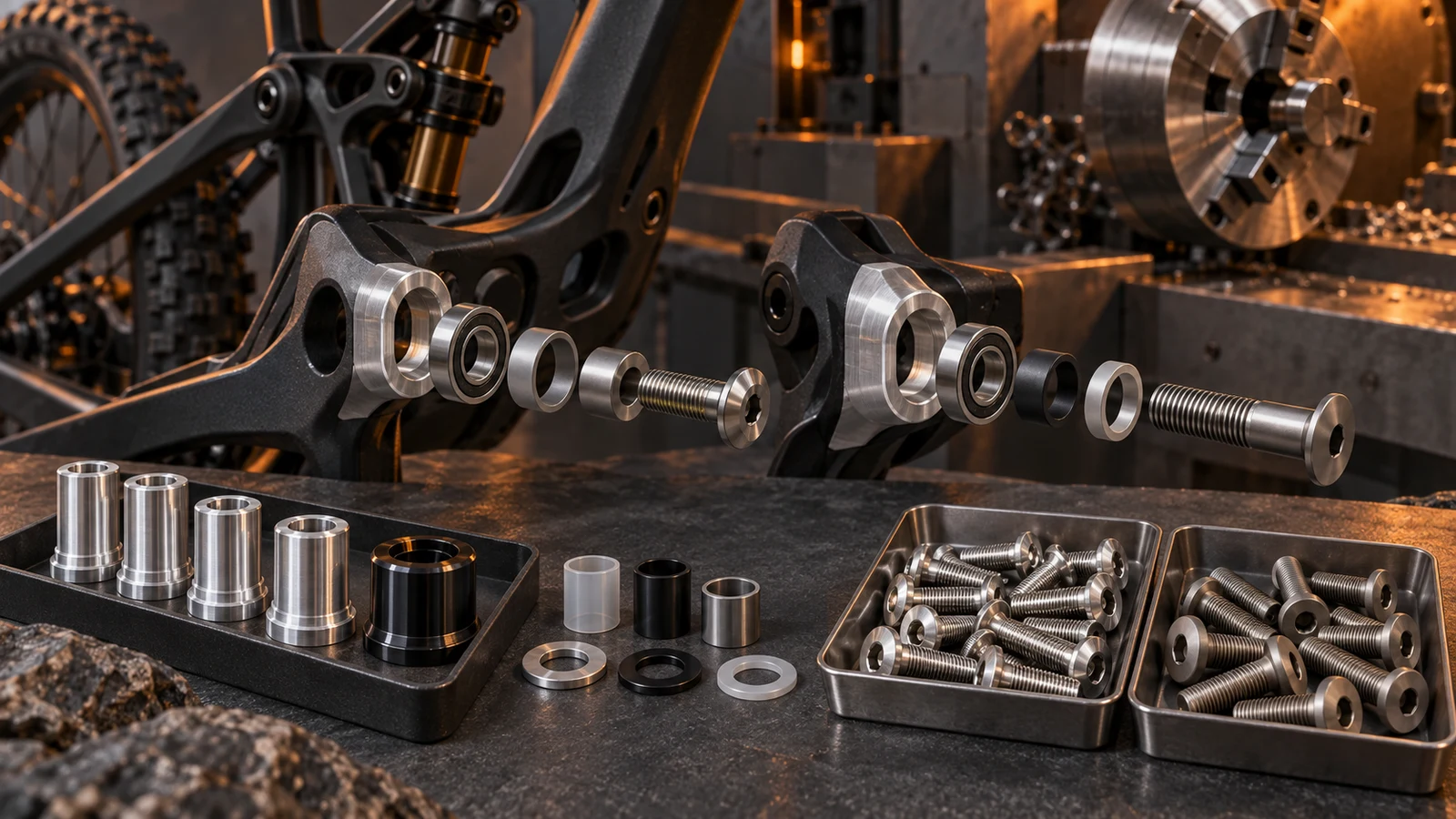
Changing a stainless screw to titanium does not automatically protect an aluminum pivot axle, receiver or spacer. The replacement's own corrosion resistance is a different question from the behavior of the coupled aluminum member. Identify each material and surface, where electrical contact remains and how a conductive liquid can reach the connection. Then compare protection and mechanical requirements for the complete configuration. Same-material construction is one possible design choice, not the only solution or proof that every corrosion mechanism disappears. Put the accepted protection condition against each BOM item so the aluminum component does not vanish from the substitution review.
Hero: concept illustration of example hardware and its application. It is not a factory photograph, tested component or approved production geometry.
Follow the aluminum member through the material change
Identify whether the aluminum part is a load-bearing axle, tapped receiving member, spacer or visible cap. Replacing a mating screw does not change that part's geometry, finish boundary or wetting exposure by itself. The decision should therefore state what the aluminum member needs, not only what the new screw is called.
TIMET's corrosion guide explains that passive titanium is normally the cathodic member in seawater couples and can accelerate attack on another coupled metal, with exposed areas affecting the result. Its industrial discussion is not a bicycle compatibility rating. It does show why the titanium member's resistance cannot stand in for protection of the other member.
For stainless and aluminum, BSSA describes a similar need to consider the coupled condition rather than names alone. The earlier stainless bolt in an aluminum frame guide covers electrical paths and head-washer proposals in detail. Here the procurement decision is whether a changed mixed-material set still meets each aluminum item's protection requirement.
Distinguish metal replacement from protection replacement
Separate three proposals: changing the screw alloy, changing a coating or barrier, and redesigning the contact arrangement. These may occur together, but each affects different requirements. A bare titanium screw substituted for a finished stainless screw is not simply the old configuration with better corrosion resistance.
Compare thread condition, mating surfaces, specified assembly products and accepted finish coverage in the two configurations. If an old barrier is omitted, identify the protected location it previously represented. If a different barrier is proposed, define its actual function and compatibility rather than inferring insulation from a product's anti-corrosion label.
Do not silently retain an old tightening instruction after the thread material or surface system changes. Friction and locking requirements belong to the selected assembly state. The torque and clamp-force guide explains that an installation torque is not a material-independent preload guarantee. No replacement torque is proposed here.
| Proposal | Question it addresses | Aluminum risk left open | Required comparison |
|---|---|---|---|
| Stainless screw changed to titanium | Selection of the mating screw | Aluminum exposure and contacts remain | Both material/surface configurations and installed requirements |
| Specified coating or barrier retained | Protection at defined locations | Coverage and installed continuity may differ | Actual treated zones, contact state and compatibility |
| Isolation component added | An identified electrical contact | Changed locating or clamp interface | Mechanical role plus full relevant electrical path |
| Same-material redesign | A selected dissimilar-metal pairing | Other contacts and non-galvanic mechanisms | Entire assembly and revised component requirements |
| Exposure or drainage change | Water access or retention | Actual use may not match loose-part testing | Assembled geometry, use and maintenance definition |
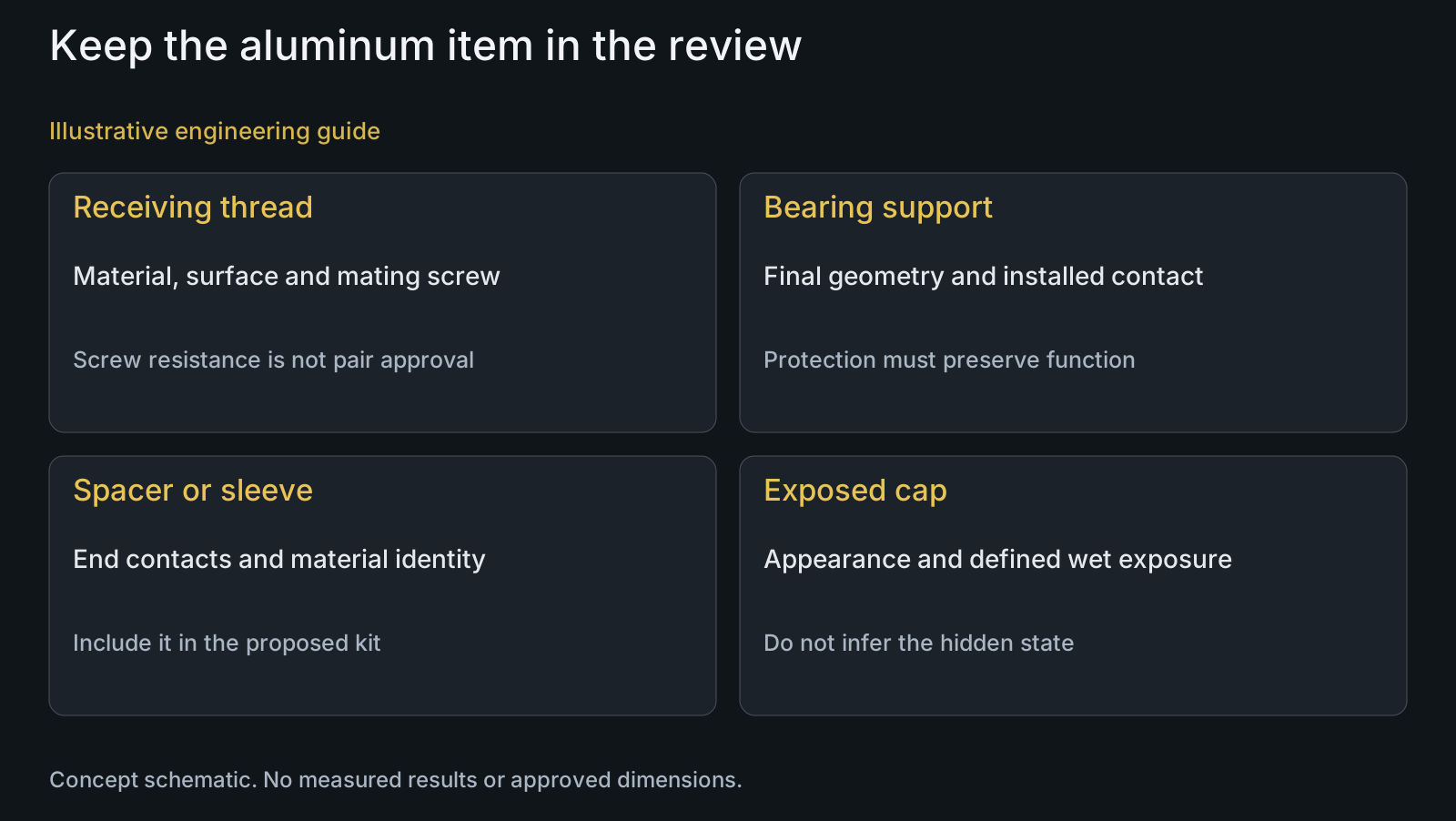
Match protection to the critical aluminum surface
Mark the receiving thread, bearing-support surface, spacer end and external cosmetic surface separately. Define which condition is acceptable on each. An external appearance sample does not establish protection or dimensional acceptance inside a receiving thread or beneath an assembled contact.
BSSA's galvanic guidance requires electrical coupling and a conductive liquid connection, and emphasizes relative exposed areas. In the engineering review, describe the installed contacts and relevant wet exposure rather than ranking candidates from a dry photograph. A sheltered receiving feature can need a different exposure assessment from the cap visible outside it.
An isolation detail must remain consistent with the mechanical role. Review any changed sleeve, spacer or washer for its locating or clamping requirement; do not assume that an electrical objective permits an arbitrary soft component in the load path. The hardcoat surface-role discussion similarly separates protection from finished contact geometry.
Compare options without declaring all mixed metals forbidden
Retaining the pair with defined protection may be appropriate for review where the geometry and installed condition can meet the requirements. Changing the aluminum component or the contact architecture is another option, but it can affect mass, fit, strength, manufacturing and service. Treat it as a revised design, not a corrosion-only purchasing edit.
A same-material proposal removes a particular dissimilar-metal pairing only if that pairing is actually absent throughout the relevant assembly. Remaining bearing rings, sleeves or other hardware can retain different contacts. It also does not establish that the selected alloy resists every non-galvanic exposure.
Drainage, exclusion of water and service access can address the exposure rather than only the material pair. Define those features in the customer's assembly requirement and compare them with the intended use and maintenance conditions. No generic coating, seal or full-kit material change is presented as a guaranteed cure.
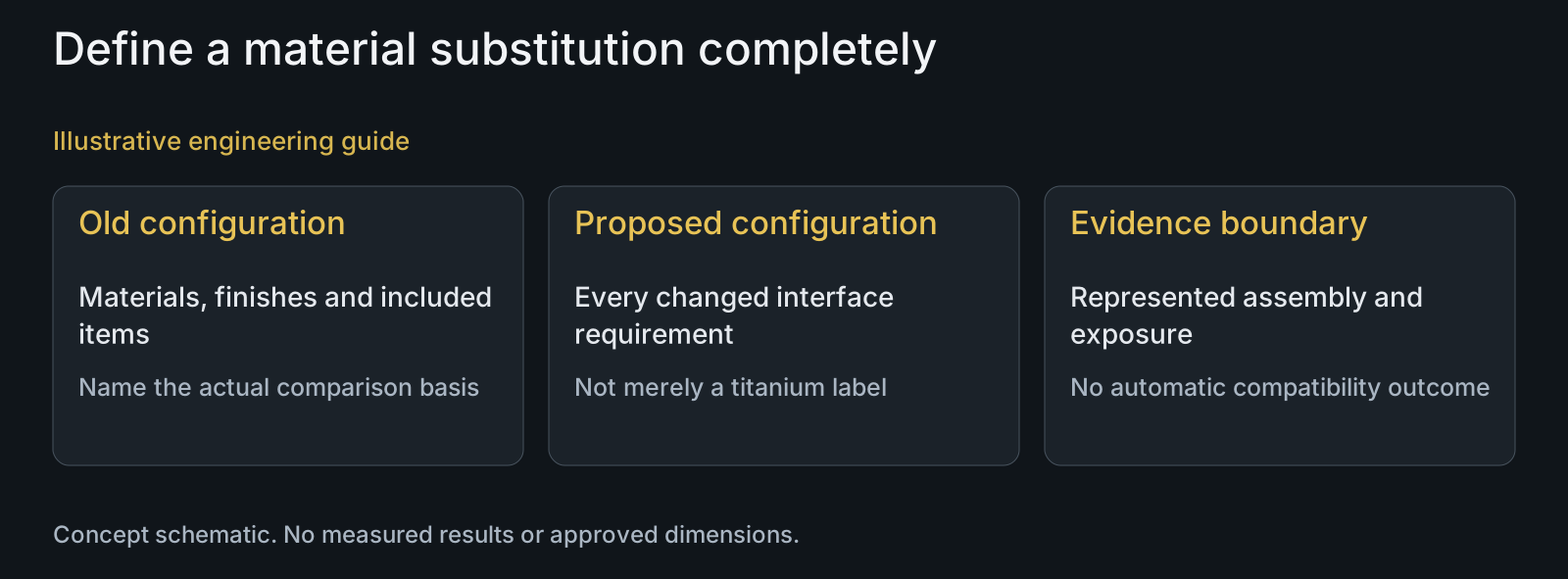
Illustrative substitution review: the aluminum receiver remains
Illustrative engineering example: assume a coastal-use pivot BOM has an aluminum receiving axle and a finished stainless retaining screw. Purchasing proposes a titanium screw but has not stated whether the original barrier and assembly-product requirements remain. No corrosion rate, field failure or observed test result is assumed.
The team keeps the aluminum receiver's part number and functional surfaces in the comparison. It identifies the proposed screw and surface changes, then asks which protection and installation requirements carry over and which require new evidence. Approval of the titanium material document alone does not answer those interface questions.
The useful comparison is a complete proposed configuration against the same receiving-thread, locating and exposure requirements. A favorable isolated-screw appearance is insufficient. This example makes the substitution's scope explicit without claiming that either candidate passes or that the original joint has corroded.
Request evidence for the represented assembly
Specify whether an exposure result represents a coupon, one loose part or an assembled material pair, including finish and any intentional damage condition. State the method, observed location, duration and acceptance criterion. ASTM B117's public guidance cautions against using stand-alone salt-spray results to predict natural-environment performance; a duration is not a universal conversion to bicycle service years.
For a supply discussion, send both BOM configurations, assembly section, material/finish requirements, installed protection and wetting or cleaning conditions. PremFixer can review the anti-corrosion solution scope and coordinate the specified manufactured parts and partner services. A complete kit offer should identify included barriers and assembly items rather than leaving them outside the quotation boundary.
Questions buyers need to confirm
Does titanium automatically protect the aluminum receiver?
No. Its own corrosion resistance does not approve the coupled aluminum member. Define the pair's surfaces, contacts and wet exposure and review the receiver's protection requirement in the proposed configuration.
Must the whole pivot kit use one metal?
Not necessarily. A defined mixed-material design can be considered, but every relevant contact and protection requirement needs review. A same-material label also does not eliminate contacts with remaining bearing or sleeve materials.
Can the existing assembly compound stay after a screw substitution?
Only if it remains appropriate for the selected thread pair, surfaces and installation requirements. Identify the product and its function. Do not assume an old friction or locking requirement carries over unchanged.
Which aluminum surfaces should the drawing identify?
Identify receiving threads, locating seats, clamped ends and cosmetic zones separately, with their finish boundaries and final acceptance state. External color approval does not establish a hidden thread or bearing-seat condition.
Can salt-spray hours establish years of pivot life?
Not by a universal conversion. State the tested item or assembly, method, surface condition, duration, observation and criterion. Keep the result within that scope rather than presenting it as a service-life warranty.
What should a mixed-material kit RFQ include?
Supply the assembly and both candidate BOMs, exact material/finish requirements, protection items, assembly products and wetting or cleaning conditions. Identify which parts and partner treatment or evaluation deliverables are included.
Technical references and scope
BSSA: bimetallic corrosion guidance. Electrical/liquid conditions and relative exposed areas, not a universal bicycle material-pair acceptance.
TIMET: corrosion resistance of titanium. Industrial guide's seawater galvanic discussion and area sensitivity, not a pivot-specific corrosion rate or guarantee.
ASTM B117-26: significance and use. Public controlled-exposure and natural-environment prediction limits; no purchased test clause or universal pass duration inferred.
Explore related component, material and sourcing decisions in the customer decision knowledge center. For a drawing review, use the Drawing/BOM RFQ path.
Review the aluminum members in the complete proposed kit
Send the baseline and proposed BOMs, assembly section, material and finish requirements and intended protection or exposure scope. PremFixer can review a defined mixed-material manufacturing quotation with the aluminum receiver, sleeves and included protection items visible.
Discuss the drawing and BOM