
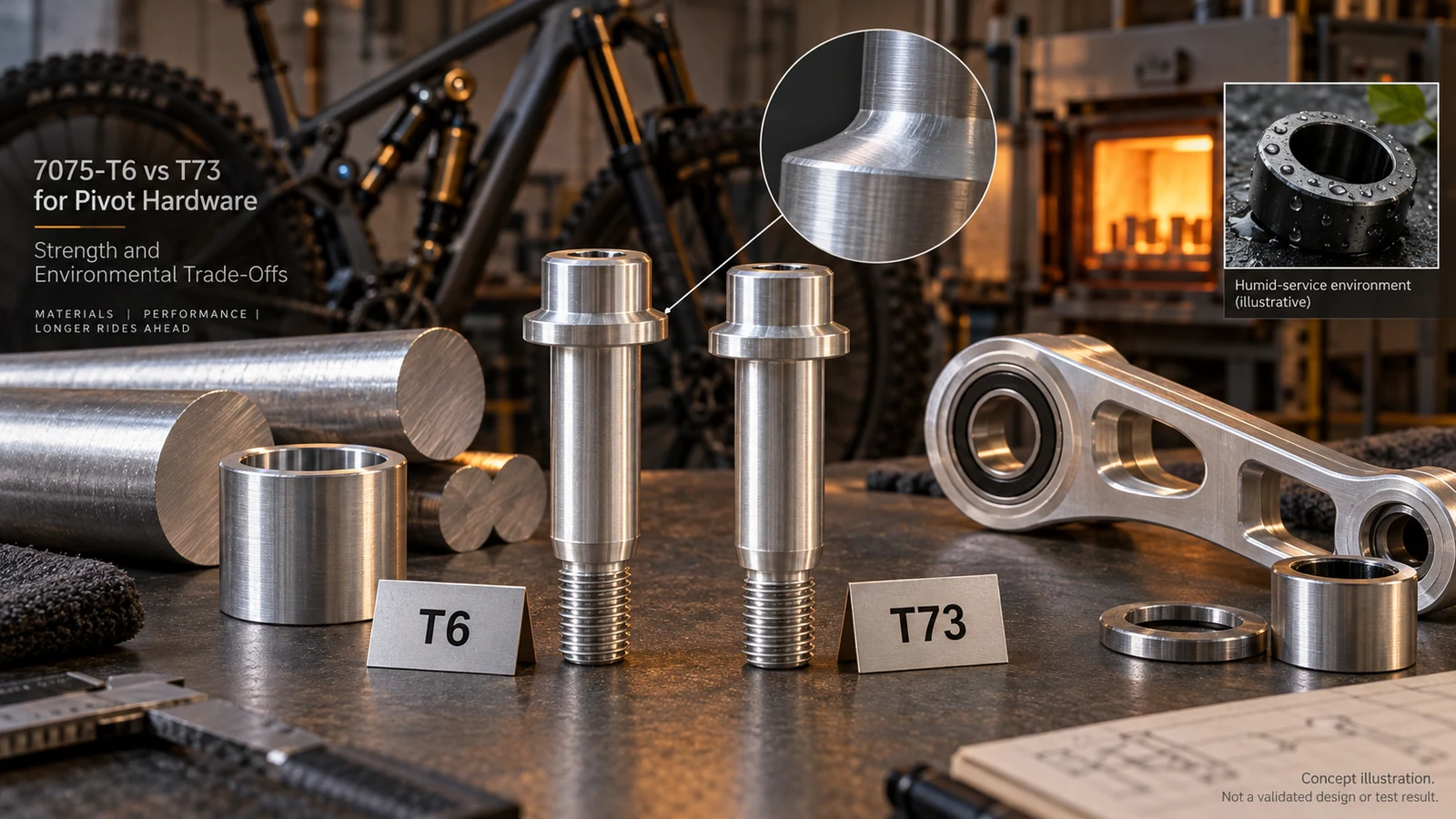
For 7075 T6 T73 pivot hardware, wet service is a reason to review the temper, not an automatic instruction to choose T73. T73 is an overaged condition intended to improve stress-corrosion resistance, with a different mechanical-property basis from T6. Compare data for the actual stock form, size and condition, then review the bolt section, receiver engagement and clamped contacts. Do not apply one strength-reduction percentage to every product or assume that a temper change replaces surface protection. The suitable choice is the complete component configuration that meets the project's mechanical and environmental requirements, supported by the specified material and finished-part evidence.
Hero: concept illustration of example hardware and its application. It is not a factory photograph, tested component or approved production geometry.
Know which material decision the temper changes
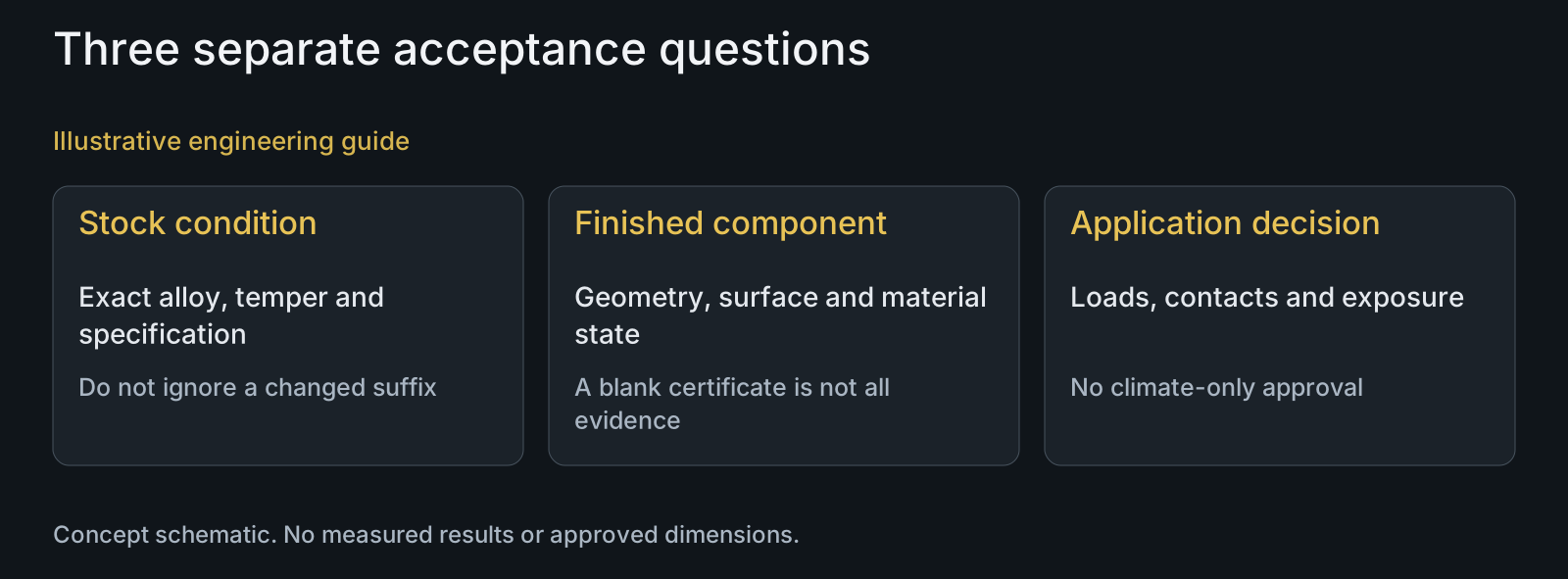
BIKAR's delivery-condition reference describes T6 as solution heat treated and artificially aged, and T73 as a solution-treated, overaged condition directed toward stress-corrosion resistance. These are processing conditions within the alloy designation, not separate aluminum grades. Specify the complete condition rather than ordering 7075 with an informal description such as corrosion grade.
The T6 and stress-relieved-stock guide addresses a different decision: how stretching stress relief and stock form enter machining. Here the question is the strength and environmental trade-off between temper options. A suffix relating to stress relief should not be confused with evidence that a finished pivot resists the project's exposure.
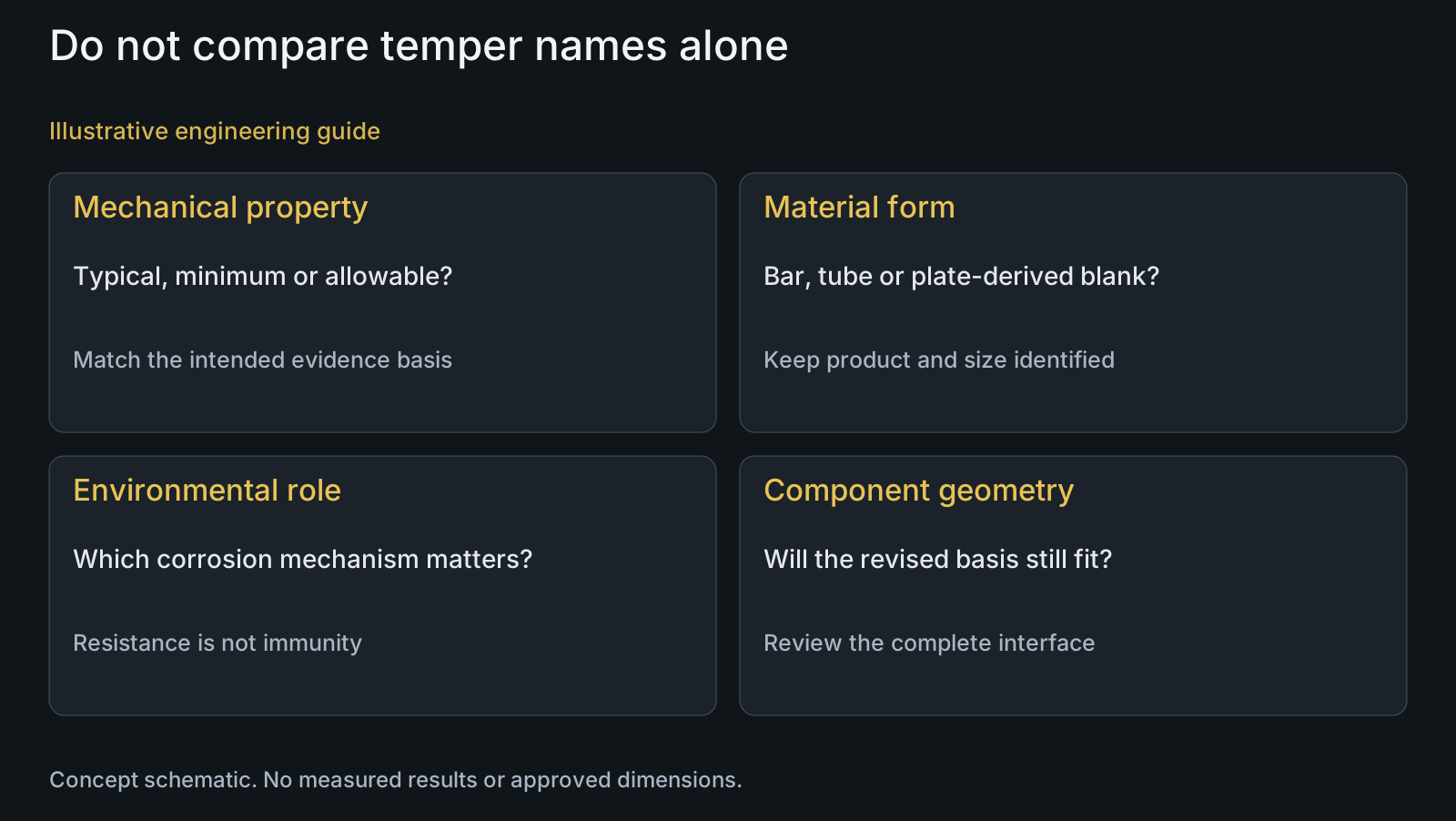
Keep the proposed form visible. Round bar, tube and plate-derived stock are not interchangeable descriptions for every design. If the proposed purchase changes both temper and form, the comparison has two variables. Resolve the applicable specification and property basis before interpreting a supplier's shorter material label.
Read the strength comparison without creating a design allowable
Kaiser's 7075 rod-and-bar sheet lists typical ultimate tensile and yield values of 572 and 503 MPa for T6/T651, versus 503 and 434 MPa for T73/T7351. These are typical material data, not guaranteed purchase minima or finished-pivot allowables. They illustrate why a substitution needs a mechanical review; they do not establish a universal percentage change.
Identify which property the existing design uses and what its data represent. Ultimate strength, yield strength, elongation, hardness and fracture toughness answer different questions. A larger elongation value alone is not proof of a component's toughness, just as hardness alone does not establish its permissible installation load.
Check whether the source matches the requested product form, dimensions, direction and material condition. Do not combine a typical value from one sheet with a specified minimum from another and describe the difference as a temper effect. The purchasing requirement must name its governing evidence, not merely attach the most favorable table found online.
| Review question | T6-based proposal | T73-based proposal | Evidence needed |
|---|---|---|---|
| Mechanical basis | Use applicable T6 data, not alloy name alone | Reassess applicable T73 data against the design | Matching form, size, direction and required property basis |
| Stress-corrosion concern | Explain stressed region and environment | Evaluate the stated resistance benefit under relevant conditions | Material reference and application-specific assessment |
| Existing geometry | Preserve the validated drawing baseline | Confirm section and interface requirements remain satisfied | Shoulder, head, thread and mating-stack review |
| Surface protection | Retain specified treatment and contacts | Do not delete protection solely because temper changed | Finished zones, exposure and assembled configuration |
| Supply and processing | Identify the supplied and final condition | Quote the exact alternative condition and route | Stock proposal, later processes and acceptance scope |
Keep stress corrosion distinct from other exposure concerns
The Kaiser reference separates general corrosion from stress-corrosion characteristics and relates the latter ratings to sustained tensile stress and specimen direction. This is why better stress-corrosion resistance does not mean every wet-service concern is solved. No immunity, service duration or corrosion rate for a bicycle joint follows from that material comparison.
For the project review, identify why stress corrosion is being considered: the relevant stressed region, exposure and supporting material data. A photograph of surface discoloration does not by itself diagnose a stress-corrosion crack. An investigation should distinguish observations from the proposed mechanism and use an appropriate assessment rather than selecting a temper from appearance alone.
Retain the defined finish, contact materials and moisture-control features in both alternatives. The 7075 corrosion-protection guide treats those surface and specimen decisions separately. T73 should not silently remove an approved protection requirement, and a good finish result should not be treated as proof of a different mechanical property.
Review the geometry before carrying over assembly requirements
A proposed lower strength basis may affect more than the smallest bolt diameter. Review the shoulder transition, drive recess, head seating and complete thread section, along with the receiver. The question is whether the existing component satisfies the required load cases in the proposed condition, not whether the stock still feels hard.
If an alternative needs a larger section, check whether the mating space permits it and whether the changed part still has the intended grip and clearance. A drawing revision can affect the sleeve, washer or receiver. Buying a different temper while leaving those consequences outside the review can produce a quote for a component the assembly cannot use.
Do not lower or raise the installation setting by the same percentage as a material-table difference. The specified procedure depends on the joint, contact condition and required clamping function. The responsible design team must establish its suitability for the revised configuration; this comparison supplies no new torque instruction.
Illustrative review: environmental benefit with a geometry constraint
Illustrative engineering example: assume an OEM is comparing T6 and T73 stock for a pivot shoulder bolt intended for repeated wet exposure. The shoulder diameter and head envelope are constrained by an existing linkage. No actual crack, test result, allowable load or successful substitution is assumed.
The reviewer first identifies applicable data for the proposed stock and compares the mechanical basis with that used for the existing design. The environmental reason for T73 remains relevant, but the team cannot assume that a thicker replacement will fit. It keeps the original finish and mating stack in the comparison rather than treating temper selection as the whole protection strategy.
If the existing geometry cannot meet the required conditions with the proposed material basis, the team must revise the complete design or examine another defined option. If it can, the quotation still identifies the exact stock and acceptance scope. The example's result is a bounded decision process, not approval of either temper for an unspecified bicycle.
Quote the condition that will actually be delivered
For CNC turning, distinguish machining approved supplied stock from a route that heat-treats the component later. A later operation needs its own controlled requirements and final-state acceptance. PremFixer coordinates specified thermal and surface operations through qualified partners; no in-house treatment, universal schedule or proprietary recipe is implied.
Connect the material-document request to the actual lot and purchase condition. Use the material-certificate scope guide to distinguish stock identity from finished-component evidence. A certificate for the blank does not replace geometry verification or application-specific validation of the completed pivot.
Questions buyers need to confirm
What does T73 mean for a 7075 purchase?
It identifies an overaged heat-treated condition directed toward stress-corrosion resistance. State it with the alloy, stock form and applicable specification. Do not replace the full purchase requirement with an informal corrosion-resistant label.
Is the T73 strength reduction always ten percent?
No universal percentage is established here. Compare the same property and evidence basis for the actual product. Typical material data, specification minima and component allowables should not be mixed into one percentage comparison.
Does T73 remove the need for anodizing or other protection?
Not automatically. Temper selection and the specified finish address separate parts of the design. Review the actual contacts, protected zones and exposure before proposing to remove an approved treatment.
Does higher elongation prove the finished bolt is tougher?
No. Elongation, fracture toughness and component performance are distinct evidence. Define the property and failure concern being evaluated, with an applicable method, rather than substituting one favorable material-table entry.
Can the same installation setting be used after changing temper?
Do not assume it. Review the required clamp function, component geometry, receiver and surface condition with the responsible design team. A material-strength comparison is not a new assembly instruction.
What should accompany a T6-to-T73 quotation proposal?
Provide the original and proposed stock specifications, product form, component drawing and reason for the change. Identify any later thermal or finishing operation, geometry constraint and acceptance evidence so the customer can assess the complete alternative.
Technical references and scope
Kaiser Aluminum: 7075 rod and bar technical data. Typical rod/bar strength comparison and separate general/stress-corrosion ratings. Values are not specification minima, design allowables, finished bolt properties or pivot life.
BIKAR: 7075 product forms and delivery conditions. T6/T73 and related condition definitions, and form-specific reference structure. No temperature recipe, current stock availability or guaranteed finished-component outcome adopted.
Explore related component, material and sourcing decisions in the customer decision knowledge center. For a drawing review, use the Drawing/BOM RFQ path.
Compare complete 7075 temper proposals
Send the controlled pivot drawing, requested stock form and specification, assembly constraints and environmental requirements. Identify the original condition and proposed alternative, with quantities and required evidence. PremFixer will review the manufacturing and supply differences without silently substituting stock or assigning an unverified installation setting.
Discuss the drawing and BOM