

Use ABC inventory for bicycle fasteners to rank a declared value measure, then add the consequence of missing the actual kit item. A custom pivot bolt is not automatically A-class, and a low-cost sleeve is not automatically safe to manage with minimal attention. Specify the item population, period and valuation basis before assigning classes. Separately review accepted alternatives, replenishment difficulty and revision exposure. These dimensions can justify different count, identity, availability and purchasing controls for the same item. The useful decision is which risk each control addresses, not whether a familiar component name or a single spend letter can prescribe its safety stock and supplier-management arrangement.
Hero: concept illustration of example hardware and its application. It is not a factory photograph, tested component or approved production geometry.
Declare what the ABC ranking actually measures
Choose the relevant item population and period before comparing values. Historical consumption value, unit cost and current stock value are different measures. A rarely consumed expensive bolt can rank differently from a frequently consumed inexpensive washer, and neither ranking alone describes the assembly consequence of a shortage.
Oracle's classification-criteria documentation illustrates these different criteria, including historical usage value based on transactions and their unit costs. This primary software example supports stating the basis; it does not require a particular application or prescribe your class cutoffs.
For a consumption-value approach, use consistent item identities, quantities and cost units across the selected period. Do not mix a bag price with a per-piece quantity or compare an incomplete launch period with a full year without explanation. Document the cutoff rule rather than present a familiar percentage split as a mandatory standard.
Assess shortage consequence on a separate axis
Ask what the absent item prevents and which accepted recovery paths exist. A standard-looking washer can still have a controlled thickness, finish or matching requirement. A custom sleeve can be low in annual spend while remaining essential to the only accepted kit configuration.
Keep operational supply criticality distinct from a safety qualification. Preventing kit completion does not itself classify a part as safety-critical or prove the design's load capacity. Identify the affected assembly requirement and available alternatives without inventing an engineering approval from an inventory label.
Oracle's ABC overview notes that counting decisions can consider criticality, cost, lead time and stock movements. The two-axis policy map here is an original buyer decision aid, not a claimed standard matrix or an actual PremFixer stock classification.
| Declared value and supply condition | Main decision | Risk of one-label policy | Useful targeted review |
|---|---|---|---|
| Higher value; usable alternatives | Protect accurate value records | Spend rank mistaken for shortage severity | Counts, discrepancies and actual recovery scope |
| Higher value; constrained recovery | Protect value and availability | One control expected to solve both | Separate record control and fallback review |
| Lower value; ready replenishment | Keep handling proportionate | All requirements reduced with spend rank | Simple routine with required identity/acceptance |
| Lower value; revision-specific blocker | Preserve usable kit availability | C-value label hides assembly dependency | Criticality exception and replenishment basis |
| New item; little usage history | Avoid false low-demand interpretation | Launch item classified as established slow mover | Declared planning assumptions and review point |
| Phase-out or revision exposure | Control further commitment | Automatic buffer creates obsolete stock | Affected-state and authorised demand review |
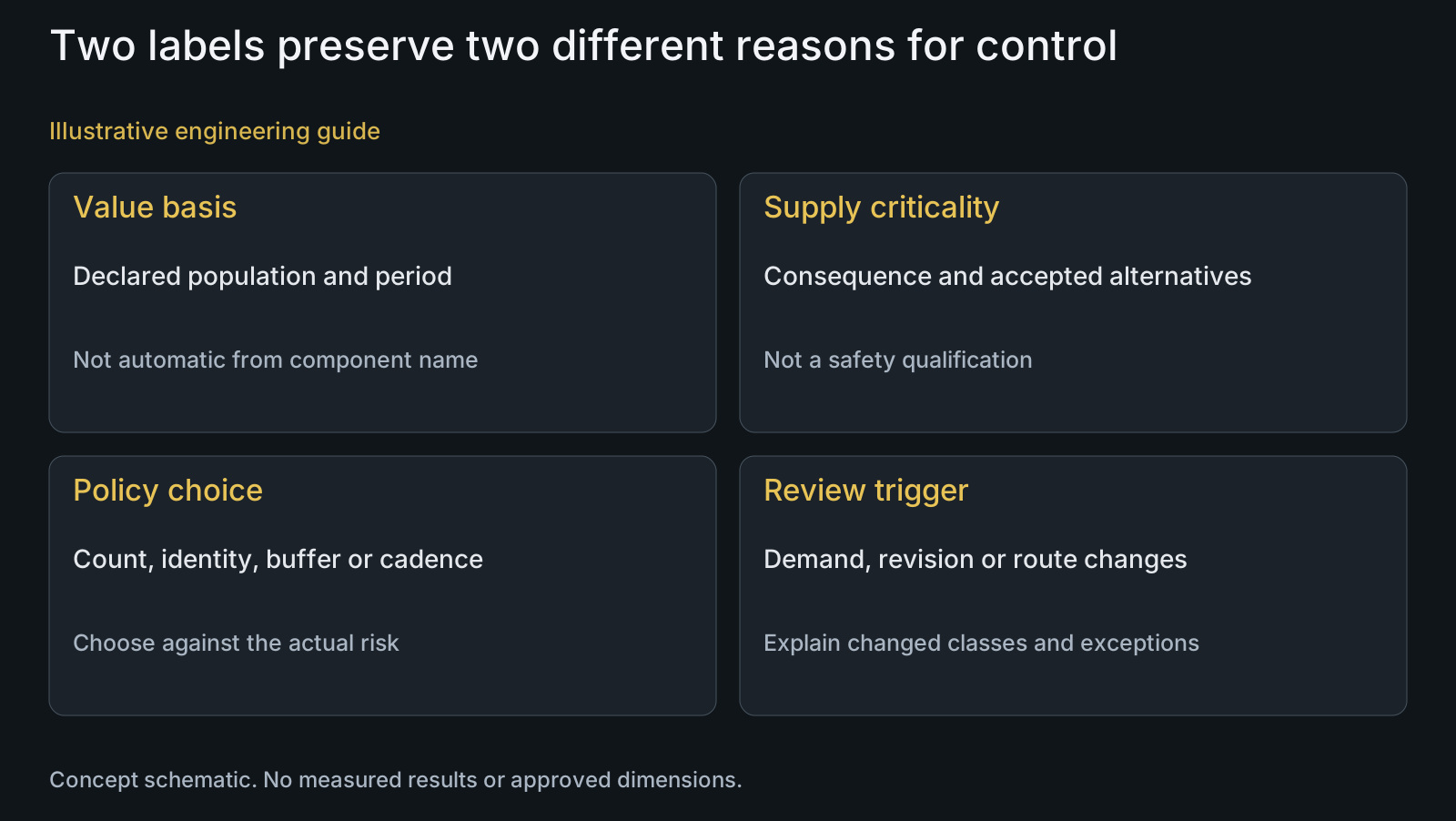
Choose each control against its own risk
For a high-value item, accurate records and discrepancy review protect the represented financial balance. For a hard-to-replenish kit blocker, visibility of usable quantity and an actionable recovery arrangement protect assembly availability. These purposes can overlap, but one does not replace the other.
A low-value, readily replenishable item may suit simpler routine handling within its actual requirements. A low-value revision-specific blocker may instead need clear identification, availability review and a scoped buffer proposal. Do not downgrade revision or acceptance controls merely because the spend rank is low.
Separate count frequency from buffer quantity and purchase cadence. Counting more often does not create supply, and holding more does not repair an unreliable identity. Use the VMI signal guide where replenishment data quality is the issue; inventory classification alone cannot establish the operating arrangement.
Review replenishment difficulty and demand shape
Identify the route and time basis that make the item usable, including required manufacture, treatment, evidence and receiving. A replenishment estimate for bare components cannot define availability of the specified finished configuration. Confirm the scope through the manufacturing overview and relevant materials requirements.
Distinguish regular use from intermittent demand, a new program and a planned phase-out. Historical low usage can mean low ongoing demand, but it can also mean the item has not yet entered full production. An ABC output based on that history needs a visible planning qualification, not an invented demand estimate.
The seasonal demand guide addresses timing, mix and manufacturing commitments. Here those facts inform classification policy; they do not authorise new stock. Review the current demand basis separately from work already committed when choosing a buffer or procurement cadence.
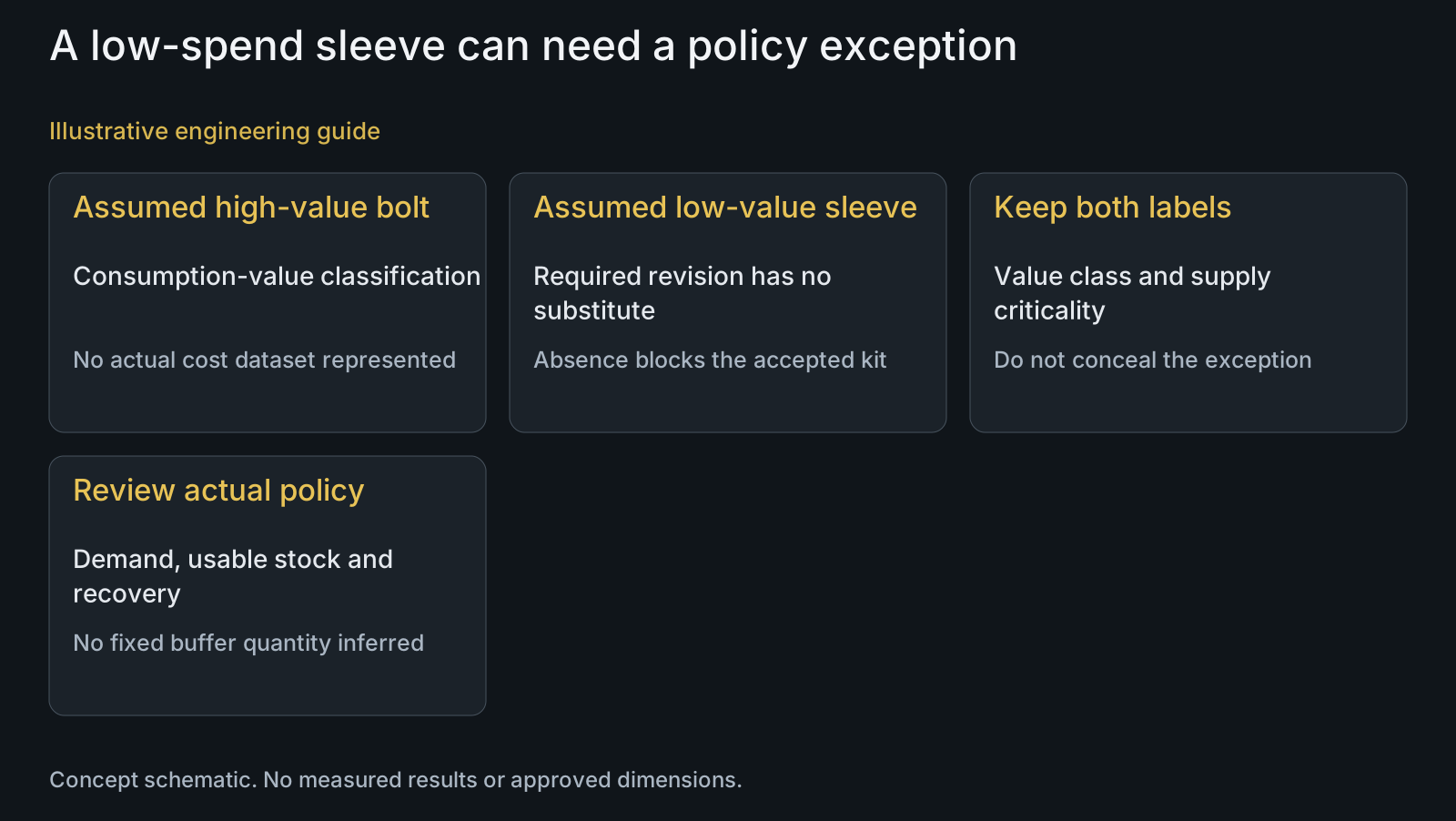
Compare a high-spend bolt with a low-spend sleeve
Illustrative engineering example: assume a program's declared consumption-value ranking places a repeatedly purchased pivot bolt in a high-value class and a revision-specific sleeve in a low-value class. The sleeve has no accepted substitute for the intended kit. No actual prices, usage history, classification cutoffs or supplier results are assumed.
The bolt merits the agreed value-related record and count controls. The sleeve additionally needs clear revision identity and a reviewed availability response because its absence blocks the same kit. The buyer retains the sleeve's calculated value label and records a separate criticality-based policy exception.
This does not prove that the sleeve needs a particular reserve quantity or that all bolts require the same treatment. The team still reviews demand, usable stock and replenishment assumptions. The example demonstrates how two independent reasons for control can coexist without disguising one as the other.
Preserve the basis when classes or requirements change
Keep the classification date, population, valuation criterion and applicable policy visible. If cost, demand or the selected item group changes, a changed letter can reflect the input basis rather than a changed operational risk. Preserve enough explanation to compare the two results honestly.
Review policy exceptions when the accepted alternative, revision or supply route changes. A new approved recovery path may reduce one dependency without changing annual spend. Conversely, a discontinued source can increase replenishment difficulty while the value class stays the same.
PremFixer can discuss drawing-led manufacture and scoped partner coordination, not universal A-class pivots or automatic C-class VMI. Use the sourcing recovery guide for usable fallback output and the knowledge center for adjacent decisions. Agree actions for the actual represented items instead of treating the classification report as procurement approval.
Questions buyers need to confirm
Are all pivot bolts automatically A-class inventory?
No. Calculate the selected measure within a declared item population and period, then apply the agreed cutoffs. Component type or unit price alone cannot establish the resulting class or the separate consequence of a shortage.
Can a C-value sleeve require strong control?
Yes. If the accepted kit needs that revision and recovery is constrained, its availability and identity may warrant more attention than the spend class suggests. Preserve the value result and document the separate criticality reason instead of pretending the two measures are identical.
Does an A classification set safety stock?
Not by itself. It identifies the result of the chosen ranking. A buffer decision also needs usable stock, demand, replenishment scope and revision exposure; accurate value records and extra quantity address different risks.
Is unit price the same as annual consumption value?
No. A consumption-value measure includes usage over the declared period, while unit price concerns one represented unit. Verify quantity and cost units before ranking. High volume can give an inexpensive item a larger consumption value than a rarely used expensive one.
Should every C-class standard item use VMI?
No automatic policy follows. Check the item's actual requirements, demand shape, replenishment data and responsibilities. Standard-looking geometry does not establish universal interchangeability, and a low-value classification does not create an inventory-management agreement.
When should the value-criticality policy be reviewed?
When the data basis, demand, revision, accepted alternative or supply route changes. Explain whether the value rank, recovery consequence or both changed. New programs and phase-outs need visible planning qualifications rather than uncritical reliance on earlier usage.
Technical references and scope
Oracle ABC classification criteria. Primary software examples distinguish valuation criteria including historical usage value; no mandatory cutoffs or deployed software inferred.
Oracle ABC analysis overview. Public classification and counting context includes multiple decision considerations. Original value-criticality map is not a prescribed standard.
Explore related component, material and sourcing decisions in the customer decision knowledge center. For a drawing review, use the Drawing/BOM RFQ path.
Discuss inventory policy for the actual kit items
Submit the drawing or STEP model, BOM revisions, usage basis, current usable stock and replenishment assumptions through the Drawing/BOM RFQ path. Identify kit-blocking items and accepted alternatives separately from spend classes. PremFixer can discuss the scoped manufacturing inputs and recovery dependencies without assigning universal stock levels or inventory-service promises.
Discuss the drawing and BOM