

An AI material tool can help organize candidate information for a custom pivot bolt or spacer, but it cannot establish suitability from a few fields labeled load, environment, weight and budget alone. Identify the component's function, load path, mating contact, specified material condition, final treatment and validation need before interpreting a ranking. Ask which source supports each comparison and which inputs remain unknown. Keep suggested, analyzed and approved states distinct. PremFixer manufactures against agreed customer requirements; this article does not establish an operating AI selector, validated recommendation accuracy or authority to release a loaded joint from a generated answer.
Hero: concept illustration of example hardware and its application. It is not a factory photograph, tested component or approved production geometry.
Define the component task before requesting a material name
A clamping bolt, supported pivot shaft and bearing-contact spacer can perform different tasks in the same assembly. Specify what the part transfers or locates and which surfaces matter. A generic bicycle-bolt prompt can omit the contact and engagement requirements that distinguish the actual design.
Separate service loading from assembly and contact demands. A lightly described location may still contain a threaded engagement or an axial contact requirement. Do not rank candidates using only one external load label while ignoring the rest of the component task.
The alternative-material guide assesses changes against original requirements. An AI suggestion is a candidate for that assessment, not permission to silently replace the material on a released drawing.
Make the candidate specification complete enough to compare
A material-family name does not define product form, condition and supplied component requirements. Identify the exact specification and state relevant to the proposed route. Stock data, a typical property and a finished-part acceptance requirement can describe different subjects.
Ask whether cited information represents the candidate condition and application. A confident explanation without a retrievable relevant source remains a gap. Do not promote a generic property table into an allowable value for the finished pivot.
Include finish, protected contacts and manufacturing constraints in the comparison. The materials pages and surface-treatment scope help frame those questions. A proposed material change may require a different route or evidence even when the nominal geometry is retained.
| Review subject | Input or evidence needed | Risk of omission | Decision action |
|---|---|---|---|
| Component function | Load path, locating and contact tasks | Ranking solves only a weight preference | Restore the actual component constraints |
| Candidate condition | Specification, product form and supplied state | Generic material data treated as final properties | Check relevant source subject |
| Mating interface | Bearing contact, thread and stack context | Same envelope mistaken for equivalence | Assess affected interface requirements |
| Environment and surface | Exposure and final treatment scope | Bare-stock comparison hides finished condition | Review candidate and process together |
| Recommendation basis | Sources, assumptions and missing inputs | Confident output becomes design authority | Keep facts and hypotheses distinct |
| Release decision | Responsible assessment and required evidence | Candidate silently replaces the drawing | Identify authorized material and BOM revision |
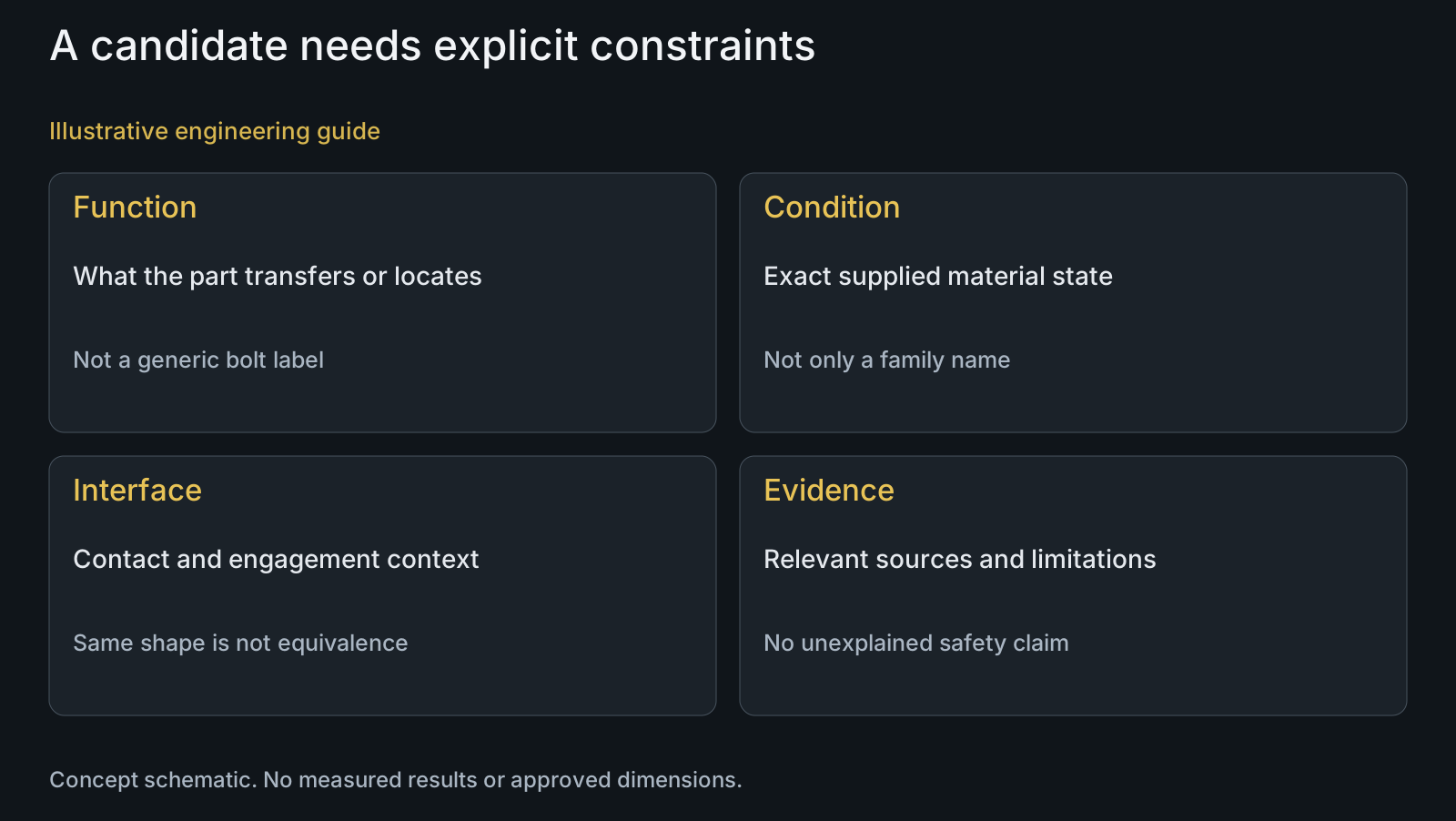
Treat the ranking as a hypothesis with visible limitations
Ask the tool to separate facts, assumptions and missing inputs. It should identify why a candidate is relevant and what could overturn that reasoning. An unsupported numerical confidence score is not proof that the bearing contact or loaded thread is suitable.
NIST's AI Risk Management Framework overview describes voluntary consideration of AI trustworthiness across design, use and evaluation. That is general risk-management context, not certification of a material recommendation or a pivot-specific selection method.
Keep the output's input set, source references and tool version available for review. If the geometry, exposure or required condition changes, identify which reasoning is no longer applicable. A previously generated answer does not automatically remain a recommendation for the new design.
Preserve the engineering decision and validation scope
The responsible design owner must assess the candidate against the actual joint and required evidence. A material ranking does not choose an acceptable engagement, finish boundary, fit or component geometry. Manufacturing feasibility is another relevant question, not a replacement for functional assessment.
State the unresolved analysis or validation needs instead of claiming every suggestion is safe. The supplied drawing and BOM should identify the authorized material and condition after the applicable decision. A candidate response should remain separate from that accepted requirement.
PremFixer's manufacturing discussion can clarify the proposed supplied scope and manufacturing questions. No in-house universal simulation, AI approval service or finished-joint validation capability is asserted by this article.
Review a lightweight suggestion that omitted contact requirements
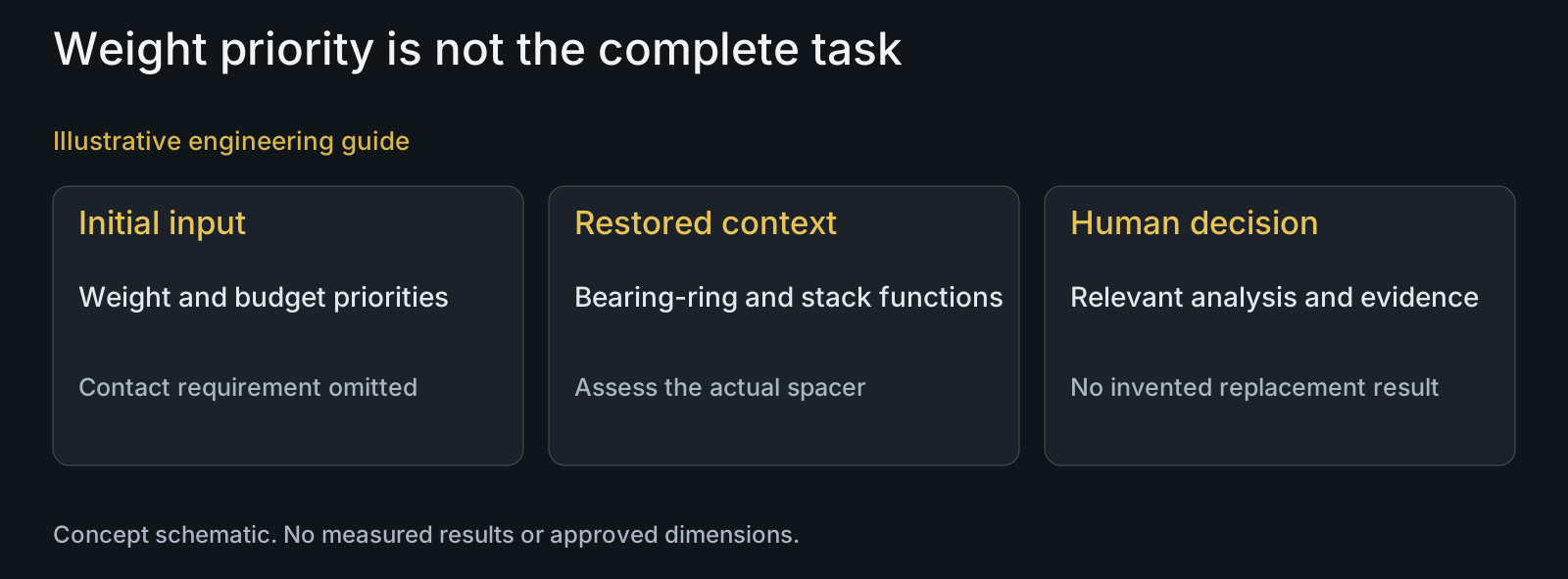
Illustrative engineering example: assume a conceptual tool ranks a lighter material candidate for a spacer after receiving weight and budget priorities. The input omits the bearing-ring contact task, axial stack definition and final-condition requirements. No actual tool output, material grade, load or tested result is assumed.
The reviewer does not accept the ranking as suitability evidence. It restores the missing function and contact inputs, requests relevant condition-specific sources and identifies the assessment needed for the actual spacer. If the candidate requires geometry or process changes, those become part of the alternative definition.
The example supplies no approved replacement or weight saving. It demonstrates that a plausible ranking can answer the wrong optimization question when constraints are absent. The useful result is a better-defined candidate assessment, not a green approval label.
Use assistance for a bounded comparison rather than a release shortcut
AI can help organize questions and source comparisons when the reviewer can examine their basis. It should not invent missing test results, certifications, service life or customer outcomes. If evidence is unavailable, narrow the statement and leave the affected decision open.
Maintain the baseline and proposed alternative as separately identified options. Compare function, manufactured condition and necessary evidence before discussing recurring price. The material-cost comparison distinguishes identical geometry from equivalent function.
Use the knowledge center for adjacent material and interface decisions. The final manufacturing request should carry the actual authorized requirement or clearly state which option remains under review; no automated selector is created or promised here.
Questions buyers need to confirm
Can AI approve a material for a loaded pivot?
No approval authority is established here. Treat the output as a candidate comparison and obtain the responsible assessment for the actual load path, interfaces, supplied condition and required validation.
Are load, environment, weight and budget enough inputs?
Not necessarily. Identify component function, contact and engagement, geometry, exact material condition, final treatment and evidence needs. Missing constraints can change which candidate is relevant.
Can a typical stock property be used as a finished-pivot allowable?
Do not make that automatic transfer. Check the data's product form, condition, represented test and intended use against the actual design requirement. A source citation alone does not establish applicability.
What should be retained with the recommendation?
The input configuration, sources, assumptions, missing information, tool version and reasons for the responsible decision. This supports review of what the output represented rather than treating it as unexplained authority.
Does keeping the same geometry make a material suggestion equivalent?
No automatic equivalence follows. Review structural, thread, contact, finished-fit and manufacturing consequences. A proposed geometry or process change must remain part of the alternative, not a hidden modification.
Does PremFixer operate an AI material selector?
That deployed service is not established here. Submit the actual requirement or clearly identified alternatives for a manufacturing discussion. No recommendation accuracy, automatic validation or release promise is given.
Technical references and scope
NIST AI RMF public overview. Voluntary AI trustworthiness and risk-management context only; no full framework conformance, material-selection method or supplier implementation asserted.
Explore related component, material and sourcing decisions in the customer decision knowledge center. For a drawing review, use the Drawing/BOM RFQ path.
Bring the candidate and its constraints to the manufacturing discussion
Send the drawing, STEP, BOM, component function, material condition, mating context, exposure and finish needs through the Drawing/BOM RFQ path. Identify the baseline and proposed candidate so PremFixer can clarify manufacturing scope while engineering suitability remains with the responsible review.
Discuss the drawing and BOM