
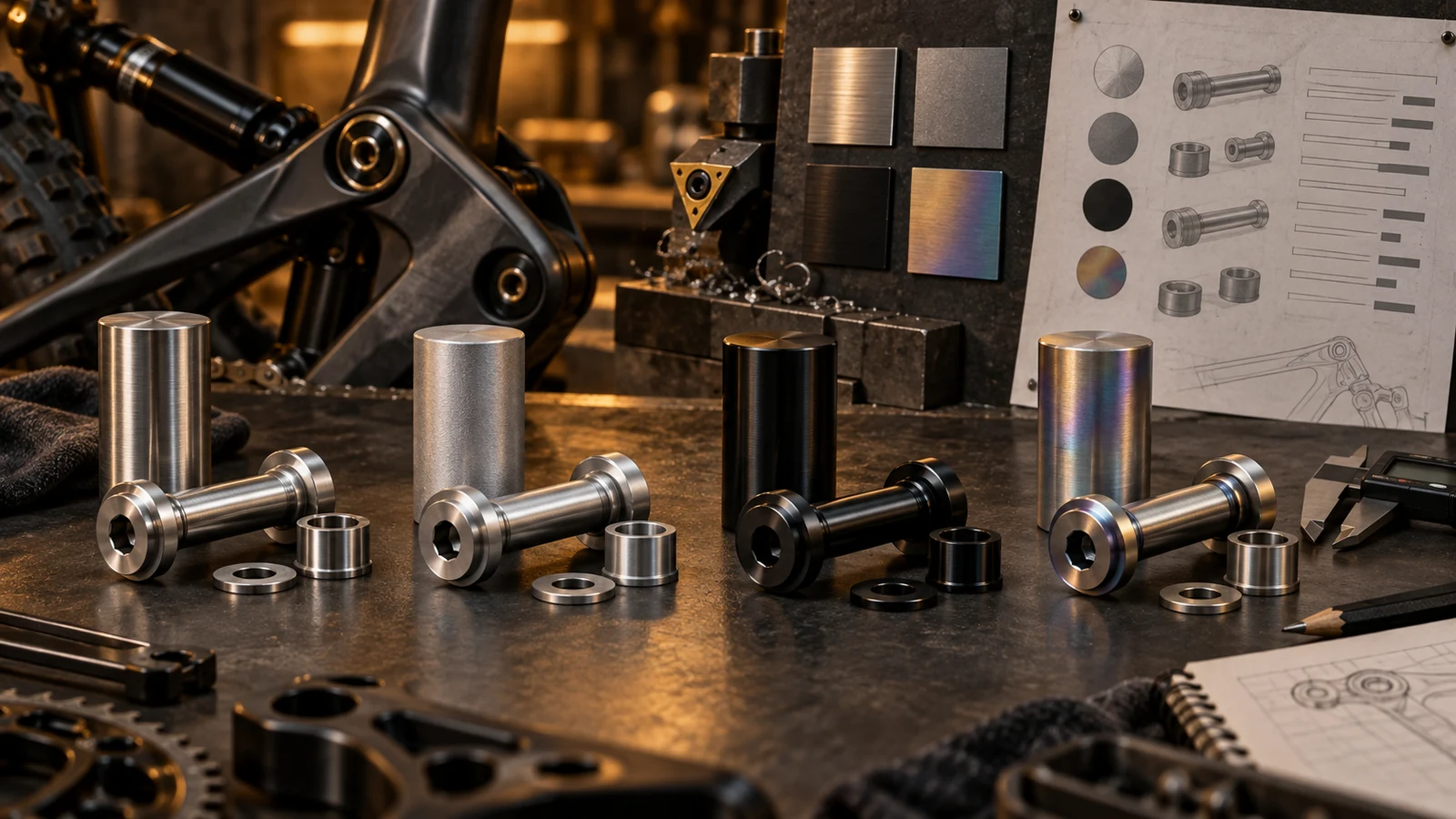
Titanium pivot hardware does not have a reliable universal price multiplier over stainless steel. An OEM comparing 304, 316, 7075 and TC4 must first decide whether the comparison holds geometry fixed or compares separately defined parts that meet the same functional requirements. Those are different questions. Specify product form, material condition, production quantity, final treatment and acceptance evidence for each option, then obtain comparable finished offers. Raw-stock cost cannot establish complete-kit price, and a lower-density alloy does not by itself establish an acceptable replacement or longer life. Treat price, finished mass and application evidence as separate outputs rather than use one assumed advantage to justify another.
Hero: concept illustration of example hardware and its application. It is not a factory photograph, tested component or approved production geometry.
Choose the comparison question before filling the cost sheet
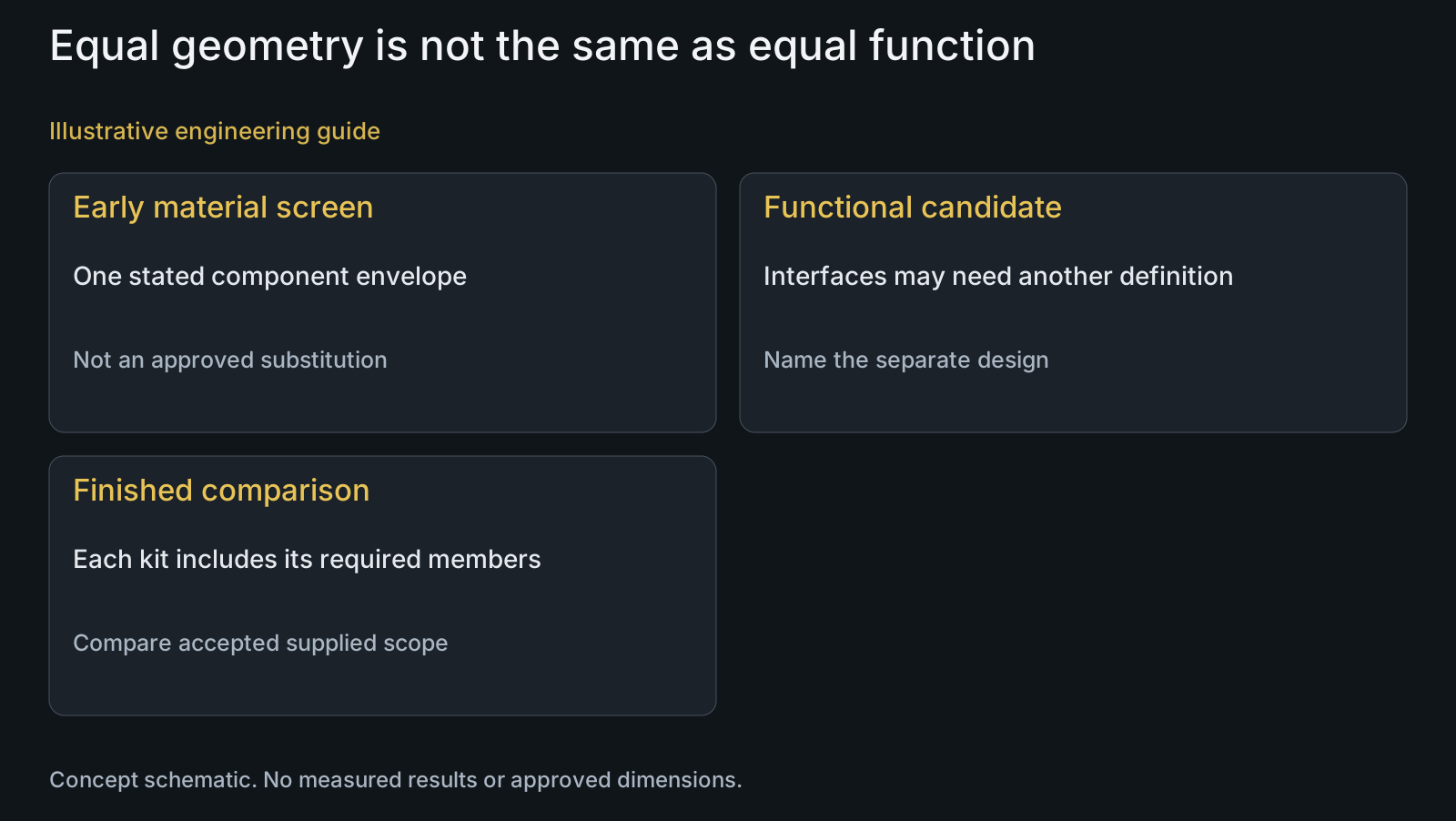
An equal-geometry screen asks what changes when the same component envelope is assigned different specified materials. It can help organize early questions, but it is not four approved designs. A functional comparison asks what each accepted option must look like and include to satisfy the actual joint.
Keep these comparisons in separate columns or worksheets. If a candidate needs a revised section, contact or engagement, identify that revision rather than continue calling it the same bolt. Otherwise an apparent material-price comparison quietly contains an unreviewed redesign.
The material substitution review addresses accepting a change from a specified baseline. This article owns the comparison experiment itself: equal geometry versus equivalent functional scope and the meaning of the resulting cost. Use Materials to identify the candidate definitions.
304 and 316 need an exact purchased and delivered condition
A stainless grade name alone leaves stock form, condition and finished requirements unresolved. Obtain a dated offer for the specified product and quantity. Do not assign a universal cost ranking or translate a commodity quotation directly into a manufactured pivot price.
Outokumpu's public machining introduction notes that grade-dependent physical and thermal properties influence machining, alongside cutting, cooling and chip control. That supports a route-specific conversion review. It does not provide PremFixer machine rates or show that every 316 component costs more to manufacture than every 304 one.
Keep the environment and finished contact state in the comparison. If engineering requires one grade for a particular application, a cheaper quotation for another grade is not yet a competing approved option. First identify the permitted choice, then compare the commercial offer on that basis.
| Candidate | Input to complete | Potential comparison error | Evidence or verification |
|---|---|---|---|
| 304 stainless | Stock form, condition and final requirements | Grade price treated as complete pivot price | Dated stock basis and finished offer |
| 316 stainless | Same supplied scope and defined application | Premium assumed to prove longer service | Application basis and equivalent acceptance |
| 7075 aluminum | Temper, treatment and actual candidate geometry | Equal envelope retained after redesign | Condition-specific definition and kit BOM |
| TC4 titanium | Controlling specification, form and condition | Trade shorthand treated as purchase equivalence | Material basis and conversion route |
| Equal-geometry screen | One stated volume and scope | Candidate screen mistaken for approved substitution | Separate functional assessment |
| Functional alternatives | Each accepted design and full kit | Added members omitted from price or mass | Complete constituent and evidence comparison |
7075 is not a complete specification without its condition
Kaiser's rod-and-bar data distinguish typical properties by temper. That producer-specific sheet supports naming the actual condition rather than using 7075 as one uniform material state. Its specimen data are not finished-pivot design allowables or guarantees for a different supplier's stock.
For a proposed aluminum design, record its treatment and protected functional zones alongside geometry. A change to the section or receiver arrangement changes the part being priced. Do not preserve an earlier equal-volume assumption after engineering changes the envelope.
Compare the complete constituent set. A lighter candidate axle accompanied by different sleeves or contact provisions is a different kit comparison. Include those members and their manufacture instead of comparing only the aluminum axle with a stainless assembly price.
TC4 needs a stated purchase specification and conversion scope
Resolve the TC4 shorthand into the controlling material specification, product form and condition before asking for an equivalent titanium offer. Do not silently equate every trade label with the same chemistry, processing state or evidence. The purchasing definition must identify what is actually ordered.
TIMET's TIMETAL 6-4 manual describes cutting-interface heat buildup, tool interaction and workpiece compliance as machining considerations. It also distinguishes supplied forms and conditions. These are reasons to review conversion work; they do not establish a current titanium price ratio or any PremFixer cycle time.
Review the relevant manufacture through CNC turning, including final surfaces and the required evidence. An earlier route for another alloy is not automatically transferable, but titanium also should not be assigned an invented manufacturing penalty merely because its stock is more expensive.
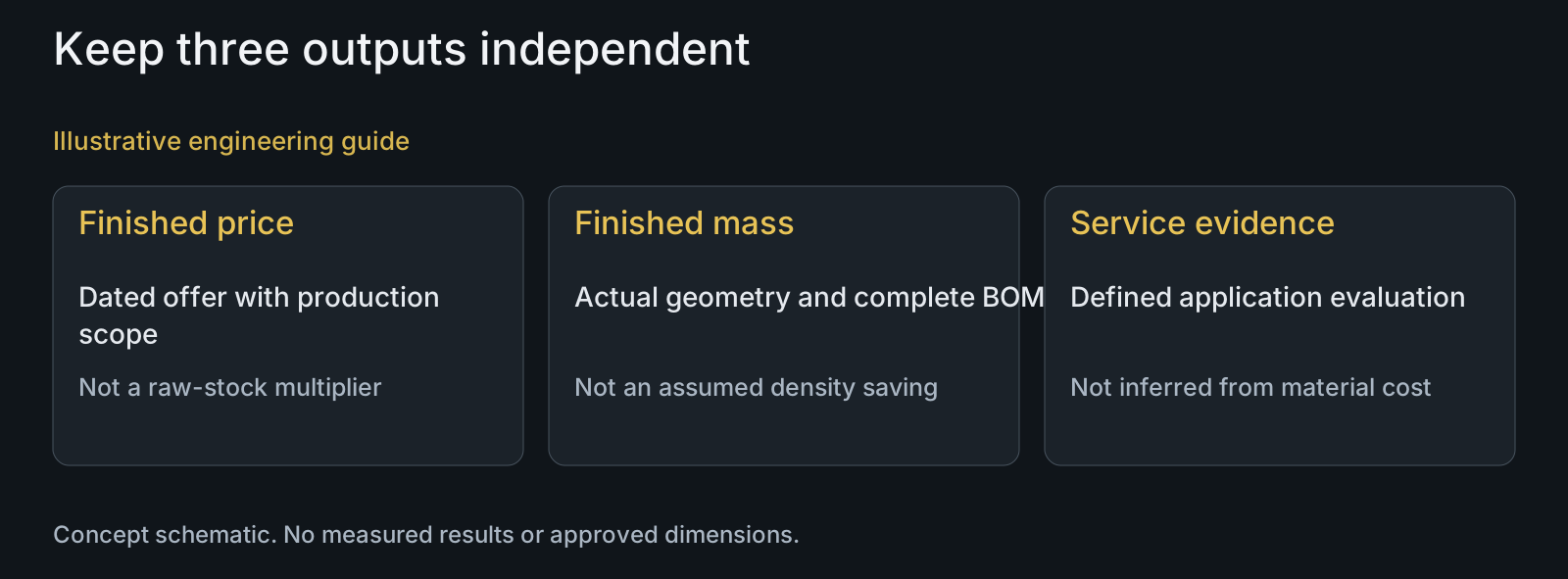
Report mass and service evidence independently of the quote
For a defined geometry, mass depends on volume and the appropriate density. Once a candidate is redesigned, use its actual volume and complete BOM rather than apply a fixed saving percentage. Include retained and added kit constituents so the compared object stays identifiable.
A quotation is not evidence of fatigue life, corrosion life or installed performance. State what evaluation supports each functional option and what remains open. More expensive material cannot be assigned a longer lifetime to make the commercial comparison appear favorable.
The cost-driver guide separates preparation, lot and component activities. Use that classification for each alternative, then keep any weight objective or service-value assessment beside the price, not hidden inside an unsupported universal multiplier.
Review example: the equal-envelope table stops being comparable
Illustrative engineering example: assume a team screens one axle envelope in stainless, aluminum and titanium. During review, an aluminum candidate requires a different interface definition and a changed spacer. No actual dimensions, suitability conclusion, mass saving or prices are assumed.
The reviewer retains the original screen as a labeled early comparison but creates a separate aluminum design and kit scope. Its quotation includes the altered constituent and relevant treatment and evidence. The other options remain associated with their own defined configurations.
The buyer can now compare finished alternatives that engineering permits, with unresolved work visible. They cannot call the changed kit an equal-volume material substitution or claim a life benefit from its price. The useful decision is which complete candidate warrants quotation or evaluation, not which alloy wins an invented universal ranking.
Questions buyers need to confirm
How much more does TC4 cost than stainless pivot hardware?
No universal multiplier is established. Request dated finished offers with exact material specifications, quantities and delivered scope. Stock price is one input, not the cost of machining, treatment, evidence and complete kits.
Should all four candidates have identical geometry?
Only for a clearly labeled initial screen. If satisfying the joint requires another section, engagement or constituent, define a separate functional candidate. Do not keep calling that revised kit an equal-volume material comparison.
Why does the 7075 temper matter to a price comparison?
It identifies the material condition being purchased and evaluated. Different conditions cannot be treated as the same functional input simply because the alloy number matches. State the temper, product form and final processing scope in the request.
Can TC4 and Ti-6Al-4V be accepted from their names alone?
No. Identify the controlling specification, form, chemistry and condition required by the project. Resolve the trade shorthand before ordering; a familiar alloy-family label cannot replace the complete purchase definition.
Does titanium's lower density prove the kit saves a fixed percentage?
No. Compare actual geometry and all included constituents, using the relevant material data. A redesigned axle or changed spacer alters the compared volume and BOM; no fixed complete-kit saving is established here.
Can a material premium be justified with an assumed longer life?
Not without relevant evidence. Keep fatigue, corrosion and installed-use assessment separate from quoted price. No service-life multiplier follows from the raw material cost or a producer's general alloy description.
Technical references and scope
Outokumpu machining-guide introduction. Public introduction to grade-dependent machining considerations. Gated handbook not accessed; no prices or numerical route recommendations used.
Kaiser 7075 rod-and-bar technical data. Historical producer-specific temper distinctions and typical properties, not current contract guarantees or pivot allowables.
TIMET TIMETAL 6-4 properties manual. Product/condition distinctions and machining considerations; no universal TC4 equivalence, price ratios or bicycle lifetime inferred.
Explore related component, material and sourcing decisions in the customer decision knowledge center. For a drawing review, use the Drawing/BOM RFQ path.
Request material alternatives as defined finished components
Send baseline and candidate drawings or STEP, exact material specifications and conditions, mating interfaces, full BOM, final treatment, quantities and required evidence through the Drawing/BOM RFQ path. PremFixer can compare manufacturing scope while your team identifies which functional alternatives are permitted.
Discuss the drawing and BOM