
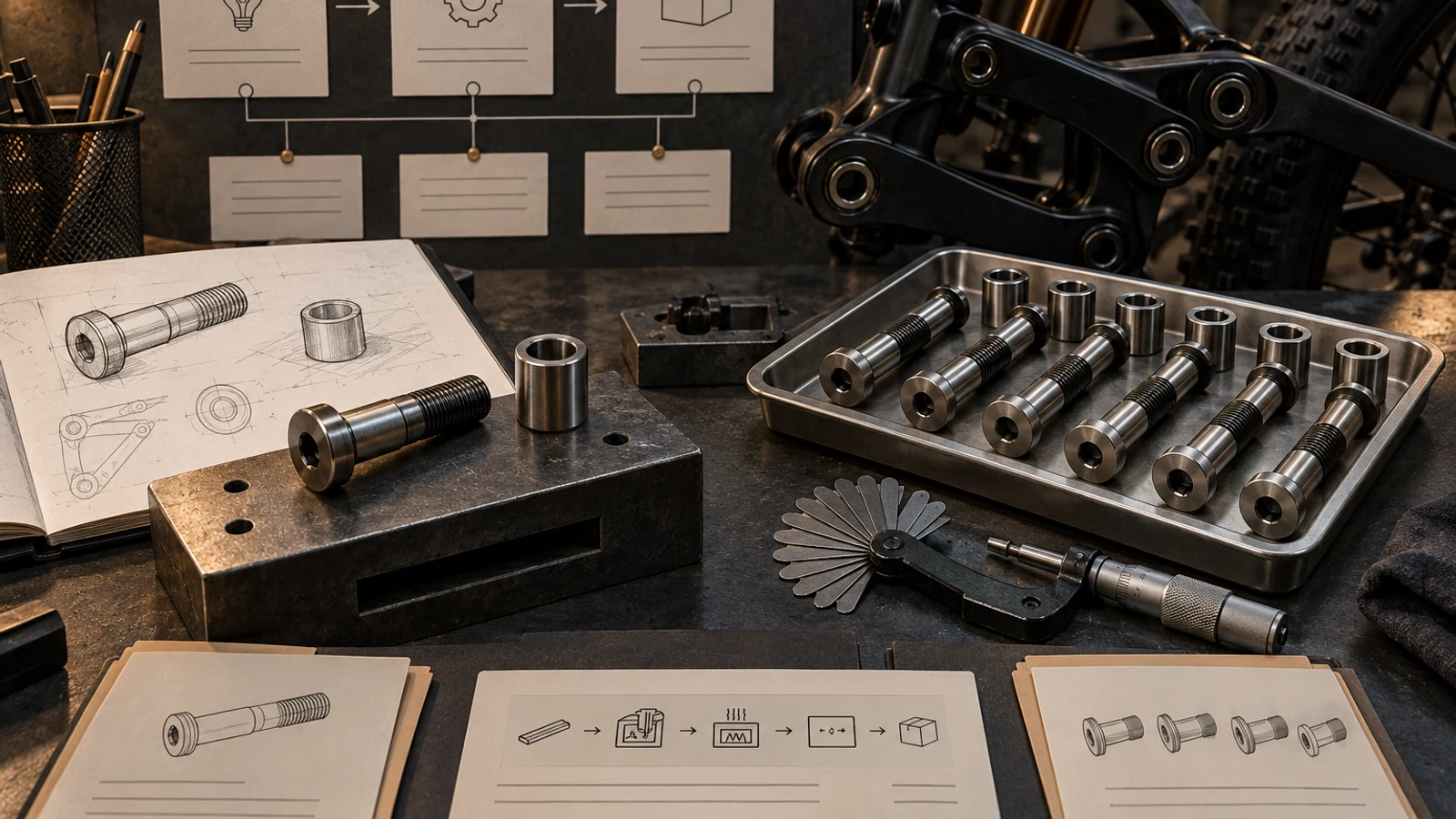
APQP and PPAP address different questions in a custom bicycle pivot project. Use quality planning to resolve interface, manufacturing and acceptance risks early; use the agreed production submission to demonstrate the defined production configuration against customer requirements. A prototype that assembles correctly is useful, but it does not establish that the intended production route produces acceptable parts. Before scheduling approval, agree the drawing revision, receiver interfaces, required evidence and who can accept unresolved changes. Otherwise a project can reach its submission date with an organized document package while the geometry or production basis remains unsettled.
Hero: concept illustration of example hardware and its application. It is not a factory photograph, tested component or approved production geometry.
Separate planning decisions from production evidence
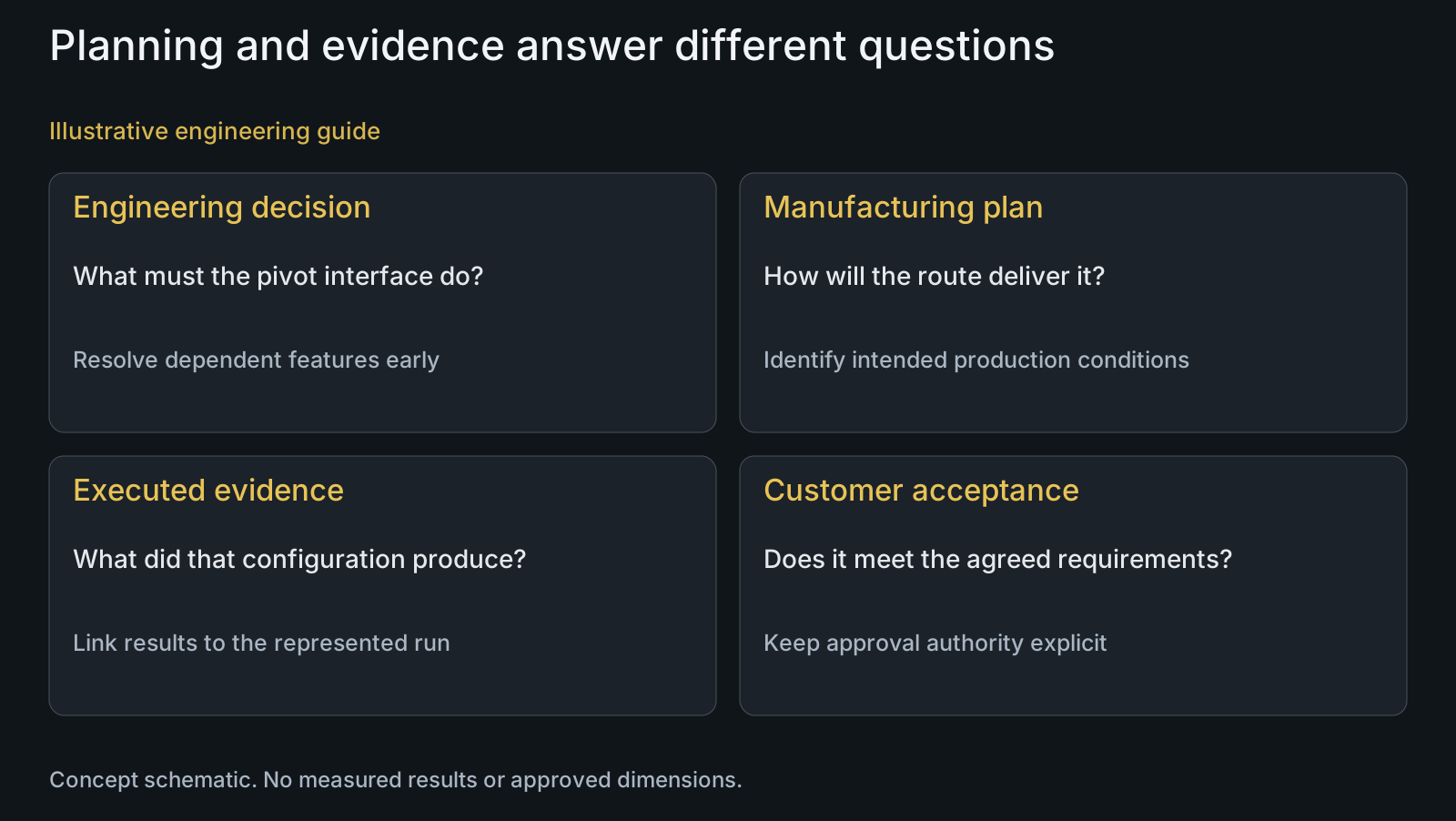
A planning question asks what must be decided, by whom and before which dependent activity. For a pivot, that can mean identifying the clamped members, bearing arrangement, shoulder datum or receiving thread. These decisions determine what manufacturing must deliver; they cannot be recovered from a submission checklist after the part has been produced.
AIAG's Core Tools overview distinguishes APQP quality planning from PPAP production approval. Its PPAP description concerns actual production meeting design and specification requirements. This is a useful distinction for a bicycle project, not a claim that automotive customer requirements automatically apply to every bicycle order.
If the customer requests these tools, establish the applicable manuals, customer-specific requirements and project deliverables. Use the pivot drawing review guide to identify the engineering inputs that planning needs before any production-evidence commitment.
Resolve receiver uncertainty before committing the hardware
The bolt drawing alone may not establish how the assembly behaves. Ask whether the frame receiver, sleeve and bearing stack are released, provisional or still being tested. A shoulder chosen against provisional receiver geometry can become unsuitable even when the supplier manufactures that shoulder exactly as drawn.
Track the engineering decision, not just the availability of a file. For example, a receiver drawing may exist while its usable thread depth remains undecided. Record which assembly dimension depends on that depth and when the frame team will resolve it. This makes the effect on sample manufacture and later production visible.
The drawing and fit guide explains how related size limits and datums support an interface decision. Planning should expose missing mating information rather than ask the factory to infer a universal bicycle fit.
| Open question | Useful action | Risk if confused | Evidence or decision needed |
|---|---|---|---|
| Receiver interface is provisional | Resolve the dependent hardware features | An accurate bolt may fit the wrong configuration | Released mating definition and interface review |
| Prototype used a different route | State the sample's limited purpose | Sample success is mistaken for production evidence | Identified route differences and relevant later verification |
| Inspection control is only planned | Agree how it will be executed | A written control is treated as a measured result | Results tied to the represented production configuration |
| Customer submission scope is unknown | Obtain the applicable requirements | An extensive package may still omit required evidence | Agreed elements, level if applicable and acceptance authority |
| Revision changes after sampling | Review affected interfaces and evidence | Old results silently cover a new part | Change disposition and applicable customer notification |
Distinguish an early sample from the intended production route
An early sample may be made with a different setup, material condition or inspection arrangement from the planned production run. State those differences. The sample can still answer a limited question, such as whether the tool clears the frame, without proving repeatable production of the final configuration.
Ask which operations, external processes and inspection methods represent the intended route. Evidence from one route should not silently cover another. A later finishing change, revised tool strategy or different subcontracted operation may alter what must be reviewed, even if the part number remains familiar.
Use rapid prototyping to discuss the specific sample purpose and manufacturing process information to review the intended route. Agreement on a plan is not evidence that its controls have been executed.
Review a receiver change as a project decision
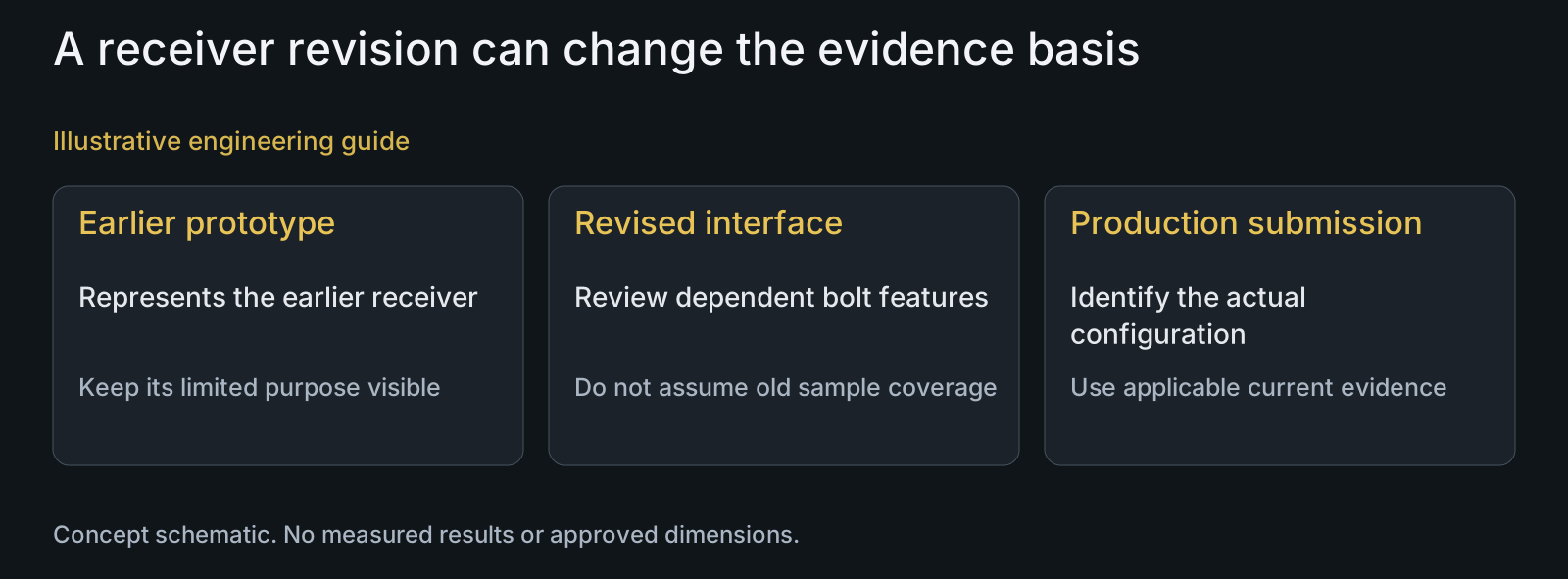
Illustrative engineering example: assume a pivot prototype assembled with a provisional sleeve and receiver. The frame team then changes the receiver's thread-depth geometry while the supplier prepares the production setup. No dimensions, test results or completed customer approval are assumed here.
The first task is to identify which bolt features and assembly checks depend on the revised receiver. The earlier sample remains evidence about the earlier configuration. Decide whether the revision changes thread clearance, shoulder contact or the represented clamped stack, and whether a new interface review is necessary before manufacturing continues.
Planning controls the timing and responsibility for that decision. Production submission must later identify the configuration actually represented by its evidence. Renaming the earlier sample as a production sample would conceal the open interface question rather than solve it.
Agree customer approval requirements without promising a universal package
AIAG's APQP and Control Plan update information identifies APQP Third Edition and the separate Control Plan First Edition. Its automotive implementation context does not establish the required edition, submission level or customer acceptance process for your bicycle project. Confirm those requirements with the responsible customer team.
Specify required submission elements, represented manufacturing conditions and acceptance authority. Do not assume a universal sample quantity, capability threshold or submission level from the acronym PPAP. Those commitments need the applicable requirements and the actual feature and measurement basis.
The PPAP Level 3 guide addresses submission scope in more detail. This planning guide focuses on the decisions that must be closed before those records can credibly represent the intended part and route.
Keep open decisions visible at the proposed production date
A dated submission plan can hide uncertainty if every issue is described as a document still to be collected. Separate missing evidence from an unresolved design choice. The former may need a production activity; the latter may require customer engineering action before that activity makes sense.
For each material change, state the affected configuration, dependent decisions and evidence that may no longer apply. Ask the customer which changes require notification or a new submission under its requirements. Do not infer permission from silence or treat delivery urgency as acceptance.
Send the defined scope through the pivot RFQ input guide. PremFixer manufactures to agreed customer inputs; approval ownership and special submission obligations must be established for the project rather than inferred from a general quality-system description.
Questions buyers need to confirm
Is APQP mandatory for every bicycle pivot order?
No universal requirement is established here. Confirm the customer's contract, quality requirements and requested editions. These determine whether formal APQP deliverables are required or whether a narrower project review is appropriate.
Can a successful prototype be the only PPAP evidence?
Not merely because it assembled. Identify whether its material, revision, process and manufacturing conditions represent the required production basis. A prototype made for access or interface review may answer only that limited question.
Should PPAP Level 3 be assumed when requesting a quotation?
No. Specify the customer-required level or submission elements and acceptance rules. The scope changes preparation effort, required production activities and timing; an undefined PPAP request does not establish those commitments.
What if the receiver drawing changes after sample approval?
Review the affected hardware interfaces and the applicability of earlier evidence. Supply the revised receiver geometry, bolt revision and change description. Thread depth, shoulder contact or stack changes can require a different engineering decision even if the earlier sample was acceptable.
Does an ISO 9001 certificate demonstrate a completed PPAP?
No. A management-system certificate and a part-specific production submission address different subjects. Request the actual configuration, required evidence and customer disposition rather than treating company certification as production approval.
What must be agreed before setting a submission date?
Agree the released or provisional interfaces, drawing revision, intended production route, required records and acceptance authority. Identify unresolved decisions separately from missing measurements so the schedule does not assume customer engineering work is already complete.
Technical references and scope
AIAG Quality Core Tools overview. Public descriptions distinguishing quality planning and production approval; not the full normative manuals or a bicycle customer mandate.
AIAG APQP and Control Plan update information. Public edition and separate Control Plan information; automotive implementation dates are not generalized to bicycle projects.
Explore related component, material and sourcing decisions in the customer decision knowledge center. For a drawing review, use the Drawing/BOM RFQ path.
Define the pivot project and approval scope
Submit the drawing, STEP model, receiver and sleeve interfaces, BOM, sample purpose, intended volume and customer quality requirements. Identify open revisions and requested APQP or PPAP deliverables. The review will separate early engineering decisions from production evidence and clarify the scope that must be agreed before an approval schedule can be committed.
Discuss the drawing and BOM