

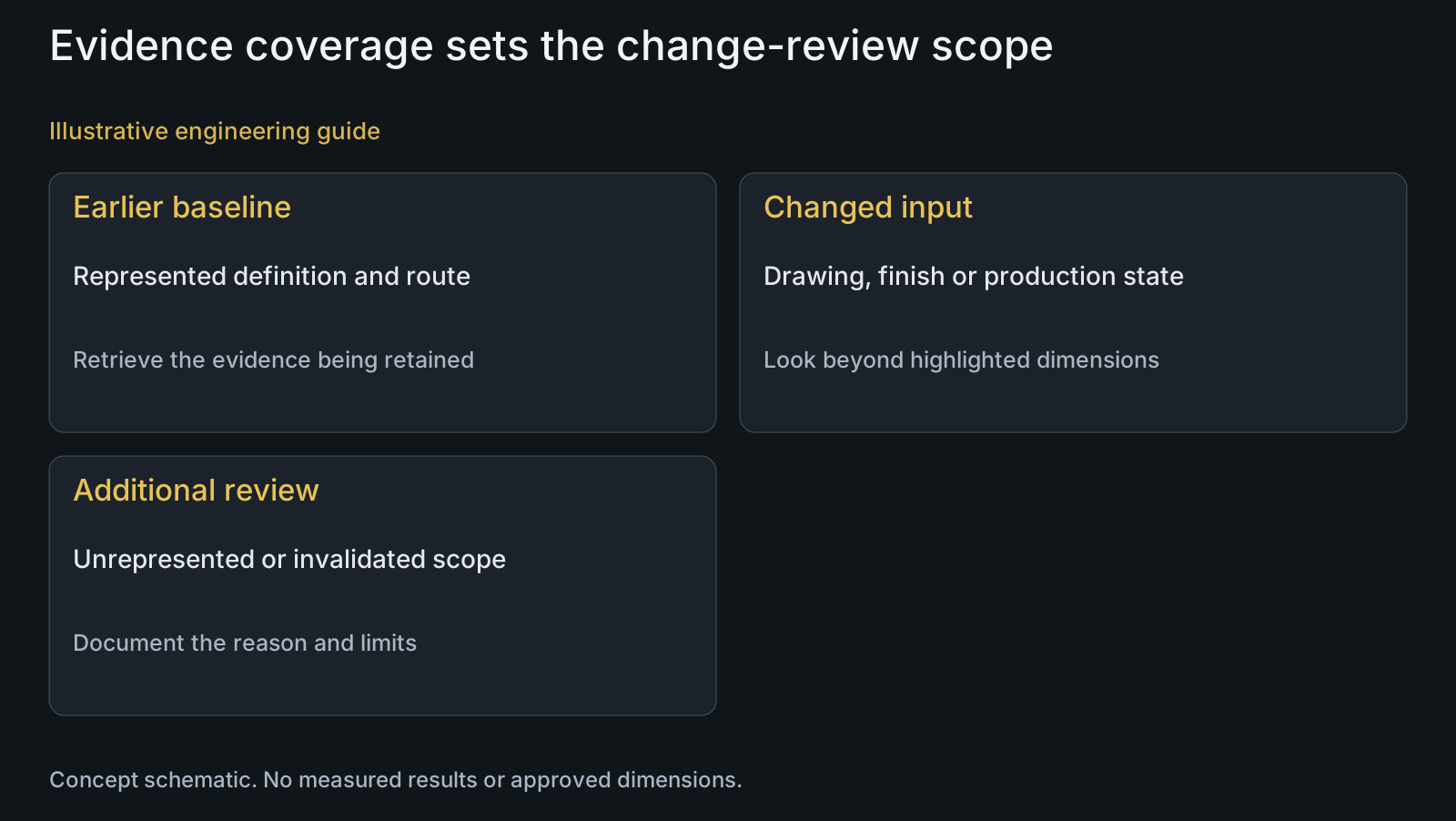
A bicycle pivot project does not require AS9102 merely because it uses custom bolts, but a buyer may specify an FAI deliverable contractually. When a drawing, finish or production route changes, do not assume the earlier report covers the new condition or that inspecting only the redlined dimensions is sufficient. Compare what the previous article represented with the new requirements, then identify affected evidence and agree the additional review. A partial scope may be appropriate under the applicable requirements; it needs a defensible basis rather than a smaller spreadsheet. FAI review, product acceptance and complete bicycle validation remain separate decisions.
Hero: concept illustration of example hardware and its application. It is not a factory photograph, tested component or approved production geometry.
Identify the obligation and the baseline before evaluating a change
Establish whether the order calls for conformity to a named AS9102 revision or an adapted first-article report. SAE's public AS9102C record identifies the June 2023 revision and explains that its requirements complement customer and applicable regulatory requirements. A familiar template cannot resolve the contract's actual scope.
Collect the earlier report's represented part revision, manufacturing configuration and supplied state. If it describes an uncoated prototype but the order concerns finished production hardware, that difference belongs in the baseline comparison rather than disappear behind the same part number.
Use the first-article introduction for initial evidence planning. This article focuses on the later decision: what a change leaves unrepresented and what review is needed before earlier evidence can be retained.
Compare requirements and evidence, not just drawing redlines
Create a short change assessment that connects each changed input to potentially affected characteristics. For a pivot axle, a revised shoulder can alter the seating arrangement; a finish change raises a question about the condition represented by earlier dimensions. The reviewer should examine those relationships instead of considering only the edited text.
IAQG's Revision B-to-C summary highlights a documented change-evaluation process and characteristics invalidated or not represented. That public guidance supports examining evidence coverage. It is not a complete implementation procedure or a substitute for the applicable standard.
Separate an observed drawing change from a proposed consequence. Record why a particular characteristic's evidence remains relevant or needs review. Do not invent a measured coating effect, new tolerance or service-performance result merely to make the assessment look quantitative.
| Change or gap | Review question | Risk of a narrow shortcut | Useful basis |
|---|---|---|---|
| Shoulder geometry revised | Which seating relationships and characteristics changed? | Only the edited dimension is considered | Old and new definitions plus connected feature evidence |
| Finish added; diameter text unchanged | Does earlier evidence represent the required final surface? | Pre-finish values are treated as final | Defined finish and final-condition verification scope |
| Thread manufacturing route changed | What required characteristics need renewed evidence? | Same nominal thread means same demonstrated process | Described route and applicable verification requirements |
| Fixture or datum method changed | Does the evaluation still represent the controlled relationship? | A coordinate list is copied without reviewing its basis | Datum definition and measurement setup evidence |
| Earlier package unavailable | What baseline can actually be retained? | A partial report refers to missing evidence | Retrievable represented configuration and coverage |
| Only one kit component changed | Which part and assembly questions are affected? | One report is assumed to cover every item | Component definitions and linked assembly requirements |
Treat manufacturing changes as evidence questions too
An unchanged drawing does not necessarily mean an unchanged represented process. A different thread route, fixture arrangement or treatment provider can raise different questions about how the required characteristics are demonstrated. Describe the actual change and the relevant evidence rather than declare every process change harmless or mandate the same response to all changes.
For example, a fixture change may prompt review of datum establishment and the relationship used to evaluate a shoulder. A treatment change may prompt review of process records and final-condition verification. These are project-specific engineering review questions, not claimed AS9102 clause-by-clause triggers.
The CMM feature-and-datum guide addresses whether the measurement represents the controlled feature. The manufacturing scope helps identify the proposed route and any coordinated partner work without assuming every operation is in-house.
Define a partial scope with its retained baseline
If the applicable process supports a partial FAI, identify the baseline being retained, the reason for the new review and the characteristics it must cover. Explain the evidence supporting unaffected requirements. A partial package should not leave the reviewer guessing where the remaining information resides.
If the baseline cannot be retrieved, the represented process is unclear or the change affects a broader group of characteristics, resolve that gap before promising a minimal scope. Missing baseline evidence and a limited engineering change are different situations, even if the customer sends the same one-line revision notice.
Do not combine several similar kit components into one assumed identity. An axle, receiver and sleeve can share an assembly while having different definitions and changes. Organize their evidence at the level required by the agreed deliverable and keep assembly questions distinguishable from individual-part requirements.
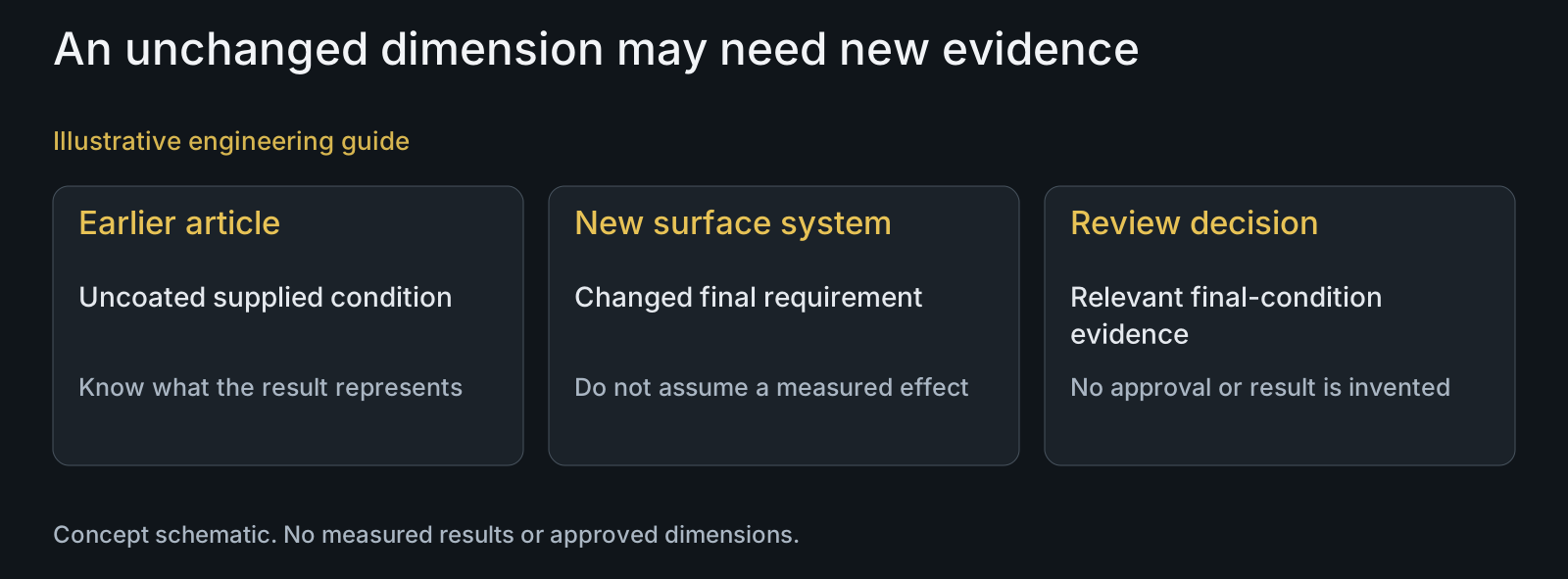
Illustrative engineering example: a finish change with no redlined diameter
Illustrative engineering example: assume an OEM has an earlier first-article package for an uncoated pivot axle. The new order specifies a surface system while retaining the nominal shoulder dimensions. No coating thickness, measured size, accepted report or actual customer result is assumed.
A redline-only review might inspect nothing because the diameter text is unchanged. An evidence review instead asks whether the earlier dimensional result represents the required finished surface, which process evidence is needed and whether any relevant acceptance method changes. Unrelated information can be considered for retention only within the applicable requirements.
The proposed additional scope follows those unanswered characteristics and its documented baseline. The scenario does not decide that a particular partial FAI is compliant, approve the finish or prove the assembled bearing performance. Its useful conclusion is why an unchanged dimension can still need new evidence.
Keep report review and product release as separate deliverables
IAQG's Revision C change summary explicitly clarifies that FAI is not a product acceptance document. Name who verifies the report, who handles unresolved nonconformities and which separate order requirements control product release. Do not infer shipment authorization from a completed-looking file.
State the proposed change-review scope in the quotation, including required forms, evidence sources and customer instructions. Confirm whether PremFixer can supply the requested compliant deliverable for that project; no universal AS9102 reporting or aerospace certification is established by this article.
Use the custom-order document guide to distinguish material, process and feature records, and the customer decision knowledge center for related interface decisions. Report what remains unresolved without expanding one first article into lifetime approval of every subsequent batch.
Questions buyers need to confirm
Is AS9102 mandatory for all bicycle pivot projects?
No universal obligation follows from the part name. Confirm the customer's contractual requirement and applicable revision. An aerospace-origin reporting framework can be used in another sector without becoming a bicycle product certification.
Can a partial FAI inspect only redlined dimensions?
Not as an automatic rule. Evaluate the change against the earlier represented configuration and evidence. Unchanged-looking characteristics may need review when their evidence is invalidated or the required final condition was never represented.
Does an unchanged drawing mean earlier process evidence remains valid?
Not necessarily. Identify any route, fixture, treatment or other relevant production change and assess the affected characteristics under the applicable requirements. Do not assume either no review or a complete restart without that basis.
What should a partial-review request identify?
Identify the retained baseline, new definition, reason for review, affected characteristics and required supporting records. Include customer instructions and the applicable standard revision so the proposed scope can be assessed rather than inferred from a template.
Does a reviewed FAIR authorize shipment or validate the linkage?
Not by itself. Keep FAI verification, nonconformity disposition, product release and assembly validation distinct. Identify the actual authority and evidence for each decision instead of extending a report signature to unexamined requirements.
Can PremFixer promise a compliant AS9102 package without project review?
No blanket availability is established here. Provide the required revision, forms, earlier package, drawings and change description. Confirm the evidence sources, responsibilities and proposed deliverable before treating it as an order commitment.
Technical references and scope
SAE: AS9102C public scope and revision record. Publisher's June 2023 revision and complementary customer/regulatory requirement scope, not the full paid standard.
IAQG: 9102 First Article Inspection Requirement. Aerospace origin and possible standardized FAI use in other sectors. No universal bicycle obligation or supplier certification.
IAQG: Revision B-to-C summary of changes. Official public documented change-evaluation, invalidated/unrepresented characteristics and non-product-acceptance clarification. No exhaustive trigger list or full implementation claimed.
Explore related component, material and sourcing decisions in the customer decision knowledge center. For a drawing review, use the Drawing/BOM RFQ path.
Define the first-article scope for your changed pivot project
Send the current and previous drawings, item-level BOM, earlier first-article package and a description of material, finish or process changes. Include the required AS9102 revision and customer instructions so PremFixer can discuss the proposed evidence scope and deliverable availability.
Discuss the drawing and BOM