
ASTM A276 and B348 are useful starting references for stainless and titanium pivot stock, not complete specifications for finished bicycle hardware. State the governing edition, grade, product form, supplied condition and evidence required for the order. A stainless bar request differs from a sheet or forging request, and B348 alone does not select one titanium grade. Keep 304, 316 or TC4 shorthand connected to its actual governing requirement rather than assume every familiar name is interchangeable. The component drawing must separately define the shoulder, thread and contact surfaces that machining creates. Stock conformity does not approve those features or the assembled joint.
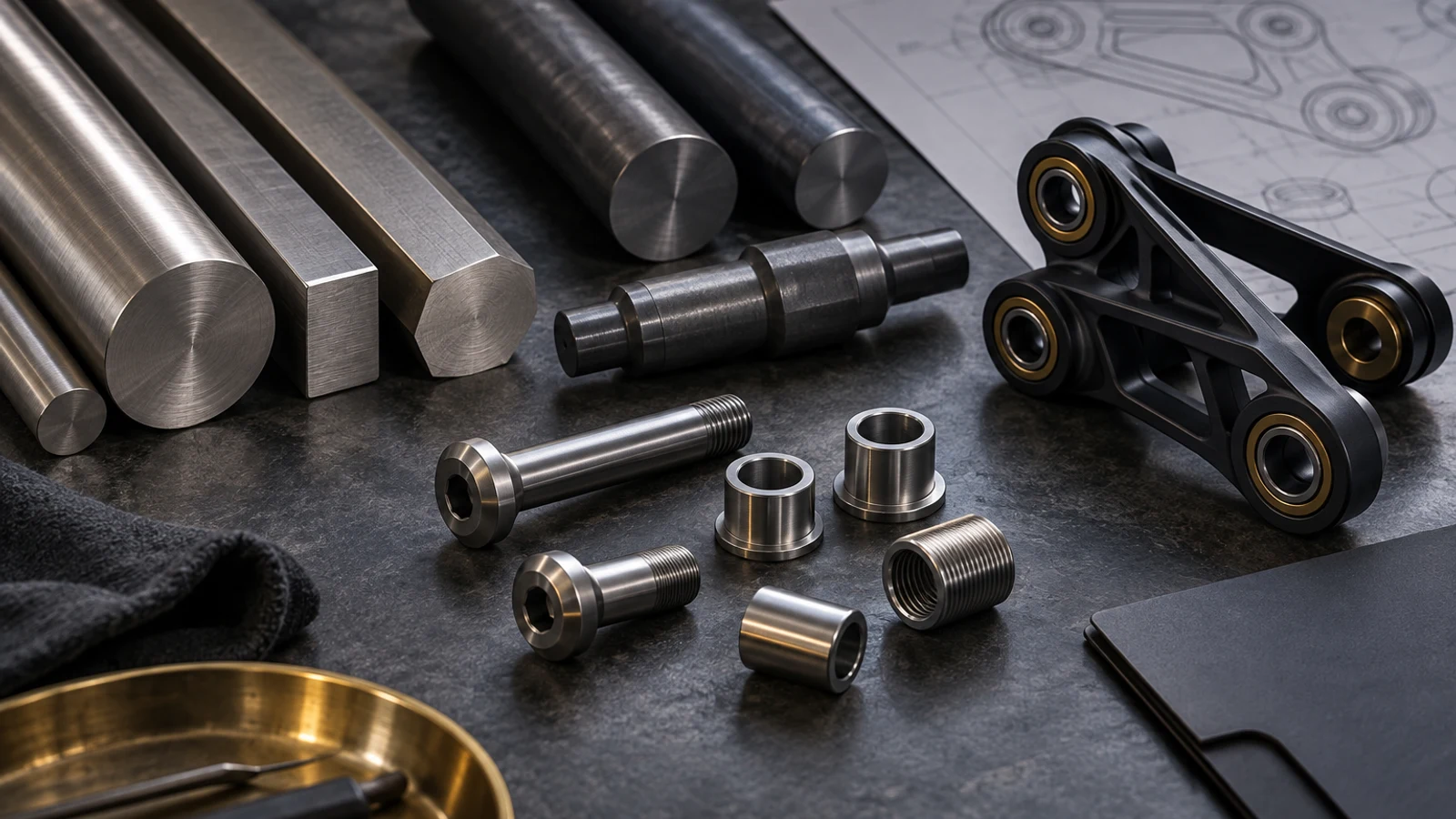
Hero: concept illustration of example hardware and its application. It is not a factory photograph, tested component or approved production geometry.
Select the stock form before selecting its specification
ASTM A276/A276M-25's public scope covers hot- or cold-finished stainless bars and shapes, with stated exclusions. The title is not a universal specification for every stainless product. A drawing machined from round bar needs a relevant stock requirement, not a sheet requirement copied from another BOM.
ASTM B348/B348M-25 concerns annealed titanium bars and billets. Match that subject to the actual proposed feedstock. Do not describe plate, wire or a finished forging as covered merely because it uses a similar alloy designation.
An illustrative supplier specification chart lists different stainless references for bar, plate, pipe and forgings, including 304 and 316 bar entries. That commercial chart helps explain the form distinction; the contracted standard remains the governing source, not a substitute chart.
Keep grade selection separate from the standard number
A standard covering a family of materials does not select one member for the order. A276 without the required stainless designation leaves the buyer's material choice unresolved. For 304 or 316 requests, identify the actual specified grade and condition rather than use stainless as a complete description.
B348 likewise includes multiple titanium grades. Specify the required grade and governing requirement. A TC4 description needs its own stated specification and acceptance basis; do not silently translate that label into complete conformity to another system from broadly similar alloy wording.
The AMS4928-versus-B348 guide addresses cross-standard titanium proposals. This article concerns making either stock request complete before manufacture. The material-selection guide treats the separate choice of material for the joint.
| Field | Stainless request | Titanium request | Risk if unresolved |
|---|---|---|---|
| Standard and edition | Applicable A276/A276M requirement | Applicable B348/B348M requirement | Wrong contractual scope |
| Grade | Named stainless designation | Selected titanium grade/specification | Family name leaves alloy unresolved |
| Product form | Actual bar or shape subject | Actual bar or billet subject | Different feedstock assumed equivalent |
| Supplied condition | Grade-appropriate ordered state | Ordered condition within scope | Evidence describes different material state |
| Required evidence | Allocated material and requested results | Allocated material and requested results | Generic record attached to unrelated goods |
| Finished drawing | Shoulder, thread and contacts | Shoulder, thread and contacts | Stock record mistaken for part acceptance |
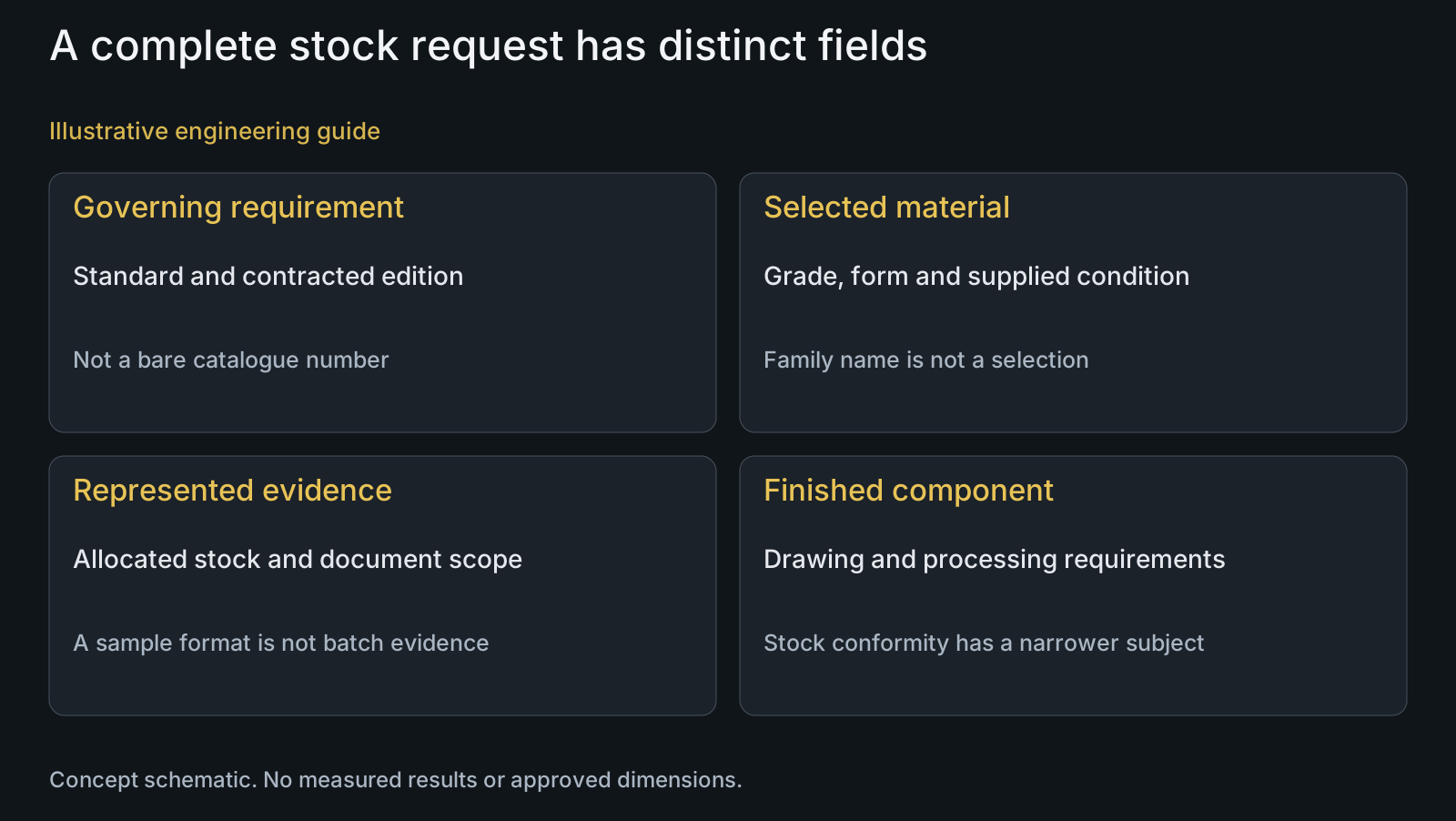
State the condition that the supplied evidence must represent
A276's public description distinguishes supplied conditions rather than treating every bar as one mechanical state. Select the condition appropriate to the required grade and order. Do not assume every listed condition applies to every stainless type, or invent a strength value for an unspecified condition.
A supplier can quote the requested alloy name while proposing a different supplied state. Compare the offered condition with the drawing's requirement and evidence. If the condition is not yet chosen, identify the unresolved design input instead of letting procurement accidentally choose it through stock availability.
Also identify relevant processing after stock supply. Machining and a separately specified surface operation do not make the mill's stock record a complete description of every finished requirement. Distinguish material evidence from the final dimensional or surface evidence requested.
Connect the stock callout to manufactured features
A mill record cannot tell whether a bearing shoulder, under-head contact or receiver thread matches the finished drawing. Those are manufactured features with their own size, geometric and inspection requirements. Keep them explicit rather than assume a material standard supplies the missing limits.
Stock form also affects how the proposed blank relates to the component envelope. Identify the intended production route and any separately required material-orientation information. Do not claim that machining from one available form automatically reproduces a previously assessed component made by another route.
Use CNC turning and the drawing DFM review to connect the material request to the actual part. No universal machining allowance, strength gain or in-house capability beyond the confirmed manufacturing scope is assumed.
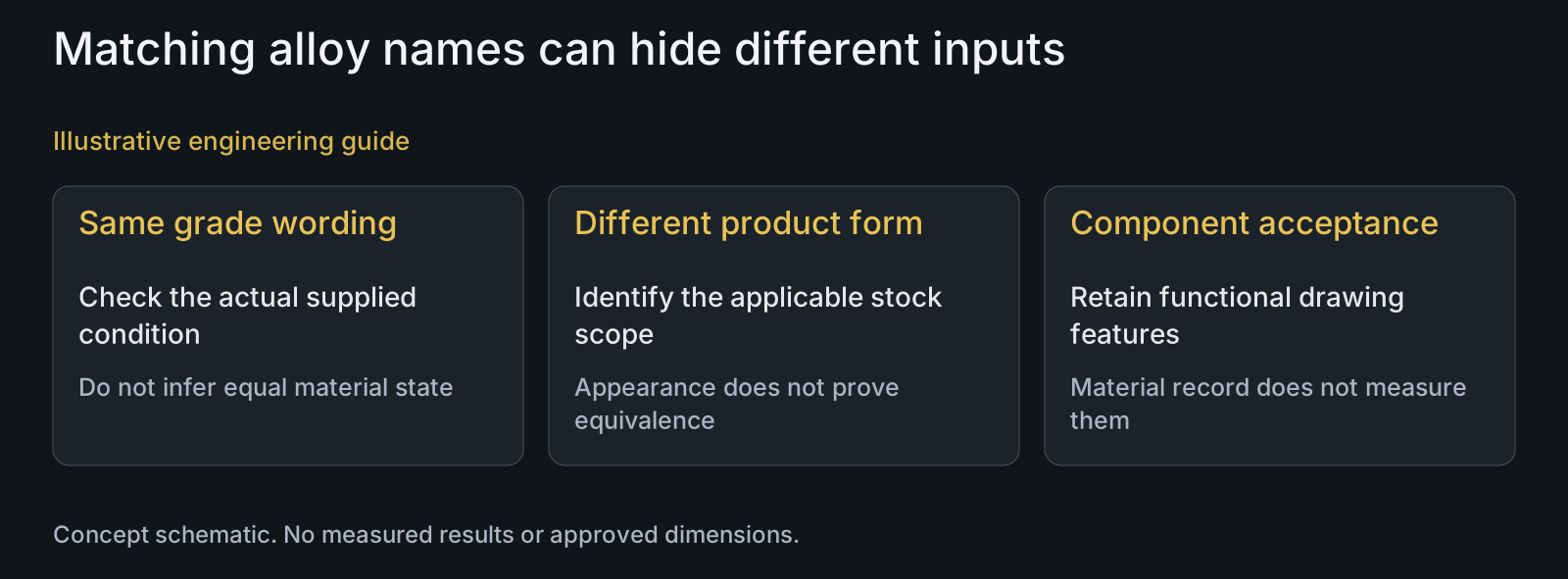
Define material evidence without using it as product approval
The quotation should state what document is expected for the allocated material and which results or declarations it represents. A generic example format is not evidence for a particular supply. Preserve the relationship between the actual material allocation and the affected part numbers.
For a kit, identify each item's material requirement. A shared folder or common color does not make one bar document cover the axle, spacer and nut when their materials differ. Even where items share a selected material, the represented stock needs an identifiable relationship to those items.
The material-document scope guide addresses document type separately. PremFixer can discuss required stock evidence and finished-part manufacturing, but availability of every grade, condition or certificate is not guaranteed by this article. Confirm the requested deliverables in the order.
Illustrative comparison of two similar-looking stock offers
Illustrative engineering example: assume an OEM orders a stainless shoulder pivot with a specified bar requirement and condition. One offer names the intended grade but omits condition; another names a material in a different form and proposes machining the same external shape. No actual supplied stock, property value or customer result is assumed.
The buyer does not choose from the alloy name alone. It asks the first supplier to resolve the supplied condition and evidence. It asks the second to identify the form requirement and consequences of the proposed route. Matching finished appearance does not settle those material differences.
The responsible engineering team retains or explicitly changes the requirement. Send the drawing, original stock callout and proposed alternatives through the RFQ-input guide. The resulting comparison concerns identifiable manufacturing inputs, not a claim that either hypothetical part passed qualification.
Questions buyers need to confirm
Does A276 alone specify the stainless grade for a pivot?
No. Name the actual grade and supplied condition within the relevant requirement. A material family reference is not a complete alloy selection. Keep the finished drawing and any separate fastener requirements visible.
Does B348 automatically mean Grade5 titanium?
No. Its scope contains multiple grades. Specify the required grade, form, condition and edition. A familiar titanium label does not select the stock or establish conformity of the material allocated to your order.
Can TC4 be changed to another system's grade without review?
Not automatically. Identify both governing specifications and the actual requirements and evidence. Similar alloy shorthand does not authorize complete cross-system substitution. The responsible customer team should resolve differences before changing the manufacturing input.
Can plate and bar be considered equivalent because the alloy name matches?
Not on that fact alone. The product forms have their own applicable requirements and production context. Compare the requested and offered form, condition and evidence. Matching external machined geometry does not eliminate that review.
Does a material record confirm the bearing shoulder is acceptable?
No. It represents material evidence, not measurement of that manufactured interface. Define the shoulder's size, geometry and final condition on the drawing and request appropriate inspection separately. Keep the scope of each record clear.
What should accompany a stock-standard RFQ?
Send the part drawing, exact material requirement and edition, grade, form, supplied condition and required evidence. Include any proposed substitution and the kit's item-level materials. These fields turn a shorthand alloy note into a quotation with defined inputs.
Technical references and scope
ASTM A276/A276M-25 public scope. Stainless bars/shapes and supplied-condition context; no numeric property limits or universality across all stainless product forms asserted.
ASTM B348/B348M-25 public scope. Annealed titanium bar/billet scope and multiple-grade selection; no TC4 equivalence or finished-component certification asserted.
Ace Stainless: product-form specification chart. Supplier's original bar/plate/forging distinction and304/316 bar entries, used as an illustration not normative acceptance evidence.
Explore related component, material and sourcing decisions in the customer decision knowledge center. For a drawing review, use the Drawing/BOM RFQ path.
Complete the pivot-stock specification before comparing quotations
Share the drawing or STEP and your material callout, including grade, product form, supplied condition and edition. Add required evidence and explicitly marked alternatives. PremFixer can review the stock-to-component manufacturing scope without treating a mill record as finished-joint approval.
Discuss the drawing and BOM