

An ASTM B117 report is not automatically interchangeable with an ISO 9227 request for bicycle pivot hardware. Compare the specified edition and test variant, delivered surface system, specimen arrangement and assessed endpoint before accepting a substitute. Similar salt-fog descriptions do not establish that the same component question was tested. A bare pass statement or matching hour count can hide different observations, excluded surfaces or unrepresented mating parts. The receiving customer must agree what evidence satisfies the order. Use the report to support that defined decision, not to predict riding years or claim that every finish and joint configuration is equivalent.
Hero: concept illustration of example hardware and its application. It is not a factory photograph, tested component or approved production geometry.
Compare the required variant before comparing report covers
ASTM B117's public scope describes the operating salt-spray environment. ISO 9227's public scope includes neutral salt spray, acetic acid salt spray and copper-accelerated acetic acid salt spray. An ISO 9227 label without the selected variant leaves an important part of the request unspecified.
Read the purchase specification and the report together. Identify the named procedure and edition rather than infer an exact match from the word salt. If a laboratory proposes an alternative, ask for its relevant scope comparison and any differences against the customer's actual requirement.
Do not turn public summaries into a full clause-by-clause equivalence declaration. The applicable documents and receiving requirement must support that decision. The neutral-versus-cyclic article addresses choosing environmental histories; this review concerns acceptance of one reported procedure against another requested procedure.
Confirm what specimen the report represents
A flat finish coupon and a delivered shoulder bolt do not present the same geometry. Threads, drive recesses and under-head regions can be relevant assessed locations. A report about one surface cannot silently become evidence for all the surfaces on a different component.
Identify substrate, coating system, specimen preparation and supplied condition. A replacement treatment, sealer or process change may leave a previous report outside the new quotation's scope. Do not accept a finish trade name as the only link between a report and purchased hardware.
If the question includes corrosion at a mixed-material receiver contact, establish whether that interface was represented. An isolated fastener report cannot describe an omitted receiver. The anti-corrosion solution can help organize the interface and manufacturing discussion without asserting a passed test.
| Comparison | Potential mismatch | Purchasing risk | Useful verification |
|---|---|---|---|
| Method and edition | Different procedure or unnamed variant | Wrong requirement answered | Compare actual required scope |
| Specimen | Coupon instead of supplied bolt | Geometry and regions omitted | Identify represented configuration |
| Surface system | Different treatment or retained layer | Old evidence applied to new part | Link report to supplied condition |
| Assessment endpoint | Appearance versus substrate or function | Pass label hides missing observation | Specify locations and criterion |
| Receiving decision | No agreed substitution | Genuine report still rejected | Record acceptance or additional need |
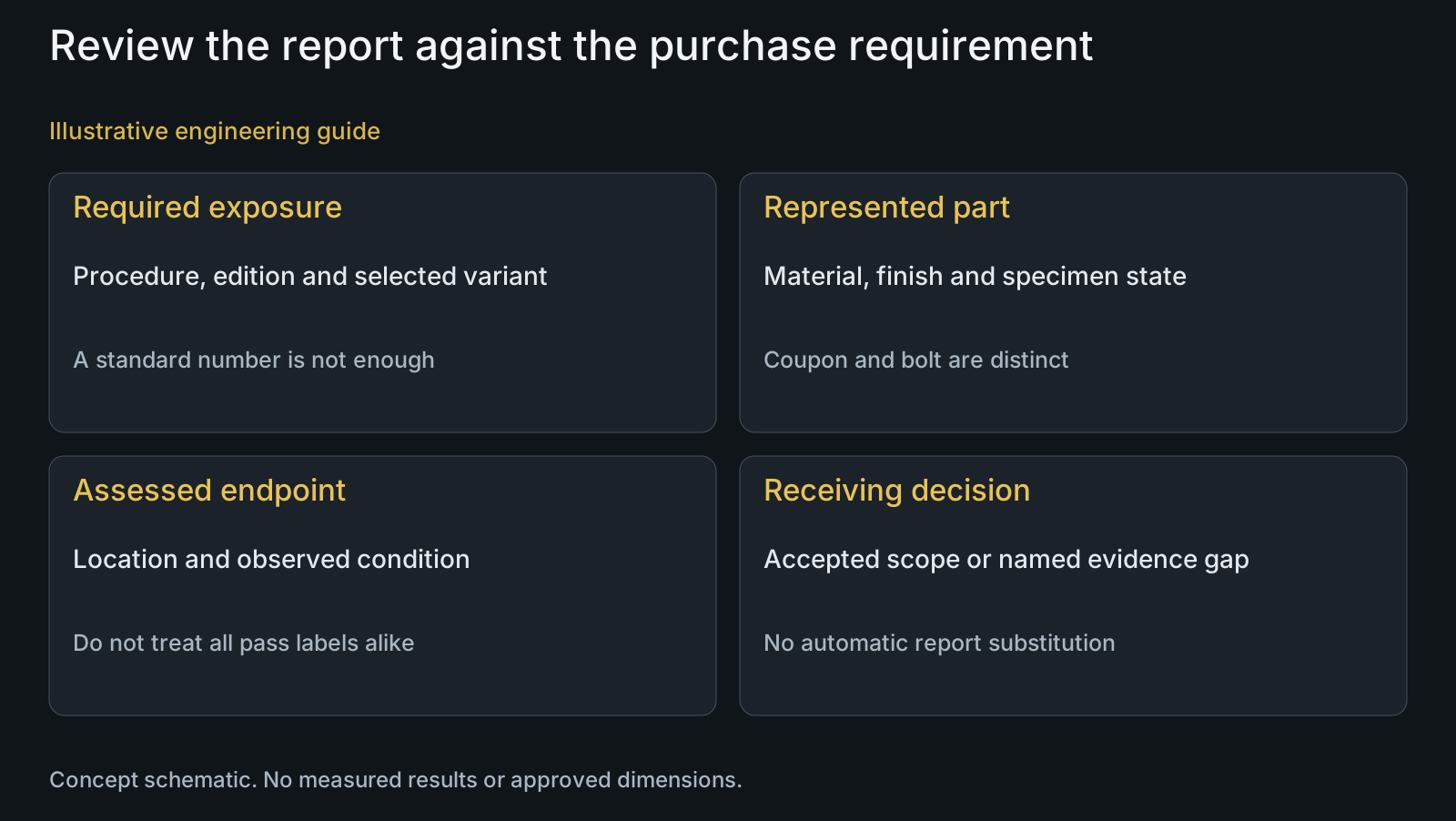
Specify the observed condition separately from the exposure
Both standards' public scopes leave product-specific exposure and interpretation to the relevant requirements. Therefore the buyer must identify the actual assessment basis. More recorded hours do not make an undefined observation into a useful acceptance result.
Distinguish coating appearance, substrate attack and any separately requested post-exposure function. A report accepting appearance can fail to answer whether a recessed tool interface or bearing contact remains functional. State the location and observation that matter rather than use corrosion resistance as one undifferentiated checkbox.
Ask whether edge regions, intentionally damaged areas or fixture contacts are included in the assessed scope. Do not invent one exclusion policy for every coating. Any exclusion should be visible to the receiver before comparing the report with the contract.
Resolve substitution through a requirement-to-evidence comparison
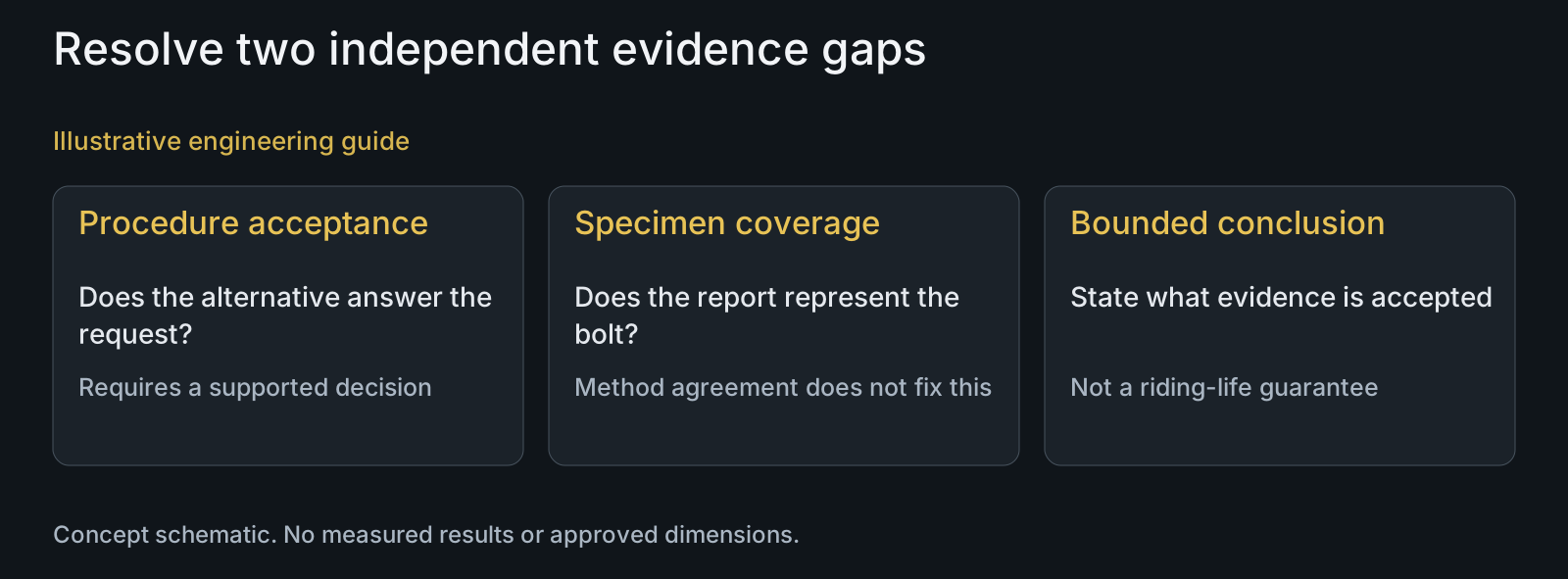
Make a short gap comparison: requested procedure versus reported procedure, purchased condition versus represented condition, and required endpoint versus actual observation. This exposes missing coverage without dismissing a genuine report as worthless. Its original conclusion may remain useful within its own scope.
The receiving authority may accept a justified alternative, ask for supplemental evidence or retain the original requirement. Record that decision explicitly. A supplier or laboratory should not rename the existing report to make its cover match the order.
When a new exposure is needed, agree the specimen and observation before requesting it. PremFixer's confirmed manufacturing model uses qualified partners for relevant testing and surface treatment; it does not establish an owned salt-fog chamber or included testing for every order. Define the actual surface-treatment scope in the quotation.
Keep report acceptance separate from a field-life ranking
ASTM cautions against standalone prediction from salt-spray data, and ISO does not intend its methods to predict long-term corrosion resistance or generally rank different materials. A report accepted for a purchasing requirement does not automatically justify a broader service-life statement.
For a finish-change decision, explain which relevant variables are held constant and what question the exposure can inform. Do not declare a titanium, stainless or plated-steel joint universally superior from unlike specimens and a headline hour count. Different contact arrangements introduce questions the laboratory comparison may not represent.
Where field corrosion is the concern, review wetting, drying, cleaning, retained moisture and the actual location of attack. The wet and coastal material guide addresses application inputs. It does not supply a conversion from a laboratory report to years of bicycle use.
Illustrative review of an offered substitute report
Illustrative engineering example: assume a coastal-use pivot drawing requests an identified ISO 9227 NSS exposure and a defined observation on supplied bolts. A quotation attaches an ASTM B117 report for a finish coupon bearing a similar treatment name. No test duration, observed result or real customer record is assumed.
The buyer checks two separate gaps: procedure acceptance and represented specimen. Even if the responsible receiver agrees the alternative exposure, the coupon still needs a justified relationship to the supplied bolt and required assessed regions. Acceptance of one difference does not automatically resolve the other.
The team either records supported acceptance, requests the missing information or retains the specified test. It does not rewrite the report or invent a failure result. Send the drawing, supplied finish and report through the RFQ-input guide so the quotation names the evidence gap accurately.
Questions buyers need to confirm
Are B117 and ISO 9227 reports automatically mutually accepted?
No. Compare the actual required procedure, specimen and endpoint, and obtain the receiving authority's decision. Similar descriptions do not establish contractual acceptance. Keep the original report's stated method rather than relabel it.
Is ISO 9227 enough to identify the test variant?
No. Its scope includes NSS, AASS and CASS. Name the selected variant and edition in the request and compare them with the report. Do not infer a neutral exposure merely from the general salt-spray title.
Does the standard number define the required hours and pass condition?
Not for every pivot product. The project or product requirement must state those acceptance inputs. Identify the assessed surfaces and observation as well as the exposure; a generic pass label cannot resolve what was required.
Can a finish coupon report cover a machined pivot bolt?
Only with an adequate, accepted representation basis. Identify the coupon treatment and its relationship to the supplied configuration. Features and relevant assessed locations absent from the coupon may require additional evidence. Do not assume coverage from a matching finish name.
Does an accepted report establish bicycle service life?
No. Acceptance answers a bounded requirement, not every field exposure. Keep any service-life claim separate from the reported corrosion observation. No universal salt-spray-hour conversion into riding years is justified here.
What should accompany a substitution request?
Send the specified method and edition, report, drawing, material and supplied finish, specimen identity and required assessed regions. Include the acceptance source and receiving contact. This makes procedure differences and part-coverage gaps separately reviewable.
Technical references and scope
ASTM B117 public scope and significance. Operating environment, product-specific interpretation and limited standalone natural-environment prediction; no full clause equivalence or latest contractual edition assumed.
ISO 9227:2022 public scope. NSS, AASS and CASS scope and product-specific interpretation boundaries; no general material ranking, life prediction or mutual report recognition asserted.
Explore related component, material and sourcing decisions in the customer decision knowledge center. For a drawing review, use the Drawing/BOM RFQ path.
Review whether the corrosion evidence fits your pivot order
Share the drawing, material and finish specification, requested procedure and existing report. Include the required assessed locations, endpoint and receiving authority. PremFixer can discuss the represented component and quotation scope, distinguishing a proposed substitution from any additional testing that must be agreed.
Discuss the drawing and BOM