

To avoid missing a relevant bicycle standards update, monitor the exact references used in the product and purchase requirements, not every industry headline. Record the publisher source or selected alert coverage and assign someone to assess the event. Then connect any needed action to the affected drawing, purchasing instruction or validation plan. A quiet inbox does not prove the reference is covered, and a received notification does not automatically require pivot redesign. Drafts, published changes and customer adoption decisions need different responses. Preserve the authorised order basis until the responsible team has resolved the actual impact and transition.
Hero: concept illustration of example hardware and its application. It is not a factory photograph, tested component or approved production geometry.
Build the monitored set from real requirements
Start with the exact designation and edition on the released drawing, purchase specification and applicable product-assessment basis. Record which parts, platforms or markets use it and why. Include a related test or material reference where it actually controls a requirement, rather than monitor only the bicycle standard's headline number.
Separate national adoption from the underlying international document. A related ISO alert does not establish that every named national edition has changed. Likewise, a catalogue family search can miss an amendment if the selected coverage excludes development records. Check the actual monitored item and event types.
The five-system cross-reference guide identifies document relationships. Here the task is different: ensure that the reference used by an order is present in the team's monitoring set and linked to the people who can assess its effect.
Choose alert sources without assuming complete coverage
ISO catalogue records provide lifecycle status and an RSS-updates link. Use the exact publisher record to verify a notice rather than treat an email subject as the requirement text. Check what the selected source actually reports; this article does not establish that every RSS feed delivers all national, contractual or regulatory changes.
DIN Media describes its Standards Ticker as monitoring selected documents for new editions, replacements and withdrawals, with draft monitoring selectable. That is a published service option, not a mandatory platform or a service PremFixer supplies. Its described periodic alerts should not be presented as guaranteed instant notice.
An association or laboratory message can flag an issue worth investigating. Keep it as a lead until the relevant publisher or authority confirms the event. Assign a backup reviewer and a review point appropriate to the project's risk; do not invent a universal legal monitoring interval.
| Observed event | Decision question | Risk of shortcut | Verification and action |
|---|---|---|---|
| No alert received | Is the exact reference and event type covered? | Quiet inbox called proof of no change | Check source coverage and assigned review |
| Draft notification | Does the proposed subject affect our planned work? | Draft treated as final requirement | Verify status and assign relevance review |
| Published new edition | Which applicable requirement actually changed? | Automatic redesign or stock rejection | Obtain text and assess affected configurations |
| Confirmation notice | Is the edition retained? | Confirmation year becomes new designation | Preserve publisher identity and basis |
| National adoption event | Which national reference or obligation uses it? | ISO event assumed identical everywhere | Check actual adoption and project scope |
| Impact decision made | Which used document or order changes? | Email marked read without implementing decision | Close drawing, purchase or validation action |
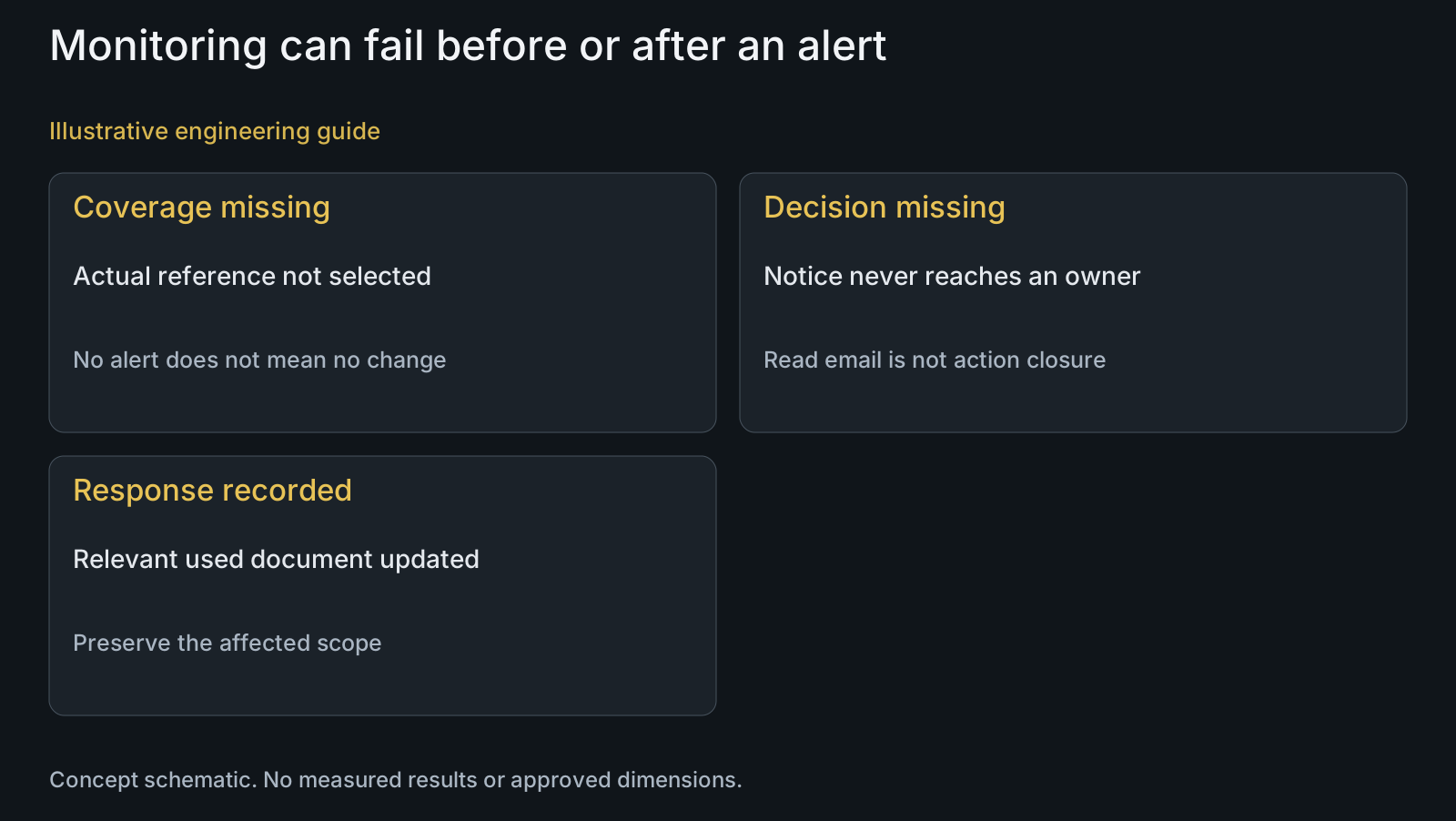
Separate an event from an adopted requirement
ISO's stage-code explanation distinguishes draft development, publication, confirmation and withdrawal events. A draft notification is not final text, and confirmation does not give an existing edition a new publication year. Preserve those meanings when discussing an alert with engineering and purchasing.
A published edition may justify a substantive comparison, but its publication date is not automatically the cutover date for every contract. Identify the relevant legal, certification or customer basis and any actual transition instruction. Do not invent a deadline from a newsletter or imply that publication alone invalidates every stocked pivot.
The 2023-2026 action map gives a dated bicycle-reference snapshot. This guide concerns the ongoing notification and response mechanism, so it does not repeat that snapshot as a universal list of current changes.
Assign the impact question to the responsible reviewer
Identify the changed requirement and whether it concerns the component drawing, material or finish, assembled bicycle validation, document content or a different subject. The supplier cannot infer a custom bearing-seat change from a broad platform alert. Obtain the relevant authorised text for the actual requirement comparison.
Give engineering the affected interface and configuration, purchasing the order and contractual basis, and the compliance owner the relevant market or scheme question. These can be separate decisions. A laboratory can explain its assessment scope without being authorised to revise the customer's component drawing.
State what evidence is sufficient to decide and what remains missing. A no-component-change outcome can be reasonable if the review establishes that the event concerns another subject; it must not be inferred merely because the bolt's nominal size is unchanged. Avoid blanket retesting and blanket acceptance alike.
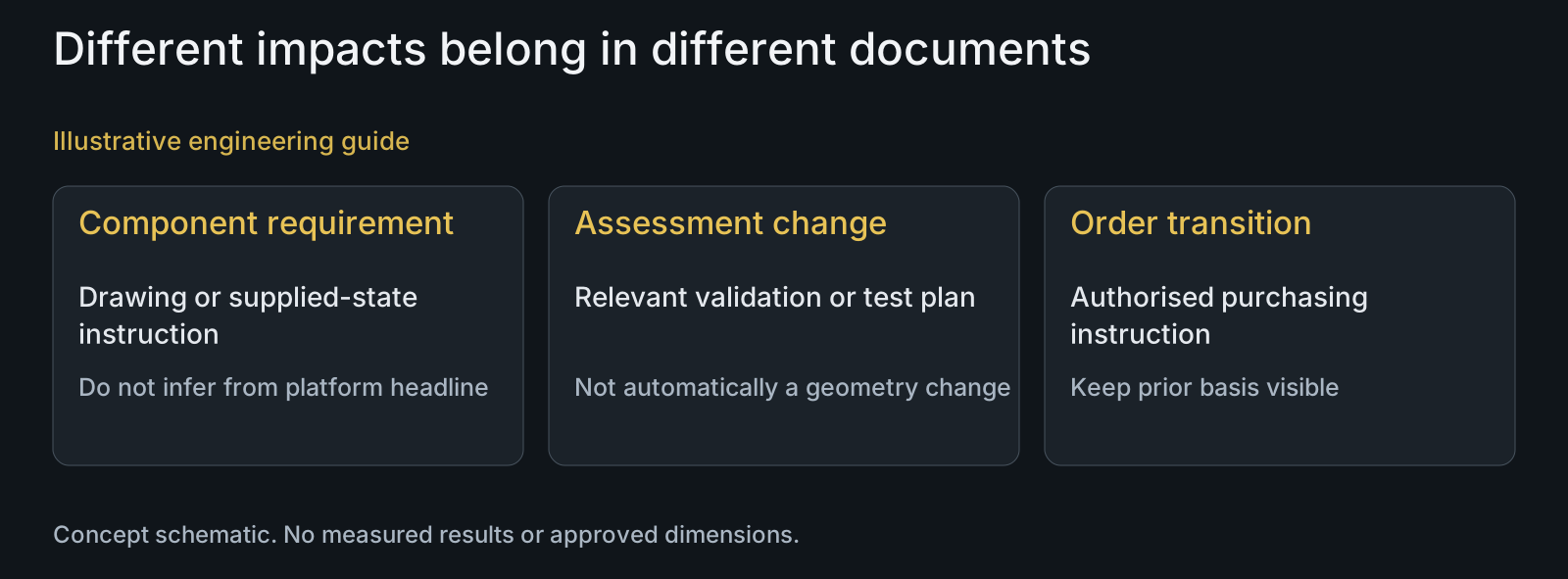
Close the response where production and purchasing use it
When a component requirement changes, identify the updated drawing or supplied-state instruction and its affected parts. When the effect is only on validation, identify the relevant test-plan action without rewriting the bolt geometry. For a reference-only clarification, make the intended document basis clear in the purchasing information.
Record the responsible decision, its reason and any authorised order transition. Mark an unresolved impact as open rather than close it because the notification was read. Retain the prior requirement basis for earlier deliveries instead of silently changing the historical file.
The file-management guide explains historical evidence retrieval. For manufacturing discussion, use manufacturing and the drawing and BOM guide. The supplier needs the resulting component requirement, not only a forwarded headline.
Illustrative engineering example: a draft alert reaches two teams
Illustrative engineering example: assume a purchasing team receives a draft-update notice for a bicycle reference used by a platform. An existing order follows a defined drawing, while a new platform review is planned. No actual amendment content, mandatory transition or approved design outcome is assumed.
The owner verifies the development status and confirms that the reference is within the monitored set. Engineering identifies which potential changes deserve review for the new platform; purchasing preserves the existing authorised order basis unless a responsible decision requires otherwise. The alert is not rewritten as a final requirement.
The action remains open if a substantive comparison cannot yet be completed. If later published text requires a component change, the responsible team defines the affected drawing and order transition. If it only changes assembly evaluation, the action belongs to that plan. The knowledge centre connects the resulting engineering questions without pretending monitoring itself proves conformity.
Questions buyers need to confirm
Does a quiet subscription inbox prove our standards are unchanged?
No. Verify the exact references, event types and source coverage selected. National adoptions, amendments or contractual changes may need different sources. Keep responsibility for checking coverage instead of relying on silence.
Can an ISO RSS link monitor every market obligation?
Do not assume that. Catalogue updates concern the relevant publisher record. Establish additional national, regulatory or contractual sources where needed, and confirm what each selected alert covers before describing monitoring as complete.
Should a draft notification immediately change open hardware orders?
Not automatically. Verify development status, assess relevance and preserve the authorised order basis until a responsible decision requires a change. A draft does not establish final content or a universal cutover date.
Who should decide whether a pivot drawing needs revision?
The responsible engineering and requirement owners should assess the affected feature and configuration. Purchasing and compliance may have separate order or market decisions. A forwarded newsletter or a laboratory comment alone is not authorisation to change geometry.
Can a review close with no component change?
Yes, if the assessed event and project basis support that conclusion. Record the reason and any separate validation or documentation action. Do not infer no impact from unchanged nominal size or lack of final text.
What should PremFixer receive after the standards review?
Provide the authorised component drawing and BOM, complete references, affected features or supplied-state requirements and order transition instructions. Include defined evidence changes so manufacturing can address the resolved scope, not guess from an alert headline.
Technical references and scope
ISO: international harmonized stage codes. Publisher distinguishes development, publication, confirmation and withdrawal status. Not a legal transition timetable.
ISO: example catalogue lifecycle and RSS link. Public catalogue demonstrates lifecycle status and RSS-updates access. Not proof that one feed covers all bicycle or national obligations.
DIN Media: Standards Ticker. Publisher service describes selected-document monitoring and optional draft coverage. No subscription made, instant-alert guarantee or software recommendation asserted.
Explore related component, material and sourcing decisions in the customer decision knowledge center. For a drawing review, use the Drawing/BOM RFQ path.
Send the resolved component requirement, not just the alert
Share the affected drawing or STEP, BOM, exact reference, changed requirement and intended order transition. Include the responsible review conclusion and requested component evidence. PremFixer can discuss manufacturing impacts without revising an approved design from an unassessed notice.
Discuss the drawing and BOM