
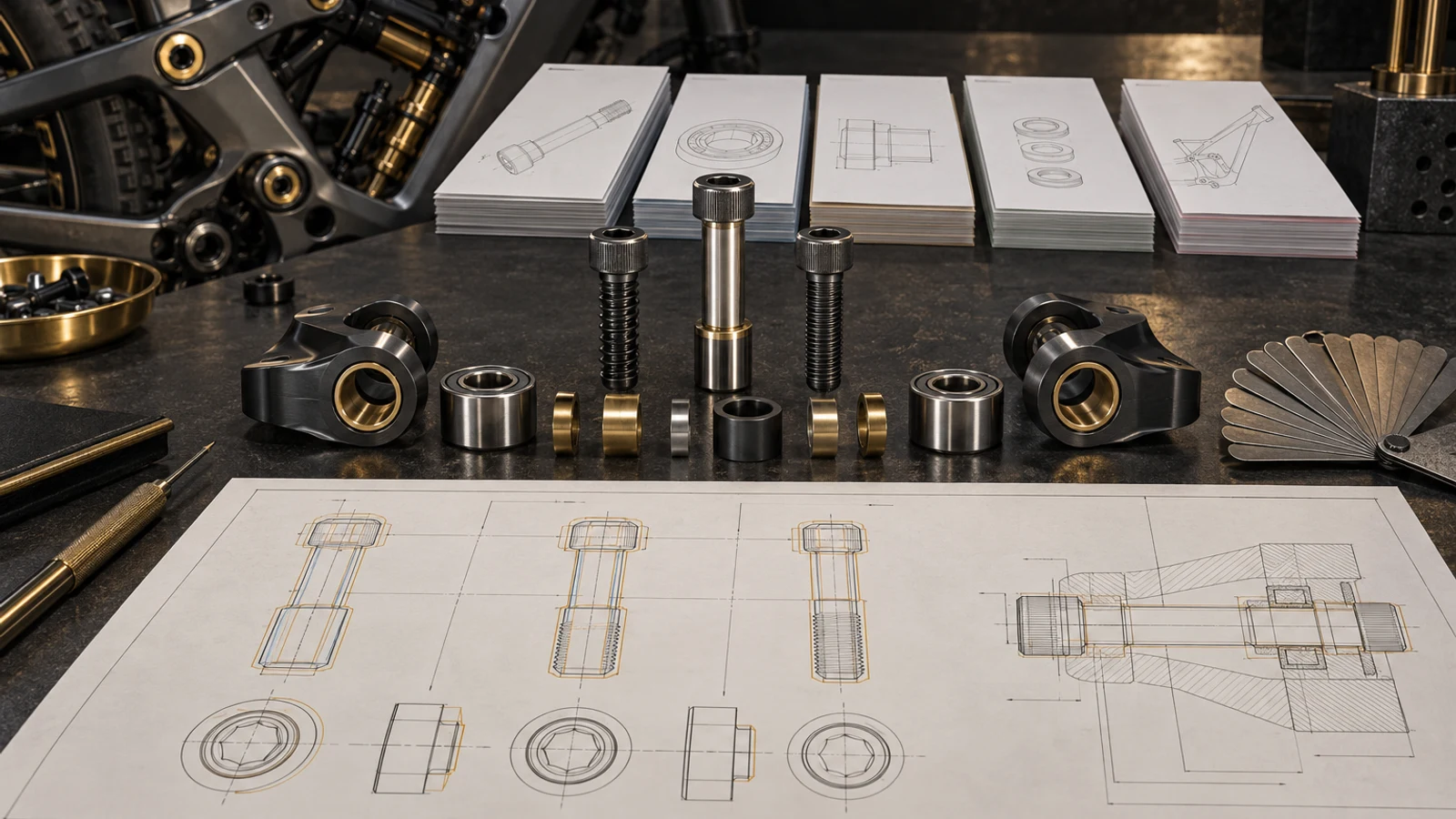
For a metric socket-head screw described by ISO 4762, ASME's B18.3.1M catalogue is a related American product reference to investigate; ASME B18.3 is an inch series, not a metric substitute. Neither reference proves a custom bicycle pivot interchangeable. Compare the specified editions, head and thread requirements, material basis and drawing-controlled shoulder before accepting an alternative. A five-system table should expose differences and unanswered questions, not turn similar product names into equal signs. Keep the buyer's approved drawing in control until the responsible reviewer has decided which changes, if any, are acceptable.
Hero: concept illustration of example hardware and its application. It is not a factory photograph, tested component or approved production geometry.
Answer the American-reference question precisely
ISO's public catalogue identifies ISO 4762:2004 as hexagon socket head cap screws with coarse-pitch threads. ASME separately lists B18.3.1M for metric socket head cap screws and B18.3 for an inch series that includes several socket-screw types. These are useful product identities, not a verified dimensional equivalence statement.
Do not shorten a request to ANSI bolt. That label does not identify the exact product standard, edition or metric versus inch system. Ask for the complete reference written on the order and obtain its applicable text and status before making it the manufacturing basis. A catalogue listing alone does not resolve those questions.
A receiver expecting a defined metric pitch cannot accept an inch alternative merely because the screws look alike. Nor does converting a nominal length establish compatible threads. Use the thread-standard guide for the separate thread-definition decision.
Read adoption and replacement relationships accurately
DIN Media's DIN 912:1983-12 record identifies replacement references including DIN EN ISO 4762:2004-06. A replacement relationship tells the reviewer where to investigate a legacy designation. It does not establish that every old drawing, head envelope or custom feature can be silently replaced.
JSA's JIS B 1176:2014 preview describes a standard based on ISO 4762 and ISO 12474, with additional provisions and an overall modified relationship. It covers coarse and fine-pitch product scopes. SAMR's GB/T 70.1-2008 record also identifies a modified adoption of ISO 4762:2004. Those descriptions are reasons to examine differences, not label the documents identical.
Keep the edition and amendments beside each reference. Do not merge a historical DIN name, a Japanese amended document and a Chinese adoption into one current requirements column. The comparison table below deliberately states what each source establishes and what remains to be checked.
| System and related reference | Public source establishes | Difference or risk | Check before substitution |
|---|---|---|---|
| ISO: ISO 4762:2004 | Coarse-pitch socket-head cap-screw product scope | Custom pivot interfaces remain drawing-defined | Ordered features, edition and actual requirements |
| DIN: legacy DIN 912 | Publisher record lists replacement documents | Legacy name does not preserve every drawing exception | Required edition and feature differences |
| American: ASME B18.3.1M / B18.3 | Separate metric and inch product identities | ANSI alone is incomplete; inch is not metric | Exact document, status, thread and head requirements |
| JIS: JIS B 1176:2014 | ISO-based scope with additions and modified relationship | Coarse/fine scope and additions are not one equal sign | Applicable amendment and relevant provisions |
| GB: GB/T 70.1-2008 | Publisher identifies modified ISO 4762 adoption | Adoption label does not approve a custom replacement | Actual changed provisions and ordered features |
| Project drawing: custom pivot | Bearing seat, clamp stack and specified exceptions | Standard screw may omit functional interfaces | Feature comparison and responsible change decision |
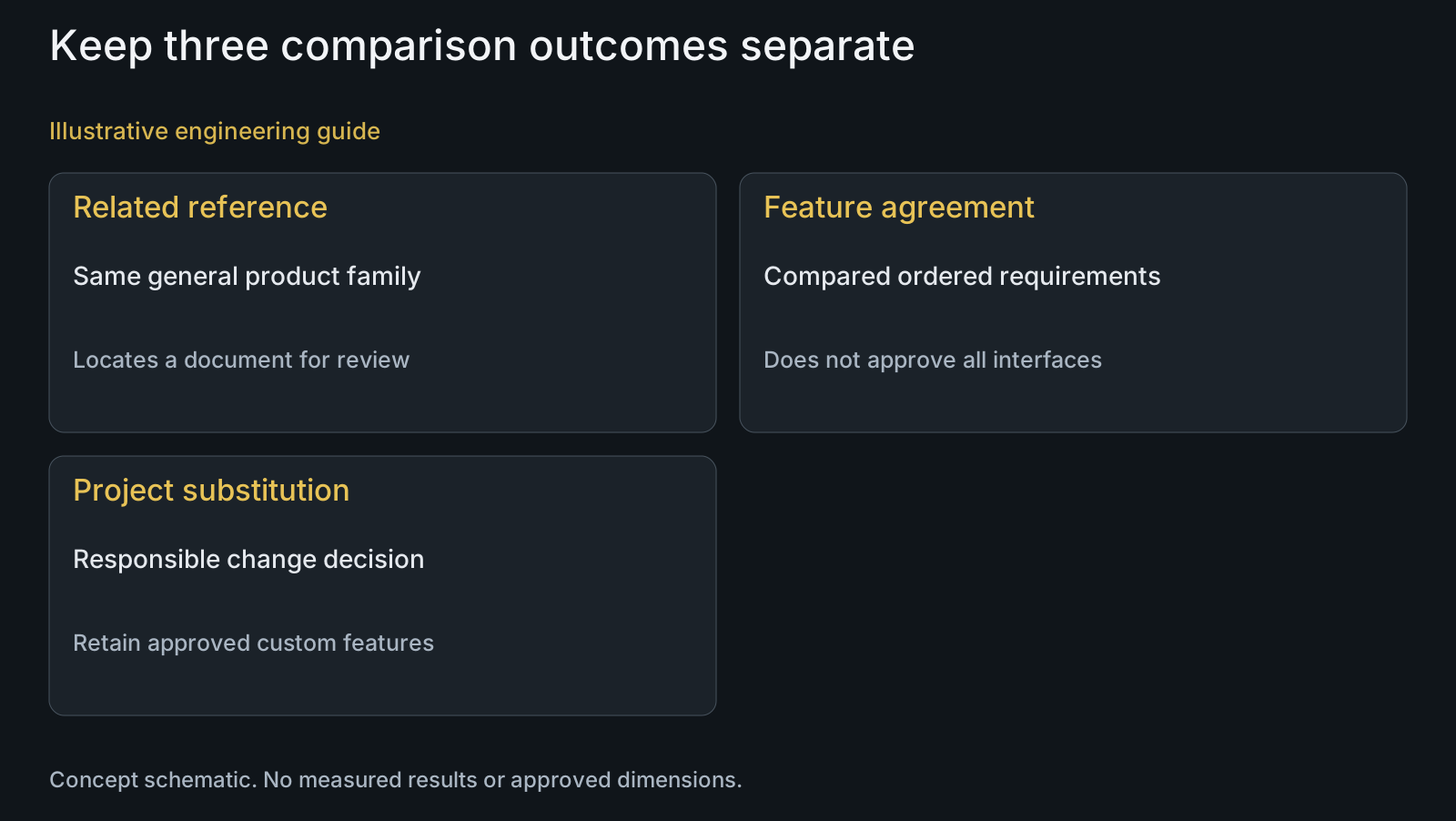
Compare features instead of translating the standard number
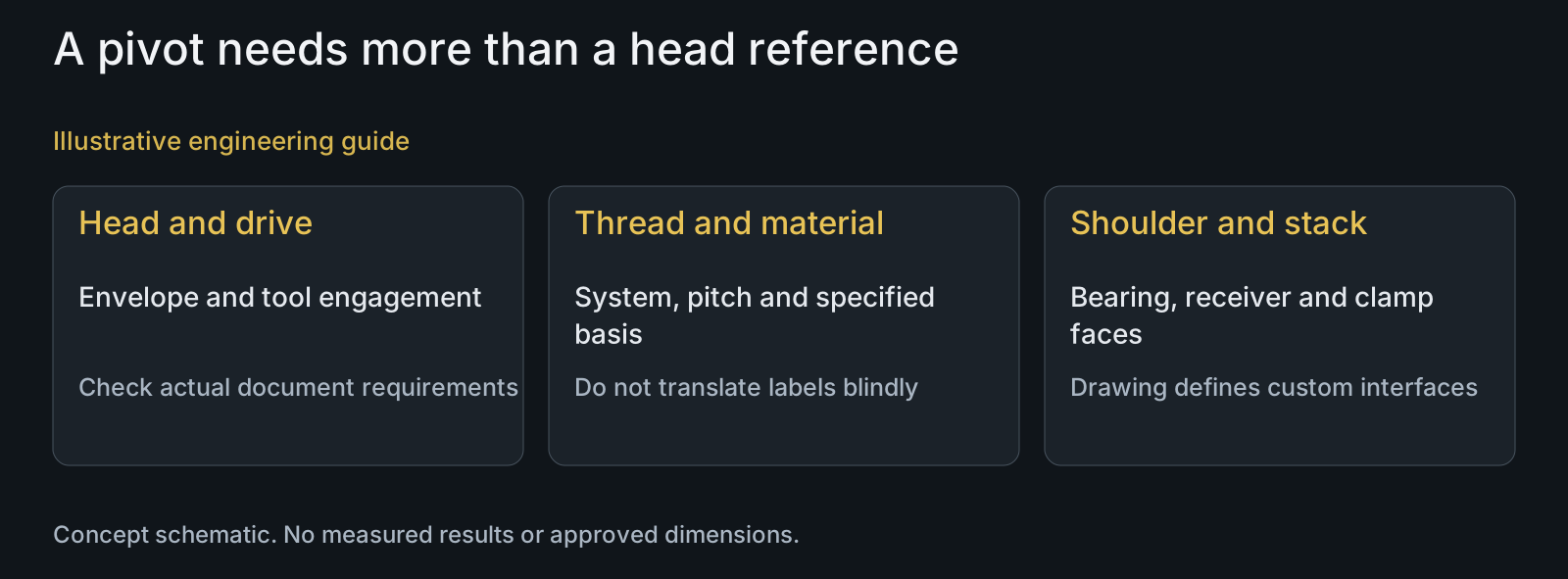
Start with head diameter and height, drive form and engagement, under-head transition, body and thread lengths, pitch and tolerance designation. For each, identify the requirement from the actual cited document and the ordered drawing. Leave an unresolved item visible rather than invent a dimension from a similar catalogue product.
Then compare material and mechanical requirements on their own basis. A familiar strength label is not a material grade and should not be transferred to a titanium custom axle without a justified specification. The materials guide and titanium stock discussion help separate product-reference geometry from material definition.
Finally identify the custom bearing seat, effective shoulder length, receiver and spacer interfaces. A standard screw body does not automatically define a precision locating shoulder. The DIN head-form guide addresses physical head selection; this article addresses cross-document agreement and substitution authority.
Give the drawing an explicit precedence rule
If a drawing cites one standard but a purchase note cites another, determine which requirement controls each feature. Do not ask the manufacturer to satisfy conflicting head dimensions while silently selecting the more convenient reference. Record the resolved interpretation in the controlled purchase information.
Distinguish a retained standard feature from a custom exception. For example, the specified drive may follow a reference while the shoulder, bore or clamp face follows the drawing. This is a defined hybrid part, not necessarily a standard catalogue screw manufactured to every clause of the cited product specification.
A proposed substitution should show the old requirement, new requirement, difference and affected interface. An unchanged nominal diameter is not enough. Review CNC turning inputs and finished surface conditions when a difference affects the bearing seat or clamp stack.
Illustrative engineering example: a related screw is not a replacement
Illustrative engineering example: assume a buyer's pivot drawing uses a socket-head reference with a custom shoulder and a defined metric receiver. A supplier proposes a screw under an American reference. No actual dimensions, test results or approved substitution are assumed.
The reviewer first identifies whether the proposal is metric or inch and the complete document edition. An inch-thread proposal cannot be treated as a simple document translation for the assumed metric receiver. A metric proposal still needs its head, drive, thread and shoulder requirements compared with the drawing.
If the alternative has no drawing-defined bearing shoulder, its related head style does not resolve the missing interface. The reviewer can request a custom part retaining the approved shoulder or reject the substitute as insufficiently defined. A feature-by-feature comparison supports that decision without claiming every screw under either standard interchangeable.
Make the cross-reference useful to purchasing
Give procurement a document relationship and a feature-difference list, not a bare sequence of five numbers. Separate related product identity from verified feature agreement and from project-authorised substitution. A buying system should not convert the first category into permission to order any item in the last.
Send the released drawing, STEP or mating section, exact references and editions, material, finish and proposed alternative. Identify the buyer's accepted exceptions and unresolved conflicts. A commercial comparison is meaningful only when the quoted alternatives describe the same required interfaces or disclose their differences.
PremFixer manufactures from customer-defined inputs rather than a universal pivot cross-reference SKU. Use manufacturing for the capability discussion and the customer decision knowledge centre for adjacent engineering questions. The RFQ can define what needs comparison without pretending full standard texts or project approval have already been obtained.
Questions buyers need to confirm
What American standard should I compare with ISO 4762?
ASME's B18.3.1M catalogue identifies a related metric socket-head cap-screw reference. Confirm the applicable document and status before use, then compare actual features. ASME B18.3 is an inch series, and neither designation alone proves an equivalent custom pivot.
Can DIN 912 simply be rewritten as ISO 4762 on the order?
Do not change it silently. The publisher lists replacement documents, but the buyer must establish the intended edition and compare affected requirements. Retain custom head, shoulder and clamp exceptions rather than assume a new catalogue designation preserves them.
Are JIS B 1176 and GB/T 70.1 identical to ISO 4762?
Do not describe them as identical from the names alone. JSA's preview identifies an ISO-based modified relationship with additions, and SAMR identifies a modified adoption for GB/T 70.1-2008. Review applicable provisions and amendments for the ordered features.
Which differences matter beyond the nominal screw size?
Head envelope, drive engagement, under-head transition, thread system and pitch, body length, material requirements and finished shoulder geometry all need comparison. A match on nominal diameter cannot resolve a receiver mismatch or missing bearing-location surface.
What if two references conflict on the drawing and purchase order?
Resolve feature-level precedence with the responsible buyer before manufacture. Identify the old and proposed requirements and their interface effects, then record the agreed interpretation. The manufacturer should not guess which conflicting dimension is acceptable.
What should accompany a standards-cross-reference RFQ?
Provide the approved drawing, mating section or STEP, exact references and editions, material, finish and proposed alternative. Include custom exceptions and the substitution decision required so the comparison addresses real interfaces instead of standard names alone.
Technical references and scope
ISO: ISO 4762 public catalogue. Public coarse-pitch socket-head cap-screw product identity; not a reproduced normative dimensional table.
ASME: metric socket-head cap-screw catalogue. Published B18.3.1M metric product identity. Catalogue identity is not a confirmed current requirement or ISO equivalence.
ASME: inch-series socket-screw catalogue. Public B18.3 inch-series scope, distinct from the metric reference. No dimensional equivalence asserted.
DIN Media: DIN 912:1983-12 record. Publisher lists replacement documents including DIN EN ISO 4762. Replacement identity does not prove custom-part interchangeability.
JSA: JIS B 1176:2014 public preview. Introductory scope explains ISO 4762 and ISO 12474 basis, additions and modified relationship. Full tables and later amendment text are not reproduced.
SAMR: GB/T 70.1-2008 record. Public product identity and modified adoption of ISO 4762:2004. Not a complete clause-by-clause comparison.
Explore related component, material and sourcing decisions in the customer decision knowledge center. For a drawing review, use the Drawing/BOM RFQ path.
Compare the proposed reference against the approved pivot drawing
Send the released drawing or STEP, mating section, exact standards references, material and finish, plus the proposed alternative. PremFixer can discuss feature-level manufacturing differences and missing inputs without claiming universal interchangeability or changing the buyer's approved design.
Discuss the drawing and BOM