

Do not redesign a pivot or reject existing stock merely because a standards catalogue changes. First identify the actual event, its status and which bicycle platform and agreed requirement it can affect. Published editions, draft amendments, national adoption and customer cutover decisions are not the same date. As checked on 11 October 2026, the cited bicycle catalogues include published 2023 editions and amendments still under development. That is a reason to review the project basis, not invent a universal deadline or future test value. PremFixer needs an authorized component requirement and transition scope; the OEM retains the platform applicability and validation decisions.
Hero: concept illustration of example hardware and its application. It is not a factory photograph, tested component or approved production geometry.
Use a dated status check instead of a forecast
ISO 4210-2:2023 is listed as a published bicycle and subassembly requirements edition. ISO 8098:2023 is published for its defined young-children bicycle scope, with an English corrected version listed for August 2023. These are actual catalogue events, not a prediction of later obligations.
The 4210-2 amendment record lists a committee draft under development; the 8098 amendment record lists a draft amendment under development. Those checked statuses do not establish final amended requirements or a publication deadline.
Record the source, exact designation, status and date checked. Keep the review dated so a later reader can distinguish a historical snapshot from a newly verified status. Obtain the applicable authorized text for a substantive clause comparison.
Separate revision, correction and confirmation
A new edition and an amendment can change a requirement basis, but their effect still needs comparison with the relevant project. A correction also needs its actual subject identified; do not assume the document changes every feature or test.
Confirmation is different from publication of a new edition. For example, ISO 10360-2:2009 is listed as confirmed in 2026 while retaining its 2009 designation. It should not be renamed ISO 10360-2:2026 in a purchase request.
The general-tolerance review and acceptance-plan review illustrate different surrounding specification subjects. Do not turn every updated supplier reference into a bicycle-system redesign event.
| Event | Meaning to preserve | Risk in a shortcut | Useful action |
|---|---|---|---|
| Published edition | Actual named requirement document | Publication called universal cutover | Compare affected requirements and project basis |
| Draft amendment | Development status, not final content | Forecast treated as mandatory requirement | Track status and review relevance |
| Corrected version | Specific correction subject | Every feature assumed changed | Identify actual corrected requirement |
| Confirmed edition | Existing designation retained | Confirmation year used as new edition | Preserve exact reference |
| National adoption | Relevant adopted reference and context | One date assigned to every market | Check actual adoption and project obligation |
| Customer cutover | Authorized parts, scope and orders | Existing goods silently relabeled | Define transition and stock disposition |
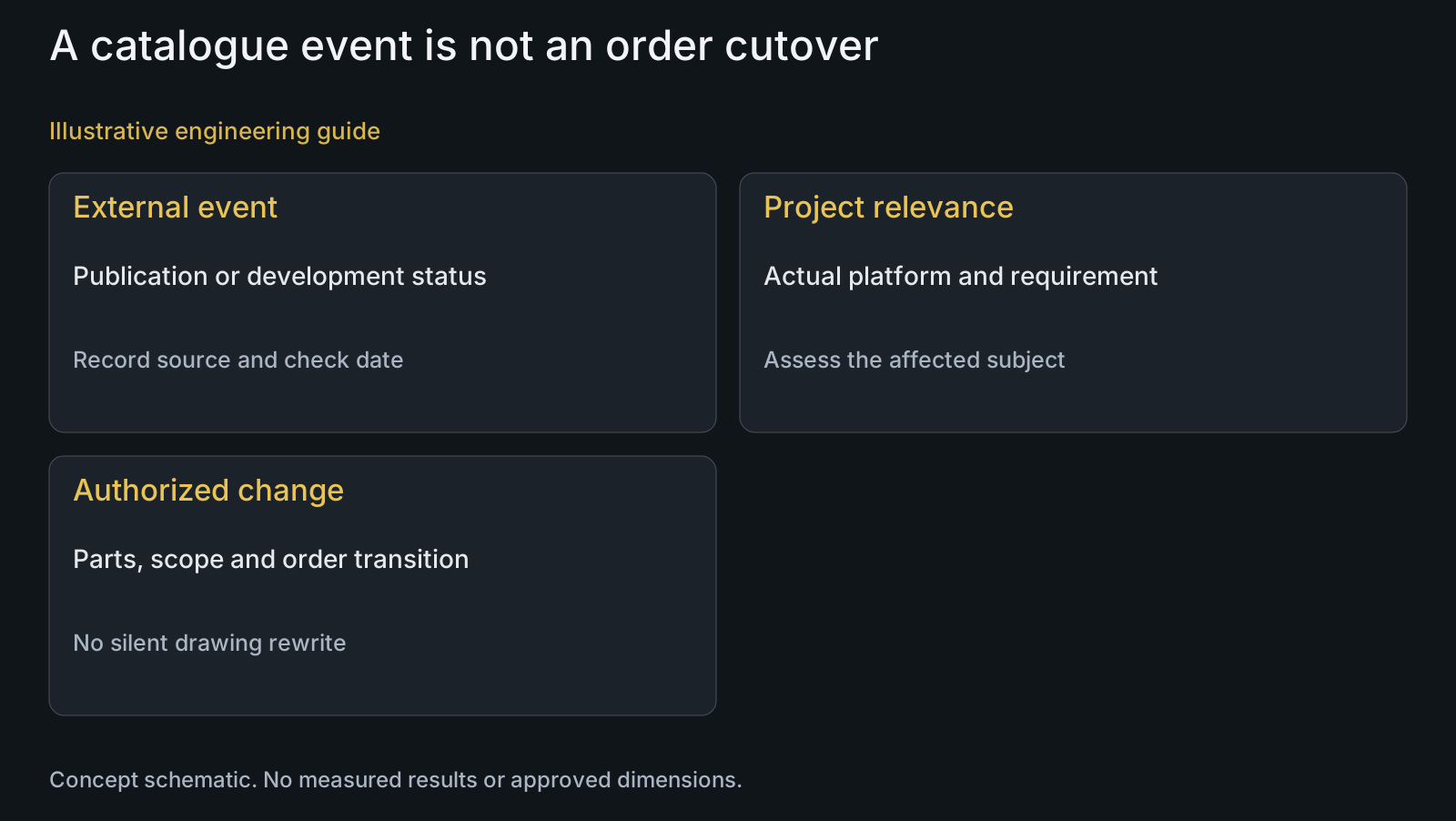
Match the event to the supplied platform
List the actual platforms, uses and markets affected by the review. A product family name is too broad when the interfaces, application categories or agreed specifications differ. Preserve those distinctions instead of assign one outcome to every model in a catalogue.
The standards-applicability guide selects references by requirement subject. The young-children bicycle guide develops that specific coverage question. Here the task is tracking how a relevant external event changes an already identified project's basis.
For European or national references, check the relevant adoption record and the actual contractual or applicable regulatory context separately. The EN and ISO comparison explains the reference layers. No universal legal transition or market-access deadline is established here.
Identify what evidence needs comparison
Ask the responsible platform reviewer which requirement changed and what existing evidence represents. Do not call a prior report invalid merely because its title carries an earlier edition; establish whether its configuration and assessment answer the current agreed question.
If the requirement affects assembly validation, identify the represented bicycle configuration and evaluation scope. If it affects a purchased component feature, identify the drawing callout or supplied-state requirement. Keep these tasks separate so the supplier is not asked to certify an entire bicycle through a bolt report.
Record whether a document review, additional defined assessment or component change is needed and why. An unresolved clause comparison should remain an open decision, not become an invented test threshold or a blanket retest demand.
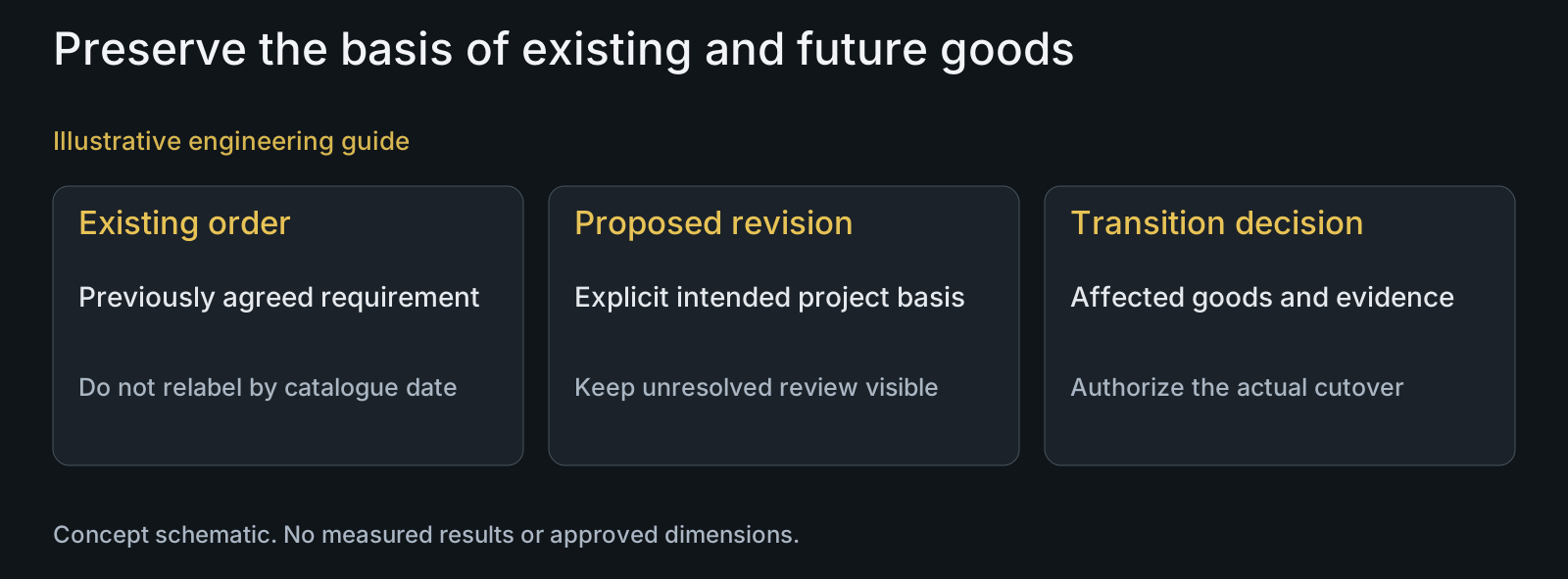
Control the transition for orders and existing goods
A customer change notice should identify affected part numbers, drawing or requirement revisions, quantities and the authorized cutover. State what happens to open orders and existing goods rather than assume every supplier interprets 'use latest' identically.
Separate goods made to the prior agreed basis from goods made after the authorized change. Neither group should be relabeled without the actual decision and supporting review. Catalogue publication alone does not tell purchasing whether existing goods may be used, assessed further or replaced.
Discuss the component scope through manufacturing, materials and the drawing/BOM RFQ route. Request only the manufacturing or evidence changes that follow from the affected requirement, with application decisions remaining explicit.
Review one platform while a draft remains open
Illustrative engineering example: assume an OEM has an open order under a named published edition and sees a related amendment listed as under development. A new platform revision is also planned. No actual customer, final amendment content, test result or mandatory transition date is assumed.
The team keeps the open order's authorized basis visible and asks the platform reviewer to assess the draft's relevance without declaring it final. It separately defines the intended basis for the planned revision and the conditions for any later change notice.
If a future published change affects the component, the notice identifies the actual feature, evidence and order transition. If it concerns system validation only, it does not silently rewrite the pivot drawing. The result is an explicit review path, not a claim of achieved compliance.
Questions buyers need to confirm
Are the listed 2026 bicycle amendments already final?
The cited records were under development when checked on 11 October 2026. Check their current official status before using them; this snapshot does not establish final amendment content or a publication deadline.
Does a new catalogue publication require immediate pivot redesign?
Not by itself. Identify the relevant platform, obligation and affected requirement, then determine whether a component, document or validation change is actually needed.
Should a confirmed standard use the confirmation year as its edition?
No. Preserve its actual designation. Confirmation and a new edition are distinct events; record the status-check date separately from the referenced edition.
Can a prior test report be carried into a new project basis?
Assess its actual scope and represented configuration against the affected requirement. Do not automatically accept or invalidate it by the year in its title alone.
What happens to hardware on an open purchase order?
The authorized transition must say. Identify affected part numbers, revisions, quantities and disposition; catalogue publication does not independently decide the status of existing goods.
What does PremFixer need after an OEM standards review?
Provide the authorized component drawing/BOM, applicable references, affected features or supplied state, required evidence and order cutover. Keep the platform validation decision separate from the component manufacturing request.
Technical references and scope
ISO 4210-2:2023 public catalogue. Published designation and bicycle/subassembly subject.
ISO 8098:2023 public catalogue. Published child-bicycle edition and English corrected-version record.
ISO 4210-2 amendment development record. Committee-draft status checked 11 October 2026, not final amendment content.
ISO 8098 amendment development record. Draft-amendment development status checked 11 October 2026.
ISO 10360-2:2009 public catalogue. Confirmation in 2026 distinguished from publication of a new edition.
Explore related component, material and sourcing decisions in the customer decision knowledge center. For a drawing review, use the Drawing/BOM RFQ path.
Translate the relevant change into a component request
Send the drawing, STEP or sample reference and BOM with the dated standards basis, affected platform, requirement comparison and authorized transition scope. Identify which component features, evidence or open orders change so PremFixer can discuss the actual manufacturing request without inventing a universal compliance timetable.
Discuss the drawing and BOM