
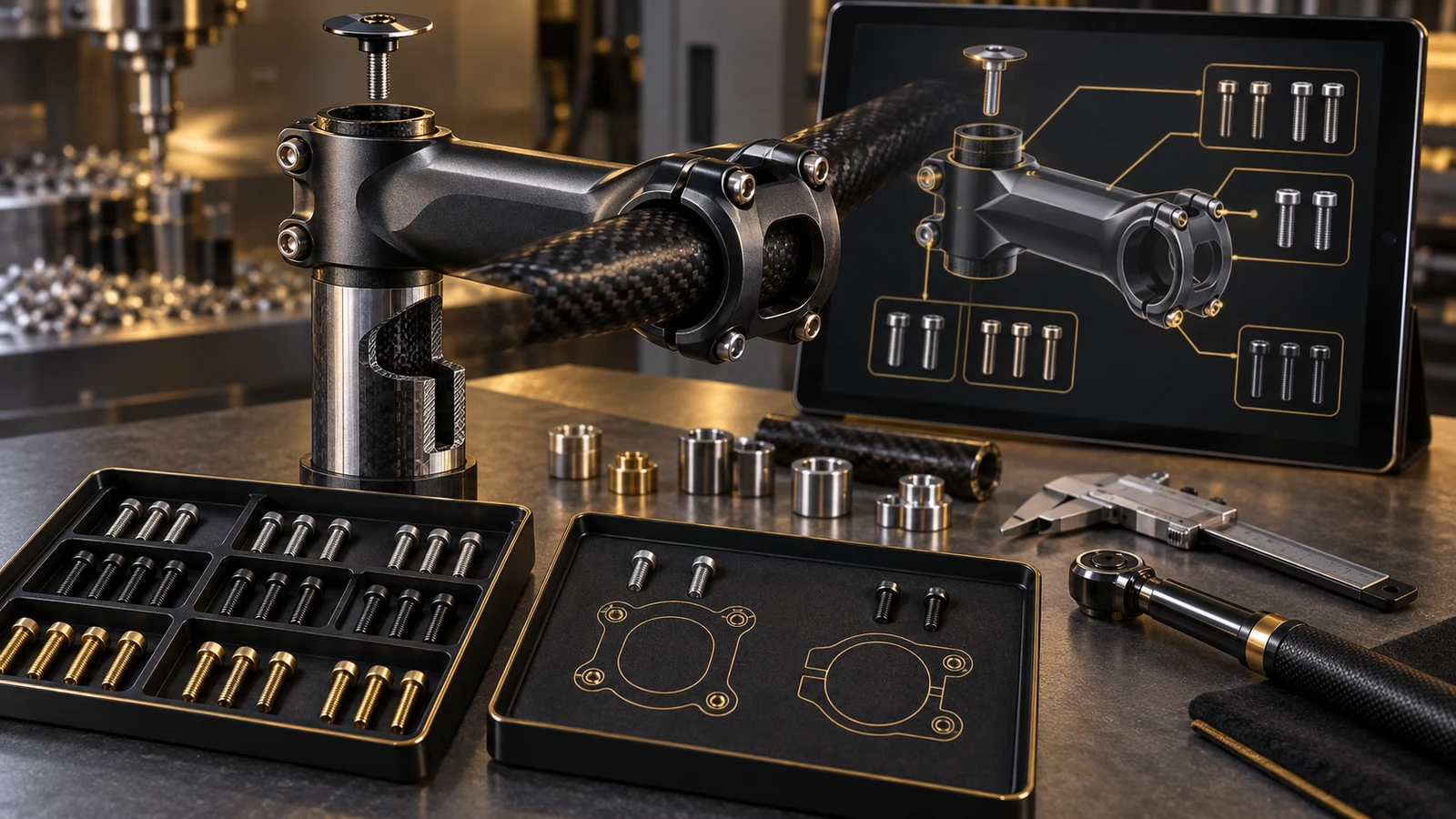
Control a bicycle stem fastener substitution by mapping every proposed screw to its exact position and original requirement. A titanium kit label or matching thread size cannot establish replacement permission across the whole stem. The buyer is deciding which bolt groups change, which mating interfaces remain, and what evidence supports that scope. Faceplate, steerer-clamp and top-cap hardware have different functions and may use different part definitions. For existing bicycles, use the component manufacturer's applicable service parts and instructions. For custom OEM supply, keep the candidate distinct from an approved service kit until the responsible design owner evaluates the represented configuration and its assembly conditions.
Hero: concept illustration of example hardware and its application. It is not a factory photograph, tested component or approved production geometry.
Define the kit by positions, not a material headline
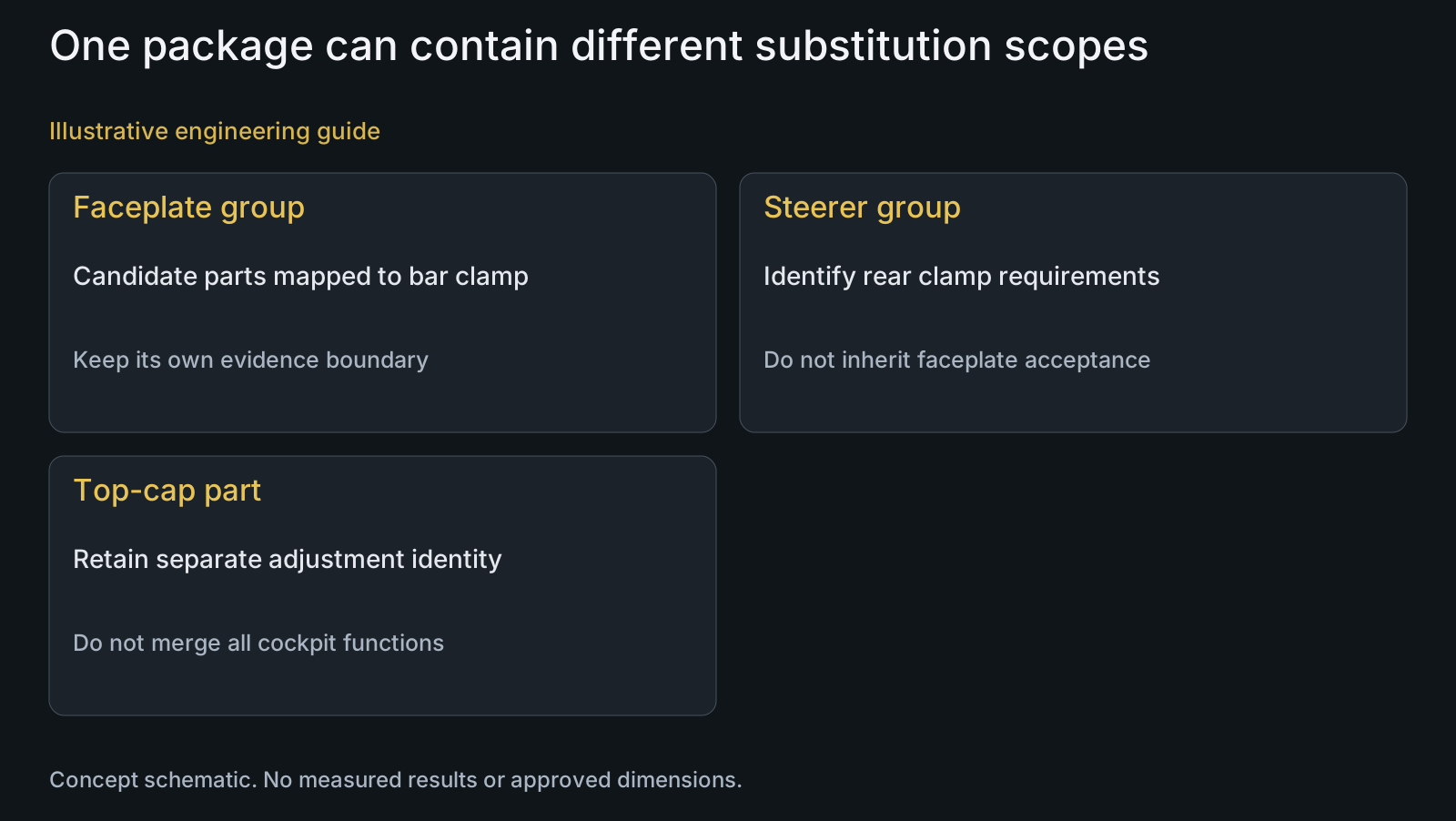
Give each group a position on an assembly view, baseline part definition, proposed part definition and quantity. Include any specified washers or inserts. Distinguish faceplate bolts from steerer-clamp hardware, and keep the headset top-cap part separate from the stem's clamp groups.
Ritchey's public replacement-bolt list ties sets to named stem models and lists different constituent lengths, thread sizes or drives. It is a practical example of model-specific kit composition, not a compatibility list for custom PremFixer parts. Do not copy its commercial part references into an unrelated OEM BOM.
A set containing the right total number of screws can still contain the wrong groups. Define how picking and receipt distinguish the positions when screws appear similar. Quantity agreement alone cannot establish that the supplied set replaces the intended hardware.
Separate a service replacement from an OEM development candidate
A manufacturer-defined service kit has an explicitly stated application. A custom drawing request asks a factory to manufacture a candidate, not to inherit that manufacturer's compatibility declaration. Keep those two purchasing tasks identifiable in the RFQ and product description.
For service use, obtain the applicable approved replacement and instructions rather than reverse-engineer permission from an installed sample. For OEM development, state who controls the candidate's drawing and assembled-system acceptance. Manufacturing to the requested geometry is not itself the compatibility decision.
The titanium stem joint guide examines contact, receiver and assembly suitability. This article controls position-specific substitution scope and kit identity so that one evaluated joint is not silently presented as an approved whole-kit change.
| Proposed scope | When applicable | Risk of overstatement | Evidence to retain |
|---|---|---|---|
| Named manufacturer service kit | Exact listed model and kit | Compatibility extended to another stem | Maker's application and current instruction |
| One OEM bolt group | Only identified positions change | One group presented as whole-kit approval | Baseline/candidate and affected joint comparison |
| Several different groups | Distinct definitions inside one package | Quantity or color used as identity | Position map and constituent requirements |
| Changed mating component | Receiver or contact also revised | Screw-only evidence hides new assembly | Complete represented configuration |
| Different finish or compound | Delivered preparation state changes | Original instruction assumed equivalent | Location-specific preparation and tightening basis |
| Another model or revision | Application scope expands | Prior kit label treated as permission | Explicit new applicability assessment |
Locate each change before choosing its evidence
Compare the head seat, drive, shank, usable thread, length and finished surface for each proposed group. Identify the receiving component and whether it also changes. A material-only description can conceal a geometric difference that affects one position but not another.
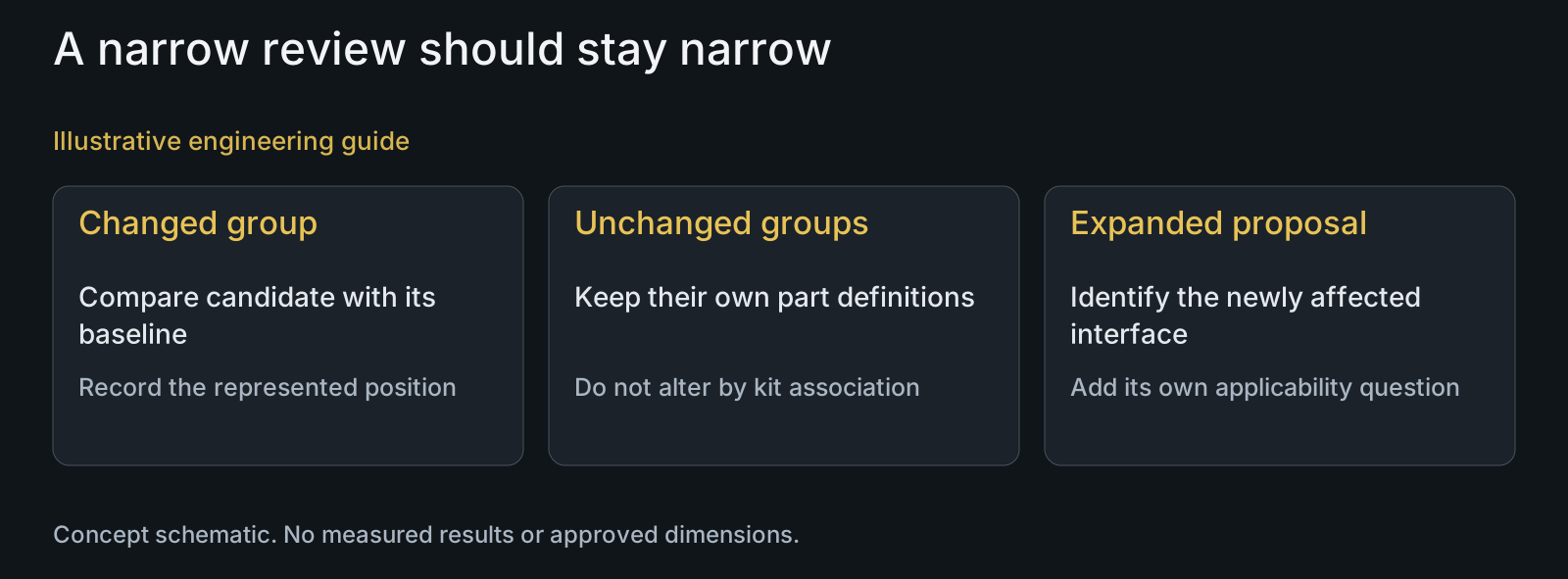
Keep the conclusion as narrow as the evidence. A dimensional comparison for a faceplate group does not evaluate steerer-clamp function. Likewise, an assessment of one named stem version does not automatically represent another version with a different receiver or clamp arrangement.
For drawing-led manufacturing, provide the unchanged interfaces as explicit requirements and name the proposed differences. This lets the process review address real features rather than use a general titanium capability claim as a substitute for a controlled part definition.
Keep preparation and instructions attached to their locations
An assembly document may distinguish screw-thread preparation from handlebar or steerer contact preparation. Zipp's stems and drop-handlebars manual does this and names different bolt preparations for specific models. That example does not authorize its compounds or numeric settings for another cockpit.
If a proposed bolt has a different coating, lubricant or locking state, identify the affected group and compare the existing tightening evidence with that condition. Do not change every kit member's preparation merely because one group changes material.
Retain the correct manufacturer's gap and tightening requirements for existing components. Where the custom proposal is outside those instructions, the design owner must resolve the development question. The assembly-instruction guide explains clarity of states and tools, not a transferable stem installation recipe.
Distinguish part evidence from assembled steering evidence
Material identity, finished dimensions and thread inspection each support a defined part question. They do not by themselves establish clamp retention, safe component contact or an approved steering-system substitution. Identify the represented assembly when requesting any functional evidence.
The existing titanium stem guide discusses the public steering-test scope of ISO 4210-5. A standard name should not become a label that certifies an individual replacement screw or prescribes a universal material. Specify applicable requirements and evidence through the responsible project owner.
Do not infer a universal titanium recommendation or an across-the-board aluminum prohibition from this review. For an existing stem, replacement authorization is the immediate question. For a new design, candidate materials still require the complete part and assembly requirements, not permission from an alloy name.
Review example: one changed group inside a mixed kit
Illustrative engineering example: assume an OEM proposes titanium faceplate screws while keeping the existing steerer-clamp hardware and top-cap part. The complete kit is visually presented in one tray. No dimensions, torque, mass saving or test result is assumed.
The reviewer marks only the faceplate group as changed and compares its part and assembled-joint requirements. The unchanged groups retain their own controlled definitions and instructions. The packaging list names the positions so production or service personnel do not exchange similar-looking screws between them.
If an additional steerer-clamp replacement is later proposed, it is a new change within the kit scope, not an extension justified by the faceplate review. The example prevents a useful narrow assessment from being turned into an unsupported whole-stem compatibility claim.
Questions buyers need to confirm
Can titanium screws replace original stem bolts by thread size?
No. Use a manufacturer-defined option or an OEM-evaluated candidate for the exact positions and configuration. Compare contact, receiver, material condition and supplied surface; the thread match is only one part of that decision.
Can one faceplate review approve every screw in the kit?
No. Identify each group and its mating function. Steerer-clamp and top-cap parts may have different requirements. Keep the approval scope attached to the represented positions instead of extending it through a shared package.
Why do we need a position map when quantities match?
Because different lengths, drives or receivers can be present within one set, and similar parts can be confused. The map links each supplied definition and quantity to its intended location; total count alone does not prove the kit is correct.
Does copying a branded service part make our candidate approved?
No. Manufacturing resemblance does not transfer another maker's application statement or design acceptance. Identify the custom candidate, allowed changes and responsible OEM evaluation separately from an approved manufacturer service kit.
Should every titanium kit member receive the same lubricant?
Do not infer that rule. Retain position- and product-specific preparation requirements and the actual delivered surface. A changed group needs an affected-evidence review, not an automatic preparation change for all screws.
What should a stem hardware substitution RFQ include?
Send the stem model or controlled assembly, a position map, baseline and candidate drawings or samples, quantities, mates, material conditions and final surfaces. Mark changed groups and provide existing instructions and approval ownership so the proposal remains accurately scoped.
Technical references and scope
Ritchey stem bolt set replacement list. Named-model replacement sets have distinct constituent sizes, quantities and drives. No commercial part reference or compatibility transferred to custom hardware.
Zipp stems and drop-handlebars user manual. Printed page 9 distinguishes contact preparation and named-model bolt preparation. No compound, torque or installation prescription transferred to another cockpit.
Explore related component, material and sourcing decisions in the customer decision knowledge center. For a drawing review, use the Drawing/BOM RFQ path.
Scope the stem hardware change by position
Send the marked cockpit assembly, baseline and candidate drawings or STEP, position-specific BOM and finish requirements through the Drawing/BOM RFQ path. PremFixer can review constituent manufacture and kit identity while your team defines the affected assembly assessment and compatibility approval.
Discuss the drawing and BOM