
A satin bead-blasted titanium pivot surface does not by itself demonstrate better fatigue performance. For a shoulder bolt with a head transition and working thread, distinguish the appearance request from a controlled peening objective. Glass beads can be used in peening, so the media name alone does not settle that distinction. Identify the treated regions, material condition and applicable process controls, then assess the evidence relevant to the critical features. Appearance, surface integrity, final fit and fatigue remain separate questions. Do not approve a claimed life benefit from a texture photograph or assume that a cosmetic finish is necessarily harmless to every functional zone.
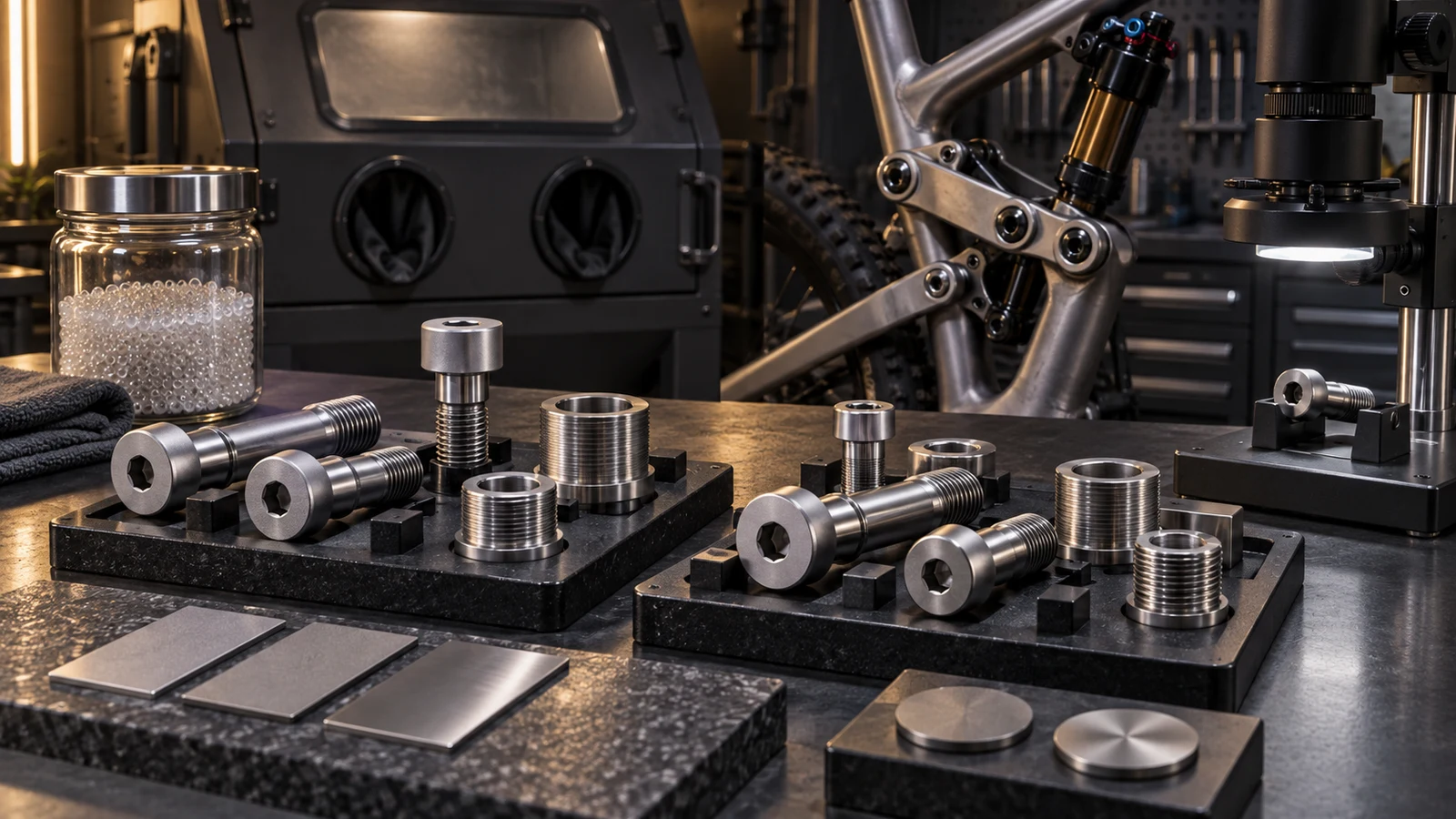
Hero: concept illustration of example hardware and its application. It is not a factory photograph, tested component or approved production geometry.
The process objective matters more than the shared media name
Curtiss-Wright's glass-bead peening overview identifies glass beads as peening media, including for delicate geometry. That prevents a misleading distinction in which every glass-bead operation is called cosmetic and every steel-shot operation is called strengthening.
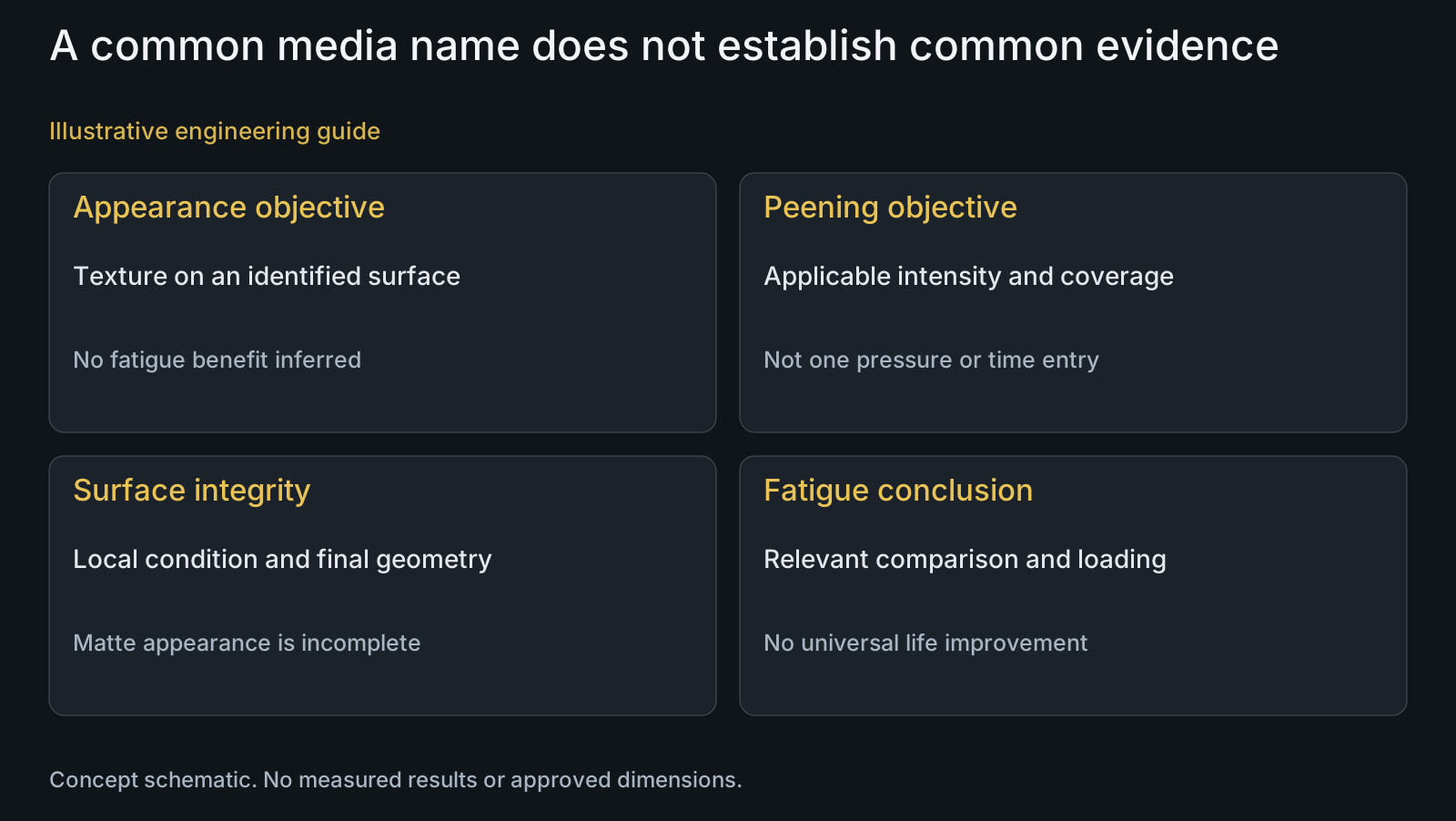
An appearance request defines texture on a represented surface. A peening proposal defines a controlled surface-enhancement purpose and its requirements. The same-looking result does not establish that both operations used the same controls or produced the same relevant state.
Name the purpose on the drawing or agreed process scope. The titanium finish-selection guide compares surface systems; this review asks what a proposed blasting or peening operation must demonstrate before a fatigue claim can be used.
Compressive-stress mechanisms do not supply a bolt-life guarantee
Curtiss-Wright's shot-peening explanation describes local plastic deformation and residual compressive surface stress. This explains a mechanism relevant to fatigue behavior, not an achieved benefit for a particular titanium pivot bolt.
For the engineering review, connect the proposed treatment to the actual critical region, material state and loading. A surface mechanism does not establish which feature controls failure in the assembly, whether that feature is reached or whether the finished geometry remains acceptable.
Do not adopt general supplier improvement ranges as PremFixer results. A claim about a tested specimen needs its own baseline, geometry and conditions. The rolled titanium thread guide covers a different manufacturing route; evidence for thread rolling cannot qualify a later blast operation.
| Requested conclusion | Relevant evidence | Insufficient substitute | Remaining review |
|---|---|---|---|
| Specified satin appearance | Reference and comparison on the represented surface | Media name alone | Visible zones and viewing conditions |
| Peening process conformity | Applicable intensity, coverage and process records | Pressure or dwell-time note alone | Actual zones and provider instruction |
| Acceptable local surface state | Defined examination of relevant features | Uniform matte photograph | Damage, residues and method scope |
| Finished shoulder and thread fit | Delivered-state feature inspection | Appearance approval | Treatment boundaries and mating requirements |
| Fatigue-related improvement | Relevant comparison with stated loading and endpoint | Generic supplier life multiplier | Component representativeness and validation limits |
| Equivalent repeated route | Identified process requirements and represented geometry | Repeated texture description | Material, media and subsequent operations |
Intensity and coverage are different control questions
SAE J443's public scope concerns deriving and verifying peening intensity. SAE J2277's public scope concerns coverage and cautions that insufficient or excessive coverage can be detrimental. Neither public overview supplies a qualified recipe for this pivot.
Ask the responsible provider which process requirements apply and what its records represent. A pressure setting, dwell time or matching satin finish cannot silently replace the selected intensity and coverage controls. Do not invent numerical settings where the actual process instruction has not been established.
Map the required areas and access around head transitions, thread runouts and recesses. Coverage evidence for an open coupon does not automatically represent a sheltered component feature. Conversely, a visible untreated zone may be an intentional exclusion rather than a missed region; the specification must distinguish them.
Keep contamination, texture and final dimensions separate
TIMET's design and fabrication handbook warns about embedded or smeared iron contamination during titanium-equipment handling. For the proposed pivot route, ask how media and contact equipment are managed for the specified material. This is not a chemical-cleaning recipe or proof of actual contamination.
As engineering assessment, examine the surface condition relevant to the requirement, not only whether the part is uniformly matte. Identify unacceptable local damage, remaining residues or feature changes using an agreed examination method. Do not diagnose embedded material from a photograph alone.
Retain the final shoulder and thread requirements. If working features are excluded, define the boundary and accepted condition. If they are treated, assess them in that state. A roughness result does not inspect thread fit; the roughness and fatigue guide explains why a texture parameter is not a complete fatigue description.
Specify the evidence for the claim actually being made
For appearance, identify the reference surface and viewing conditions. For process conformity, identify the applicable controls and represented treatment zones. For fatigue, identify the component or specimen, material condition, initial surface, loading, comparison baseline and stopping or failure criterion.
These evidence types can complement each other without replacing one another. A process-control record does not report a component fatigue test, and a component test does not make an unstated process reproducible. State the conclusion and the limitations of each.
Discuss surface-treatment coordination with PremFixer against the drawing and required partner-service scope. Any specialist peening provision and validation responsibility need confirmation for the order. No owned peening line, residual-stress laboratory or routine fatigue benefit is claimed.
A texture instruction cannot silently become a strengthening instruction
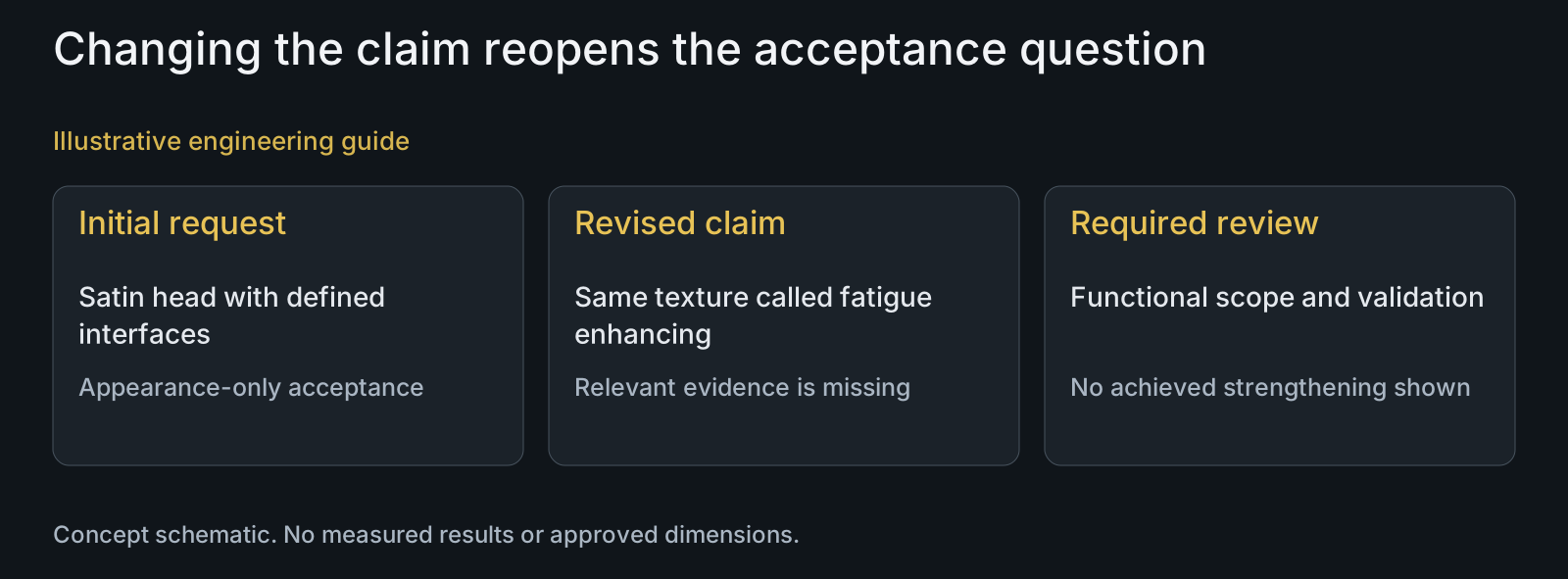
Illustrative engineering example: assume an OEM requests a satin texture on an exposed titanium bolt head while retaining a defined shoulder and thread. A revised procurement note describes the same operation as fatigue enhancing, but adds no process requirements or component evidence.
The reviewer separates the original appearance acceptance from the new functional claim. If a peening objective is required, the responsible provider and design owner must define the applicable scope and evidence, including the critical transition and any excluded features. The earlier texture sample does not approve that new claim.
No actual strength loss, measured compressive stress or increased cycle count is asserted. The example shows why a change in the claimed function requires a different review even when the requested visible texture remains unchanged.
Questions buyers need to confirm
Is glass-bead blasting automatically a controlled peening operation?
No. Glass beads can be used in peening, but the media name does not identify the objective or controls. Review the specified process and evidence rather than infer qualification from texture.
Does a satin surface prove residual compressive stress?
No. An appearance reference assesses the visible result. A stress-related claim needs relevant evidence and cannot be established by a matte photograph.
Can more exposure always improve fatigue?
No. SAE's coverage guidance warns that inadequate or excessive coverage can be detrimental. Use the applicable provider instruction and component review; do not prescribe longer treatment as a universal improvement.
Should threads and locating shoulders also be treated?
Only within the defined functional scope. Identify required and excluded regions, assess access and retain final geometry requirements. Whole-part treatment is not automatically preferable to a controlled boundary.
Does a supplier's published fatigue multiplier apply to this pivot?
Not without a supported relationship to the actual material, geometry, surface, loading and comparison. Keep generic process context separate from component validation and riding-life claims.
What should a titanium blasting review include?
Supply drawing and STEP, titanium condition, purpose of treatment, marked zones and critical transitions, final interfaces and available surface or fatigue requirements. Identify whether the request is appearance, preparation or a controlled peening objective.
Technical references and scope
Curtiss-Wright: Glass-bead peening. Glass beads can be peening media. No titanium-specific outcome, provider qualification or numerical media recipe transferred.
Curtiss-Wright: Shot-peening mechanism. Surface-deformation and residual-compression context only; published benefit ranges and company approvals are not PremFixer claims.
SAE J443_202512 public scope. Intensity determination and verification purpose only; no unread method or numerical limit.
SAE J2277_202301 public scope. Coverage purpose and insufficient/excessive coverage caution; not a bicycle-specific process prescription.
TIMET: Design and fabrication handbook. Titanium-equipment iron-contamination context only. No cleaning chemistry, universal corrosion prediction or pivot fatigue result transferred.
Explore related component, material and sourcing decisions in the customer decision knowledge center. For a drawing review, use the Drawing/BOM RFQ path.
Define the purpose of the titanium surface operation
Send the drawing and STEP, titanium specification, desired texture, treatment-zone map and final interface requirements. If a fatigue function is requested, include the critical features and available validation scope. PremFixer will review manufacturing and partner-treatment provision without treating cosmetic approval as strengthening evidence.
Discuss the drawing and BOM