

A lower Ra can be relevant to a pivot surface, but it does not predict a fixed improvement in fatigue life. Ra is an average profile parameter evaluated under specified measurement conditions. It does not describe every local scratch, transition or thread-root detail, and it does not define the component's loading. For an OEM deciding whether a finer finish is worth specifying, identify the region and its function first. Then distinguish texture acceptance from retained geometry and fatigue evidence. Compare the actual configurations and test conditions before assigning any measured life difference to roughness alone. No universal Ra limit or life multiplier applies to every pivot surface.
Hero: concept illustration of example hardware and its application. It is not a factory photograph, tested component or approved production geometry.
Ra describes an evaluated profile, not the whole component
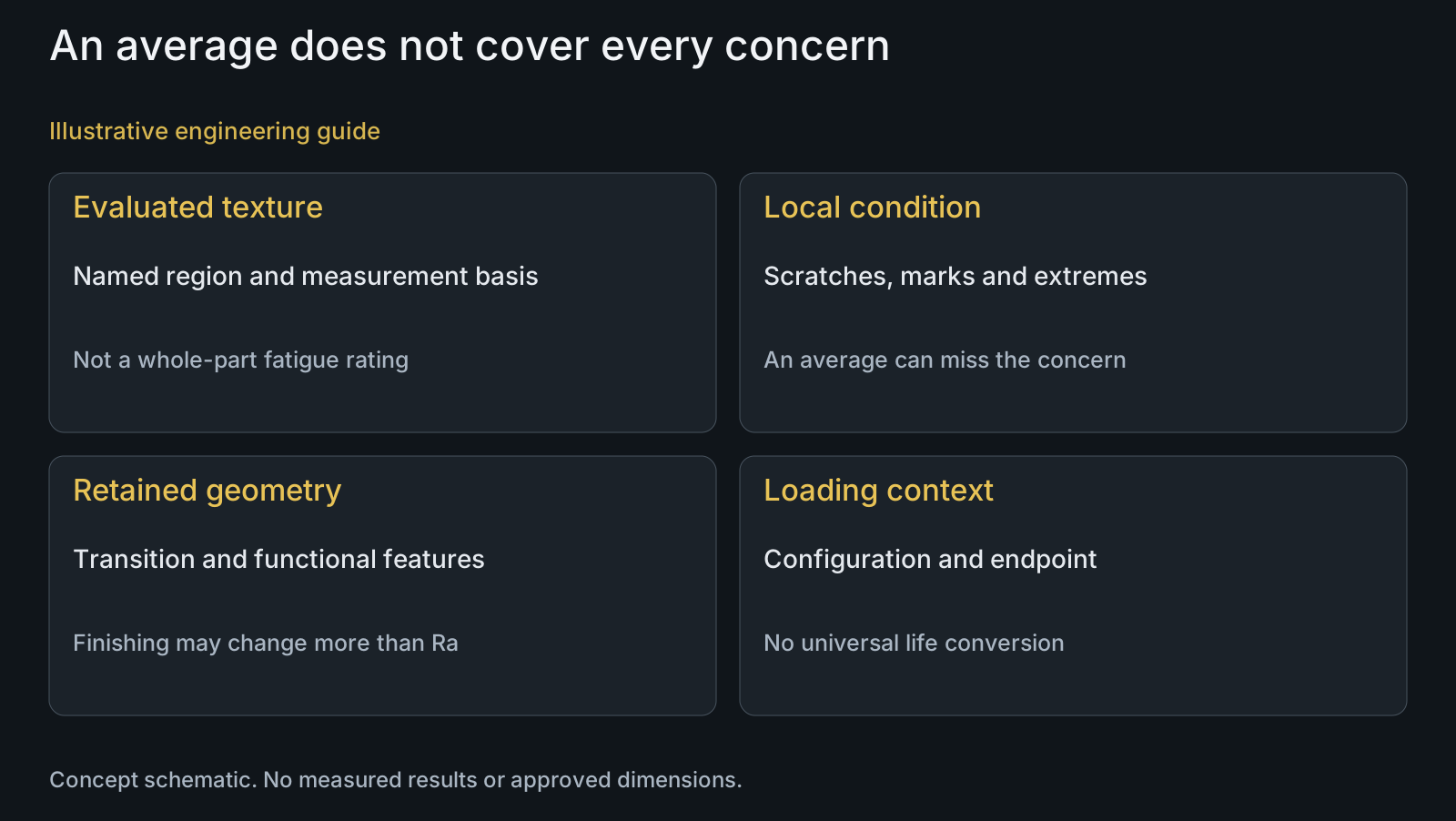
KEYENCE's surface-height explanation describes Ra as an average measure and discusses its limits for local extremes and defects. A recorded Ra therefore needs its measurement location and conditions, not just a small number beside a component photograph.
Identify where the profile was evaluated and whether that region represents the surface requirement being discussed. A reading on an accessible shaft region does not automatically describe a shoulder transition or thread root. Avoid using one convenient measurement to label the entire axle's surface quality.
Keep visible defect assessment separate from the numerical texture check. A photograph can communicate a suspect mark but cannot establish its Ra or depth. Conversely, an acceptable texture result elsewhere cannot dispose of an unexplained local defect on a relevant region.
Start with the surface function and failure concern
A locating surface, sliding region, bearing contact and exposed head perform different tasks. State the particular function and concern when specifying a texture requirement. A cosmetic finish target should not silently become a proven fatigue improvement, and a fatigue concern should not be reduced to brightness.
Locate the region involved in the fatigue argument. As engineering analysis, a comparison about initiation near a transition needs information about that transition and its surface, not only a roughness value measured far away. Identify the component geometry and load context that make the region relevant.
Do not apply the same finest finish to all surfaces without a functional basis. The specification should explain the required region, evaluated parameter and accepted supplied state. A more demanding requirement may add manufacturing and inspection work without answering the particular failure concern.
| Evidence or proposal | Useful supported question | What it cannot establish alone | Next comparison needed |
|---|---|---|---|
| Ra result at a named region | Specified profile texture under stated conditions | Every local defect or the whole axle surface | Relevant-location and local-condition assessment |
| Photograph of a mark | Location and visible appearance concern | Numerical texture or fatigue life | Appropriate measurement and defect disposition |
| Finer finishing operation | Proposed change to a defined region | Unchanged geometry and automatic life improvement | Retained dimensions, transition and supplied treatment |
| Fatigue result on another specimen | Behavior under its stated test scope | Direct bicycle-pivot life or a universal finish factor | Material, geometry, load and endpoint applicability |
| Matched component comparison | Defined outcome for represented configurations | Every service environment or isolated Ra effect | Changed variables and application-validation boundary |
A surface comparison needs a defined material and loading basis
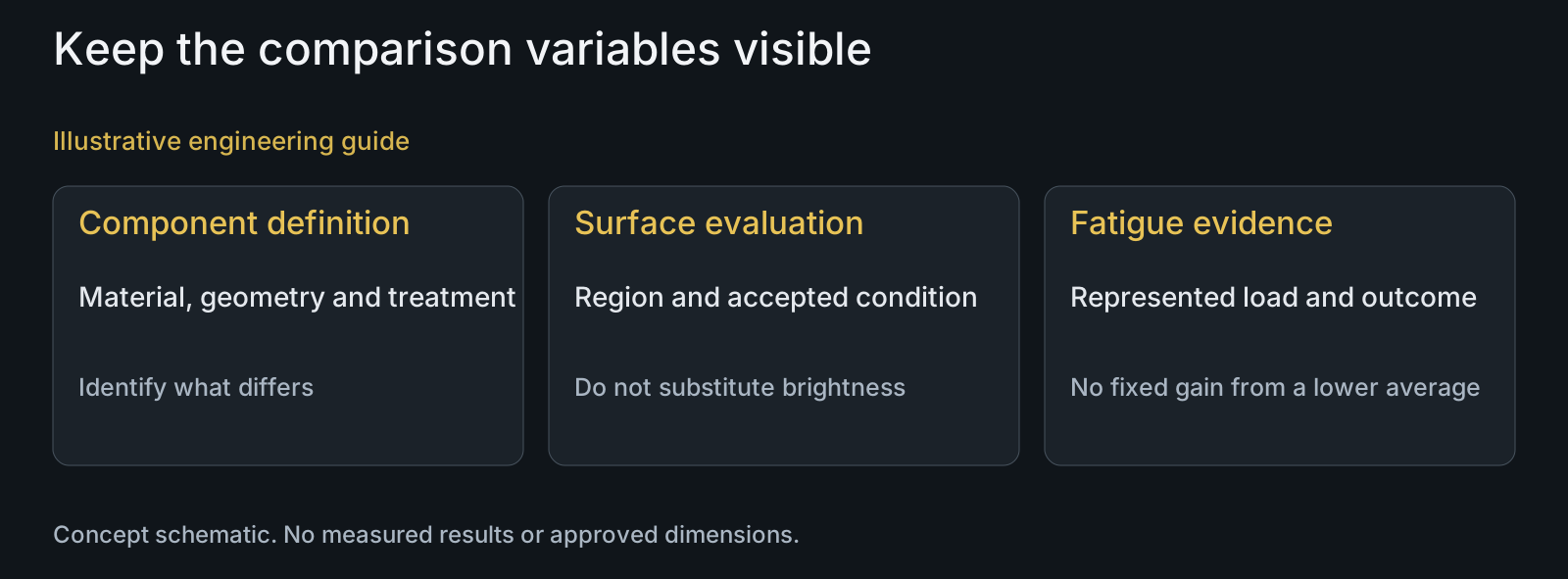
The published abstract of Zhu and colleagues' machined-specimen study describes bending-fatigue work on stepped 42CrMo steel shafts with different surface conditions and a topography-related prediction approach. It demonstrates a material, geometry and test context, not a universal Ra-to-life rule for bicycle pivots.
For a project comparison, identify the material condition, component configuration, loading arrangement and endpoint. Keep surface processing and subsequent treatments visible. If these differ between groups, the resulting difference cannot be assigned to Ra alone without an appropriate basis.
State whether the evidence reports life at a particular load, a stress-based comparison or another outcome. These are not interchangeable gains. Retain the represented conditions with any result rather than copying a percentage from a differently defined test into a pivot purchasing promise.
A finer-looking finish can conceal a different component
Polishing or another finishing operation should preserve the required geometry and supplied surface. Material removed near a transition or functional thread can change more than texture. A brighter part is not automatically an equivalent part with a better fatigue rating.
Ask which regions the operation affects and what remains to be checked afterward. Include any dimensional or geometric requirement relevant to the locating surfaces and transitions. If the final treatment is changed or removed, keep that difference in the comparison rather than treating it as the same supplied state.
A surface-related improvement proposal is useful when its intended mechanism and acceptance scope are clear. It is incomplete when the supplier supplies only a smaller average value and asks the buyer to infer service life. Keep measured finish compliance and validated component behavior as separate conclusions.
Two finish proposals can answer different questions
Illustrative engineering example: assume two pivot finish proposals use the same initial drawing. One addresses a specified external texture region. The other adds polishing near a shoulder transition. Neither proposal supplies actual profile measurements or fatigue results.
The team checks whether both delivered geometries and treatments remain equivalent. It identifies where texture would be evaluated and how local marks and the transition would be assessed. If polishing changes that transition, a later fatigue difference would not be a clean roughness-only comparison.
Select an appropriate finish requirement for the actual functional region, then define any additional validation needed for the intended fatigue claim. The example gives no winning route, numerical surface value, measured cycle count or predicted life gain; it shows why the comparison must retain more than the average parameter.
Separate the finish request from the life claim in the RFQ
Send the drawing and STEP with material condition, marked surface regions, finish and quantities to the CNC manufacturing review. State the texture convention and measurement conditions required for acceptance instead of requesting a generic mirror finish.
Connect any later treatment to the surface-processing scope. The workholding guide addresses local contact damage, while the matched titanium-thread fatigue guide addresses a separate process-comparison question.
PremFixer manufactures to the agreed customer definition. If a particular fatigue outcome is part of the project, provide the applicable component and validation context separately from the texture requirement. No generic life improvement, company test result or default whole-part Ra limit is established here.
Questions buyers need to confirm
Can a reduced Ra prove a fixed percentage gain in fatigue life?
No. Identify the component, material state, surface changes, load and endpoint. A texture result alone does not supply the fatigue comparison or isolate which changed variable caused an outcome.
Does an acceptable Ra rule out a damaging local mark?
No. Ra is an average profile measure at the evaluated region. Locate the mark and assess its relevant characteristics separately; a reading elsewhere does not dispose of that concern.
Should every pivot surface have the same low Ra requirement?
Not without a functional basis. Identify locating, sliding, contact and appearance regions and the specific acceptance task. One whole-part value can add work while leaving the important local requirement unclear.
Can polishing improve finish without further geometric checks?
Do not assume that. Identify the treated regions and retained dimensions, thread and transitions. Review the supplied coating or treatment too, since removed material or altered surfaces can change the comparison.
Can a stepped-shaft research result be used as a pivot guarantee?
No. Its material, geometry and bending-test context delimit the evidence. Use it as scoped technical background, not an installed-product lifetime or transferable numerical gain.
What should accompany a roughness and fatigue RFQ?
Send drawing and STEP, alloy condition, marked surface regions, texture convention, measurement conditions, final treatment and quantities. Provide the component loading and intended validation outcome separately if a fatigue claim is being evaluated.
Technical references and scope
KEYENCE: Surface height, Ra and Rz explanation. Relevant average-profile and local-defect explanation read during SRC087 research. No questionable standard identifier or Rz conventions from that page adopted.
Zhu et al.: Fatigue life prediction of machined specimens with surface roughness. Published abstract accessible through indexed primary-paper content:42CrMo stepped-shaft bending and topography prediction context. Full-text page was blocked; no methods detail, figures, quantitative results or verified model performance used.
Explore related component, material and sourcing decisions in the customer decision knowledge center. For a drawing review, use the Drawing/BOM RFQ path.
Specify the surface requirement your pivot actually needs
Send the drawing, STEP, material condition, marked functional regions, final finish and quantities. Include any available loading or validation brief. PremFixer will review the texture and retained-geometry manufacturing scope without converting an Ra target into an unsupported service-life promise.
Discuss the drawing and BOM