
Overview
Choosing the right bicycle fastener involves three interdependent decisions: material, coating, and torque specification. Get any one wrong, and the bolt either fails, corrodes, or damages the frame. This hub connects our in-depth engineering articles into a single selection workflow — start with your bike type, answer three questions, and arrive at the correct fastener specification.
Quick Navigation
1. Fastener Selection Workflow
For every bolt on your bike, follow this 3-question decision tree:
Carbon road bike? Aluminum MTB? Steel commuter? This determines your galvanic safety requirements.
Structural (stem, brake, pivot) → strength priority. Non-structural (bottle cage, accessory) → weight priority.
Coastal/salt → maximum corrosion resistance. Dry/indoor → standard protection sufficient. Wet/mud → waterproof sealing needed.
2. Material Decision Matrix
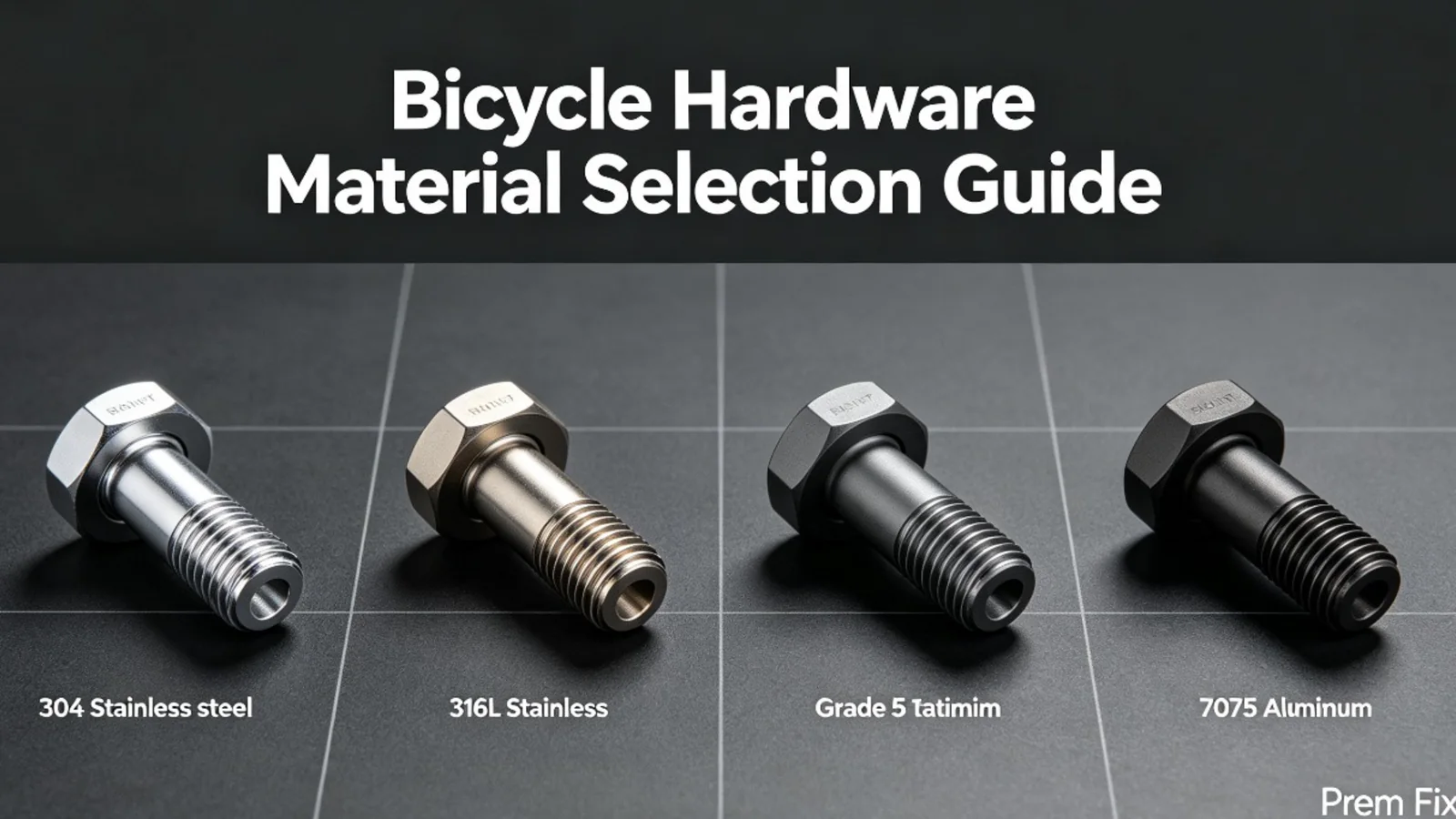
| Material | Tensile (MPa) | Salt Spray (h) | Weight vs Steel | Cost (× Steel) | Best For | Carbon-Safe? |
|---|---|---|---|---|---|---|
| 12.9 Alloy Steel | 1,200 | 150 (bare) | Baseline | 1.0x | DH, e-bike, high-impact | No (needs coating + washer) |
| A4-70 316SS | 700 | 1,000+ | +5% | 1.5x | All-weather, coastal, folding | Yes |
| A2-70 304SS | 700 | 500 | +5% | 1.2x | Urban, dry climate, value builds | Conditional |
| TC4 Ti-6Al-4V | 950 | 1,500+ | −42% | 3.5x | Premium road, carbon, weight-weenie | Yes (best) |
| 7075-T6 Al | 570 | 200 (anodized) | −65% | 2.5x | Non-structural: bottle cage, accessory | No — never on carbon |
3. Recommendations by Bike Type
Road Bike (Carbon Frame)
| Location | Material | Coating | Typical Torque (N·m) |
|---|---|---|---|
| Stem faceplate | TC4 Ti | None (passivated) | 4-5 |
| Stem steerer | TC4 Ti | None (passivated) | 5-6 |
| Brake caliper | 316SS | Passivated | 6-8 |
| Seatpost clamp | TC4 Ti | None (passivated) | 5-6 |
| Bottle cage | 7075-T6 Al | Anodized | 2-3 |
Full kit cost: ~$14.50 (Ti) / ~$8.00 (316SS) | Weight savings with Ti: ~40g
Enduro / DH MTB (Aluminum Frame)
| Location | Material | Coating | Typical Torque (N·m) |
|---|---|---|---|
| Pivot bolts | 12.9 Steel | Dacromet | 25-30 |
| Shock mount | 12.9 Steel | Dacromet | 20-25 |
| Brake caliper | 12.9 Steel | Dacromet | 8-12 |
| Stem faceplate | 316SS | Passivated | 5-7 |
Priority: Maximum tensile strength. 12.9 steel at 1,200 MPa handles rock strikes and big drops that would yield titanium.
E-Bike (Mid-Drive, Aluminum)
| Location | Material | Coating | Locking | Torque (N·m) |
|---|---|---|---|---|
| Motor mount | 12.9 Steel | Dacromet | Nord-Lock + Loctite 243 | 35-40 |
| Battery tray | 316SS | Passivated | Nord-Lock | 8-10 |
| Controller cover | 316SS | O-ring groove | Loctite 243 | 2-3 |
Priority: Vibration resistance + waterproofing. Motor mounts demand 12.9 steel with dual locking; controller compartments must be IP67 sealed.
Folding Bike (Steel / Aluminum)
| Location | Material | Coating | Torque (N·m) |
|---|---|---|---|
| Hinge pin | 316SS | Ground + passivated | 15-20 |
| Latch bolt | 316SS | Passivated | 6-8 |
| QR lever pivot | 316SS | Passivated | 4-5 |
Priority: High-cycle durability + urban corrosion resistance. 316SS + ground finish rated for 10,000+ fold cycles.
4. Coating Selection Guide
| Environment | Recommended Coating | Salt Spray (h) | Notes |
|---|---|---|---|
| Coastal / marine | Dacromet or passivated 316SS | 720-1,000+ | Maximum corrosion protection mandatory |
| Wet / all-season commute | Zn-Ni Alloy | 600 | Balanced performance and cost |
| Dry / urban | Zinc Plating or A2-70 bare SS | 240-500 | Budget-appropriate protection |
| Carbon frame | ED Black Zinc or bare TC4 Ti | 480-1,500+ | Must be carbon-compatible coating |
| High vibration (e-bike) | Dacromet + mechanical locking | 720+ | Coating + locking method specified together |
Frequently Asked Questions
Can I use the same bolt material everywhere on my bike?
Technically yes — many OEMs standardize on A4-70 316SS for all fasteners on a given model. This simplifies BOM management and eliminates material mix-up risks. However, a fully optimized bike uses different materials for different locations: titanium for weight-critical non-structural bolts (stem, seatpost), 316SS for exposed structural bolts (brake calipers, pivots), and 12.9 steel for the highest-load locations (DH pivots, e-bike motor mounts).
What's the most common fastener mistake you see?
Bare 12.9 steel bolts on carbon frames. It's the number one cause of warranty frame damage we see in our test lab. The bolt itself doesn't fail — it chemically destroys the carbon fiber matrix through galvanic corrosion. The fix costs $0.34 in insulation washers, but the frame replacement costs $500-$4,500.
Do I really need to care about torque specifications?
Yes — torque is not a suggestion, it's an engineering requirement. Under-torqued bolts loosen under vibration. Over-torqued bolts crush carbon fiber or yield aluminum threads. A calibrated torque wrench is the cheapest insurance against both failure modes. For carbon frames specifically: always use carbon assembly paste (not grease), always torque to carbon-specific values (not aluminum values), and always verify with a calibrated wrench.
Not Sure What Fasteners Your Bike Needs?
Send us your frame BOM or tell us about your bike. Our engineers return a complete fastener specification — material, coating, torque, and locking method for every bolt. Free, within 4 hours.
Request Fastener Specification