
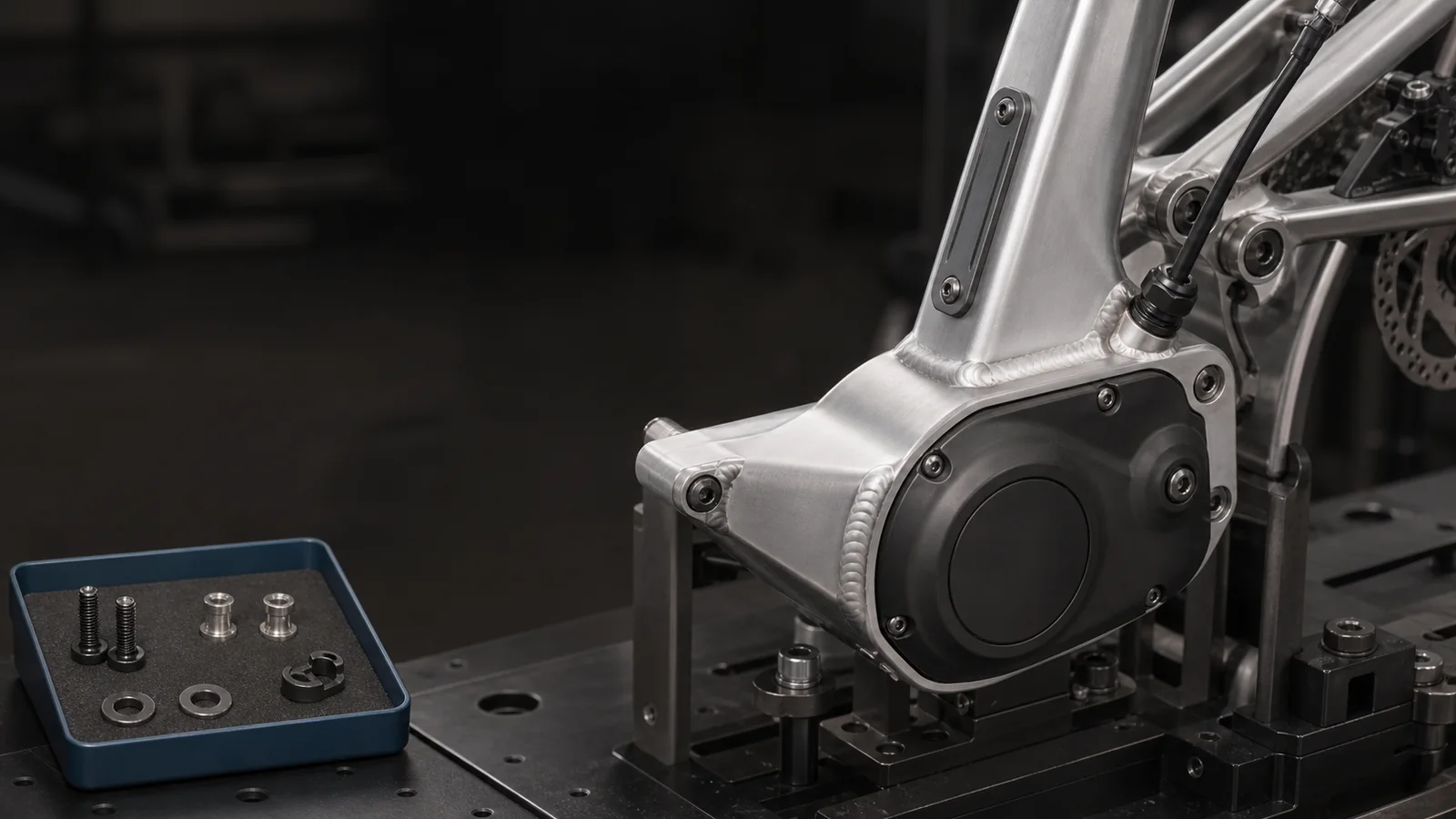
Overview
E-bikes are the fastest-growing bicycle category — and they demand a fundamentally different approach to fastener engineering. A traditional bicycle weighs 8-14 kg; a modern e-MTB or cargo e-bike weighs 22-35 kg with a motor delivering up to 85 N·m of continuous torque. Add 30+ km/h speeds, all-weather commuting, and sealed electronic compartments, and you have an engineering challenge that standard bicycle fasteners were never designed for.
This hub collects everything PremFixer knows about e-bike fasteners in one place — from the vibration profiles at every motor mount interface to the IP67 sealing data our lab generates on every production batch.
Quick Navigation
1. Vibration & Anti-Loosening Systems
Why E-Bike Vibration Is Different
Traditional bikes face intermittent impact vibration — a rock strike, a pothole, a landing. The fastener has time to recover between events. E-bike motors produce continuous, high-frequency vibration that propagates through every bolted joint on the frame, every second the motor is running. A mid-drive motor (Bosch CX, 250W, 85 N·m) generates vibration at 25-45 Hz with amplitudes up to 3.2g at the lower motor mount. This is a constant loosening force with no recovery period.
The 7-Position Vibration Profile
Not all locations on an e-bike vibrate equally. Our lab mapped the complete vibration profile across a mid-drive e-MTB:
| Location | Frequency (Hz) | Max Amplitude (g) | Failure Mode | Criticality |
|---|---|---|---|---|
| Motor mount (lower) | 25-45 | 3.2 | Transverse loosening | Critical — motor detachment |
| Motor mount (upper) | 25-40 | 2.1 | Transverse loosening | Critical — motor detachment |
| Battery latch (lower) | 18-30 | 1.8 | Axial loosening | Critical — battery ejection |
| Battery tray | 22-35 | 2.5 | Shear loosening | High |
| Controller cover | 35-55 | 4.1 | Gasket compression loss | High — water ingress |
Junker Test: Which Locking Methods Actually Work
The Junker test (ISO 16130) is the industry standard for evaluating self-loosening. At PremFixer, we tested M8 motor mount bolts with 6 locking methods at 12.5 Hz for 2,000 cycles:
| Locking Method | Clamp Retention (%) | E-Bike Recommendation |
|---|---|---|
| Nord-Lock + Loctite 243 | 96% | Motor mounts, battery latch |
| All-metal deformed lock nut | 80% | Battery tray, general |
| Nyloc prevailing torque | 78% | Lower-temp positions only |
| Loctite 243 only | 71% | Controller cover bolts |
| Spring (split) washer | 42% | Not recommended for e-bike |
| Plain bolt (no locking) | 0% | Unacceptable — certain failure |
The engineering behind Nord-Lock: the wedge-locking washers use cam geometry where the cam angle (α) exceeds the thread pitch angle (β). This creates a mechanical lock — the bolt cannot rotate loose without overcoming the wedge angle, regardless of vibration frequency. Combined with Loctite 243 filling thread clearance, this achieves the closest thing to permanent locking without welding.
Read the complete guide: E-Bike Fastener Reliability — full Junker test data for 5 locking methods + 7-position vibration profile →2. Waterproofing & IP67 Sealing
Why Water Is the E-Bike's Worst Enemy
A traditional bike can get soaked — the worst outcome is a rusty chain. An e-bike getting water into its motor housing or battery compartment means short-circuited electronics, corroded connectors, and potentially catastrophic battery failure. The economic impact: a single water-damaged e-bike system costs $800-$2,500 to replace. The fastener sealing that prevents this costs $0.04-$0.12 per bolt.
4 Sealing Methods — Tested to IP67
IP67 means protection against temporary immersion in 1 meter of water for 30 minutes. We tested four common sealing approaches on M8 battery compartment bolts under IEC 60529:
| Sealing Method | IPX7 Pass Rate (n=200) | Post-Vibration Pass Rate | Cost/Bolt | Best Application |
|---|---|---|---|---|
| O-ring + groove bolt (captive EPDM) | 100% | 100% | $$$ | Battery compartment, motor housing |
| Bonded sealing washer (EPDM/steel) | 98% | 88% | $$ | Controller covers, display mounts |
| Pre-applied thread sealant (Loctite 577) | 94% | 92% | $ | Frame cable guides, sensor mounts |
| Flat nylon washer | 22% | 6% | $ | Not for waterproofing |
Why O-ring groove bolts are the gold standard: The EPDM O-ring sits in a machined groove under the bolt head. As the bolt is torqued, the O-ring compresses against the housing surface, forming a seal that is independent of thread engagement. Even if the bolt rotates 5-10° due to vibration, the O-ring maintains its seal — making it the only method with a 100% post-vibration pass rate.
Read the complete guide: E-Bike Fastener Challenges — IP67 sealing comparison + vibration locking test data →3. Compliance Standards That Apply to E-Bike Fasteners
The Regulatory Landscape
E-bike fasteners don't just need to be strong — they need to be certifiably compliant with regional safety standards. Here's what each standard requires specifically for fasteners:
| Standard | Region | Fastener Requirement | Test Method |
|---|---|---|---|
| EN 15194 | EU | Electrical system fasteners withstand vibration per ISO 16750-3; battery mount retains battery under 30g shock | Vibration sweep 10-2,000 Hz at 1.0g, 8h per axis |
| UL 2849 | USA/Canada | Battery enclosure fasteners remain secure after 500 thermal cycles (-20°C to +60°C); no loosening permitted | Thermal cycling + post-test torque verification |
| ISO 13063 | International | Motor mount fasteners withstand 2× rated torque without yield | Static torque test on complete assembly |
| IP67 (IEC 60529) | International | Compartment fasteners maintain seal after 2,000 vibration cycles | 1m submersion for 30 min post-vibration |
| UN 38.3 | International | Battery pack fasteners survive T4 thermal shock (-40°C to +75°C, 24 cycles) | Visual + torque check post-test |
What "Compliant" Fasteners Actually Mean
A compliant e-bike fastener is not just a bolt that meets a strength grade. It means:
- Material traceability: Every bolt has an EN 10204 3.1 certificate with heat number, chemical composition, and mechanical properties — auditable to the raw material batch.
- Test documentation: Supplier provides test reports for the specific locking method and sealing method used on your BOM, tested to the applicable standard.
- Batch-level QC: Not just a certificate on the website — a real inspection report from your production batch with actual measured values.
4. Material & Coating Selection for E-Bike Applications
E-Bike Material Decision Matrix
An e-bike is not one material problem — it's several. The motor mount needs compressive strength to handle 85 N·m of torque transmission; the battery compartment needs maximum corrosion resistance with zero risk of galvanic interaction; the controller cover needs moderate strength with guaranteed sealing.
| Application | Material | Coating | Locking | Sealing | Why |
|---|---|---|---|---|---|
| Motor mount (M8) | 12.9 Steel | Dacromet | Nord-Lock + Loctite 243 | None (external) | Max tensile for 3.2g vibration |
| Battery tray/latch | A4-70 316SS | Passivated | Nord-Lock | IP67 for latch pin | Corrosion immunity + structural |
| Controller cover | A4-70 316SS | Passivated | O-ring groove + Loctite 243 | IP67 mandatory | Sealing + corrosion at electronics interface |
| Wiring/cable guides | A2-70 304SS | Passivated | Pre-applied sealant | IP65 (spray-proof) | Value-grade corrosion protection |
| Display/control mount | A2-70 304SS | Passivated | Loctite 243 | None (handlebar) | Low load; rider-accessible torque under 4 N·m |
| Frame pivots (e-MTB) | 12.9 Steel | Dacromet | Nord-Lock | None (external) | 25-30 N·m pivot torque requires 12.9 |
E-Bike vs Standard Bike: The Specification Upgrade
| Parameter | Standard Bike | E-Bike | Reason |
|---|---|---|---|
| Motor mount torque | N/A | 25-40 N·m | Motor reaction torque + vibration |
| Pivot bolt torque | 18-22 N·m | 25-30 N·m | Additional motor torque through pivot |
| Brake caliper grade | 10.9 / A2-70 | 12.9 / A4-70 minimum | Higher mass = higher braking loads |
| Anti-vibration | Loctite 243 | Nord-Lock + Loctite 243 | Continuous motor vibration vs intermittent |
| Sealing requirement | None | IP67 on electronics compartments | Water ingress = system failure |
| Cargo rack bolt size | M5 | M6 minimum | Higher static + dynamic cargo loads |
5. E-Bike Fastener BOM: What's in a Complete Kit
A complete e-bike uses fasteners across 6 distinct modules. Each module has different material, locking, and sealing requirements — there is no single "e-bike bolt" that works everywhere:
| Module | Typical Fasteners | Material | Locking | Sealing | Compliance |
|---|---|---|---|---|---|
| 1. Motor Mount | 4× M8 (mid-drive); 6× M8 (hub) | 12.9 Steel + Dacromet | Nord-Lock + Loctite 243 | None | ISO 13063 |
| 2. Battery Tray | 3× M6 tray; 2× M5 latch | A4-70 316SS | Nord-Lock | IP67 latch | UL 2849 |
| 3. Controller | 4× M4 cover screws | A4-70 316SS | O-ring + Loctite 243 | IP67 | IEC 60529 |
| 4. Wiring/Cables | 6-8× M4 clip screws | A2-70 304SS | Thread sealant | IP65 | Visual |
| 5. Display/Remote | 2× M4 display; 2× M5 remote | A2-70 304SS | Loctite 243 | None | — |
| 6. Speed Sensor | 1× M5 sensor; 1× magnet bolt | A2-70 304SS | Loctite 243 | None | Functional |
Typical total fasteners per e-bike: 18-24 bolts across 6 modules. Complete e-bike kit cost at 1,000 units: ~$32 (316SS + 12.9 steel + Dacromet + Nord-Lock). All fasteners ship with batch-level EN 10204 3.1 material certificates and application-specific test reports.
Read the complete guide: E-Bike Fastener Reliability — full 6-module BOM checklist with torque and spec tables →Frequently Asked Questions
Can I just use standard bicycle bolts on an e-bike?
For non-critical points like bottle cage bosses or accessory mounts — yes. But for the four critical interfaces (motor mount, battery tray, controller housing, and pivots on e-MTBs), the answer is no. Standard bolts lack the locking method to survive continuous motor vibration (plain bolts fail Junker test within 200 cycles), lack the sealing to protect electronics compartments (standard bolts provide zero water protection), and may be under-sized for the higher static and dynamic loads of a 25-35 kg e-bike platform. The cost of upgrading to e-bike-spec fasteners is typically $3-8 per bike — far less than one warranty claim.
What's the single most important e-bike fastener spec?
Nord-Lock wedge-locking washers on motor mount bolts. This single specification prevents the most common e-bike fastener failure mode: motor mount bolts loosening under vibration and causing catastrophic motor detachment. Nord-Lock + Loctite 243 achieves 96% clamp retention after 2,000 Junker cycles. Spring washers — still commonly used on budget e-bikes — achieve only 42%. The cost difference is approximately $0.30 per bolt. If you specify only one thing for your e-bike BOM, make it this.
Do I need IP67 sealing on every bolt?
No — only on bolts that penetrate sealed compartments. On a typical mid-drive e-bike, this means: the 4 controller cover screws, the 2-3 battery latch/tray bolts that pass through the battery compartment wall, and any bolt that enters the motor housing. Wiring guide clips and display mounts do not require sealing. Flat nylon washers do not constitute waterproofing — they fail IP67 at a 78% rate. Use O-ring groove bolts (captive EPDM) on any bolt that must maintain a seal through vibration.
How do I verify my supplier's EN 15194 and UL 2849 compliance?
Ask for a test report — not a certificate. A real compliance test report includes: the test standard referenced, the specific bolt part number tested, the test apparatus used, the measured results (not just PASS/FAIL), and the signature of an accredited test engineer. At PremFixer, every e-bike fastener shipment includes an Application Test Summary: one page per standard with the test data for your specific production batch. If a supplier can only show you a generic certificate, they haven't tested your fasteners to the standard.
Building E-Bikes? Let's Engineer Your Fastener System Together.
Send us your e-bike frame design and BOM. Our engineers return a complete fastener specification covering vibration resistance, IP67 sealing, and EN 15194 / UL 2849 compliance — free, within 4 hours. Batch-level material certs included.
Submit Your E-Bike BOM