

For bicycle hardware supplied to Canada, agree which product the records represent, who performs the Canadian review and how relevant safety information reaches that team. Naming a Canadian standard does not settle those responsibilities. CCPSA's consumer-product definition includes components, parts and accessories, so an OEM transaction is not by itself proof that a pivot falls outside its scope. Keep legal obligations separate from the buyer's drawing and purchase specifications. Component evidence can support the review, but it should not be presented as approval of a complete bicycle. The handoff also needs a usable route for concerns that cannot wait for a finished technical investigation.
Hero: concept illustration of example hardware and its application. It is not a factory photograph, tested component or approved production geometry.
Identify the product and Canadian role without assuming an exemption
The public Canada Consumer Product Safety Act defines consumer products by their reasonably expected non-commercial use and includes components, parts and accessories. Describe the actual supplied item and intended use, then have the responsible team determine applicability. The fact that purchasing is business-to-business does not answer the product question.
Identify the Canadian importer, relevant manufacturer and supply roles for the transaction. Do not assign a legal role merely because a commercial document calls a party the supplier. Product assembly, importation and subsequent sale can require different information relationships.
The export-document guide organizes destination evidence categories. This guide addresses the Canadian handoff: who needs which component information, how it represents the product and what happens when a safety concern emerges.
Separate a purchase standard from a verified legal requirement
Ask for the exact title, edition and applicability basis of each requested Canadian, ISO or SAE reference. Determine whether it is a legal requirement for the actual product, a selected engineering specification or a certification request. These are not interchangeable reasons for putting a number in the RFQ.
Do not claim that CCPSA universally requires every bicycle or pivot to comply with an unexplained CAN/CSA Z114 reference. A named standard needs a verified subject and adoption basis before that statement is justified. This guide does not establish that blanket requirement.
For the component offer, specify the controlled geometry, material condition, thread and finished interfaces. The drawing and inspection guide connects those fields to acceptance. Meeting a selected component specification does not erase the responsible product team's separate safety work.
| Available situation | Shortcut to avoid | Useful information handoff | Decision owner or limit |
|---|---|---|---|
| OEM component ordered for a consumer bicycle | B2B purchase is treated as automatic exclusion | Product description, intended use and supply roles | Responsible Canadian team determines applicability |
| RFQ names a Canadian standard | The number is treated as universal law | Title, edition and legal or contractual basis | Product reviewer separates duties from purchase choices |
| Material and dimensional files are complete | Reports replace source and recipient records | Represented configuration and supply relationships | Each record retains its actual purpose |
| A safety concern lacks final root cause | Information is withheld until investigation closes | Observed facts, identity limits and available evidence | Responsible party assesses reporting without artificial delay |
| One pivot serves several product variants | Similar appearance proves the installed revision | Supplier delivery links and customer assembly history | Preserve alternatives until identity is supported |
| Revision changes after initial supply | Current files silently replace earlier representation | Changed features and prior configuration relationships | Agree who evaluates affected product information |
Keep supply relationships distinct from engineering reports
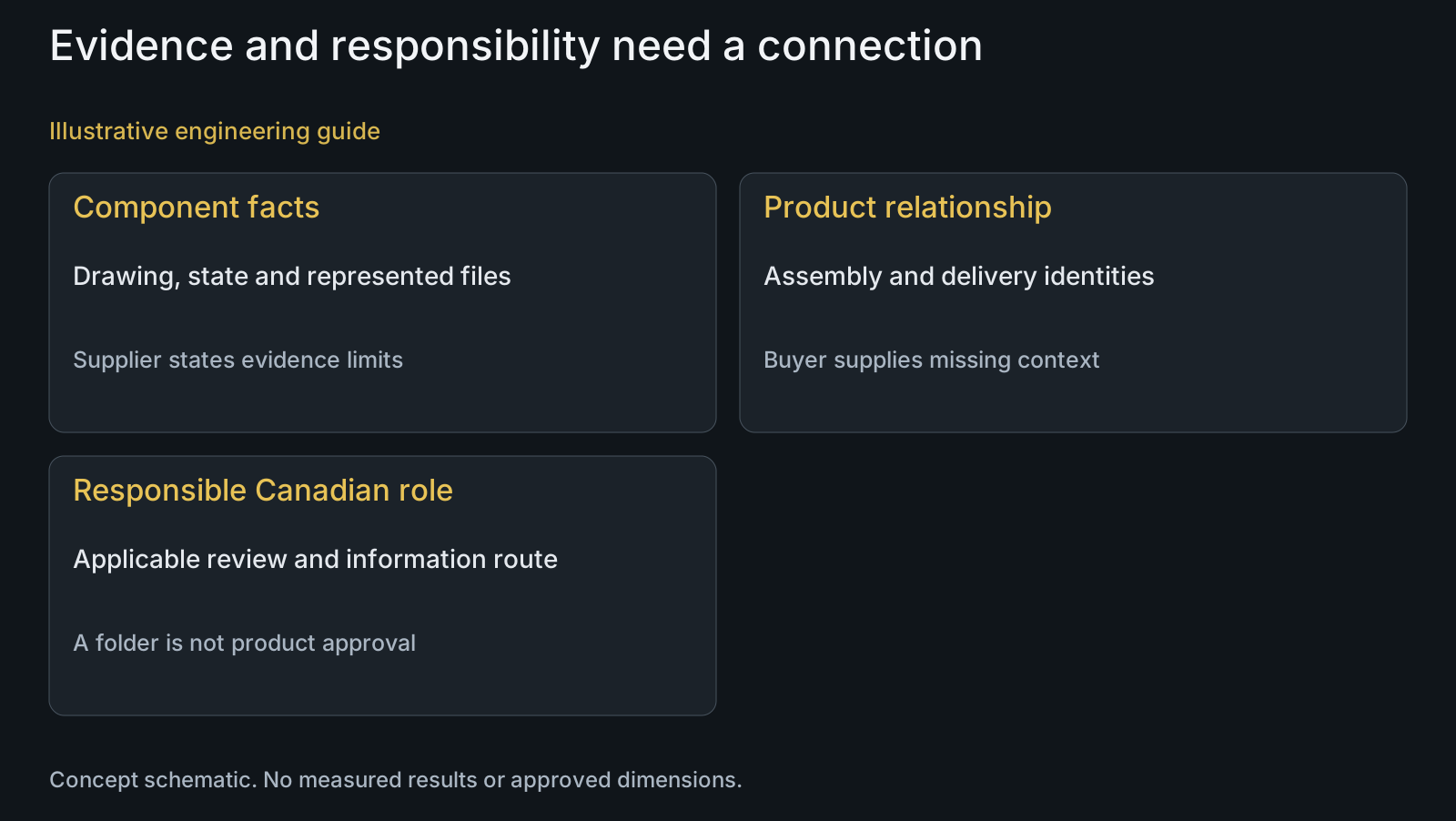
Health Canada's section 13 guidance explains supply-chain recordkeeping, with different entries for retailers and other roles. Supplier and recipient identities serve a different purpose from a dimensional report or material certificate. An inspection file cannot replace an unidentified source or recipient relationship.
For the engineering handoff, connect the drawing revision, supplied configuration, order or delivery reference and included reports. Confirm which records the Canadian team can access and how it can relate them to its product. This is a proposed project relationship, not a claim that every one of these engineering files is universally prescribed by section 13.
The heat-to-kit traceability guide examines uncertain returned-part origins. Here the priority is enabling the responsible Canadian party to obtain relevant information while keeping known identity and unresolved alternatives explicit.
Do not make final root cause a condition for safety escalation
Section 14 distinguishes initial incident information from the further written report. Its public text gives the initial duty a two-day period after the day of awareness and identifies a ten-day further-report duty for the manufacturer, or importer when the manufacturer operates outside Canada, subject to the specified ministerial period. Actual applicability and awareness require responsible assessment.
Health Canada's mandatory-reporting guidance says not to wait for a complete investigation or absolute certainty before first reporting an incident. Agree a supplier contact and information route that can support the responsible party's work. A contractual escalation procedure does not replace its statutory duties.
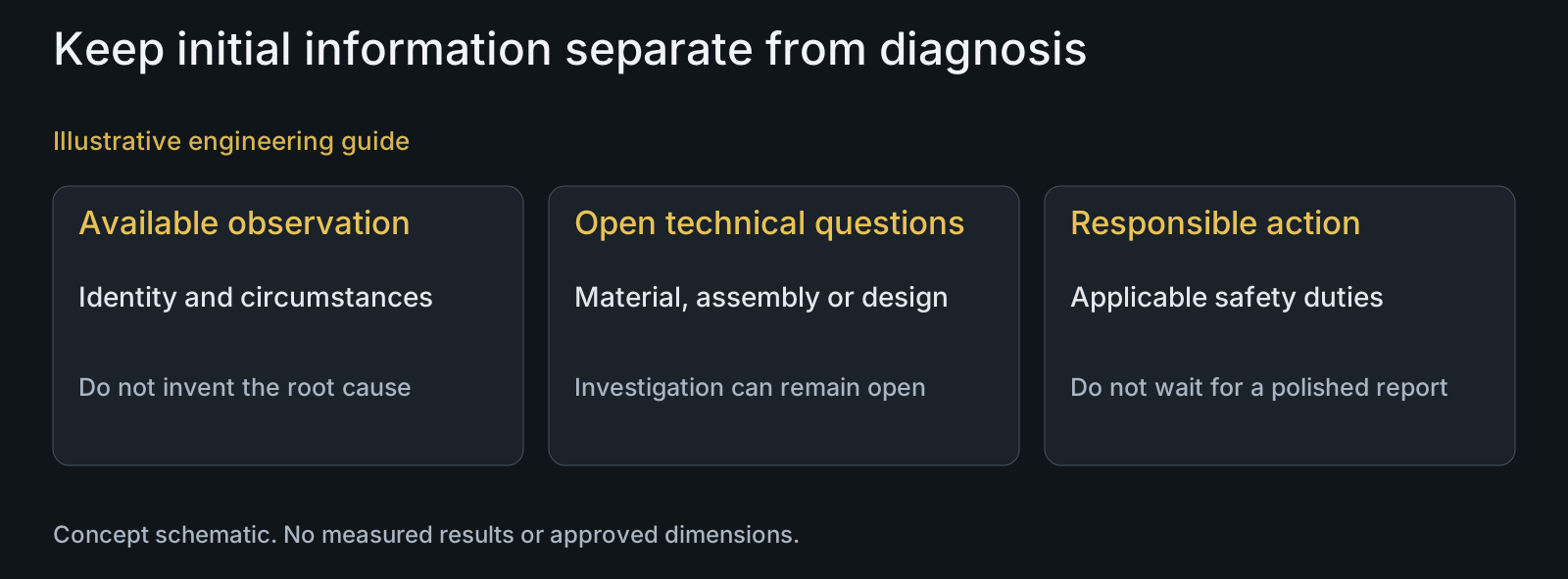
Separate the observed issue from the suspected mechanism and unresolved questions. Relevant input may include product identity, assembly circumstances and available component information. Do not delay the handoff because the team has not yet distinguished material, assembly or design causes; do not assert a cause merely to make the record look complete.
Illustrative engineering example: a shared pivot and incomplete identity
Illustrative engineering example: assume a Canadian importer receives a safety-related concern about a bicycle using a pivot shared across two assembly variants. Available photos identify the component family but not the installed revision. No real incident, legal reporting determination or root cause is represented.
The importer evaluates its responsibilities using the available information while asking the supplier for relevant component and shipment relationships. The supplier distinguishes what its records identify from what the customer's assembly history must establish. It does not label the older variant responsible because its certificate is easier to retrieve.
The engineering review can continue after the initial information handoff. A later identity finding changes the represented population only when supported by evidence. The scenario demonstrates why available facts, uncertainties and responsible contacts need to travel together rather than wait for a polished failure report.
Define the deliverable and the information route in the RFQ
Agree the represented component and configuration, selected specification basis, records included in the order and intended recipients. Ask how later revision or safety information will be linked to previously supplied items. Avoid a universal Canada-approved label that hides those boundaries.
PremFixer can discuss component records within the agreed manufacturing scope, including material and finished-feature inputs. The materials overview does not establish Canadian legal conformity, and additional testing or documentation must be agreed rather than assumed included.
Provide the Canadian arrangement and responsible product contact with drawings or STEP and BOM. Use the customer decision knowledge center for adjacent acceptance questions while preserving the distinction between supplier evidence, importer action and product assessment.
Questions buyers need to confirm
Are OEM bicycle components automatically outside CCPSA?
No automatic exclusion follows from an OEM transaction. The public definition includes components, parts and accessories of consumer products. Describe the actual item and intended use for the responsible Canadian team's applicability review.
Does naming CAN/CSA Z114 establish mandatory bicycle compliance?
Not without a verified subject and legal adoption basis. This guide does not establish a universal CCPSA requirement using that reference. Ask for the exact document and distinguish a selected purchase specification from an applicable legal obligation.
Can material and dimensional reports replace supply-chain records?
No. They answer different questions. Connect the represented component and revision to source, recipient and delivery information as applicable, and keep engineering reports within their stated scope.
Should the supplier wait for a confirmed root cause before escalating a concern?
Do not make that a condition of the information handoff. Health Canada says not to wait for a complete investigation or absolute certainty before initial incident reporting. The responsible party assesses applicability using available information and the actual duties.
Does every safety concern require the supplier to file the same report?
No role-independent reporting arrangement is asserted. Determine the actual product, incident criteria and responsible parties. The Act distinguishes initial information from the further manufacturer or relevant importer report; supplier coordination does not replace those duties.
What inputs help define the Canadian handoff?
Provide drawings or STEP and BOM, supplied and installed configurations, relevant reports and delivery references, intended use and the Canadian importer arrangement. Identify responsible contacts and requested standards with their purpose, so evidence and open questions reach the right team.
Technical references and scope
Justice Canada: Canada Consumer Product Safety Act. Public consumer-product definition and section 14 distinction between initial information and the further manufacturer or relevant importer report. No individual applicability, incident or filing determination.
Health Canada: section 13 document guidance. Public supply-chain record purposes and differing roles. Proposed engineering-file links are analysis, not universally prescribed section 13 content.
Health Canada: mandatory reporting industry guide. Public guidance on available information, role-specific reporting and not waiting for complete investigation or absolute certainty. Not a real incident assessment or supplier filing.
Explore related component, material and sourcing decisions in the customer decision knowledge center. For a drawing review, use the Drawing/BOM RFQ path.
Define the component evidence your Canadian team needs
Send the drawings or STEP and BOM, supplied configuration, material and finish, Canadian supply arrangement and requested evidence purposes. PremFixer can discuss the component records and information relationships needed for the responsible team's review.
Discuss the drawing and BOM