
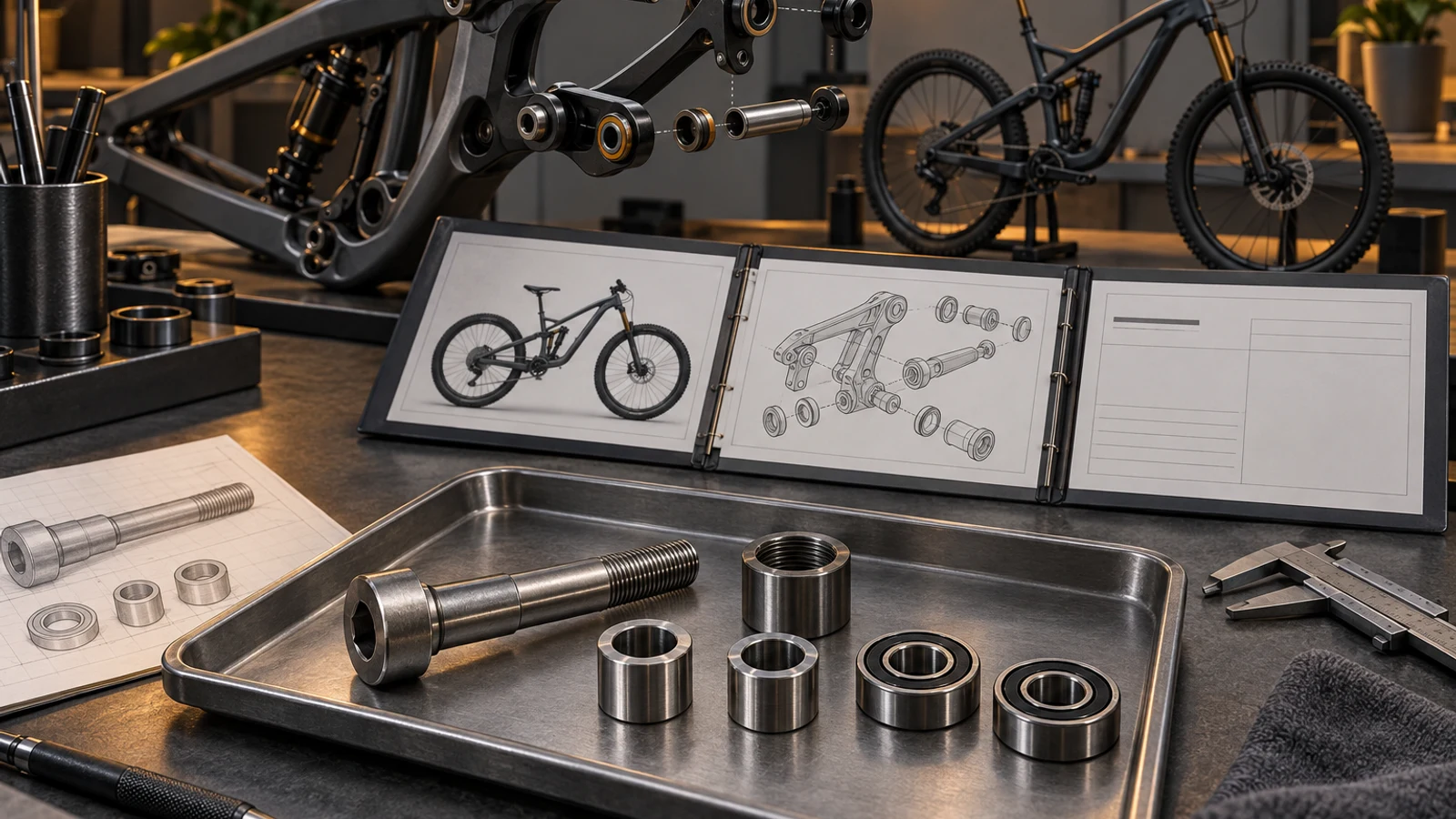
For bicycle hardware supplied to Taiwan, establish what the order contains before asking for CNS conformity or BSMI certification. A loose custom pivot, an assembled mechanism and a complete bicycle are different assessment subjects. Check the standard's title and ordered edition, then have the responsible Taiwan team determine the applicable product-inspection route. If classification is uncertain, explain the actual goods and use through the official inquiry rather than infer approval from a commodity code. Component drawing, material and inspection evidence can support that review, but none alone establishes the finished bicycle's status or permission to use a certification mark.
Hero: concept illustration of example hardware and its application. It is not a factory photograph, tested component or approved production geometry.
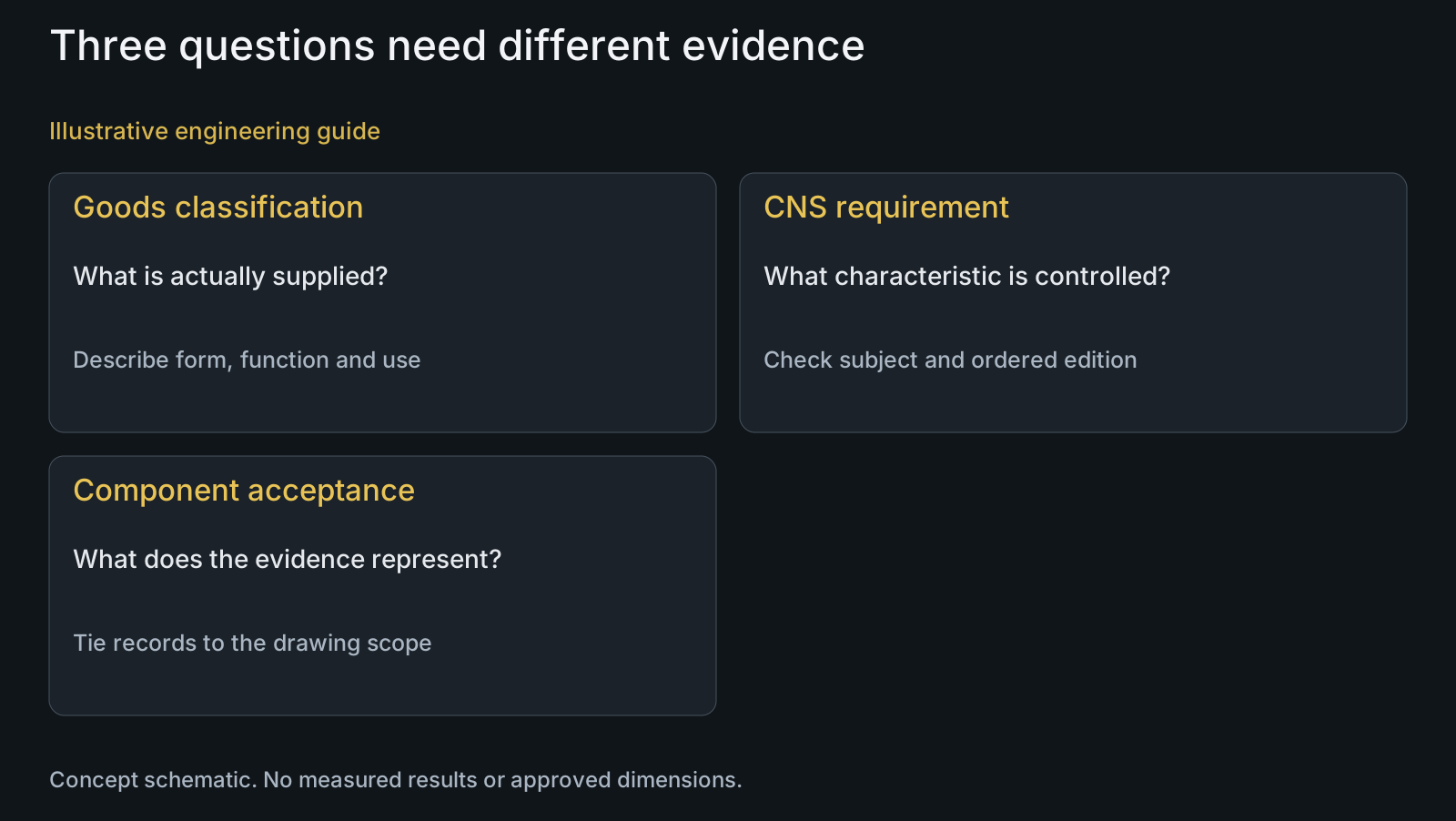
Describe the supplied goods before asking for certification
Identify whether the supplier is delivering an individual fastener, a matched hardware kit, a linkage assembly or a complete product. Include the intended use and relationship to the bicycle. The description should match the goods actually ordered, not a broader product shown in a sales photograph.
BSMI's official classification-inquiry guidance requests product documents such as a catalogue, function and use description, instructions and photographs. That is a useful reminder that an unresolved category question needs information about the goods, not just a label saying bicycle parts.
Ask the importer or responsible Taiwan product team to resolve applicability with the relevant authority where necessary. This guide does not classify every loose pivot or authorize marking. The component-versus-product conformity guide explains the similar evidence boundary in a different jurisdiction.
Correct a CNS reference before defining the acceptance task
BSMI's historical standards catalogue identifies CNS 3934 as mechanical properties of bolts, screws and studs. It is not a reliable reference for the socket-head geometry of ISO 4762. A property requirement and a head-dimension requirement answer different questions, even when both concern the same part.
BSMI also identifies CNS 15233 as LED roadway lighting. It must not be presented as the general bicycle-safety reference. These title checks correct a misplaced reference; they do not establish the latest complete edition or a substitute standard's full requirements.
For the ordered component, separate head and drive geometry, thread, custom shoulder interfaces, material condition and finish. Assign the appropriate requirement basis to each. The standard-head guide helps distinguish physical head choices from an unrelated property designation.
| Buyer question | Relevant input | Risk of using the wrong evidence | Verification purpose |
|---|---|---|---|
| What goods are supplied? | Actual form, function and product relationship | A complete bicycle photo masks a loose-parts order | Confirm the described assessment subject |
| Does a BSMI route apply? | Category review and official inquiry if uncertain | A commodity code or component certificate becomes assumed permission | Resolve applicability for the actual goods |
| What does the CNS reference cover? | Correct title, edition and requirement purpose | A property or lighting reference is used for head geometry | Check the relevant ordered specification |
| Does the component meet its drawing? | Identified features and finished condition | Product-level report hides an unverified shoulder | Assess the ordered component characteristics |
| What supports the product review? | BOM-linked component description and scoped records | A supplied bolt is described as the complete joint | Identify the represented configuration and evidence limits |
| Has the supply scope changed? | Changed assembly form or intended use | An earlier conclusion is carried into different goods | Responsible team reviews the affected scope |
Use a covered product example without extending its scope
BSMI's children's-bicycle inspection rules, amended in July 2025 and effective in August 2025, describe category-specific inspection arrangements and refer to CNS 14976 for children's bicycles. They are not a general certification procedure for every bicycle fastener.
For that registration route, the published document requirements include an assembly drawing and component information such as dimensions and materials. Such information helps identify the represented product configuration. A supplier can contribute relevant component information without claiming to have completed the product's inspection route.
Do not extend this example to an adult bicycle, another vehicle category or separately supplied spares without a scope decision. The responsible product team should identify the actual applicable category, requirements and evidence. Similar-looking hardware does not make two products the same assessment subject.
Make component evidence useful to the product reviewer
Explain which BOM item the drawing represents and whether any spacer, receiver or retaining element is included. Keep the offered material and finished condition identifiable. This prevents a component description from accidentally covering an assembly that the supplier does not provide.
Distinguish a drawing inspection from material identification and from an assembled-product evaluation. A measured shoulder can answer a size question; it does not answer whether the installed joint carries the intended load or whether a product inspection category applies. State the purpose of each requested record.
Review the material-document scope alongside the actual component requirements. PremFixer can discuss drawing-based manufacturing and the available evidence scope; no universal CNS certificate, Taiwan laboratory service or blanket BSMI approval is asserted.
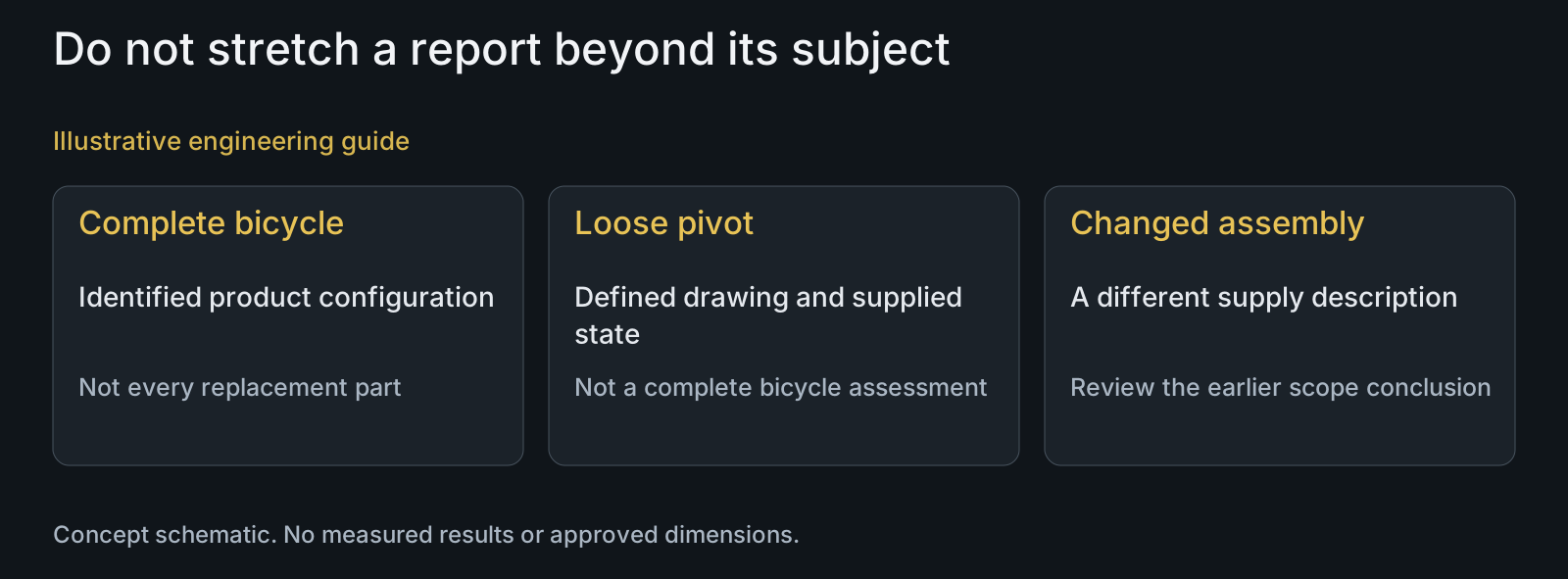
Illustrative engineering example: a spare pivot and a complete bicycle
Illustrative engineering example: assume a buyer is ordering loose replacement pivots for a specified bicycle and receives an unrelated complete children's-bicycle report. The pivot drawing also cites CNS 15233. No genuine report, classification decision or successful test is assumed.
The reviewer corrects the unrelated lighting reference and asks the Taiwan product team which requirements concern the actual spare goods. The supplied-goods description includes photographs, function, intended model relationship and the fact that no complete bicycle is delivered. Any official scope inquiry addresses that description rather than a generic bicycle-parts label.
Separately, the component review identifies its drawing revision, interfaces, material and requested inspection. The unrelated product report is not treated as spare-part approval. The illustrative outcome is a clearer question and evidence scope, not a declaration that the goods are exempt or certified.
Keep an applicability answer tied to the described configuration
Retain what the scope review actually considered: supplied form, function, product relationship and relevant description. If a later offer changes from a loose bolt to an assembled mechanism, ask whether the earlier conclusion still addresses the goods. Do not silently broaden it in the quotation.
Engineering acceptance remains necessary even when a particular inspection route does not apply. Specify the functional interfaces and relevant checks rather than substitute a broad certification sentence for the customer's drawing. Conversely, a detailed dimensional report cannot resolve an outstanding regulatory category question.
Use the Drawing/BOM RFQ guide to organize the component inputs and the customer decision knowledge center for adjacent material and validation decisions. Keep product-route responsibility visible to purchasing.
Questions buyers need to confirm
Is CNS 3934 the socket-head geometry reference for ISO 4762?
No. BSMI's historical catalogue identifies a mechanical-property subject. Confirm the correct geometry requirement separately and obtain the ordered full edition before declaring conformity. A title check alone does not prove interchangeability.
Can CNS 15233 be cited as bicycle safety?
No. BSMI identifies it as LED roadway lighting. Remove that misplaced reference and have the responsible product team identify the requirement for the actual bicycle category; do not guess a replacement for every product.
Do all loose bicycle pivots need the same BSMI certificate?
Do not assume a universal route. Identify the supplied goods, function and product relationship and resolve the actual category. This article neither grants a blanket exemption nor establishes mandatory certification for every loose part.
What information helps resolve an uncertain product classification?
Use an accurate goods description with function, use, photographs and relevant product documents. BSMI provides a classification-inquiry route. Explain whether the order is a component, kit, assembly or complete product rather than rely on a generic trade label.
Does a complete bicycle report prove that our spare pivot is accepted?
Not automatically. Check the report's represented model and configuration, then determine what evidence addresses the ordered spare and its drawing. A different product report cannot establish an unread component requirement or an unresolved category decision.
What should accompany a Taiwan-market custom hardware RFQ?
Send the drawing or STEP and BOM role, supplied form, intended use and product category, material and finished condition, named CNS editions and requested records. Identify the Taiwan contact responsible for inspection applicability so manufacturing questions and product-route decisions remain distinct.
Technical references and scope
BSMI: applying for product-classification inquiry. Official inquiry guidance and product-description inputs. No particular supplied goods classified and no inquiry submitted.
BSMI: children's-bicycle inspection operating rules. Published category-specific route and component-document context for covered children's bicycles. Not a universal loose-fastener certification rule.
BSMI: historical CNS standards catalogue. Historical CNS 3934 mechanical-property subject used to correct a misplaced reference, not to establish the latest edition or complete requirements.
BSMI: LED lighting standards newsletter. CNS 15233 roadway-lighting subject. Historical announcement, not a current bicycle standard or full edition review.
Explore related component, material and sourcing decisions in the customer decision knowledge center. For a drawing review, use the Drawing/BOM RFQ path.
Clarify the Taiwan-market hardware and evidence scope
Send the drawing or STEP, BOM relationship, supplied form and intended use, named requirements and disputed certification notes. Add material, finish and requested inspection records. PremFixer can discuss component manufacturing inputs while the responsible product team resolves the applicable Taiwan route.
Discuss the drawing and BOM