
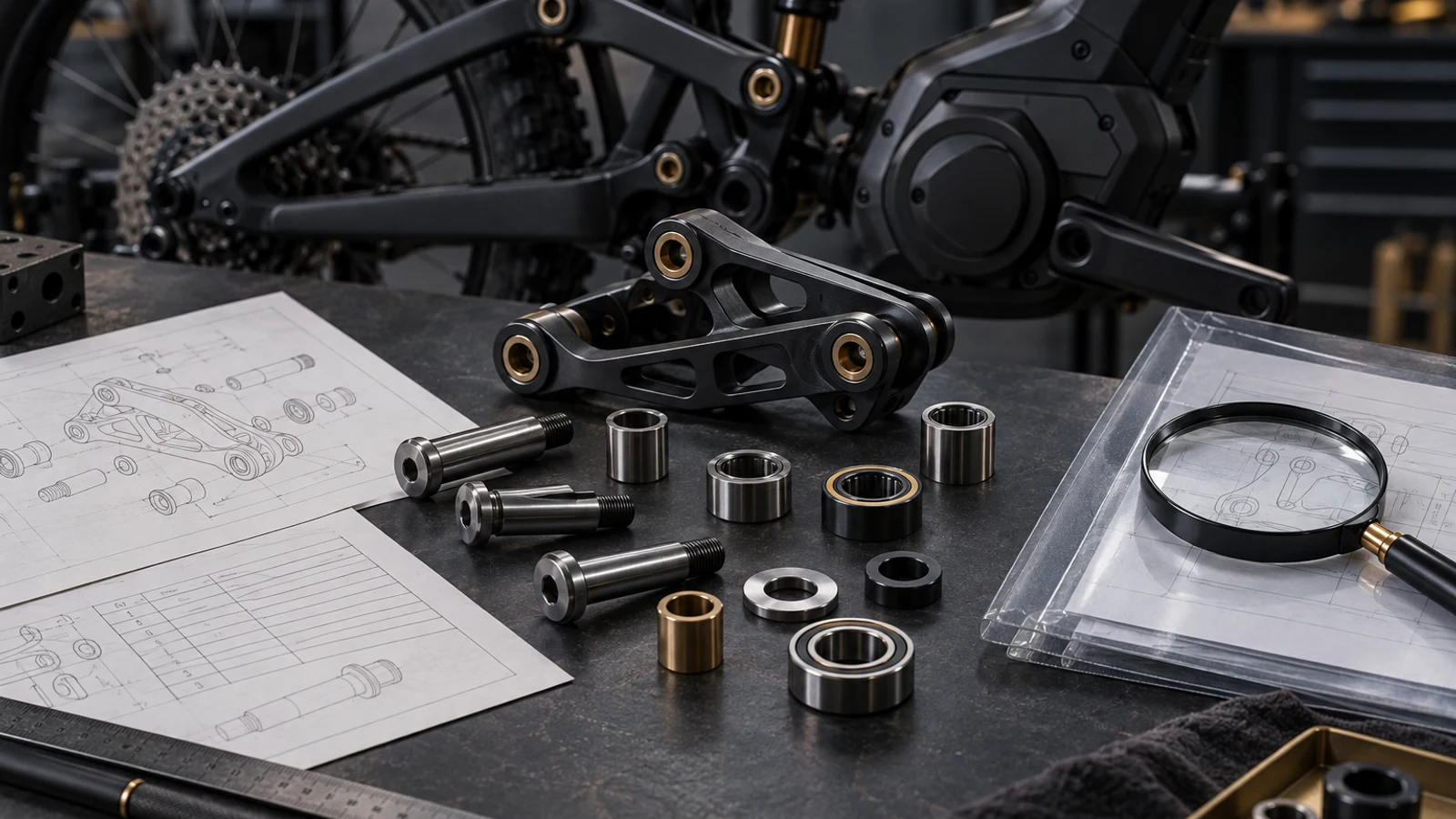
Do not request a CE mark for every bicycle pivot bolt simply because the finished bicycle is intended for Europe. First identify the actual product and the legislation that applies to it. A custom mechanical component's material and inspection documents may support the OEM's assessment without creating a separate marking obligation. Equally, absence of a CE mark does not excuse an unsafe joint or missing contractual evidence. Ask what the requested document must establish, who takes responsibility for that statement and which supplied configuration it represents. A symbol or commercial certificate cannot replace those decisions.
Hero: concept illustration of example hardware and its application. It is not a factory photograph, tested component or approved production geometry.
Ask what product the CE request actually concerns
Your Europe's CE marking guidance limits the mark to products covered by applicable requirements. The scope question comes before artwork, engraving or a certificate purchase. Do not generalize from one bicycle or electrical system to every separate item in its BOM.
For a pivot RFQ, identify whether the request concerns the supplied bolt, an assembled mechanism or the complete marketed product. A drawing that merely says CE certified leaves that subject unresolved. Ask the responsible product-compliance team to state the requirement and assessment route before the supplier promises a mark.
This article does not determine the legal classification of any particular vehicle or special-purpose assembly. Use the RoHS equipment-scope discussion for the separate substance-information issue. Similar-looking components can serve different products, and a material choice alone does not resolve product-law scope.
Separate a conformity statement from government approval
The European Commission explains that CE marking does not mean a product has been approved as safe by the EU or another authority. It also does not identify origin. Avoid those meanings in procurement language or captions showing a marked product.
A document should state its actual subject. Dimensional conformity to a drawing describes inspected characteristics; a material report describes represented material. Neither statement alone evaluates the complete bicycle's interactions, use conditions or all applicable legal requirements. More impressive wording does not expand the evidence underneath it.
For mechanical performance, keep the applicable-standard map separate from marking permission. A cited bicycle standard is not itself an authorization to engrave a symbol on a bolt. Specify which requirement and assembly the engineering evidence addresses.
| Request | What it can establish | Wrong inference | Buyer action |
|---|---|---|---|
| Drawing inspection | Represented component dimensions | Complete bicycle is approved | Define features and revision |
| Material record | Identified material evidence | All joint risks are resolved | Check material and goods linkage |
| CE engraving | A marking only with applicable basis | A preferred logo proves safety | Confirm subject and legal route |
| Commercial certificate | Its stated scope and issuer role | Every certificate is statutory | Check procedure and authority |
| Product declaration | Responsible product conformity statement | A bolt report replaces it | Keep product-level responsibility clear |
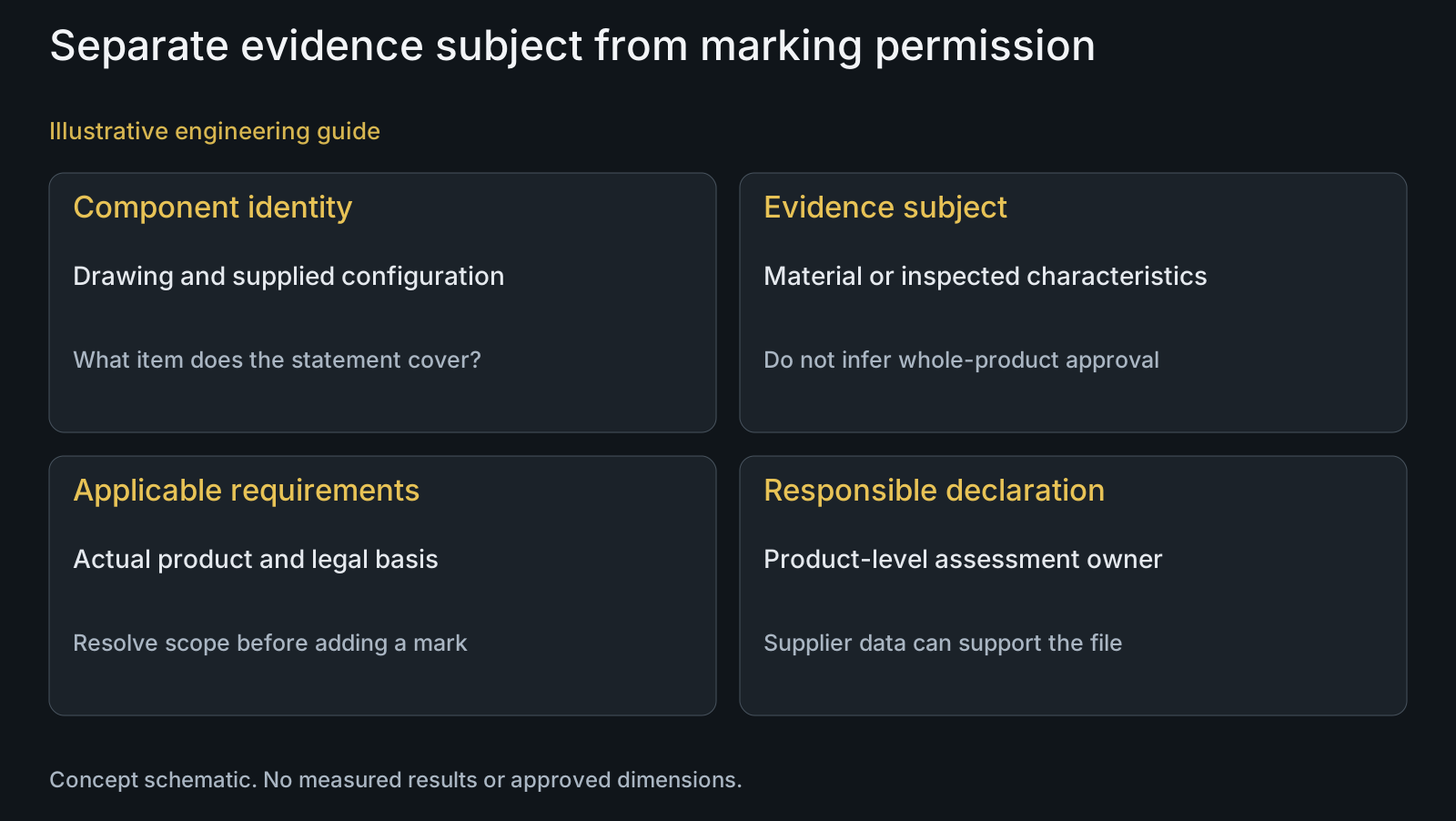
Choose supplier evidence by its contribution to the technical file
Your Europe's technical-documentation guidance connects product design, manufacture, risk assessment and relevant evidence. An OEM can therefore need useful component information without asking its bolt manufacturer to issue the complete product declaration.
For the pivot interface, describe the functional shoulder, thread, head contact and any supplied spacer. State the drawing revision and what inspection represents. A dimension report helps establish the manufactured configuration, while the OEM still determines how that configuration contributes to the joint's design evidence.
Use the material-document guide for the subject of material records and CMM feature planning for dimensional evidence. Select information relevant to the identified risk or requirement rather than send an unrelated certificate collection.
Resolve an unsupported engraving request before machining
If the purchase drawing asks for a CE symbol without a stated applicable basis, stop that marking decision, not the entire engineering discussion. Request clarification of the product subject and responsible assessment. Where the applicable rules do not provide for the mark, it must not be added just to satisfy a visual preference.
Treat traceability engraving separately. A buyer may need a batch reference or part identifier for its own control system, but that identifier does not declare regulatory conformity. Its location must also be reviewed against contact surfaces, tool access and the customer's drawing; no universal safe marking depth is assumed.
PremFixer can discuss drawing-based manufacturing and the requested identification or inspection scope. No blanket CE approval, independent certification service or right to mark every supplied component is asserted. An available document package should be described accurately in the quotation.
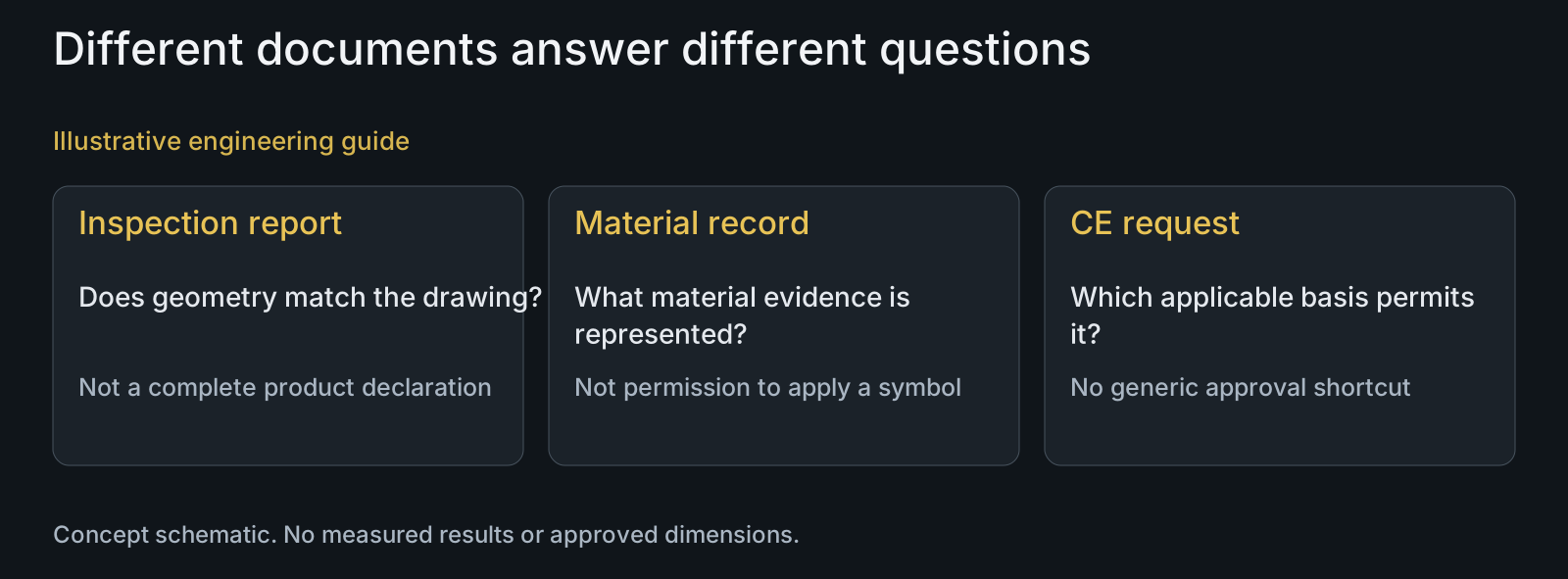
Do not buy a generic certificate to close an applicability gap
Your Europe states that there is no central EU body issuing permission to use CE marking. Whether an authorized notified body is needed depends on the applicable conformity procedure. A third-party commercial document is not automatically the required intervention.
Before accepting a proposed service, identify the product, requirement and procedure it addresses. Ask who issued the document and in what capacity. A voluntary document about an unrelated product family cannot establish the status of a custom pivot joint or transfer the complete product manufacturer's responsibilities.
If the scope remains unresolved, report that as an unresolved classification or evidence issue. Do not hide it behind a supplier's general quality certificate. Purchasing can continue discussing materials and geometry while keeping any regulatory conclusion with the responsible product team.
Illustrative review of a CE note on a pivot drawing
Illustrative engineering example: assume an OEM sends a shoulder-bolt drawing with a note requesting CE certified engraving. It also requests material identity and inspection of a bearing interface. No applicable marking provision, legal opinion, test result or real customer record is assumed.
The supplier separates the requests. Geometry and represented material can be discussed against the drawing. The CE note goes back to the product-compliance owner for a defined basis. If that owner identifies no applicable requirement providing for a mark on this supplied item, the engraving request is removed rather than supported with a purchased generic certificate.
The outcome is a clearer order scope, not a claim that the bicycle passed validation. Send the component drawing, BOM relationship, requested evidence and the exact disputed note through the RFQ-input guide. The review resolves what the component supplier is asked to manufacture and document.
Questions buyers need to confirm
Should every pivot bolt sold to an EU bicycle maker bear CE marking?
No blanket rule follows from the destination. Identify the supplied product and applicable requirements first. A buyer must not request the mark as decoration where the relevant basis is absent. Component evidence may still be required by the OEM contract.
Does CE mean the EU approved the bolt as safe?
No. The European Commission explicitly distinguishes CE marking from approval by the EU or another authority. Do not use a marked image as evidence of government inspection. Establish the actual assessment and product subject separately.
Can a material certificate replace the finished product declaration?
No. Its subject is material evidence, not all requirements of the complete product. Check the identified material and goods linkage, then use the record for its relevant contribution. The responsible product assessment remains a separate task.
Must a third party certify every CE-marked product?
No universal third-party route applies. The applicable legislation and procedure determine whether a notified body is involved. Check the required intervention and issuer capacity before ordering a commercial certificate; an unrelated voluntary certificate does not close the gap.
Can we engrave a batch identifier instead of a CE symbol?
A traceability identifier is a different request, not a substitute conformity claim. Specify its purpose and location on the drawing and review the functional surfaces. Do not invent a generic depth or assume any head area is harmless to mark.
What should an OEM send when the CE request is disputed?
Send the exact drawing note, component identity and revision, its BOM role, intended product and market, and the identified applicable basis if available. Name the responsible compliance contact and requested supplier evidence. This separates manufacturing inputs from the product-level legal decision.
Technical references and scope
Your Europe: CE marking. Applicability, absence of central permission and procedure-dependent notified-body involvement; no specific vehicle classification concluded.
European Commission: CE marking. Marking is not government safety approval or origin identification; responsible manufacturer conformity role.
Your Europe: Preparing technical documentation. Product design, manufacture, risk assessment and evidence relationship; no complete technical file or successful assessment supplied.
Explore related component, material and sourcing decisions in the customer decision knowledge center. For a drawing review, use the Drawing/BOM RFQ path.
Clarify the pivot document and marking scope
Share the drawing or STEP file, BOM relationship, exact requested marking and evidence requirements. PremFixer can discuss the supplied component's manufacturing and documentation scope; the responsible product team should resolve applicability and conformity authority. Identify any disputed requirement before adding it to the purchase specification.
Discuss the drawing and BOM