
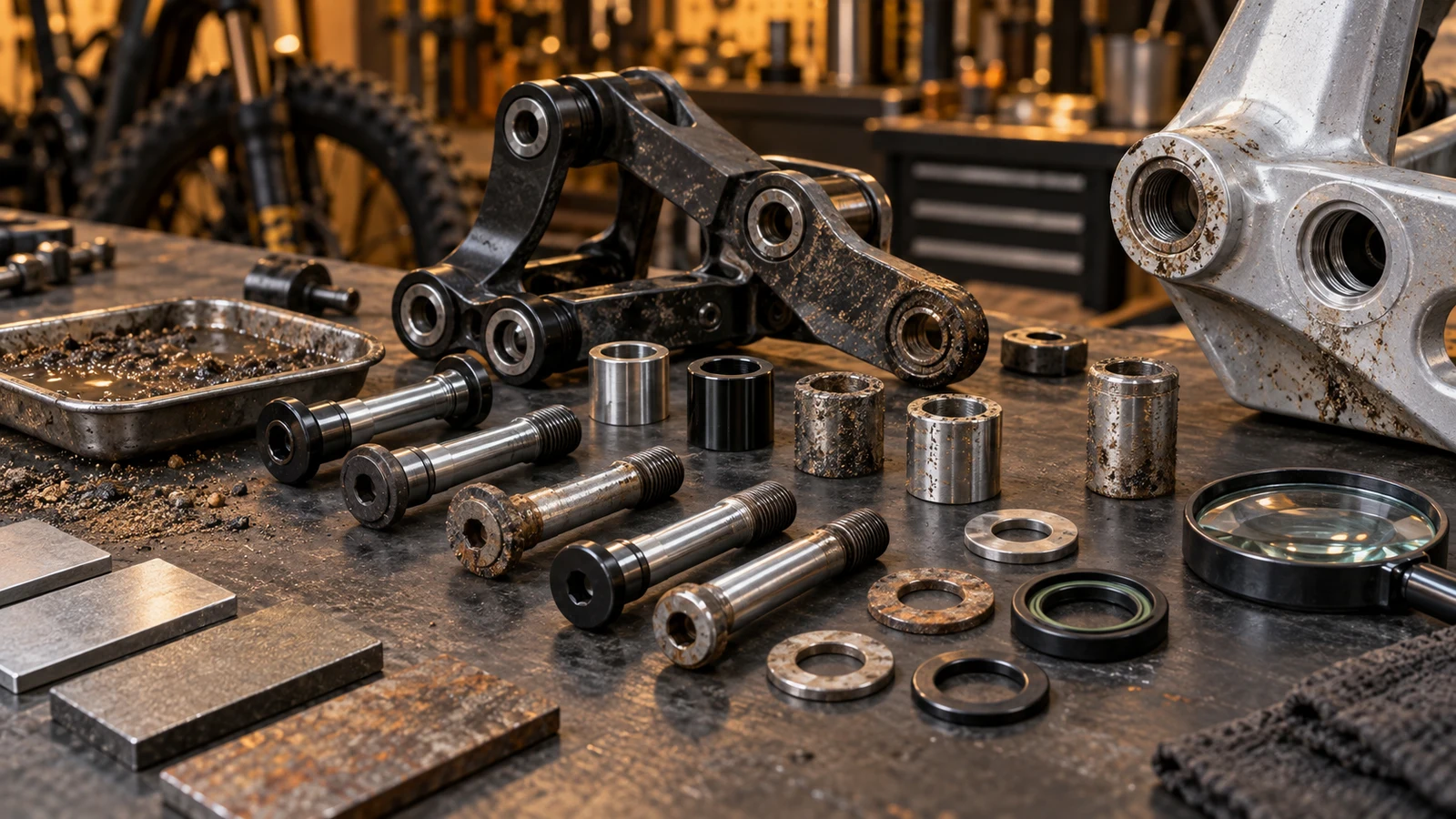
When corrosion-affected pivot hardware will not turn, obtain the exact component's service procedure or qualified assessment before escalating removal force. Heat, impact and penetrating products are not universally permitted around a bicycle frame, bearings, seals, coatings or electrical components. Record the installed hardware and visible condition without assuming that rust color identifies the cause. After authorized removal, assess the receiver and hidden contacts as well as the bolt. For replacement procurement, identify where moisture remained and which surfaces were affected. Selecting 316 stainless or TC4 titanium alone does not establish that the original corrosion pathway has been removed.
Hero: concept illustration of example hardware and its application. It is not a factory photograph, tested component or approved production geometry.
Set a component-specific removal boundary
Locate the retaining arrangement and identify the frame and hardware revision. The service authority must establish the permitted operation, support and protection of the actual assembly. A seized threaded axle and a separate retaining screw need not have the same removal sequence.
If a penetrating product is proposed, obtain compatibility and application guidance for the surrounding materials together with the component's service permission. Its label is not approval to introduce it around every seal, painted surface or electrical assembly. Avoid adopting an improvised fluid, heating or impact sequence.
Stop escalation where the permitted method is unknown, the drive is damaged or the receiving structure is at risk. Keep structurally uncertain hardware out of use pending assessment. The seized-pivot planning guide covers the broader extraction boundary; this article follows the corrosion evidence and prevention decision.
Keep paired-surface observations before cleaning erases them
Where the approved investigation permits, record the affected position, deposits, wet regions and condition of exposed contacts before cleaning. Note the orientation and identity of removed components so observations can be related back to the installed joint rather than a tray of unrelated hardware.
Rust-colored staining does not identify which component lost material or establish the mechanism. Record what is seen on the bolt, receiving thread, spacer contacts and neighboring surfaces without turning a photograph into a definitive corrosion diagnosis.
Separate pre-existing observations from marks introduced during removal. Include known wetting, washing and storage conditions and any recent surface or hardware change. These inputs let the responsible assessment compare plausible pathways; they are not evidence that the owner caused the problem.
| Condition or proposal | Decision-relevant input | Shortcut risk | Useful basis |
|---|---|---|---|
| Pivot will not turn | Exact assembly and surrounding materials | Generic heat/impact recipe damages other parts | Component-specific permitted service route |
| Deposits visible at removal | Location, orientation and chronology | Cleaning destroys paired-surface evidence | Permitted observations before and after removal |
| Hidden pocket remains wet | Entry, retention and contact arrangement | Exposed-head appearance represents the pocket | Actual region and exposure assessment |
| Mixed-metal receiver | Both materials, surfaces and wet contact | Alloy names treated as a diagnosis | Configured pair and corrosion evidence |
| 316 or TC4 bolt proposed | Mechanical, fit and receiving-contact requirements | Premium alloy called a complete remedy | Whole relevant interface comparison |
| Barrier or seal revised | Coverage, contact and required movement | Protection changes fit or traps moisture | Final-state assembly and exposure review |
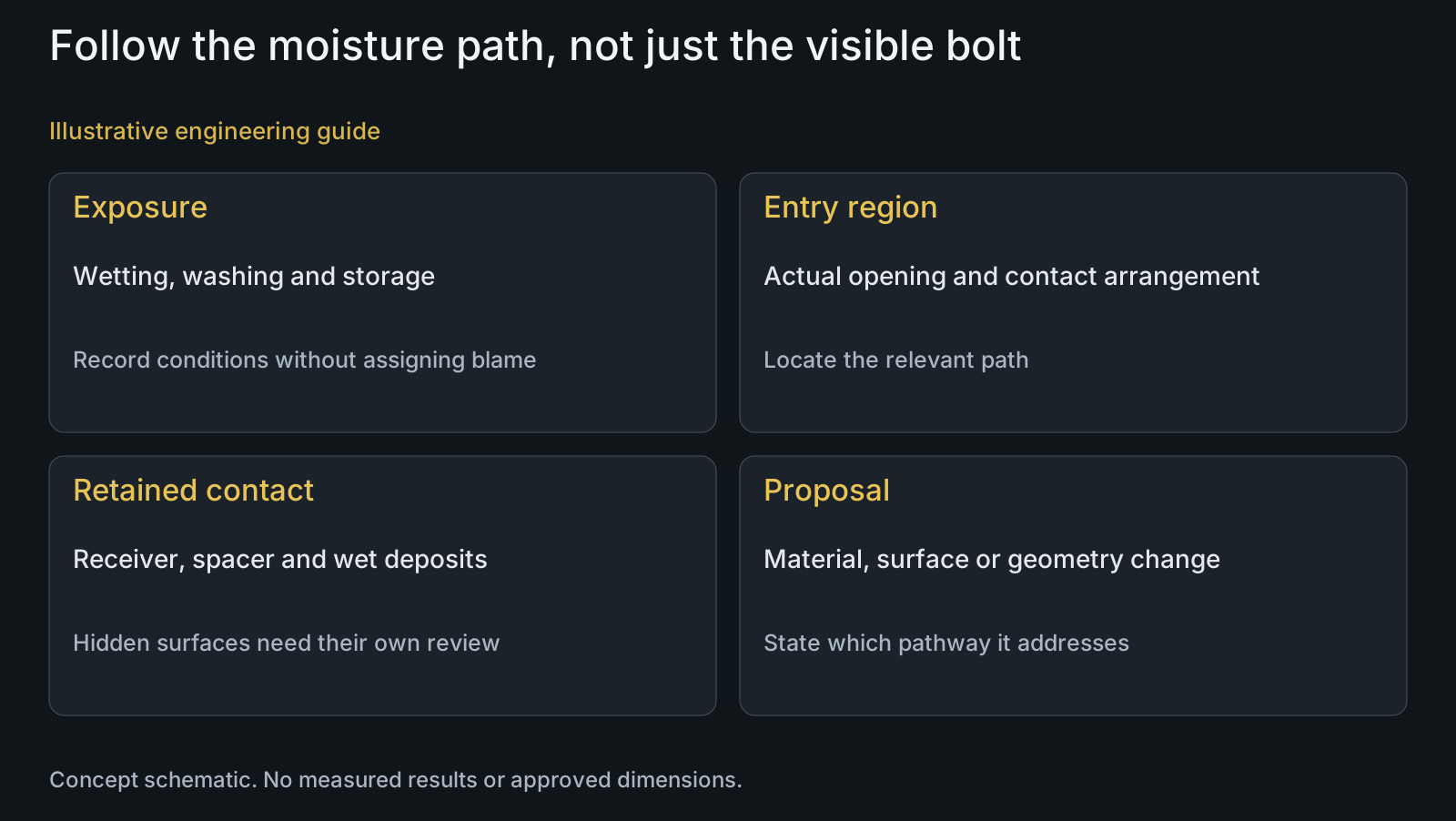
Investigate the retained-moisture region
BSSA describes crevice attack at shielded contacts and deposits where electrolyte can enter and remain stagnant. Its explanation is not limited to stainless steel. A visible head and an enclosed receiving contact can therefore pose different exposure questions; the head's appearance does not establish the hidden region's condition.
Map the actual path by which water or wet contamination can enter, remain and leave. Identify whether a washer, seal, recess or overlapping contact changes that path. Do not label every enclosed space a proven corrosion site: compare the proposed mechanism with the observed region and environment.
A redesigned seal or drainage feature needs assessment of the pivot's required movement, dimensions and contact arrangement. Adding enclosure without that review may leave the questioned region inaccessible. Use the gravel exposure guide for represented-contact evaluation rather than copy an isolated-bolt result to the whole assembly.
Assess the receiving member before accepting an alloy change
BSSA's galvanic explanation requires differing materials in electrical contact and a conductive liquid connecting them. It also discusses the significance of local conditions and relative exposed areas for stainless/aluminum combinations. A material pair is a review input, not a universal prediction that every such bicycle joint will fail.
Identify the receiver's alloy, final surface and affected contact along with the bolt. If a barrier is proposed, specify where it lies and whether assembly or movement disturbs it. Evaluate the final configuration rather than assume a washer insulates every threaded or shoulder contact.
Compare 316 or TC4 candidates against the complete mechanical and surface requirement through materials and anti-corrosion solutions. An alloy change also leaves fit, thread behavior and assembly conditions to resolve. Do not call either material rust-proof or guarantee that changing the bolt protects its receiver.
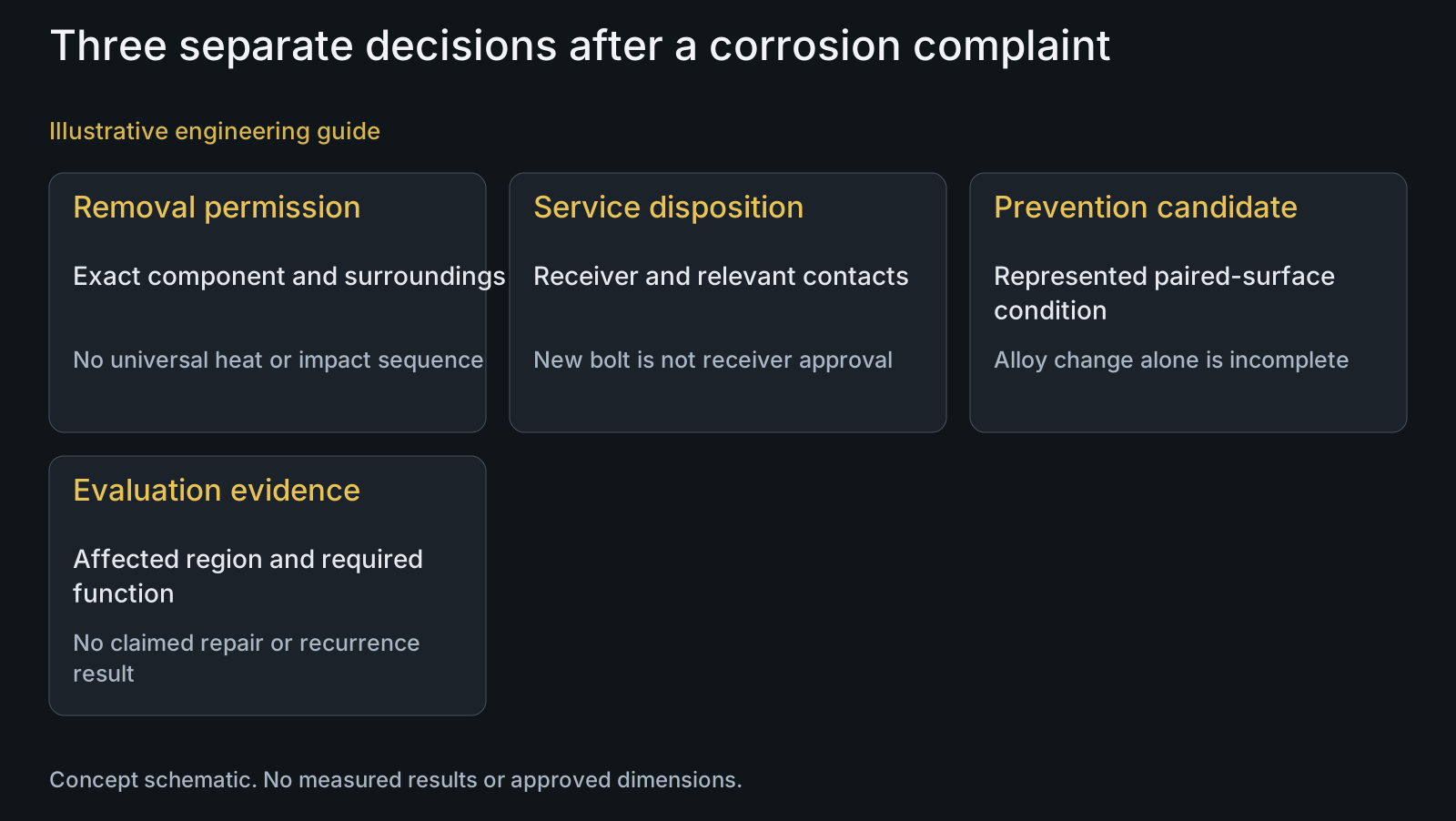
Separate service acceptance from prevention evaluation
After removal, the responsible service assessment should decide the disposition of receiving threads, relevant bearing seats and surrounding contacts. An acceptable replacement bolt does not approve a damaged receiver. Use the stripped-receiver guide if a thread repair or revised receiving feature is proposed.
For a prevention candidate, state the represented assembly, exposure question and observations required at both visible and hidden regions. Define any relevant post-exposure function separately from appearance. A shiny head after exposure does not establish serviceable receiving threads.
Keep manufacturing scope specific: supplied alloy and condition, protected or masked surfaces, finished dimensions and matching components. Discuss those inputs through surface treatment. Evaluation of a proposed protection route is different from a claim that it has already prevented recurrence on a customer's bicycle.
Review example: the bolt is replaced, but the pocket is unchanged
Illustrative engineering example: assume an OEM reviews a corrosion-affected pivot whose receiving pocket can retain wet deposits. A buyer proposes a more corrosion-resistant bolt, while the receiver and contact arrangement remain unchanged. No actual corrosion finding, material loss or test outcome is assumed.
The reviewer defines the affected region and asks whether the proposal changes the pathway into that pocket. It specifies the receiver, contact surfaces and assembly condition alongside the new bolt. A material-only quotation does not answer whether the hidden interface is represented in the evaluation.
If an altered barrier or geometry is proposed, its final fit and movement must also be reviewed. The resulting RFQ identifies a hardware and surface configuration to assess, not a proven cure or an arbitrary maintenance interval. Existing receiver serviceability remains a separate decision before return to use.
Questions buyers need to confirm
Can heat and impact be used on every corroded pivot?
No. The frame, bearings, seals, coatings and electrical surroundings constrain the operation. Use the exact component's permitted service route or qualified assessment, and stop escalation when that route or structural condition is uncertain.
Does penetrating oil make removal universally safe?
No. Identify the product, application area and compatibility with surrounding materials, and obtain the applicable service permission. A fluid label does not authorize its use throughout an assembled bicycle or define the complete removal procedure.
Does visible rust prove that the bolt itself caused the seizure?
No. Record the bolt, receiver and deposits separately and distinguish marks introduced during removal. Color or a photograph alone does not locate material loss or identify the mechanism; preserve the relevant paired observations for assessment.
Will a 316 stainless or TC4 titanium replacement prevent recurrence?
Not by alloy name alone. Include receiver material and surface, wet contacts, fit and assembly conditions in the comparison. The proposal must address the relevant exposure pathway and satisfy mechanical requirements without claiming immunity or receiver protection.
Why inspect hidden contacts if the replacement head looks clean?
The enclosed region can have a different exposure and condition. Define the receiving thread, spacer and other relevant contacts in the assessment, then separate appearance from the functional and service criteria that matter there.
What should a corrosion-prevention hardware enquiry include?
Provide drawings or STEP, BOM, both material and surface definitions and the relevant contact arrangement. Include permitted condition observations, wetting/cleaning/storage history and the proposed change. State whether the supply request concerns replacement manufacture, a protection candidate or an approved service item.
Technical references and scope
BSSA: Principles and Prevention of Crevice Corrosion. Shielded contacts, stagnant electrolyte and localized attack. No critical gap size, material ranking or bicycle-specific diagnosis transferred.
BSSA: Bimetallic Corrosion Risks with Galvanised Steel or Aluminium. Electrical contact, conductive liquid and geometry/environment dependence for paired-material review. No universal stainless/aluminum compatibility verdict transferred.
Explore related component, material and sourcing decisions in the customer decision knowledge center. For a drawing review, use the Drawing/BOM RFQ path.
Review the replacement and the interface that surrounds it
Send the pivot and receiver drawings or STEP, represented samples, BOM and final surface requirements. Include the corrosion location, available service findings, exposure history and any proposed barrier or geometry change. PremFixer can review custom hardware and specified surfaces against that configuration; removal, receiver repair and return-to-service approval remain with the responsible product/service authority.
Discuss the drawing and BOM